Three bids come in for the same back fence, and the instinct is to line up the totals and pick from the middle. On a lot in Westlake Hills or Rollingwood, those three numbers are usually not pricing the same job.
The homes here are old enough that the wood behind them has reached the end of its service life, and the rock, the trees, and the slope make every 100 feet of line different from the last. Before you can judge a contractor, you need the standard a good one is judged against.
Westlake Hills and Rollingwood Fences Are Past the 20-Year Mark
A wood fence is rated at about 20 years by the certified home-inspector association’s life-expectancy chart (InterNACHI, n.d.), and the established housing stock in Westlake Hills, Rollingwood, Lost Creek, and Davenport Ranch means most of the wood behind those homes is at or past that number. That is why the question in this corridor is rarely whether to do something. It is what the replacement should be built to.
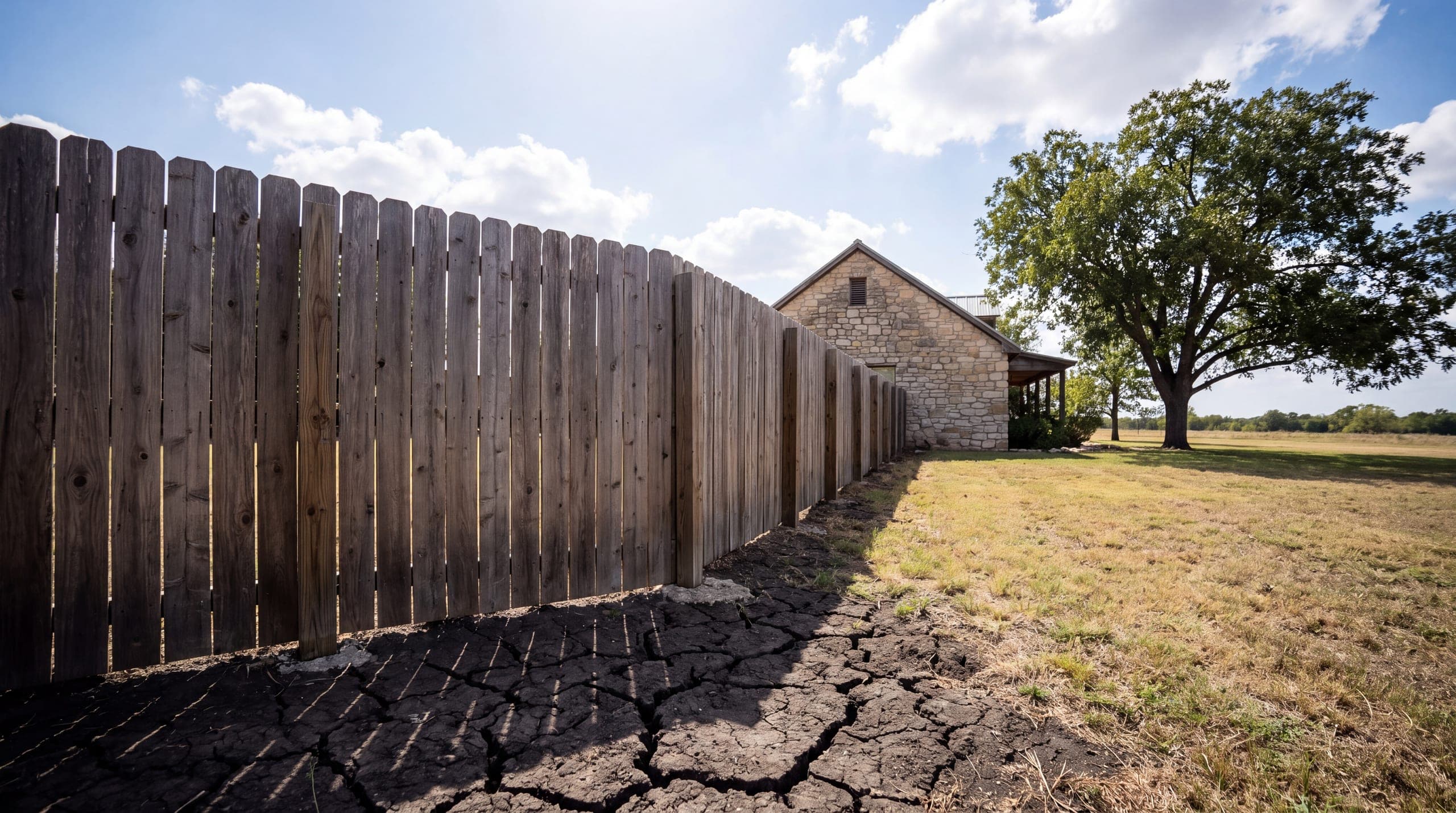
Repair is the honest alternative and worth naming. A single cracked board or one leaning panel on an otherwise sound line is a small job. What ages out a fence is the part you cannot see from the patio: the base of every post, at the ground line, where the wood meets soil.
So the first thing a good contractor does on an older lot is walk the whole line and test the posts. If a bidder quotes from the driveway, they have priced boards and guessed at everything underneath.
Limestone Under Thin Soil Stops an Auger Short
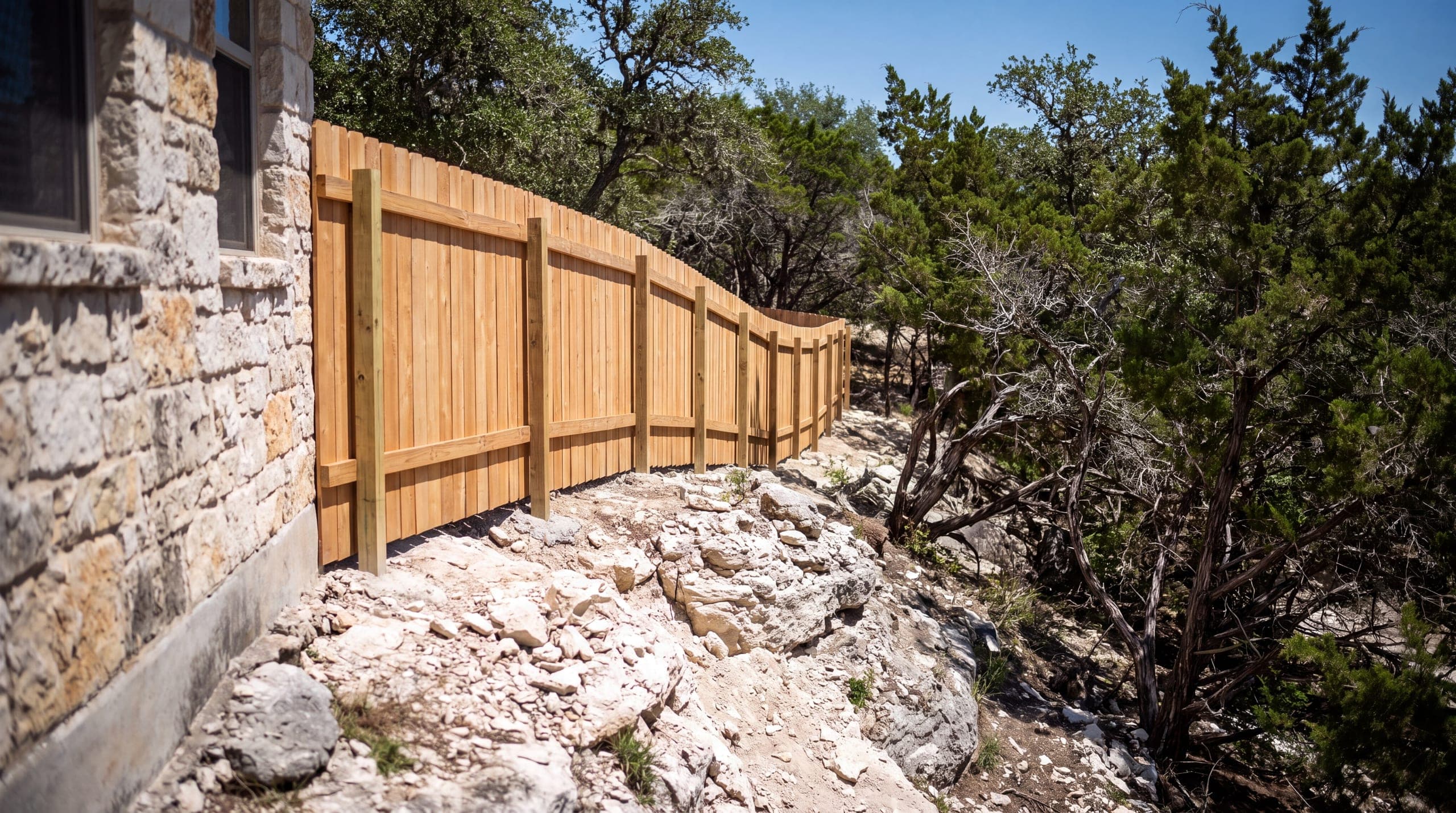
The soil over the Hill Country limestone shelf is thin, and the hard layer under it can start within 10 to 20 inches of the surface, a depth that shifts inside horizontal distances of just 25 feet (USDA NRCS, Lacoste series). One post hole goes to depth easily. The next one, 8 feet down the same line, hits rock at a foot.
This is the single biggest reason two quotes for the same fence come back hundreds of dollars apart. A post has to reach depth to hold a fence against wind, and when the auger stops early the crew has to core or break through rock to get there. That takes different equipment and more hours.
Ask any bidder what happens when the auger hits rock on your line. There are only a few real answers: rock augers or a hammer drill, wet coring, or setting a shorter post in a wider concrete footing where the code allows it. A contractor who has never had that conversation on your street will say it will not be a problem.
Mature Live Oaks Decide Where a Post Can Go
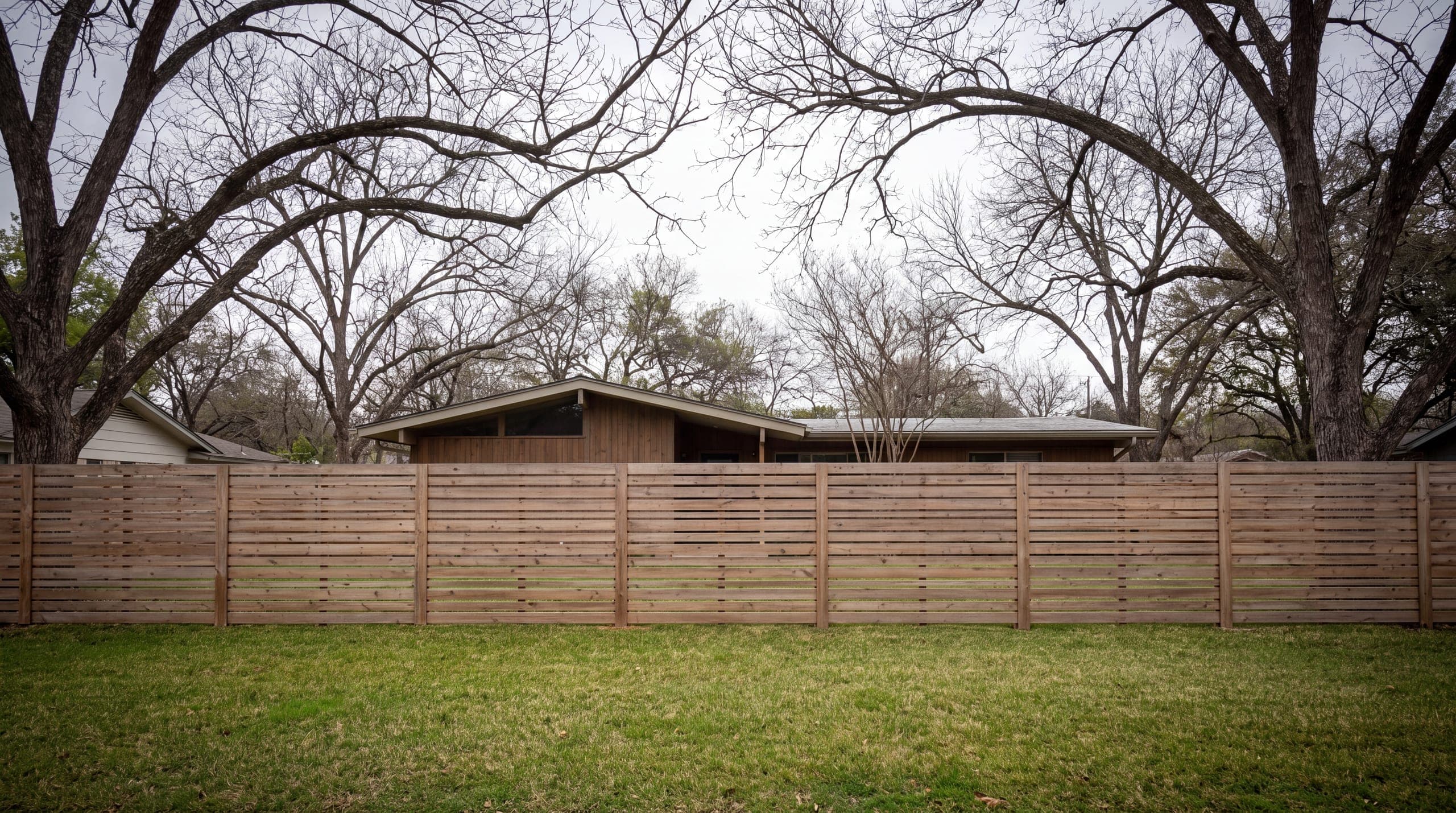
The live oaks on these fence lines were here before the fence, and they set the post layout, because a post hole cannot go through a major root and the tree cannot lose that root. On an established lot, the fence line bends around the tree. On a builder lot there is nothing to bend around.
A crew that knows this will do three things. They will hand-dig near the trunk to find roots before an auger touches the ground. They will shift a post a foot or two and carry the extra span with a longer rail rather than cut through the root plate. And they will never bolt a rail into a living trunk, because the tree grows around the hardware and the fence tears itself apart.
The canopy matters too. Shaded wood stays damp longer after rain, and damp wood at the ground line is where rot starts. That belongs in the spec, not in a surprise conversation on install day.
Slope Changes Your Panel Layout and Your Legal Height
On a steep lot, fence height gets measured from the ground under the fence, and the ground keeps moving. Austin’s code allows a solid fence along a property line up to 6 feet from natural grade, and 7 feet only where there is a grade change of at least 1 foot (City of Austin, 2025). Westlake Hills and Rollingwood are their own cities with their own rules, so confirm the limit with your city before anyone builds to it.
Grade also decides how the panels sit. Stepped panels stay square and leave triangular gaps under each step, which matters if you have dogs. Racked panels follow the slope with the pickets kept plumb, which closes the gap and costs more in labor.
A quote on a sloped lot should say which of the two it priced. If it does not, you are comparing a stepped fence to a racked one and calling it the same fence.
A Custom Home Has No Original Fence Spec to Reorder
Nobody can pull the original spec for a custom-built home the way they can on a production subdivision, so the bid you accept becomes the spec. That puts the burden on you to read what it names. These are the four words that carry most of the money.
| Term | What it means on your quote |
|---|---|
| Picket grade | Wood is graded #1 through #3. #1 has fewer and tighter knots; #3 has more and larger ones. |
| Ground contact | Lumber treated to a retention level made for being buried in soil, used for posts. |
| Natural grade | The existing ground level your fence height gets measured from. |
| Embedment | How deep the post sits in the ground, and the number a rock shelf threatens. |
Austin sits at 55.2 on the published decay hazard index, inside the moderate band (USDA Forest Products Laboratory, 2009), which is easier on wood than the Gulf Coast and harder than West Texas. That is enough decay pressure that the post spec and the drainage around it decide how long the fence lives.
Texas Issues No Fence Contractor License, So Verify It Yourself
There is no statewide general-contractor, home-improvement, or fence-contractor license in Texas; the state’s licensing authority regulates specific trades like electricians and HVAC, and fence building is not among them (Texas Department of Licensing and Regulation, 2026). Anybody with a truck can quote your fence legally. So the vetting falls to you, and it is four questions long.
| What to ask | What a real answer sounds like |
|---|---|
| Insurance | A current certificate of general liability, emailed before work, listing the carrier and dates. |
| Rock on this line | Names the tool: rock auger, hammer drill, or coring, and says how it changes the price. |
| Trees on the line | Describes hand-digging near roots and shifting posts, with no hardware into a trunk. |
| Crew depth | Says how many crews work this area, so a sick crew does not move your date by a week. |
Ask for two addresses in Westlake Hills, Rollingwood, Lost Creek, or Davenport Ranch where they replaced a fence on a rocky, treed, sloped lot. A contractor who works this corridor has them.
Five Lines a Quote Needs Before You Can Compare It
The Federal Trade Commission’s advice on home improvement work is to get written estimates listing the work, the materials, the completion date, and the price, and never to pay in full up front (FTC, 2024). On these lots that written estimate needs five specific lines before two bids can be set side by side.
- Measured footage. The number of linear feet somebody counted while standing in your yard, gate openings called out separately.
- Post spec and depth. Post material, size, spacing, and how deep each one goes, plus what happens where rock stops the hole.
- Picket grade and species. Cedar or pressure-treated pine, and the grade number. “Cedar” alone is a marketing word until a grade follows it.
- Removal and haul-off. Who tears out the old fence, who takes the old posts and concrete away, and on which day.
- Warranty terms. What it covers, for how long, and whether the coverage is on the craftsmanship, the material, or one of the two.
If a bid is missing any of the five, the gap is where the change order comes from later. Ask for the line in writing before you compare, not after.