
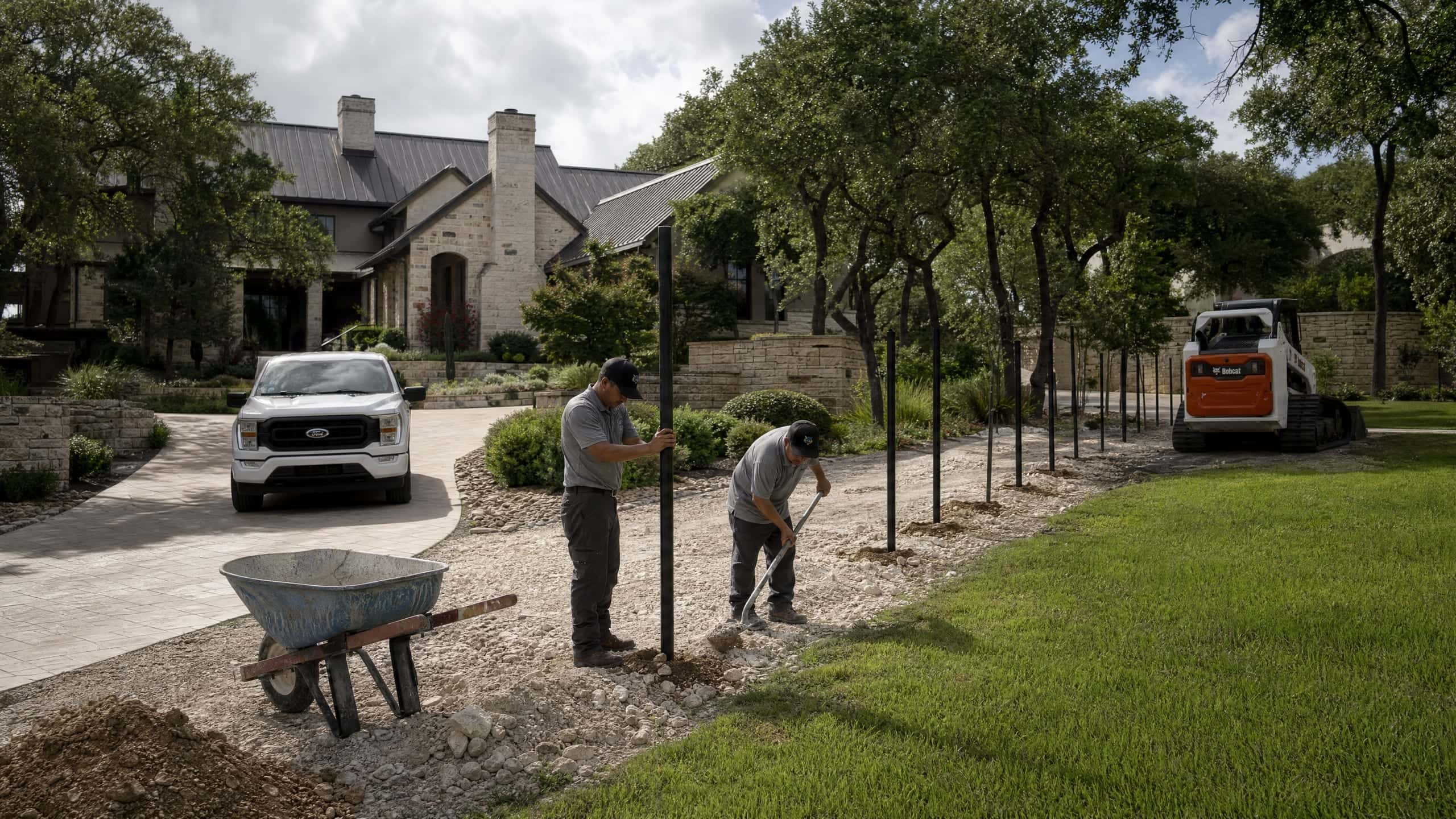
Most San Antonio fence quotes get compared on two lines: which grade of cedar, and how soon a crew can start. Both are fair questions. Neither one decides whether the fence is still standing straight after five summers.
About a foot under your grass sits a layer of cemented calcium carbonate called caliche. A post that stops on top of it is already short by code, before a single storm ever pushes on the fence.
Caliche Is a Cemented Rock Layer Under Your Yard
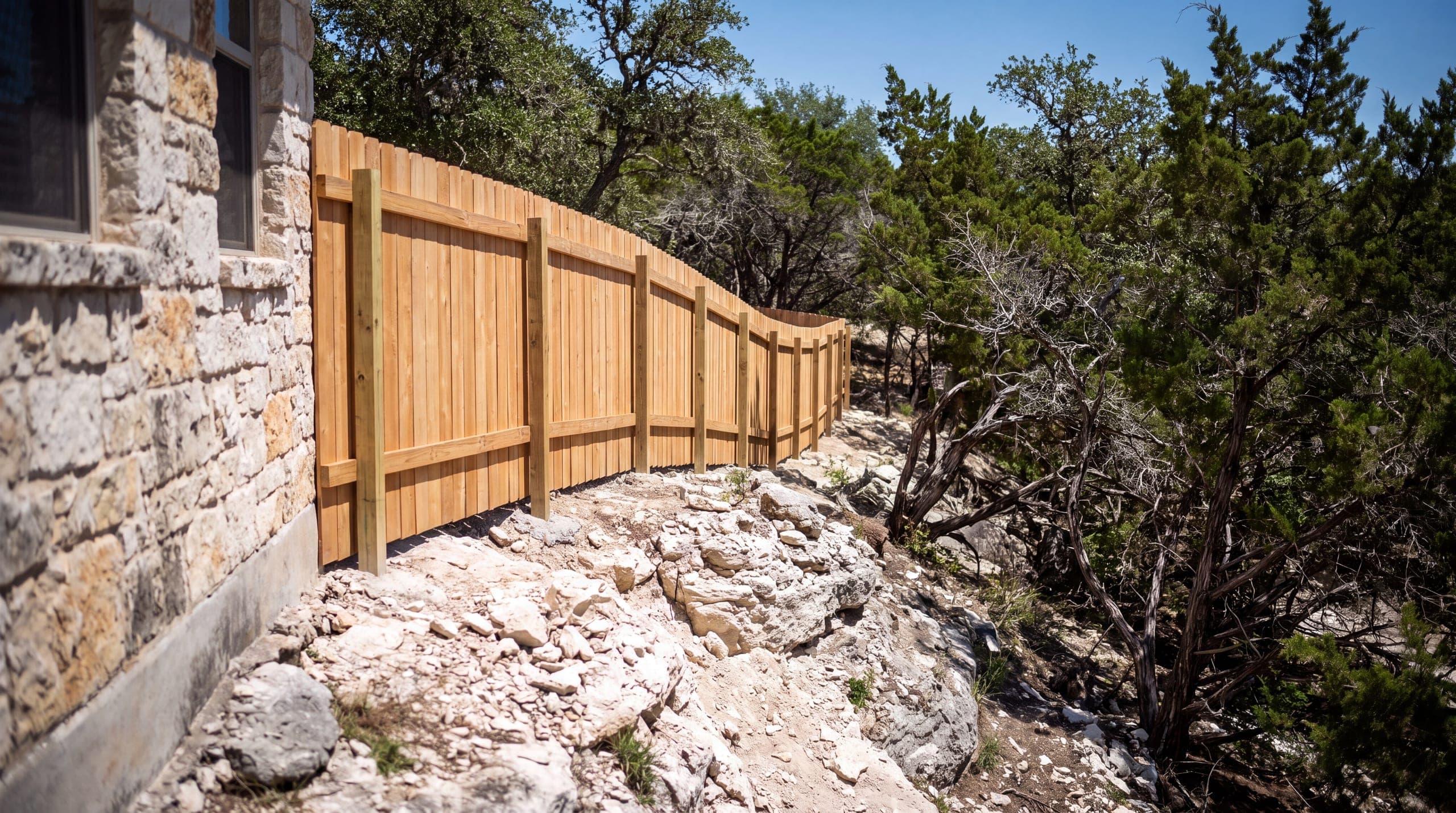
Caliche is calcium carbonate that has hardened into rock inside the soil, and around San Antonio it starts within a shovel’s reach of the grass. The USDA’s official description of the Gruene series, with its type location in Hays County, records strongly cemented, massive caliche beginning around 13 to 22 inches in the type pedon (USDA NRCS, Gruene series).
That is shallower than a fence post needs to go. An auger drops through the topsoil, hits the layer, and stops turning. What happens in the next ten minutes is the job. A crew either breaks through into the strong layer, or it calls the hole finished and sets the post in the soft fill above it.
You will never see which one you got. It is under concrete by lunchtime.
Know These Five Terms Before You Read a San Antonio Fence Quote
Reading a fence quote in this city means reading a soil report you were never handed. Five words carry most of it.
| Term | What it means | Why it matters in San Antonio |
|---|---|---|
| Caliche | Calcium carbonate cemented into a hard layer in the soil | An auger can stop dead on it at 12 to 20 inches |
| Petrocalcic horizon | The soil-survey name for a strongly cemented caliche layer | It is the layer mapped under much of the metro |
| Embedment | The length of post buried below grade | Code sizes it from wind force and soil strength |
| Lateral bearing | How hard the soil pushes back on a loaded post | Caliche pushes back hard, the fill above it barely does |
| Solid screen fence | A fence with almost no gaps across its face | San Antonio requires engineer-certified wind design above 8 feet |
Caliche and Blackland Clay Break a Fence Two Different Ways
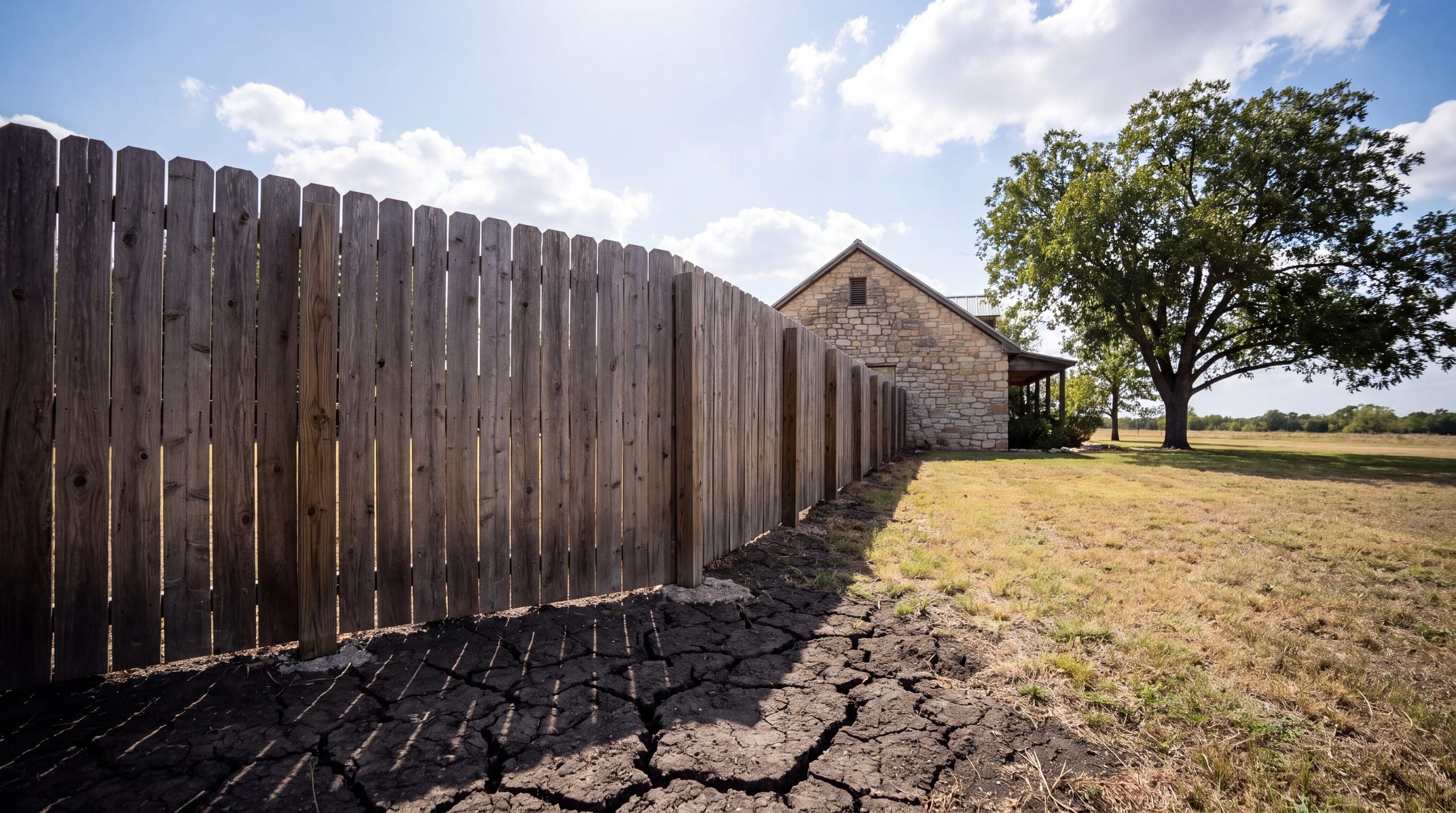
Clay moves a post, caliche stops the digging, and a crew trained on one will build the wrong footing in the other. The NRCS classifies Houston Black, the Texas state soil covering roughly 1.5 million acres of Blackland Prairie from Dallas south to San Antonio, as a smectite-clay Vertisol whose very high shrink-swell is a recognized limit for building sites (USDA NRCS, Houston Black Series, 2023).
Plenty of San Antonio lots carry both: clay near the surface, rock underneath. The build has to answer each one.
| Soil under the line | What it does to a post | What the build has to answer |
|---|---|---|
| Expansive clay | Swells wet and shrinks dry, working the post loose each season | Depth below the moving zone, and a footing that grips |
| Caliche shelf | Stops an auger at 12 to 20 inches | Break through it and seat the post in the strong layer |
| Loose fill over caliche | Gives the top of the post almost no side support | A footing wide enough to bear on undisturbed ground |
The Code Sizes Post Depth From the Soil Under It
Post depth is an engineering number, and the code writes it as one. The 2021 International Building Code sizes a nonconstrained embedded post so the required depth rises with the wind force and the height at which that force acts, and falls as the soil’s lateral bearing strength rises (2021 International Building Code, Section 1807.3.2.1). Only part of the buried length gets credit for resisting the load.
Read that against a caliche lot and it cuts both ways. Sound caliche is strong soil, so a post seated into it earns its depth. The loose fill sitting on top of the layer is weak soil, so a post stuck in that alone has to go deeper to hold the same fence, not shallower.
The tape measure the crew uses is the wrong tool for judging this. What matters is which material the last 12 inches of post is standing in.
A Post That Stops on the Shelf Is Undersized
A hole that ends where the rock begins is short by the code’s own math, and San Antonio’s ground makes that easy to do by accident. The USDA description of the Lacoste series puts depth to the petrocalcic horizon at 10 to 20 inches, a range commonly found within a horizontal distance of just 25 feet (USDA NRCS, Lacoste series). Two posts on the same run can meet the layer at very different depths.
The fence then has to carry real load with a short post. Engineers treat a solid privacy fence as a solid freestanding wall, with the wind pressure acting across its full solid face, and a fence counts as solid once its openings drop below 30% of the gross face area (ASCE/SEI 7-22, Chapter 29). A 6-foot privacy fence catches almost all of it.
Three things follow from a post that quit early:
- It is shallower than the code sizes. The lever arm above ground did not change, so the shortfall shows up as movement.
- It sits in a hole with no way out for water. The cemented layer under the concrete is close to a sealed bottom.
- It shows at the corners and the gate first. End posts and gate posts take the heaviest load on the line, which is why they lean before the middle does.
Water Trapped Above Caliche Rots the Post at the Base
A hole that stops on the shelf works like a bucket, and buried wood sitting in a bucket is on a clock. Serious decay only runs when wood moisture climbs above the fiber saturation point, an average of 30%, while wood that stays at or under about 20% carries what the USDA Forest Products Laboratory calls a reasonable margin of safety against fungal damage (USDA Forest Products Laboratory, FPL-GTR-282, 2021).
San Antonio is not the wettest corner of Texas, and it does not have to be. The water only needs somewhere to sit. Rain runs down the outside of the post, collects at the bottom of a sealed hole, and stays there through the week.
Breaking through the caliche gives that water a path down into soil that can take it. Where the layer is too thick to open fully, drilling through it with a masonry bit gives drainage a route it otherwise never gets. Either way, it is a decision the crew makes at the hole, and it is worth asking about before they dig.
Does San Antonio Require a Fence Permit?
The city regulates fences more closely than Houston does, so paperwork belongs in the plan. San Antonio requires a permit for a new fence within city limits, and for replacing more than 25 percent of one, caps a side or rear yard fence height at 6 feet unless a code exception allows 8, and calls for engineer certification of wind-load design on solid screen fences above 8 feet (San Antonio Unified Development Code, Section 35-514).
Front yards are tighter still. A solid front-yard fence is held to 3 feet and a predominantly open one to 5 feet, with a 6-foot open fence allowed by right only on large lots with wide street frontage. Outside the city line, in Converse, Helotes, Leon Valley, Floresville or New Braunfels, the height rules are the local jurisdiction’s to set, so confirm them before the design is fixed.
The engineering point sits underneath all of it. Once a wall of fence is tall enough that an engineer has to certify the wind design, the footing that resists that wind is being sized in the same breath. Caliche is part of that calculation.