Most people in Georgetown get three fence bids and compare the number at the bottom. That number is the easiest thing to compare and the least useful, because the three bids are almost never pricing the same job.
The town has grown fast enough that your shortlist will mix a builder who has worked this clay for 20 years with a company that showed up when the subdivisions did. Here is the standard to judge them by, and the questions that force a real answer out of one.
Know These Four Terms Before You Read a Georgetown Fence Bid
Four words decide what you are actually buying: linear foot, picket grade, ground contact, and embedment. Only one of them has a published standard behind it. The American Wood Protection Association’s Use Category System puts fence posts in UC4A, general ground contact, and sets a minimum preservative retention for wood buried in soil (AWPA Standard U1). A post that is not treated to that level is a different product wearing the same color.
| Term | What it means | What to ask the bidder |
|---|---|---|
| Linear foot | One foot of finished fence line, measured along the ground | Who measured the footage, and did they stand in the yard? |
| Picket grade | The mill grade of the board, #1 through #3, set by knots and defects | Which grade is this price written against? |
| Ground contact | Wood treated for burial in soil, UC4A under AWPA U1 | Are the posts rated for ground contact? |
| Embedment | How deep the post is buried, and in what | How many inches deep, and how wide is the hole? |
Two quotes that both say “cedar fence, 180 feet” can differ by hundreds of dollars and still both be honest. The words above are where the difference hides.
Georgetown Sits on Blackland Clay That Swells and Shrinks
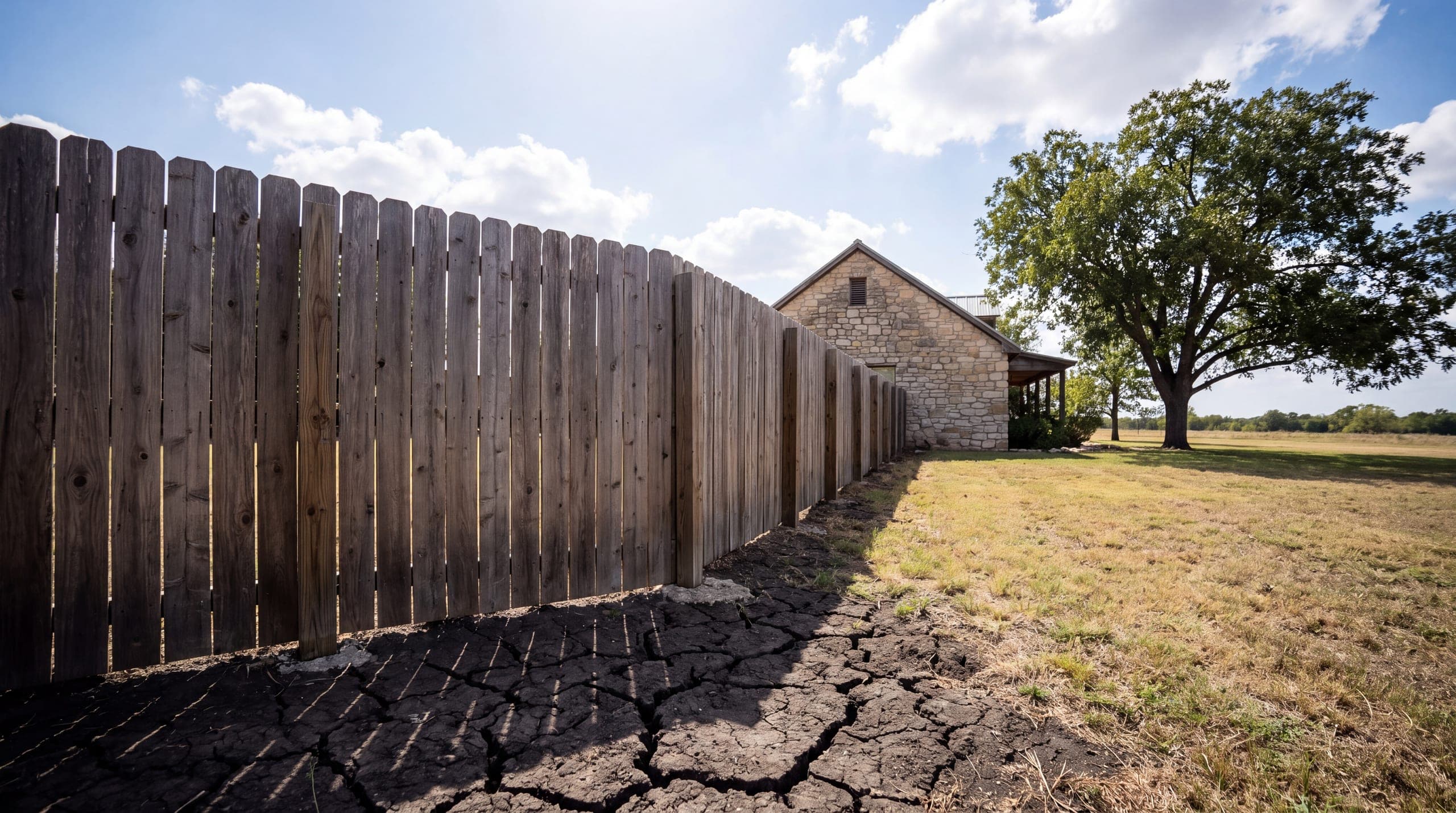
Your posts go into soil that changes size with the weather. The Blackland Prairie clay running from Dallas through Central Texas to San Antonio is a smectite-clay Vertisol of roughly 60% to 80% clay, and the USDA rates its shrink-swell potential as very high (USDA NRCS, 2023).
Here is what that does to a fence. The clay swells when it rains and pulls back when it dries, and it does that around every post, season after season. A post set too shallow gets worked loose a little at a time. You see it as a line that looked straight in year one and waves by year five.
Drive west of I-35 and the problem flips to rock, where crews fight caliche and refusal depth. In Georgetown, Hutto, and Round Rock, the ground is the opposite problem. It is soft, it moves, and a bidder who never mentions it has not thought about your yard.
Ask How Deep the Posts Go Before You Ask the Price
Post depth is set by the soil, the fence height, and the wind. Section 1807.3.2.1 of the 2021 International Building Code sizes an embedded post as a cantilever, and the required depth grows as the soil gets weaker and as the wind load and its lever arm get larger (2021 IBC). Weak, moving clay is exactly the case that drives depth down.
So ask three things and write down the answers. How many inches does the post go into the ground? How wide is the hole, and is it concrete or dry-set? Are corner posts and gate posts set deeper than line posts?
A contractor who answers in inches is quoting a build. A contractor who says “standard depth” is quoting a hope.
Texas Never Licensed Your Fence Contractor
There is no state license to check. Texas regulates about 40 occupations, and fence and general home-improvement contracting is not among them, so any fence builder can work statewide without a state license (TDLR, 2026). Licensing sits with cities and counties, and it varies.
That puts the vetting on you, and it is not hard. Ask for a certificate of insurance sent to you by the insurer instead of a PDF forwarded by the salesperson. Ask how many years they have worked Georgetown specifically. Ask for two addresses within 10 miles where they built a fence more than three years ago, then go drive past and look at the post bases.
Star Averages Cluster High Here, So Read the Repeats
Ratings matter to buyers and every serious local company knows it. 92% of consumers say star ratings factor into which local business they choose, and 68% will not use one rated below 4 stars (BrightLocal, 2026). The practical result is that almost everyone worth calling in Georgetown already sits between 4.8 and 5.0.
Your shortlist will likely include names like Encore Fence Company, K2 Fence and Stain, Georgetown Fence and Deck, and Hicks Fencing. The averages will not separate them. What separates them is what reviewers repeat.
Read 20 reviews and count the nouns. If people keep naming gates, the crew is good at gates. If people keep naming cleanup, the crew cleans up. If one salesperson’s name appears over and over, that is a real person doing real follow-up. Then read the one-star and three-star reviews and look only for what happened next.
What a Fence Replacement Runs in Texas Before Site Conditions
The figures below are a modeled planning estimate, triangulated in 2026 from the published survey ranges of HomeGuide, Angi, HomeAdvisor, and Ergeon and set for the Texas market. They are not a quote from anybody. They cover a 6-foot residential fence on flat, clear ground, materials plus labor.
| Fence type (6 ft residential) | Modeled Texas installed cost per linear foot | What pushes it up |
|---|---|---|
| Pressure-treated pine privacy | $18 to $30 | Taller panels, gates, heavy clay that slows post holes |
| Cedar privacy | $25 to $45 | Clear, knot-free grades and Western red cedar |
| Vinyl (PVC) | $30 to $60 | Wind-rated sections and custom colors |
| Ornamental steel or iron | $45 to $90 | Custom welded designs and automated gates |
Every one of those ranges excludes old-fence removal and haul-off, gates and operators, permits, and hard or sloped ground. On a Georgetown replacement, those exclusions are most of what makes your job your job.
One more thing moves the number, and buyers rarely ask about it. Contractors do not all pay the same for the same board. A company buying wood by the truckload has a lower picket cost than a company buying by the pallet, and that gap shows up in the bid without changing a single line of the spec.
A Georgetown Quote Should Name These Five Things
A comparable quote is a spec sheet with a price at the bottom. The Federal Trade Commission tells homeowners to require written estimates that list the work, the materials, the completion date, and the price, and to never pay the full amount up front (FTC, 2024). Here is the Georgetown version of that list.
- Measured footage. The linear feet, taken on site. A number estimated from a satellite photo is a guess with a decimal point.
- Species and picket grade. “Cedar” is not a spec until it names a grade. Get #1, #2, or #3 in writing.
- Post spec and depth. Material, treatment rating, hole depth in inches, spacing, and whether corners and gate posts go deeper.
- Removal and haul-off. Who tears out the old fence, which day it leaves the property, and whether that price is inside the number or beside it.
- Warranty scope. Ask which half you are getting. Craftsmanship warranties cover the install. Material warranties come from the mill or the manufacturer, and very few contractors cover both.