
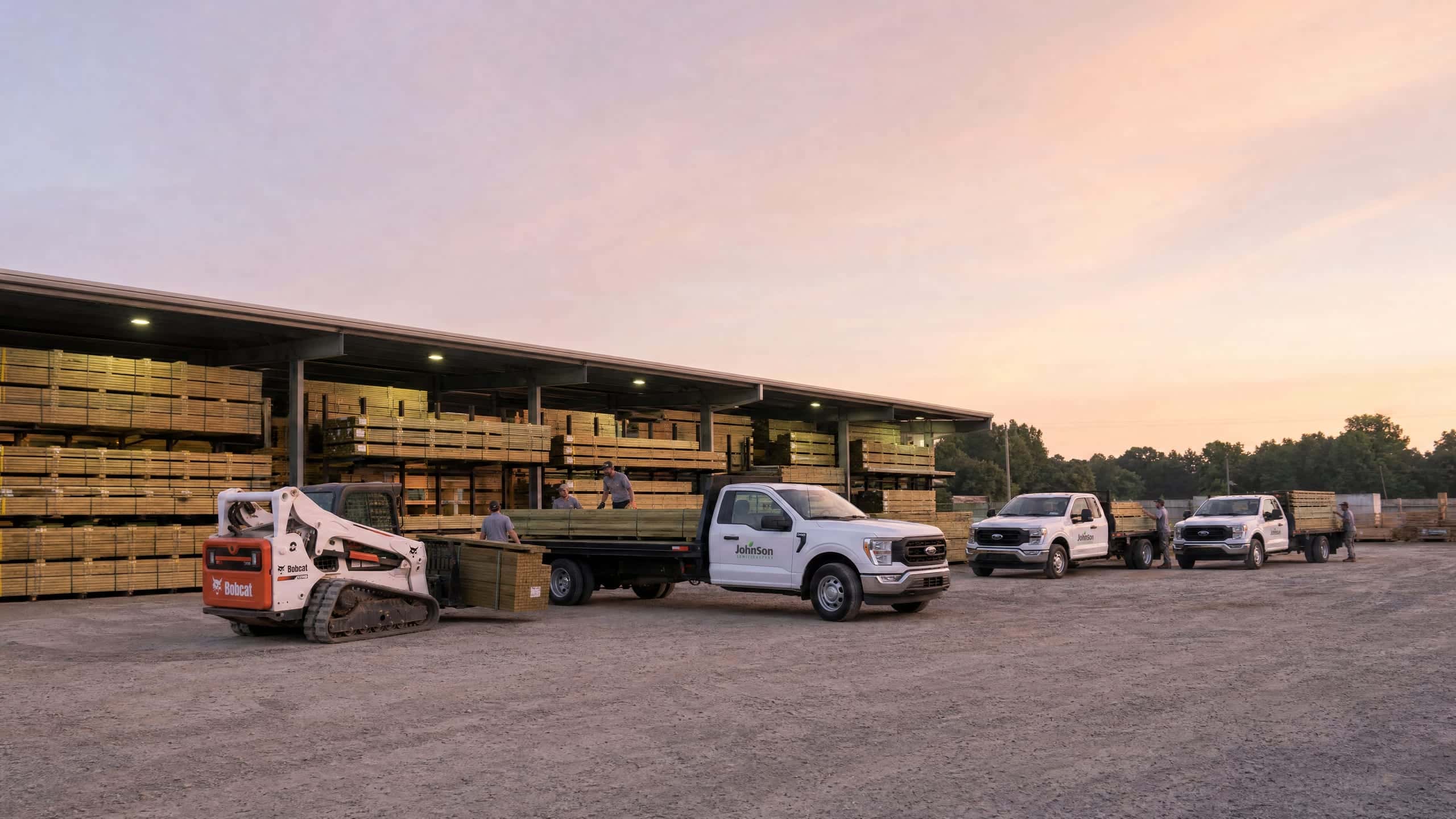
A fence crew almost never misses a date because it ran out of hands. It misses because the pickets are not on the truck yet. We buy wood at a scale no small shop can match, and the biggest thing that buys a customer is a date that holds.
A Fence Bid Is a Promise About Wood You Cannot See
Most fence contractors are small, and small buyers wait their turn at the lumber yard. About 599,000 specialty-trade contractor establishments employ roughly 5.26 million workers, fewer than ten people per establishment on average (U.S. Bureau of Labor Statistics, 2025). A shop that size buys pickets the week it needs them, at whatever the yard is charging that week, behind whoever ordered first.
That is invisible on a bid. Two quotes can name the same fence, the same height, and the same start date, and only one of them has the wood spoken for.
When the yard is tight, the buyer with the standing order gets loaded and the buyer placing a one-off order gets a phone call. Nothing about that shows up in the price column.
How Picket Buying Power Works at the Lumber Yard
Volume buys two things from a distributor: a better number and a better place in line. Master Halco named us its Largest Volume Customer for 2026, for the Southwest Region and for the world, and we are a top customer of Solid Wood. That is the same fence for less, because we buy the wood for less, and we pass the material savings straight through to the quote.
The price half of it is easy to see. Industry revenue for U.S. fence construction runs about $20.4 billion, and analysts credit recent growth to contractors passing higher material and labor costs on to customers (IBISWorld, 2026). Buying power is what lets us stop doing that.
The other half is spec honesty. Plenty of bids say “cedar” and quietly deliver a lower grade. We name the picket grade, #1 through #3, in the quote, so the number you are comparing is attached to the wood you are actually getting.
Know These Four Terms Before You Read a Picket Quote
Read the wood before you read the total. Four terms decide both what you pay and whether the date holds, and a bid that names none of them is asking you to trust it on faith.
| Term | What it means | Why it moves your price or your date |
|---|---|---|
| Picket grade (#1 to #3) | The quality tier of the fence board, #1 being the cleanest and least knotty | A quote that names no grade can be filled with the cheapest board on the yard |
| Ground contact (UC4A) | Preservative retention specified for posts buried in soil, per AWPA Standard U1 | Posts set below this spec rot first, no matter how good the pickets look |
| Linear foot pricing | Cost per foot of finished fence, measured on site | Footage measured in person is the only version that will not change later |
| Committed material | Wood already allocated to your job rather than ordered after you sign | Uncommitted wood is where a quoted install date starts to slide |
Fencing Is the Last Trade Before a Builder Can Close
On a new home, the backyard fence sits at the end of the schedule, and everything behind it is already paid for. Single-family completions averaged 9.1 months from authorization to completion in 2024, and 7.6 months from permit to completion on homes built for sale (U.S. Census Bureau, 2025). A fence trade that stalls in month nine stalls the walkthrough.
That delay has a published price. The skilled-labor shortage cost single-family builders $2.663 billion in higher carrying costs in one year, which is the direct dollar cost of a home sitting unfinished while it waits on a trade (Home Builders Institute and NAHB, 2025).
We built the fencing side of our business on that pressure. From 2002 to 2019 we fenced whole subdivisions for regional and national builders in Houston, and we ran it more like a logistics operation than a fence shop, because the last trade on site is the one everyone is watching.
Material Cost Now Decides Whether a Builder’s Margin Survives
Materials are no longer a line item a builder can absorb quietly. Construction costs reached 64.4% of the average new-home sales price, up from 60.8% in 2022 and the highest in a series going back to 1998 (NAHB, 2025). When two-thirds of the sale price is cost, a picket price that moves mid-project moves the margin with it.
Builders are already giving up ground on the other end. New-home incentives ran roughly 7% to 7.6% of sale price into 2026, against a pre-pandemic norm nearer 2% to 3% (John Burns Research and Consulting, 2026). A trade partner whose material cost is stable is one of the few pieces of that math a builder can still control.
But the Price Break Is the Smaller Half of the Win
Priority in the supply line is worth more than the discount attached to it. A distributor’s largest customer does not get told to wait a week while a larger order gets filled, which is exactly the week that turns a promised Tuesday into the following Monday. That is why we treat buying power as schedule protection first and a price advantage second.
Researchers make the same point about how trades get chosen. A 2025 study in the ASCE Journal of Construction Engineering and Management argues that awarding each trade to the lowest bidder in isolation underperforms a plan weighted for cost, duration, quality, and safety together (Bingol, Arditi, and Polat, 2025).
Homeowners see it in plainer terms. In a Google review, Rita S. wrote that we “charged almost $900.00 less than three other companies for the same metal, coating and paint for my black metal fence in Del Webb of The Woodlands.” Same spec, lower number, because of what we pay for material.
Ask a Fence Bid Five Questions About Its Wood
A bid earns its date by answering supply questions, and most bids have never been asked one. Put these five to every contractor you are weighing, including us.
- Who supplies your pickets, and what is your standing with them? A named distributor and a real buying relationship is a different answer from “whatever the yard has.”
- What grade of picket does this price cover? If the bid will not write #1, #2, or #3 on the page, the price is attached to nothing.
- Is the material for my job committed, or ordered after I sign? Committed wood is the difference between a date and a hope.
- What happens if lumber prices move before install day? Ask whether the quoted number survives a price swing, and get the answer in writing.
- How many crews do you run in my city? Crew depth is local, so a statewide number means nothing if one truck covers your metro.
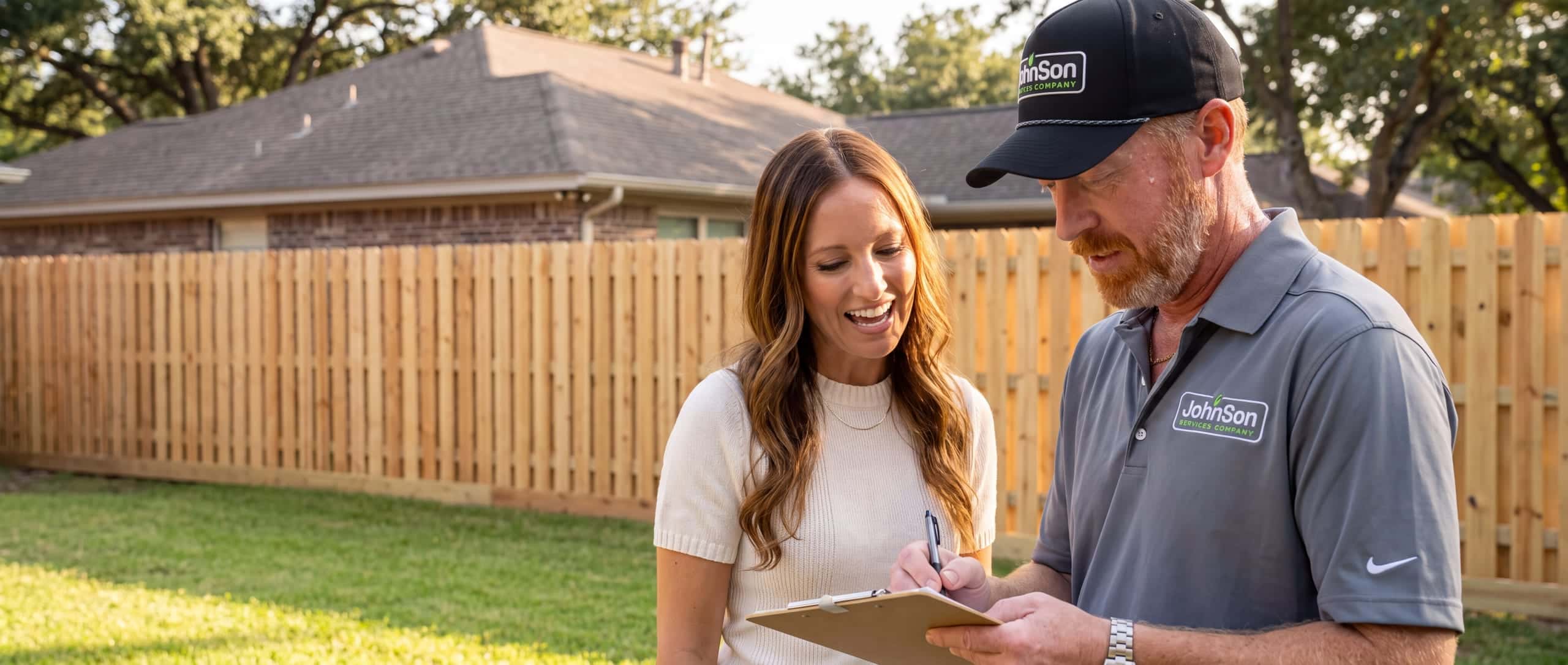
We answer all five the same way every time. We measure the job on site, specify the grade, and load the materials and the crew before anyone leaves the yard.