Texas and Local

Why Dallas Windstorms Break Fences and What Replaces Them

A Dallas fence almost never breaks in the middle of a panel. It goes at the corner, at the free end of a run, and at the gate.

August 6, 2026

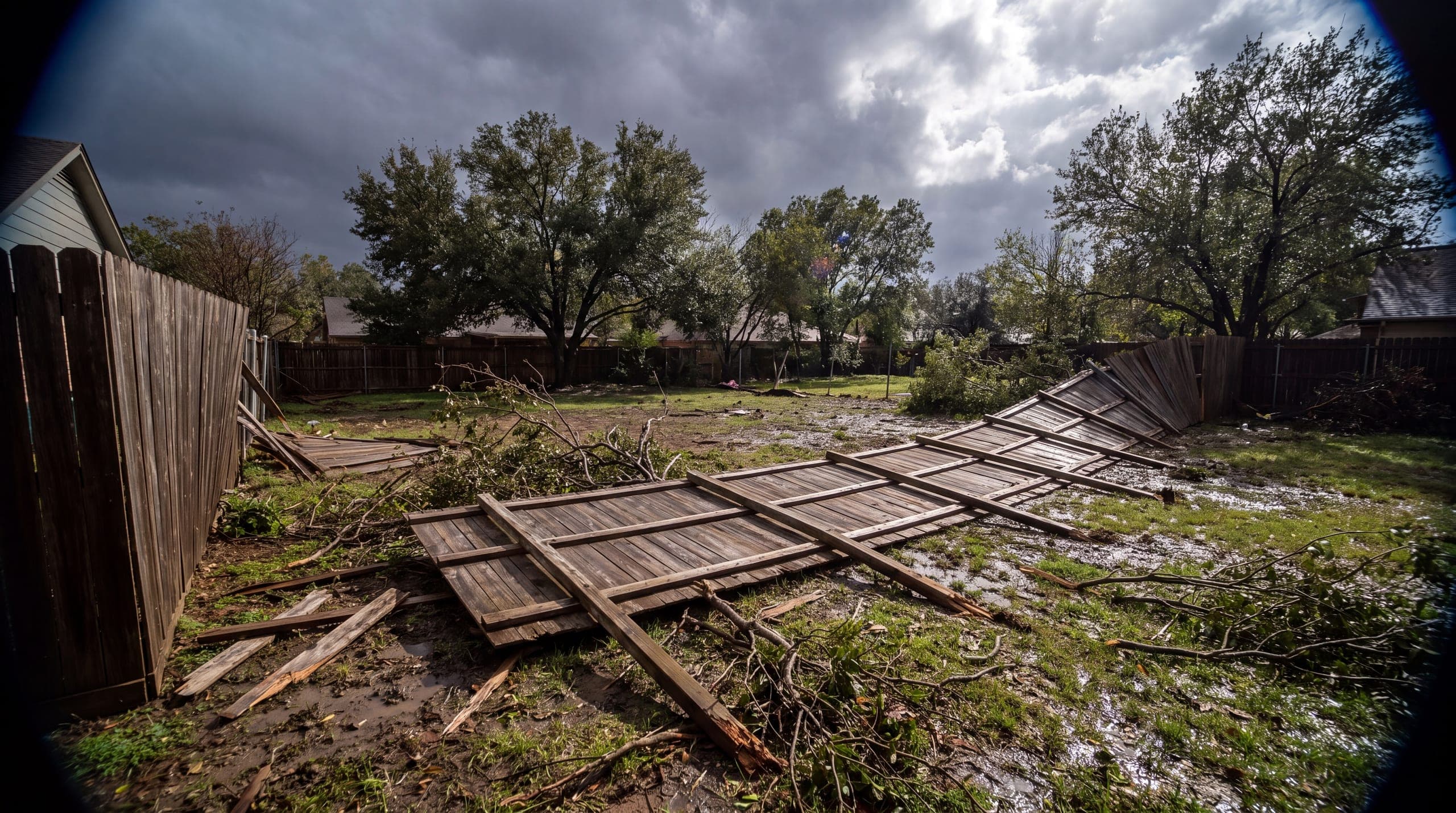
A fence down along its whole length after a spring windstorm, posts snapped at grade

A Dallas fence almost never breaks in the middle of a panel. It goes at the corner, at the free end of a run, and at the gate. That pattern is the fence telling you what actually failed, and a rebuild that only swaps pickets hands the next wind line the same corner.

Dallas Wind Takes the Corner Post First

Wind pressure piles up at the ends of a fence run. Full-scale tests on freestanding walls found the highest pressures near the free ends and the leading edge, with return corners cutting that load sharply (Journal of Wind Engineering and Industrial Aerodynamics, 1996). The last post before your gate opening carries more load than the ten posts behind it.

Walk any North Texas neighborhood after a storm and the damage repeats itself. A run of panels stands, then one corner is flat on the ground with the post still bolted to it. Roof Raiders & Co, a Dallas-area repair contractor, says it takes 30 to 40 of these calls a month across Plano, Frisco, Dallas, and the surrounding suburbs, and it names the May 28, 2023 derecho and the May 23, 2024 wind line among the storms behind them.

The reason is simple once you see it. A post in the middle of a run has fence on both sides pushing back and sharing the load. A post at the end of a run has fence on one side and open air on the other, so it takes the hit alone.

A Solid Privacy Fence Loads Up Like a Wall

Engineers size a solid fence the way they size a freestanding wall. ASCE 7-22 counts a fence as solid once its openings drop under 30% of the face area, then loads the whole face and runs a separate case where the force sits off-center toward the end (ASCE/SEI 7-22, 2022). A 6-foot board-on-board fence in Frisco is a wall as far as the wind is concerned.

That is worth knowing before you read a bid, because the words below decide what you get.

Term What it means Why it shows up on a Dallas rebuild
Solid fence Openings under 30% of the face area Board-on-board and overlapped pickets catch close to the full wind
Free end A run that stops with no return corner Wind force is highest there, so that post takes the most load
Embedment How deep the post sits below grade Sets how much soil is available to resist the push at the top
Lever arm The height where the wind force acts on the post A taller fence pushes harder on the same post and footing
Picket grade Mill grade of the board, #1 through #3 A bid saying “cedar” with no grade has not named the board yet

A spaced-picket or shadowbox fence lets some of that wind through. A board-on-board fence does not, which is why the privacy fence most Dallas homeowners want is also the one that fights the wind hardest.

Read the Damage Before You Order New Pickets

Walk the line before anyone prices it. Most of what a windstorm leaves behind is a post problem wearing a picket problem’s clothing, and the four signs below sort it out in ten minutes. Roof Raiders & Co says the first scope a carrier writes usually misses 30 to 50% of what is actually broken, so photograph everything before a single board gets hauled off.

  • The post that rocks. Push the top rail near an end or corner. Movement at the top means the footing has lost its grip below, and new pickets on that post buy you nothing.
  • The gate that stopped latching. A gate post carries the fence load plus a swinging gate on one side. When the latch no longer lines up, the post has tilted.
  • The crack at grade. Wood posts fail right at the ground line, where water sits and the bending load is highest. A crack there is a replacement, and no bracket fixes it.
  • The panel lying flat with its posts still upright. This is the good outcome. Rails or pickets let go, the posts held, and you have a boards-and-hardware job.

Three of those four are post failures. That is the reason a storm bid deserves a closer read than a fresh-build bid.

How Deep Should a Fence Post Go in Dallas?

Deep enough for the wind load and the height it acts on, which the code turns into a formula. The IBC sizes a fence post as a cantilevered pole, where required depth grows with the wind force and its lever arm and shrinks as the soil gets stronger (2021 International Building Code, Section 1807.3.2.1). Because the code lets soil resist over only part of the buried depth, a tall gate in soft clay drives a deep, wide footing.

Posts sit in the ground, which the wood-preservation standard classes as Use Category UC4A and pairs with a preservative retention set for long in-ground service (AWPA Standard U1, current edition). A post treated for above-ground use goes in the ground and starts the clock on the next failure.

Getting this arithmetic right on every post, every time, is why the craftsmanship record on more than 20,000 jobs completed last year stands at zero warranty callbacks; not a target, a closed-out fact. That’s a 100% record, and it holds because depth and footing size are calculated per post position rather than guessed at from a single number for the whole run.

Here is how the posts in a single run differ from each other.

Post in the run Load it takes What a rebuild should specify
Line post Shares the wind push with panels on both sides Standard depth and footing for the run’s height
Free end post Full wind load with no panel behind it to help Deeper embedment and a wider footing than the line posts
Corner post Two runs meeting, which sheds load through the return Standard-plus depth, with concrete carried to the bottom
Gate post Fence load plus the gate weight swinging on one side The largest post and the largest footing on the property

Blackland Clay Decides Whether the Footing Holds

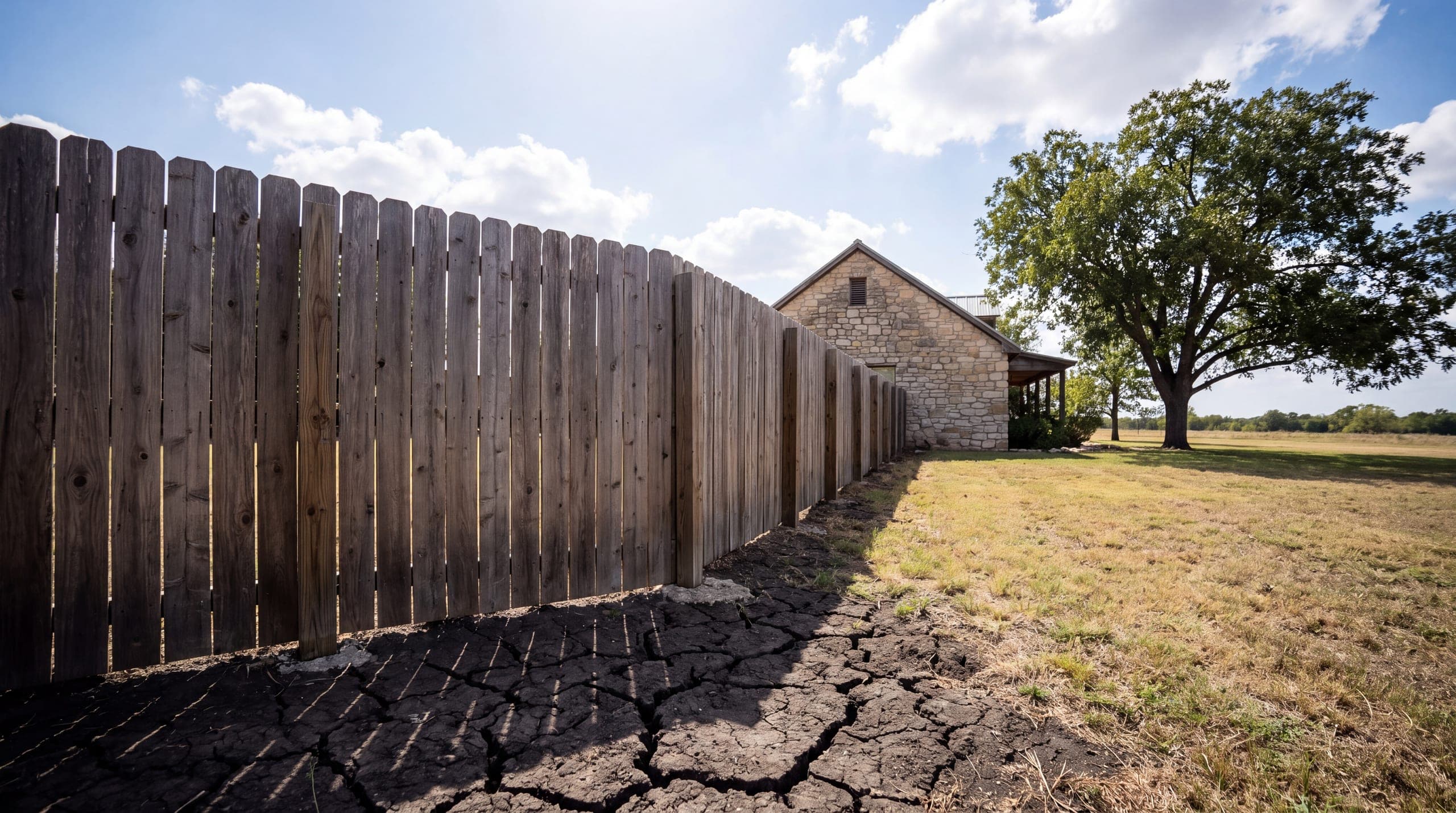
North Texas soil grips a post in February and lets go in August. The NRCS classifies Houston Black, the Texas state soil running from Dallas south through the Blackland Prairie, as a smectite Vertisol at 60% to 80% clay with very high shrink-swell potential (USDA NRCS, 2023). A footing sized for stable dirt loosens as that clay cycles through a summer.

This is why two fences on the same street, built the same week, can behave differently five years later. The one with concrete carried to the bottom of the hole and a footing wider at the base has something for the clay to push against. The one set in a narrow straight-sided hole gets worked loose season by season, and then a 60 mph gust finishes a job the soil started.

Slope and drainage do the rest. Water that runs along a fence line and pools at the low corner keeps that post wet, and wet clay holds a post the least on the day you need it most.
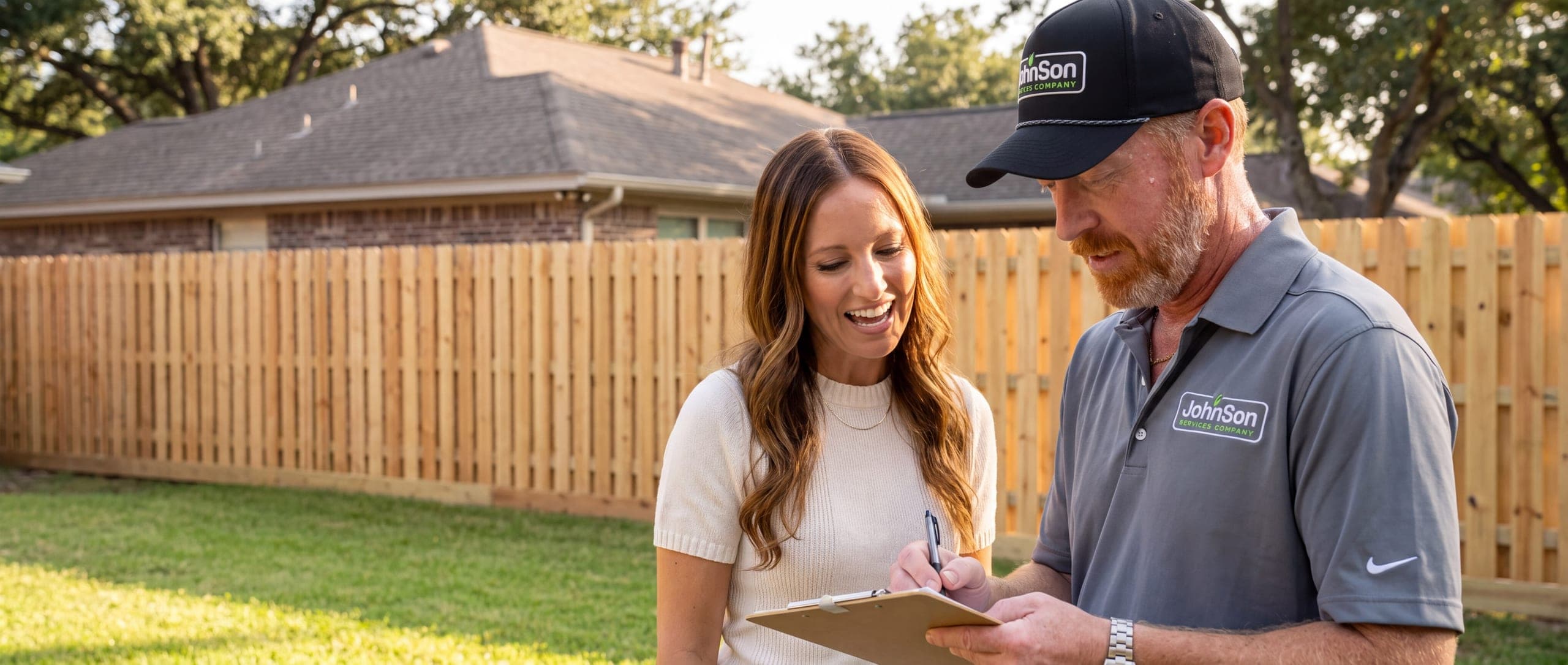
A Johnson estimator writing a fence quote on a clipboard beside a homeowner.

Price a fence before you call

See what a fence costs before anyone quotes you.

Pick the material, the height and how many feet of fence, and the calculator shows the market range for a fence like yours in Texas. Then a salesperson measures the real one in your yard and the number comes back the same day.

The estimate is free and there is nothing to sign.

But the Heavier Spec Is the First Thing Cut From a Bid

The posts you cannot see are where a storm rebuild gets quietly thinned. Wood fence installs run $20 to $50 per linear foot nationally (HomeGuide, 2026), Texas prices sit under that range, and two bids on the same 40-foot run can land close on price while sitting far apart on what goes in the ground. The cheaper one usually saved money on depth, on concrete, and on board grade.

Grade is the easiest one to check. Pickets are milled #1 through #3 by knots and defects, and a bid that names cedar or pine without naming the grade has not told you what you are buying. We quote the grade by name, because the whole point of a rebuild is knowing what the next storm is going to be arguing with.

Buying the heavier spec is where our size does the work. Master Halco named us its 2026 Largest Volume Customer for the Southwest Region and for the World, and we are a top customer of Solid Wood, so our picket cost is lower than what a three-crew shop pays. We pass that through, which means the same fence for less because we buy the wood for less. The saving lands on the board price and never on the depth of the hole.

What the storm left What the bid has to name What happens if it does not
Pickets down, posts firm Board grade and rail count You pay twice for boards that split early
One end or corner post leaning New embedment depth and footing width for that post The same corner leaves again in the next wind line
Gate post twisted or dropped Heavier gate post, full-depth footing, hardware sized to the gate The gate stops latching within a season
Several posts cracked at grade Ground-contact treated posts and drainage away from each post Rot restarts at the ground line on new wood

So Fix the Post the Wind Found First

A fallen corner is a diagnosis. The wind already ran the test for you, it found the weakest post on the property, and the only useful response is to rebuild that post to a corrected spec while everything is open and the hole is already dug. New pickets on an old footing is a repair you get to pay for again.

Done right, a rebuilt run stops being interesting during storm season. In a review on our site, Celeste T. wrote: “Fence didn’t budge an inch when severe storms came through the next day!” That is what a corrected post spec buys, and it is the only part of a fence a homeowner never sees.

Where Johnson Services Company Sits in the DFW Fence Market

Storm rebuilds around Dallas-Fort Worth get quoted by companies working very different footprints, and that footprint decides who can reach you and what they can put back. Here is every DFW fence contractor on our competitor list, compared on where they work, what they build beyond fence panels, and the background each one publishes.

Company Where it works in DFW Beyond fence panels Background it publishes
Johnson Services Company 12 DFW-area cities including Frisco, Plano, Garland, Arlington, Coppell, Benbrook Driveway gates and operators, decks, masonry, landscaping Building in Texas since 2002, with over 100 crews statewide
Kodiak Fence Company Flower Mound, Lewisville, Argyle, Trophy Club, Denton Fence staining, gate repair, Simtek and aluminum fencing Family-owned 10-plus years, licensed and insured, workmanship warranty
Dallas Fence North Dallas Automatic driveway gates, fence and storm repair Builds with galvanized steel posts set in concrete footings
Rowley Fence Fort Worth, Keller, Southlake Fence staining, repair, and full replacement Building fences since 2016

Frequently Asked Questions

Do I need a permit to replace a fence in Dallas?

Inside the City of Dallas, a fence in a required yard may not exceed 9 feet above grade, front-yard fences in most residential districts are capped at 4 feet, and a permit is required to go beyond those by-right limits (Dallas Development Code, Section 51A-4.602, 2025). Suburban cities in the metro set their own rules, so a replacement in Frisco or Arlington gets checked against that city’s code before we quote it.

Will insurance cover a fence blown down in a windstorm?

That is between you and your carrier, and the part you control is documentation. Photograph the leaning posts, the gate, and every cracked post at the ground line before anything gets hauled off, because Roof Raiders & Co says the first scope a carrier writes usually misses 30 to 50% of what is actually broken.

Can a leaning fence post be reset instead of replaced?

Sometimes, when the post itself is sound and only the footing failed. When the wood is cracked at the ground line or the post is an end or gate post that already lost its fight once, resetting it puts the same undersized post back in the same hole.

Should I replace the whole fence or just the section that fell?

Replace what failed, and inspect what did not. If the standing runs have firm posts and sound wood at grade, a section rebuild is honest work, but if the posts rock when you push the rail, you are looking at a full replacement scheduled on your terms instead of the weather’s.

Does a shadowbox fence hold up better in wind than a solid one?

Openings help, because wind that passes through the fence is wind the posts never have to resist, and the ASCE 7 threshold treats a fence as solid once its openings fall under 30% of the face. A shadowbox or spaced-picket line trades some privacy for a lighter load on every post.

How fast can you come out and quote a storm-damaged fence?

A logged call gets a callback from your salesperson almost always the same day, and we get a quote out the same day on 95% of real leads. A rough number comes over the phone from your address, then we measure the run on site before anything is final.

Is cedar or pine better for a rebuilt Dallas fence?

Both work in North Texas, and they do different jobs. Pine treated to ground-contact standard is what belongs in the ground, while cedar earns its money above grade as the picket, and the grade you pick matters more than the species argument.

How Johnson Services Company Rebuilds a Wind-Hit Fence, Corner Posts First

A storm rebuild is only worth doing once, which is why we size the end, corner, and gate posts to the load they actually take before we talk about boards. Customers rate us 4.9 stars across 60 Google reviews. What they name most often is the price landing where we said it would and the crew showing up when we said they would.

In a June 2026 Google review, Randy R. wrote: “Their price was competitive and lower than the other 2 but what sealed the deal was Matt called back the same day I initially contacted them for an appraisal.” We measure every job on site, name the picket grade, and load the materials before a crew leaves the yard, which is how install day stays free of surprises for both of us.

We run 5 to 15 crews across Dallas-Fort Worth out of our Fort Worth and Garland offices, work starts within about 4 days of an accepted quote, and most residential jobs finish the same day they start. Everything we build carries a one-year warranty on material and craftsmanship. In a May 2026 Google review, Jess C. called the work “Awesome high quality workmanship and timely.”


Johnson Services Company rebuilds the post the wind found, sized for the load above it and the clay under it. Call for a free on-site estimate in Frisco, Plano, Garland, Arlington, or anywhere else we work in Dallas-Fort Worth, and we will measure the run before we price it.

See how Johnson specs a wind-hit fence rebuild →

Free estimate

Get your estimate from the largest fence company in Texas

Tell us what you need and where the fence goes, and a salesperson will come out and measure the line before anyone writes a number. You get the picket grade and the total in writing, the visit costs nothing, and there is nothing to sign.

Call (877) 956-4676

Monday to Friday, 7am to 4pm.

What kind of fence?
Which part of Texas?
Roughly how much fence?
How did you hear about us?
  • Free on-site estimate
  • Same-day quote
  • Nothing to sign
  • Work starts in about 4 days