Texas and Local

Which Texas Cities Require a Fence Permit

Texas never adopted one statewide building code, so the fence rule that governs your yard is written by your city and by nobody above it.

August 6, 2026

8% 50%

Texas never adopted one statewide building code, so the fence rule that governs your yard is written by your city and by nobody above it. Houston waves most wood fences through, San Antonio permits nearly all of them, and Dallas and Austin sit at different heights in between. Getting that line right before the crew arrives is cheaper than learning it with the posts already in the ground.

Texas Never Set One Fence Rule, So Your City Did

The state stayed out of this on purpose. Texas has no statewide fence code and no state license for the people who build fences: the state’s occupational-licensing agency regulates about 40 trades, and residential fence builder is not one of them (Texas Department of Licensing and Regulation, 2026). What fills that gap is city code, and the four big metros disagree with each other on height, on material, and on which yard the fence sits in.

So the real question is almost never “do I need a permit.” It is “which line did this fence just cross.” Here is where each metro draws it.

City When a residential fence needs a permit The limit that bites first Where the rule is written
Houston Over 8 feet above grade, or masonry or concrete at any height Material decides it before height does Houston Permitting Center requirements
Dallas Anything above the by-right height limits 4 feet in the required front yard, 9 feet in any required yard Dallas Development Code 51A-4.602
Austin Over 7 feet, over 6 feet along a public right-of-way, or any height in a floodplain 6 feet for a solid fence on the property line Austin Land Development Code 25-2-899
San Antonio Most new fence construction inside city limits 3 feet for a solid front-yard fence, 4 feet if predominantly open San Antonio Unified Development Code 35-514

Learn the Terms Your City Code Uses Before You Read It

City fence code turns on four or five words that mean something narrower than they sound. “Above grade” and “from natural grade” are different measurements on a sloped lot. “Required front yard” is a zoning setback, and it is usually deeper than the strip of grass you think of as the front. Read these first and the code reads like a lookup.

Term What it means on your lot
Above grade Measured from the ground at the fence line, so a fence on a berm measures taller
Required front yard The zoning setback strip between the street and the front building line, not just the lawn
Predominantly open A fence you can see through, such as wrought iron or chain link
50% open Dallas’s test for whether a panel is solid enough to need a 5-foot setback
Floodplain hazard area Mapped flood-risk land; in Austin it triggers a permit at any fence height

Houston Asks What the Fence Is Made Of First

A wood or metal residential fence 8 feet or under needs no building permit in Houston at all, while masonry or concrete construction needs one at any height, including a 3-foot garden wall (City of Houston, 2026). Houston has no zoning, and the fence rule follows that logic: it regulates the risky build, then gets out of the way.

That flips the usual homeowner question. In Houston, the tall wood privacy fence is the easy one and the low brick wall is the paperwork. If a design mixes the two, say a wood fence between stone columns, the masonry portion is what pulls the project into the permit office. We tell the customer that at the estimate, not on install day.

Dallas Regulates Your Front Yard Harder Than Your Back

In every residential district except multifamily, a fence in the required front yard is capped at 4 feet above grade, and no fence in any required yard may exceed 9 feet (Dallas Development Code, 2025). Above those by-right limits, the city requires a building permit. The back yard is rarely the problem in Dallas. The front yard is where plans get redrawn.

There is a second rule out front that catches people. In single-family districts, a fence panel less than 50% open has to sit at least 5 feet back from the front lot line. So a solid 6-foot cedar panel along the street runs into the setback rule before it ever runs into a height rule, and the fix is either a shorter fence, an open one, or 5 feet of yard given back.

Austin Adds a Floodplain Trigger the Other Metros Skip

A fence of any material up to 7 feet is permit-exempt in Austin, as long as the property sits outside a floodplain hazard area; inside one, a fence needs a permit at any height (City of Austin, 2025). Austin also drops the threshold to 6 feet where a residential fence runs along a public right-of-way.

The height itself is measured tighter than most homeowners expect. A solid fence along a property line may not exceed 6 feet from natural grade, and it only earns the seventh foot where there is a grade change of at least 1 foot. On the sloped lots around Round Rock, Cedar Park, and Georgetown, that single sentence decides whether a fence line steps down or gets a permit.

San Antonio Permits Almost Every Fence in the City

San Antonio is the outlier, and it is the strict one. Permits Guide reports that the city requires a permit for most new fence construction inside city limits, filed online through the BuildSA portal for $26.50. Small fee, real step: the default answer in San Antonio is yes, where the default answer in Houston is no.

The height rules are tighter too. A solid front-yard fence is capped at 3 feet and a predominantly open one at 4 feet, an open fence up to 6 feet out front is allowed by right only on lots of at least 20,000 square feet with 100 feet of street frontage, and the maximum residential fence height is 8 feet with no special exception available above it (San Antonio Unified Development Code, 2025). That last clause matters. In San Antonio, 8 feet is a ceiling, and no variance opens it.

But No Permit Does Not Mean No Rules

The code exempts a fence not over 7 feet from a permit and then, in the next breath, still requires the wind load to be worked out per ASCE 7 (2021 International Residential Code and 2021 International Building Code, 2021). Skipping the permit office does not skip the physics, and the physics is what is standing there in the next windstorm.

A solid privacy fence gets treated as a solid freestanding wall, with the design wind force pushing on its whole solid face (ASCE/SEI 7-22, 2022). Around Houston the mapped design wind speeds run on the order of 130 to 140 mph for ordinary structures, rising toward 150 near the shoreline. Three things a permit exemption never covers:

  • Post embedment. How deep the posts go and how much concrete surrounds them is set by soil and load, and no city inspection is checking it on an exempt fence.
  • End panels and gate posts. Wind pressure runs highest near a wall’s free ends, which is why corners and the tall posts flanking a gate are the first things to lean.
  • Deed restrictions. A permit-exempt fence can still violate the covenants recorded on your lot.

Your HOA Still Gets a Say, Inside New Limits

Since September 1, 2025, a property owners’ association may not prohibit an owner from installing a perimeter fence or other security measure, though it keeps limited authority over the fence type and material (Texas Property Code Chapter 202, 2025). Fences installed before that date are grandfathered, and restrictive covenants must be construed liberally toward the owner.

Two association powers survived the change and both shape design. An HOA can still require a driveway gate to sit at least 10 feet back from a laned right-of-way, and it can still bar fencing forward of the front building line. So in a deed-restricted neighborhood, the city code sets your ceiling and the covenants set your style, and both get read before anything gets quoted.
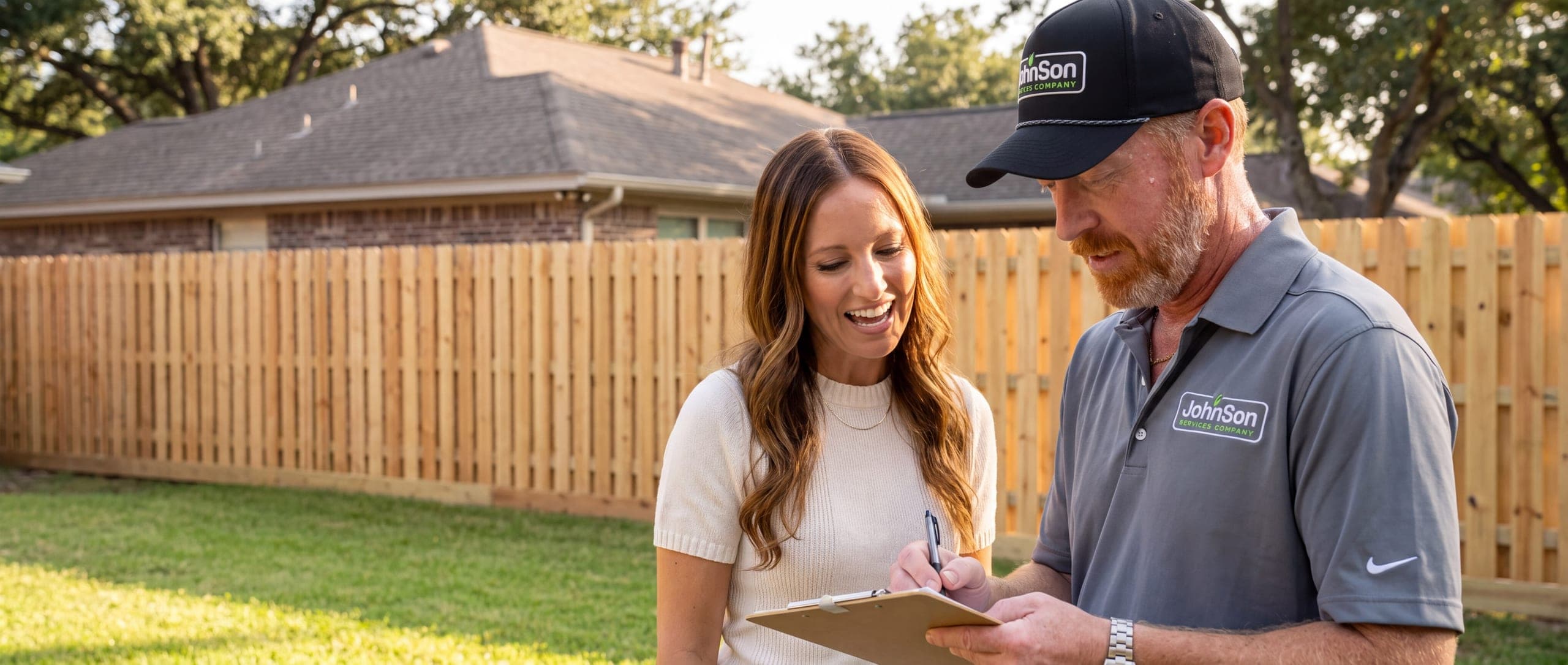
A Johnson estimator writing a fence quote on a clipboard beside a homeowner.

Price a fence before you call

See what a fence costs before anyone quotes you.

Pick the material, the height and how many feet of fence, and the calculator shows the market range for a fence like yours in Texas. Then a salesperson measures the real one in your yard and the number comes back the same day.

The estimate is free and there is nothing to sign.

Find the One Rule That Decides Your Lot

Four questions settle nearly every Texas fence: how tall, what material, which yard, and whether the lot floods. Match your situation to the rule that governs it, and the permit answer falls out.

Your situation The rule to check first What it usually means
6-foot wood privacy fence, Houston back yard Houston’s 8-foot exemption for non-masonry fences No building permit; still build for the wind load
Brick or stone wall anywhere in Houston Houston’s masonry and concrete rule Permit required at any height, even at 3 feet
Solid fence in a Dallas front yard Dallas’s 4-foot cap plus the 5-foot setback Cut to 4 feet, open it up, or set it back 5 feet
Any fence on an Austin lot in a floodplain Austin’s floodplain trigger Permit required at any height
New fence inside San Antonio city limits San Antonio’s permit requirement Expect to file; $26.50 online through BuildSA
Driveway gate in a deed-restricted neighborhood The 10-foot HOA setback from a laned right-of-way Pull the gate back from the street; operators install to UL 325

So Settle the Code Before Anyone Loads a Truck

Four metros, four different answers, and the difference between them is a foot of height or a pallet of brick. The homeowner who reads the right line first gets the fence they sketched. The one who reads it second gets a redesign with the posts already set, and that is the version that costs money.

This is why we measure every job on site before we quote it. A salesperson walks the line with you, confirms the fence type and picket grade by name, and we get a quote out the same day on 95% of real leads, with work starting in about 4 days. The code question gets answered at the estimate, where it is free.

Where Johnson Services Company Sits Among Texas Fence Builders

A fence bought in four different Texas cities is four different code problems, and the contractor list in each metro is almost entirely local. Here is one established fence builder per metro, compared on where each one can actually work and what each builds beyond fence panels.

Company Texas metros served Cities and towns covered Beyond fence installation
Johnson Services Company Houston, Dallas-Fort Worth, Austin, San Antonio 42 cities and towns statewide Gates and operators, decks, masonry, landscaping, irrigation
Texas Fence Houston only Houston and surrounding areas Driveway gates and access control
Austex Fence & Deck Austin only Austin and Central Texas Decks, pergolas, porches, and a materials showroom
Quality Fence & Welding San Antonio only San Antonio and South Texas In-house steel fabrication, masonry, decks
Kodiak Fence Company Dallas-Fort Worth only Flower Mound, Lewisville, Argyle, Denton, Carrollton, Coppell Fence staining and gate repair

Frequently Asked Questions

Do I need a permit to replace a fence that is already there?

City code asks about the fence, not about whether one stood there before. A like-for-like 6-foot wood replacement in Houston stays permit-exempt, while the same replacement inside San Antonio city limits usually still gets filed. If the replacement changes height or material, treat it as a new fence and re-check the rule.

How much does a fence permit cost in Texas?

There is no statewide fee, because there is no statewide permit. San Antonio publishes the clearest number, at $26.50 for a residential fence permit filed online through BuildSA. Elsewhere the cost is set by the city and usually scales with project valuation.

Does my fence contractor pull the permit, or do I?

We determine whether a project needs a permit and file it where one is required, which on commercial work is routine. A residential fence rarely needs one in our Houston-area markets. Ask any contractor to say in writing who is filing before you sign.

How close to the property line can my fence go?

Height and openness drive the setback more than the line itself. In single-family Dallas districts, a panel less than 50% open must sit at least 5 feet back from the front lot line, and Austin caps a solid fence on the property line at 6 feet from natural grade. Deed restrictions can pull it back further.

What if my city is not one of the four big metros?

The pattern holds even when the numbers change: height, material, which yard, and floodplain status are the four triggers nearly every Texas city uses. Call the city permitting office with the height and material you want and ask which one applies. In the smaller towns around Houston, Austin, and Dallas, the answer often comes back the same day.

Why does masonry trigger a permit when wood does not?

A masonry fence is a wall. It carries far more weight, catches the same wind across a solid face, and needs sized reinforcement and a real footing under it. Houston is explicit about this and requires the permit at any height for masonry or concrete construction.

Does an 8-foot fence need anything beyond a permit?

It needs engineering attention, whether or not the city asks for a drawing. Taller fences catch more wind over a longer lever arm, which drives deeper embedment, more concrete, and often heavier posts. That is also why an 8-foot fence costs more per foot than a 6-foot one built the same way.

How Johnson Services Company Reads 42 City Codes Before It Sets a Post

Every one of those city thresholds is a chance for a fence to get redesigned halfway through, and the way we keep that from happening is to settle the height, the material, and the yard at the free on-site estimate. We work across Houston, Dallas-Fort Worth, Austin, and San Antonio, 42 cities and towns in all, with more than 100 crews in the field and more than 2 million feet of fence installed in the last year. Members of our customer base rate us 4.9 stars across 60 Google reviews, and what they name most often is the salesperson who called back the same day and a crew that finished when it said it would.

In a June 2026 Google review, Randy R. wrote: “Their price was competitive and lower than the other 2 but what sealed the deal was Matt called back the same day I initially contacted them for an appraisal. It was a good decision and Matt was quick to reply with the cost estimate and each time I had a question. In addition the crew showed up promptly per schedule and Matt came by early to coordinate some changes I requested after accepting the original quote. The fence was installed in just 2 days and looks great! The job site was cleaned up well b4 the crew left. The original cost was revised making the total cost much less than I expected.”

The price part is not luck. Master Halco named us its Largest Volume Customer for both the Southwest Region and the World in 2026, so we buy wood pickets at a cost a three-crew shop never sees, and we pass that through: the same fence for less, at a picket grade we name out loud on the quote. Every job carries a one-year warranty on material and craftsmanship, and that warranty stayed a formality last year: across more than 20,000 jobs, we logged zero craftsmanship warranty callbacks; a 100% record, not a target we’re chasing. In a May 2026 Google review, Jess C. put the result in five words: “Awesome high quality workmanship and timely”.


Johnson Services Company turns “which line did this fence cross” into a question answered at the estimate instead of on install day. Tell us the city, the height, and the material, and we will walk the line with you at no charge.

Get a free on-site fence estimate →

Free estimate

Get your estimate from the largest fence company in Texas

Tell us what you need and where the fence goes, and a salesperson will come out and measure the line before anyone writes a number. You get the picket grade and the total in writing, the visit costs nothing, and there is nothing to sign.

Call (877) 956-4676

Monday to Friday, 7am to 4pm.

What kind of fence?
Which part of Texas?
Roughly how much fence?
How did you hear about us?
  • Free on-site estimate
  • Same-day quote
  • Nothing to sign
  • Work starts in about 4 days