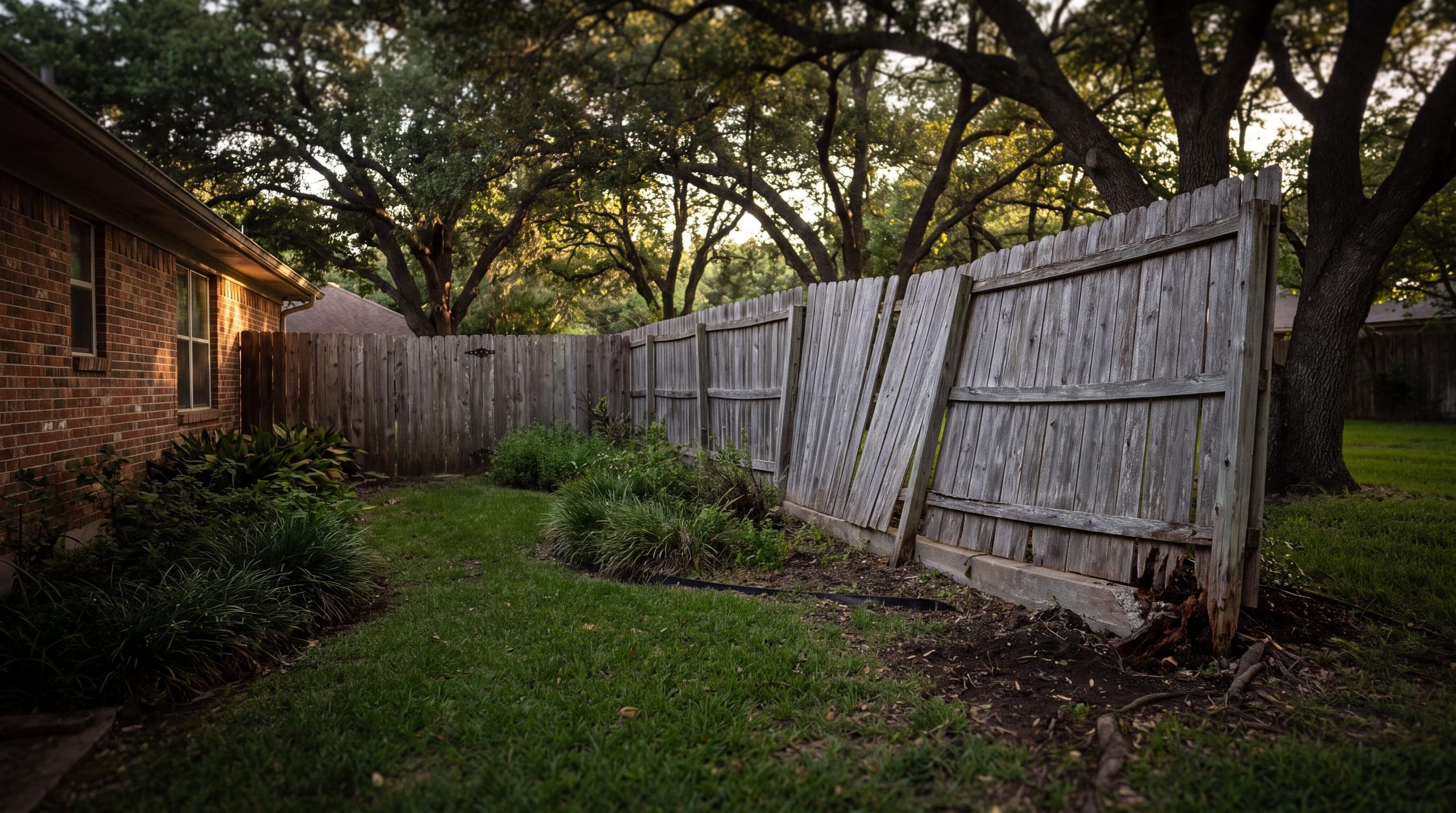
A gray, cupped, splintery fence in Memorial or River Oaks reads like a cosmetic problem. Most owners treat it that way for another two or three years.
The boards are the last part of a fence to fail here. On these lots the fence is aging against two clocks at once, a Houston climate that rots wood faster than almost any other Texas metro, and a yard that has been landscaped, irrigated, and grown over for 50 years. What the pickets look like is the least useful thing you can look at.
Houston Rots Fence Wood Faster Than Dallas or San Antonio
The USDA Forest Products Laboratory scores Houston at 77.2 on its recalculated Scheffer decay hazard index, against 44.3 for Dallas and 52.2 for San Antonio (FPL-GTR-179, 2009). Anything above 65 sits in the high band. Same lumber, same crew, same build: a fence here simply gets fewer years than the identical fence 240 miles north.
Warm air, wet soil, and long humid stretches are what drive that number. Add the deep shade of a 60-year-old live oak canopy and the base of a post stays damp for weeks after a rain. That is why the failure almost always starts at the ground line and works up, out of sight, while the part you can see just goes gray.
| Metro | Scheffer decay hazard index | Hazard band |
|---|---|---|
| Houston | 77.2 | High (above 65) |
| Port Arthur | 80.7 | High (above 65) |
| Austin | 55.2 | Moderate (35 to 65) |
| San Antonio | 52.2 | Moderate (35 to 65) |
| Dallas | 44.3 | Moderate (35 to 65) |
How Long Should a Wood Fence Last in Memorial or River Oaks?
About 20 years is the reference figure for a wood fence, per the certified home inspectors’ own life expectancy chart (InterNACHI). In these two neighborhoods that number matters more than it does almost anywhere in the city, because the housing stock is old enough that a lot of fence lines are already sitting inside the 20-to-25-year replacement window.
River Oaks holds some of the oldest stock in Houston, built from the 1920s through the 1960s. The Memorial villages, Piney Point, Hunters Creek, Bunker Hill and Hedwig, went up mostly between the 1950s and 1970s on large lots with trees that were saplings then and are enormous now. Tanglewood is in the same range. A fence on one of these lots has usually been through several owners, at least one major landscape redo, and 20 Gulf Coast storm seasons.
Push a Screwdriver Into the Base of Every Post
Serious decay only happens when wood stays above the fiber saturation point, an average moisture content of about 30%, while air-dried wood holding at or under 20% carries what the Forest Products Laboratory calls a reasonable margin of safety against fungal damage (FPL-GTR-282, 2021). The base of a fence post is the one part of the fence that never gets to dry out. So that is where you test.
Walk the line with a screwdriver and do three things at every post.
- The ground-line probe. Push the tip into the post 1 to 2 inches above the soil, hard, the way you would test a soft peach. Sound wood resists. If the blade sinks a quarter inch or more, that post is done, whatever the pickets look like.
- The shoulder push. Put a shoulder into the post between rails and lean. A post with a rotted collar underground will pivot with almost no effort, even when the concrete is still in the hole.
- The rail check. Look where the bottom rail meets each post. Rails soften from the top down as water sits on them, and a spongy bottom rail on multiple bays means the frame is going, not the fence face.
Mark every post that fails. That count is the whole basis for the decision you are about to make.
A Lean That Shows Up in Wind Starts at Corners and Gates
Wind pressure on a freestanding wall runs highest near its free ends and its leading edge, which the multi-year Silsoe full-scale wall experiments established in the field (Robertson and Hoxey, 1996). A solid privacy fence behaves like that wall. So the corner posts, the end posts, and the two tall posts flanking a driveway or garden gate carry loads the middle of the run never sees.
That gives you a quick read on your own fence. If the lean is at the corners and the gate, and the rest of the line is plumb, you are looking at load, and often at footings that were never sized for it. If posts all down the run tilt a little more each season, the soil is moving under them. Either way the pickets are innocent. Replacing boards on a frame that is already moving buys you a nicer-looking fence that falls on the same schedule.
Count the Failed Posts Before You Price Anything
Post count decides repair or replacement, and panel damage almost never does. That is the correction Houston forces on the usual advice about counting broken boards, because here the boards are the symptom and the ground line is the disease. Here is how our crews read a typical 150-foot residential line.
| What you found | What it means | What to price |
|---|---|---|
| 1 to 2 soft posts, rest solid | Local failure, often near a downspout or sprinkler head | Spot repair: replace those posts and the bays they carry |
| A third or more posts soft at grade | The whole frame reached end of life together | Full replacement, including posts and rails |
| Posts sound, pickets gray and cupped | Face wear ahead of frame wear | Re-picket on the existing frame |
| Corners and gate posts leaning after storms | Wind load on undersized footings | Replacement with deeper, wider footings at ends and gates |
| Every post tilts a little more each year | Soil movement under the footings | Full replacement with the footing spec reworked |
The reason to count first is money. Chasing three separate spot repairs over four years costs more than one replacement, and you still end up replacing it.
Removal Under a Live Oak Is the Hard Part of the Job
A replacement on an established Memorial or River Oaks lot is harder work than fencing a brand new builder lot, and the difficulty is almost all in the removal. A builder lot is flat, clear, and empty. Your lot has a 24-inch live oak trunk 3 feet off the property line, roots grown around and through 20-year-old concrete footings, and an irrigation system buried exactly where the new posts have to go.
That changes the crew, the hours, and the plan. Old footings come out by hand where they sit inside a root zone, because pulling them with equipment tears roots that keep the tree alive. Where the line meets a trunk, the fence gets boxed around the root zone or the panel gets shortened and framed to the trunk without ever bolting into it. Sprinkler heads and mainlines get located before the first hole opens, not discovered by a post-hole digger.
None of that shows up in a price per foot pulled off a website. It shows up when somebody stands in your yard, walks the line with you, and writes down what is actually in the way.