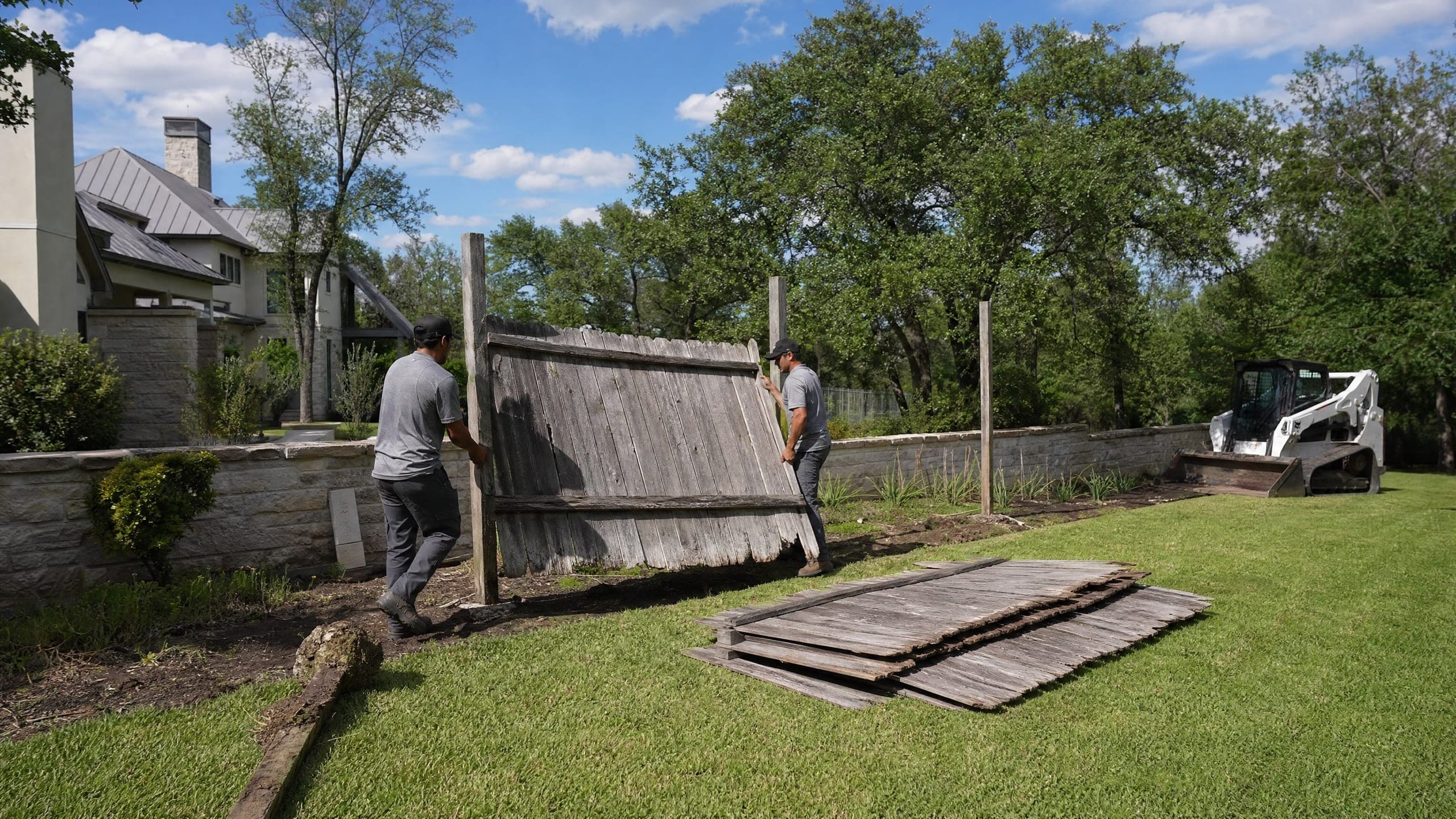
A 30-year-old wood fence has already outlived what treated pine and cedar are built to give you. That does not mean it has to come down this month, and it does not mean patching it is the cheap move either. The wood itself will tell you which one you are looking at, and asking it takes a screwdriver and about ten minutes.
Thirty Years Is Already Past What Pine and Cedar Give You
Thirty years in Texas ground is a long run for wood. The home inspectors’ own life-expectancy chart rates a wood fence at about 20 years, against 100-plus for vinyl (InterNACHI). the fence companies publishing repair guides publishes the ranges most builders use: treated pine at 10 to 15 years with maintenance, cedar at 15 to 20-plus. A fence still standing at 30 got there on good posts, good drainage, or luck.
That matters for one reason. Age alone does not tell you whether the fence is sound, because the same 30 years produce a solid line on one lot and a row of hollow posts on the next. What it does tell you is that the odds have turned, and it is time to check instead of assume.
Here is what the published service life looks like across the materials most Texas homeowners weigh.
| Material | Expected service life | Source |
|---|---|---|
| Cedar (wood) | About 20 years | InterNACHI |
| Pressure-treated pine | Decades in ground contact when treated to standard | AWPA Standard U1 |
| Vinyl (PVC) | 100-plus years | InterNACHI |
| Ornamental steel | Lifetime residential, 20 years commercial (warranty term) | Ameristar Montage |
| Composite | 25-plus years (warranty term) | ASTM D7032 / Trex |
| Chain link | Set by coating class; Class 2 outlasts Class 1 | ASTM A392 |
Push a Screwdriver Into the Base of Every Post
Take a screwdriver and push it hard into the wood within a few inches of the ground, on every post and a sample of the pickets. The read is the same one every builder uses: if the wood is soft, spongy, or crumbles easily, it is rotten. Sound wood stops the tip cold. Rotten wood takes it like a stick of butter.
Test at the ground line, because that is where fences die. The post above grade can look perfectly fine while the buried three inches has already turned to pulp. Walk the whole line, not one corner.
While you have the screwdriver out, read these five signs together.
- Rot at the ground line. The screwdriver sinks in at the base of the post. This is the one that decides the job.
- Leaning posts or sections. A line that is out of plumb is either rotten below grade or loose in the soil, and you will learn which from the screwdriver.
- Warping and cupping. Boards that bow, twist, or pull off the rails have been through too many wet-dry cycles.
- Failing hardware. Rusted nails backing out, torn hinges, gates that no longer close square.
- Loose or missing posts. A post you can rock by hand has lost its footing, its wood, or both.
Count the Failed Posts Before You Price Anything
Count, then decide. Most contractors put the line in the same place: when more than 20% to 30% of the posts are rotten or badly leaning, replacing the whole fence almost always costs less than repairing it. Below that line, and with the rest of the wood sound, a repair is honest work. Above it, you are paying a crew to visit the same fence again next year.
The count is what protects you from both mistakes: tearing down a fence with 25 good years of posts left, and sinking $800 into a line that fails again after the next windstorm.
| What you find | What it points to | Why |
|---|---|---|
| 1 to 3 soft posts, rest solid | Repair | Isolated failure, usually drainage in one spot |
| One broken or missing panel | Repair | The line is doing its job everywhere else |
| Gates sag, hardware rusted, wood sound | Repair | Hinges and latches are consumables |
| 20% to 30% or more of posts soft or leaning | Replace | The failure is the fence, not a section of it |
| Widespread warp and cupping on 30-year wood | Replace | Boards are at end of life even where posts hold |
Houston Rots Wood Faster Than Almost Any Other Texas Metro
A Texas fence is not aging on the national clock. The Forest Products Laboratory’s decay hazard index puts Houston at 77.2 and Port Arthur at 80.7, deep inside the high-risk band that starts at 65, while Dallas sits at 44.3 and San Antonio at 52.2 (USDA Forest Products Laboratory, 2009). Warm, wet, and long: that is the recipe for the fungi that eat fence posts.
So the same cedar fence that lasts 25 years in a mild climate is fighting a much harder fight in Conroe or Kingwood. And the index has been drifting upward, not down, so a figure taken from an older map understates today’s risk rather than overstating it.
This is also why the calendar lies both ways. A shaded, poorly drained fence line in Houston can be finished at 18 years. A well-drained line in Plano can still be tight at 30.
Clay Soil Moves Posts That Are Not Even Rotten
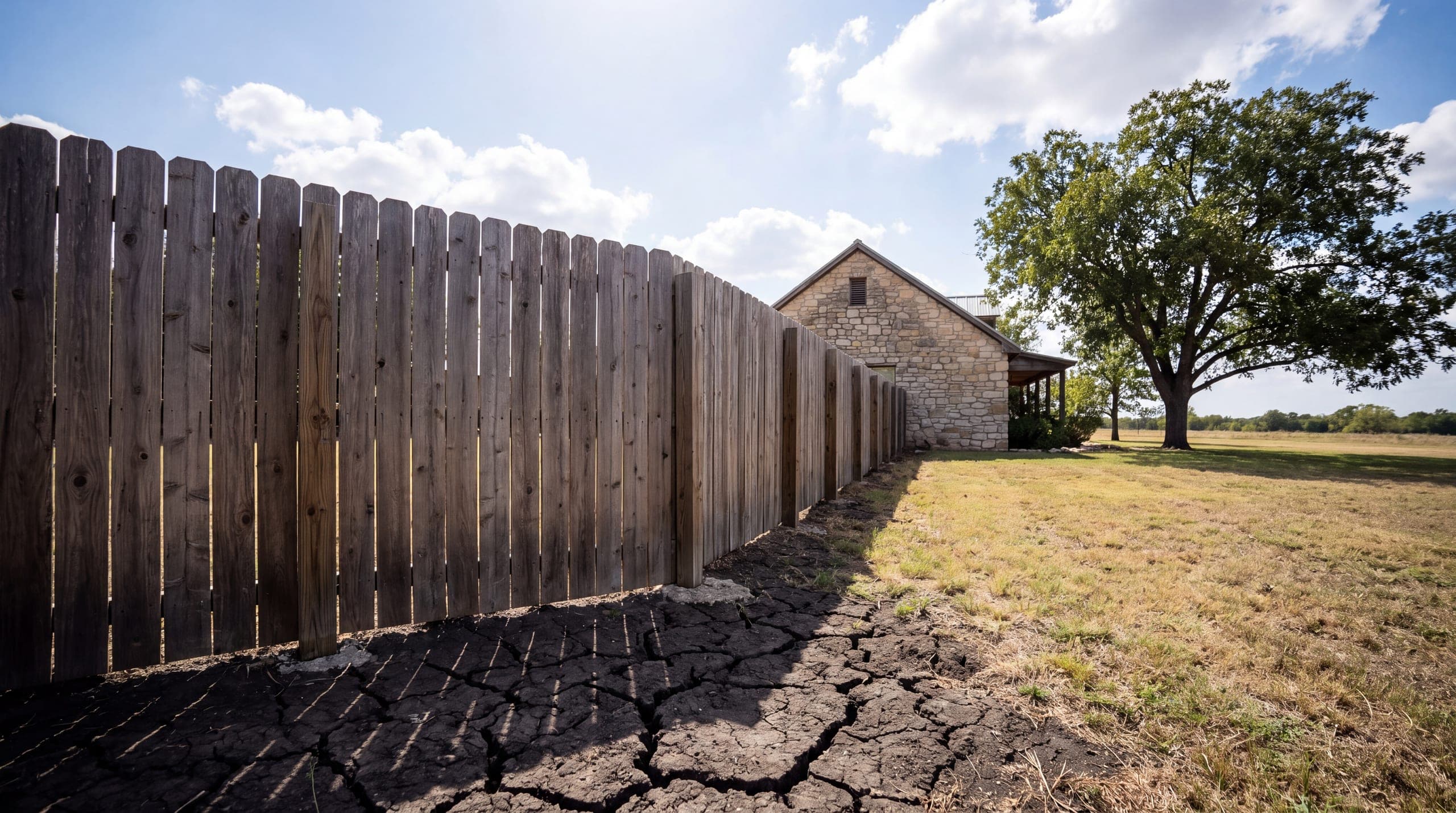
The second stress has nothing to do with fungus. Houston Black, the official Texas state soil, runs from Dallas south to San Antonio across about 1.5 million acres and is 60% to 80% clay, a soil the USDA flags for very high shrink-swell (USDA Natural Resources Conservation Service, 2023). It swells when it rains and pulls away when it dries. Every cycle works the post a little looser in its hole.
Wind then finishes the argument. Design wind speeds for the Houston metro run on the order of 130 to 140 mph for ordinary structures, rising toward 150 at the shoreline (ASCE/SEI 7-22, 2022). A solid privacy fence catches nearly all of it, and the load lands hardest at corners, ends, and the tall posts flanking a gate.
Put the two together and a 30-year-old fence here has been rotting from the ground up and rocking from the soil out, at the same time, for decades. That is the compounding a mild-climate fence never sees.
But Three Bad Posts on a Sound Line Is a Repair
Not every old fence needs to come down, and we will tell you so on site. If the screwdriver holds firm on almost every post, the rails are tight, and the trouble is two rotted posts near a downspout or a gate that has dropped out of square, that is a repair and it should be priced as one. Fixing the drainage that caused the local rot matters more than the new post does.
The same is true when only the hardware has quit. Hinges, latches, and nails are consumables on a wood fence, and swapping them on a sound line is cheap.
What does not work is new pickets on old posts. Fresh boards screwed to wood that fails the screwdriver test hide the problem for one season, and you pay for the pickets twice.