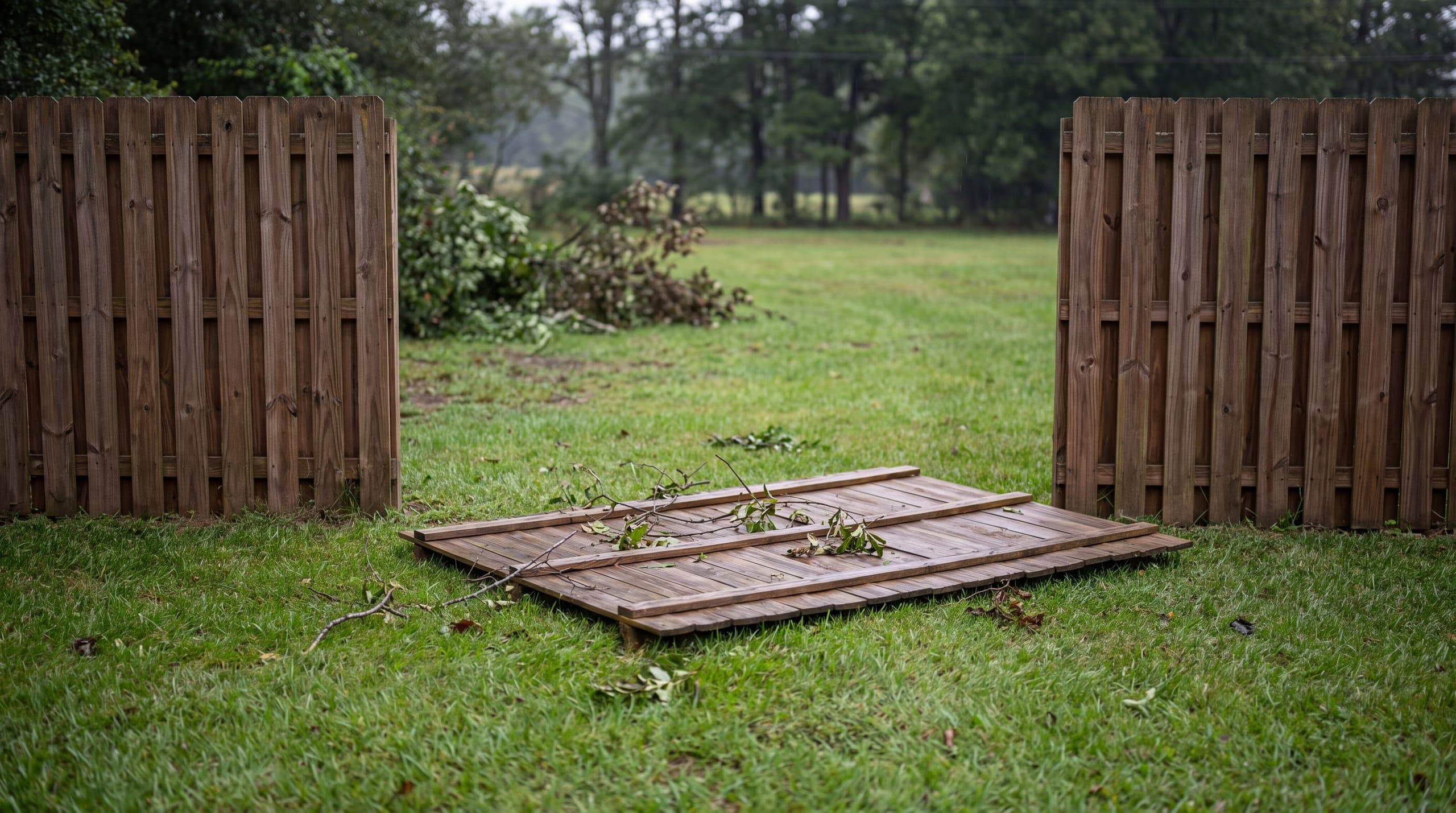
Wind above 40 mph sustained, or gusts over 60 mph, is enough to lift panels, snap fasteners, and pull a badly anchored post clean out of the ground. After the storm passes, the decision that actually matters is not what the fence looks like from the patio. It is whether this is a spot repair or a rebuild, and that call comes down to three checkable things: how much of the line is down, what the posts feel like when you push them, and whether those posts were ever set deep enough for the wind your address actually gets.
40 MPH of Sustained Wind Is Enough to Start Pulling Posts
Overwatch Roofing and Construction puts the damage threshold at sustained winds above 40 mph or gusts over 60 mph, which is enough force to lift panels, snap fasteners, and uproot posts that were never properly anchored. That is an ordinary Texas spring afternoon in Dallas and an ordinary Gulf squall line in Houston. The fence does not need a hurricane to come down.
The reason a 6-foot privacy fence is so easy for wind to grab is that it does not let the wind through. Wind-tunnel testing of freestanding walls measured a normal-force coefficient of about 1.45 that barely changes with the wall’s length, meaning a solid fence catches close to the full free-stream wind across its whole face (Letchford, 2001).
So every square foot of picket is a sail. A 100-foot run of 6-foot privacy fence presents 600 square feet of solid face to the wind, and all of that load has to go somewhere. It goes into the posts, and then into the dirt around them.
Walk the Whole Line Before You Call Anyone
Start at the ends, corners, and gate posts, because that is where the wind loads hardest. The Silsoe full-scale wall experiments found wind pressure is highest near a free end and the leading edge of a wall, and drops sharply where a return corner exists (Robertson, 1996). That is the field reason a fence usually fails at a corner or beside a gate before it fails in the middle of a straight run.
Do this in one walk, with your phone out.
- Photograph everything before you move a board. Insurance and any honest contractor both want the before, and you only get one chance at it.
- Push the top of every post, hard. A post that rocks has already lost its footing, even if the panel above it looks perfect.
- Probe the wood at the ground line with a screwdriver. If the tip sinks in without much pressure, that post is rotted where it matters most.
- Count the panels that are actually broken. Leaning is not broken. Write down the number and the total.
- Look at the gate posts separately. They carry a swinging load every day plus the wind, and they wear out first.
One safety rule overrides all of it. If a downed fence is touching a power line or holding back a pool gate, leave it and call the utility or a contractor before anything else.
Under a Third of the Line Down Is a Spot Repair
Overwatch Roofing and Construction uses a simple threshold that matches what we see in the field: if fewer than one-third of the panels need replacing, spot repairs are enough. Above that, you are paying twice, once to patch and again in a few years to rebuild the rest. Post condition can override the panel count in either direction, which is why you push every post before you decide.
| What you found | What it usually means | The call |
|---|---|---|
| Fewer than a third of panels down, posts firm | Wind beat the fasteners and the boards, the footings held | Spot repair the panels and rails |
| One or two posts loose, rest of the line solid | Isolated footing failure, often a corner or gate post | Repair, reset or sister those posts |
| Most posts rock when pushed | The whole line’s embedment is undersized for the site | Rebuild the run |
| Screwdriver sinks at the ground line | Rot has reached the load-bearing part of the post | Rebuild, patching buys a year or two |
| More than a third of panels down | Fasteners and lumber are at the end of their service life | Rebuild the run |
A repair that ignores a failed footing is cosmetic. The panel goes back up, the post keeps moving, and the next 50 mph day takes the same section down again.
Rot at the Ground Line Overrules the Panel Count
Houston scores 77.2 on the Scheffer decay hazard index against 44.3 for Dallas, on values recalculated from 1971 to 2000 climate normals (Carll, 2009). Anything above 65 is the high-hazard band, so a Houston fence post is sitting in one of the most rot-friendly climates in the country while a Dallas post is in a moderate one. Austin runs 55.2 and San Antonio 52.2.
That gap explains a lot of storm calls. Two identical fences, same builder, same wood, one in Kingwood and one in Plano, do not age at the same rate. The Houston post loses strength at the ground line years earlier, and then a windy Tuesday finishes a post that was already 60% gone.
The test is free and takes ten seconds per post. Push, then probe. A post that is sound below grade can usually be reused; a post that is punky at the ground line is going to fail whether you replace the panel above it or not.
But Most Fences Fall Because the Post Was Never Deep Enough
Post embedment is engineered, and the 2021 International Residential Code sets the math: for a nonconstrained embedded post, required depth grows with the wind force and the height of that force above grade, and shrinks only with stronger soil (IRC, 2021). A tall solid fence in soft Texas clay drives a deep, wide concrete footing. Nobody can get there by guessing.
Overwatch Roofing and Construction recommends extending post depth to 36 inches or more to anchor against both wind and soil erosion. That is the right direction, and the reason it works is that a deeper post gives the soil more use to fight back against the wind pushing on the panel above.
The wind numbers behind it are not small. ASCE 7-22 maps the Houston metro at basic design wind speeds on the order of 130 to 140 mph for ordinary structures, rising toward roughly 150 mph at the Gulf shoreline (ASCE/SEI 7-22, 2022). A post set 18 inches deep in wet clay was never in that conversation.
| Term on your quote | What it actually means |
|---|---|
| Embedment depth | How far the post goes below grade, in inches, before any concrete |
| Footing diameter | The width of the concrete around the post, which sets how much soil it pushes against |
| Ground line | The few inches of post right at the dirt, where wood rots and posts snap |
Texas Clay Loosens What the Wind Finishes Off
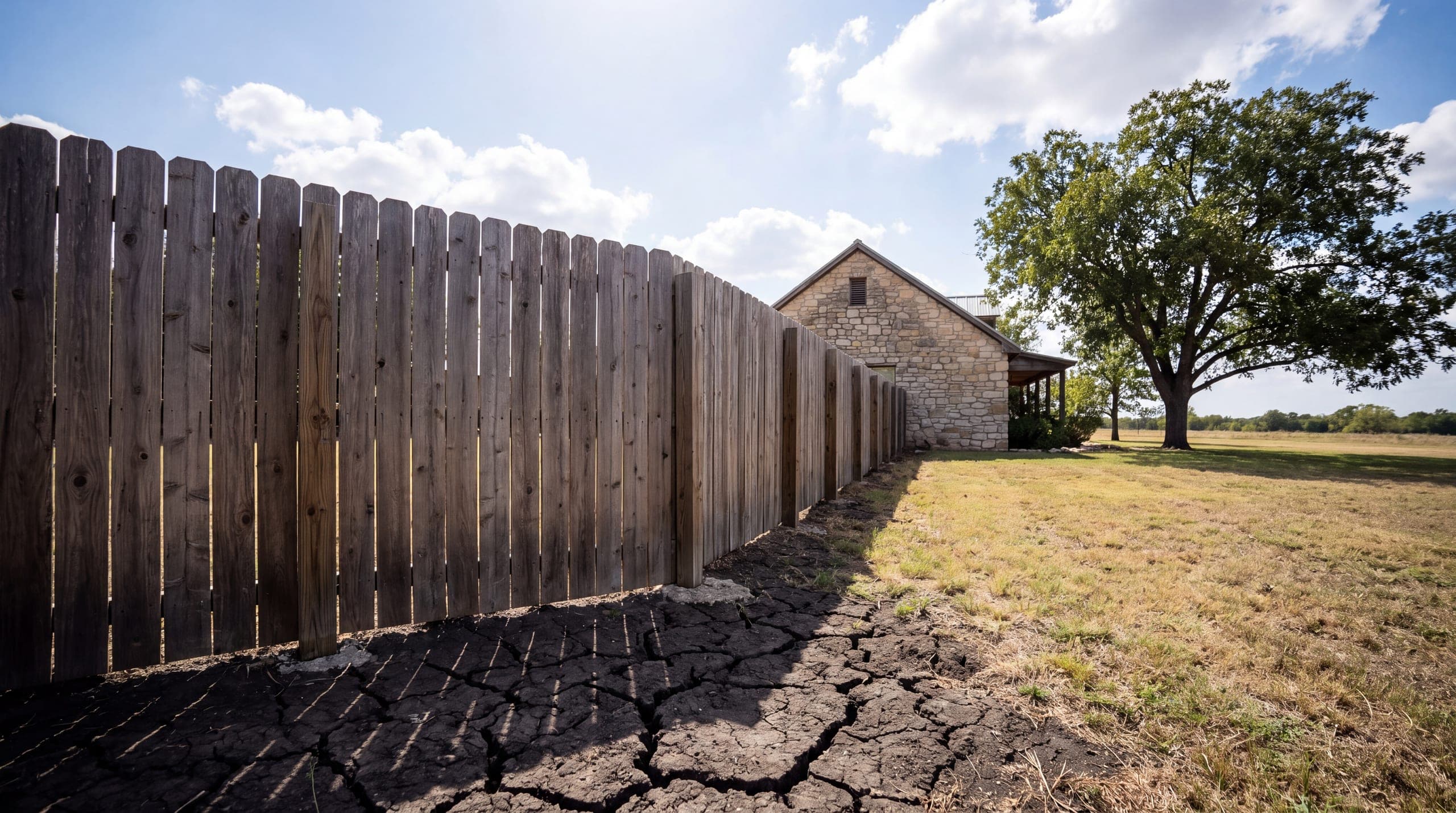
Houston Black clay, the official Texas state soil, runs about 60% to 80% clay and carries very high shrink-swell potential across roughly 1.5 million acres of Blackland Prairie from Dallas south to San Antonio (USDA NRCS, 2023). It swells when it rains and pulls away when it dries. A post set in it gets worked loose a little every season.
That is the quiet half of every storm failure. The wind gets the credit, but the soil spent three summers opening a gap around the footing first. It is also why a fence can stand through one windstorm and drop in the next one at a lower wind speed.
You can see it before the storm if you look. A post you can rock in dry weather, a visible gap between the concrete and the dirt, a line that tilts a little more each August. Those are the posts to fix on a calm week instead of an emergency one.