Most fence warranties get sold as a number. One year, five years, lifetime. The number matters less than the noun sitting next to it, because a warranty on workmanship and a warranty on material cover two different failures, and Texas finds both.
A Fence Warranty Covers the Install or the Material, Almost Never Both
A fence warranty covers one of two things. Workmanship means the install: how deep the posts went, what they were set in, whether the rails and pickets were fastened the way the spec said. Material means the wood, the vinyl, or the steel itself, and that promise almost always comes from the company that made the product, in a separate document you have never seen. A contractor who says “one year, everything” has usually not read either one.
That split is the reason to ask what the paper names. If a post leans in month four, that is an install question. If a picket cups and greys in year three, that is a lumber question, and no crew on earth controls it.
| Term | What it actually covers | Who stands behind it |
|---|---|---|
| Workmanship warranty | Post depth, footings, spacing, plumb, line, and how everything was fastened | The contractor who installed the fence |
| Manufacturer material warranty | Defects in the product itself, such as corrosion, cracking, or delamination | The mill or manufacturer, through a claim you file with them |
| Service life | How long the material is expected to last in normal use | Nobody. It is an expectation, not a promise |
What a One Year Workmanship Warranty Should Name in Writing
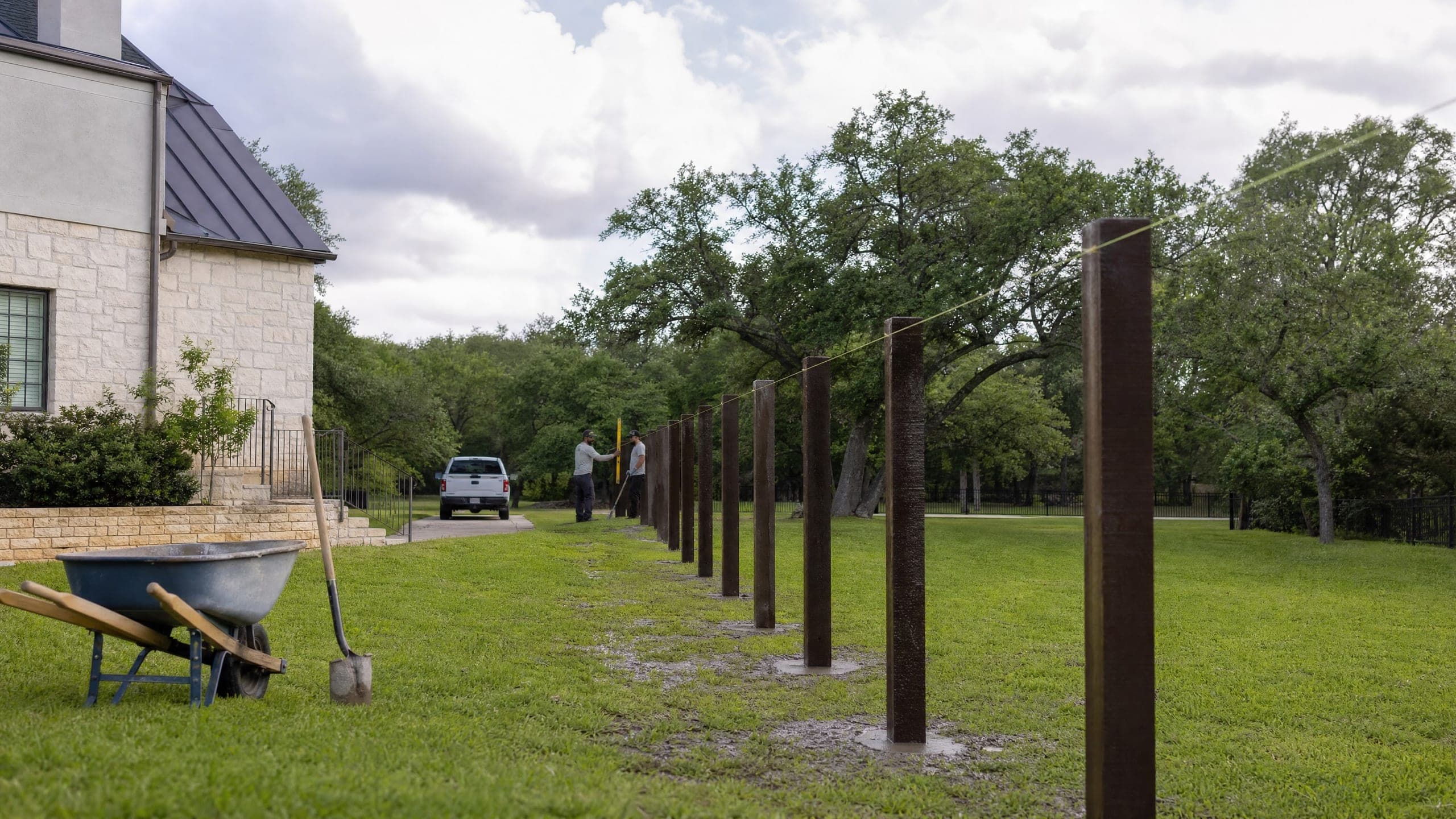
Start with the post depth, because that is where install failures begin. Fence posts are sized as cantilevered poles, and the required embedment grows with the wind force and its lever arm while it shrinks with stronger soil (International Building Code, 2021). A warranty that never states the depth is warrantying an unknown.
Here is what belongs on the page, in plain language, before anybody signs.
- Post embedment and footing. The depth in inches, the hole diameter, and what fills it. Concrete or tamped soil is a real difference, and so is a taller fence or a heavy gate.
- Post spacing and post type. Six feet or eight feet on center, wood or galvanized steel. Spacing is the single easiest thing to cut on a low bid.
- Plumb, line, and grade. Posts vertical, top line straight, boards following the grade rather than floating above it.
- Gate swing and hardware. Gates carry the most moving weight on the job and sag first. The warranty should say the gate will swing and latch, and name who resets it if it does not.
- Haul-off and cleanup. Old fence removed, holes filled, nails picked up. Write it down and it stops being a debate.
- Who answers and how fast. A phone number, a person, and a response window. A warranty with no callback path is a paragraph, not a promise.
Your Pickets Are Warrantied by the Mill, Your Posts by the Crew
Material coverage comes from the manufacturer, and it varies enormously by what you buy. InterNACHI’s life-expectancy chart for homes rates a wood fence at about 20 years and a vinyl fence past 100, the widest gap between the two most common Texas fence materials in any single reference. Wood is the one Texans buy most, and it is the one that ships with no consumer warranty at all.
That is why the grade in the quote matters more than any warranty language around it. Ask for the picket grade by name, #1 through #3, and ask what the posts are treated for. A quote that says “cedar” has told you a species and nothing else.
| Material | Expected service life | Who stands behind it | Source |
|---|---|---|---|
| Pressure-treated pine posts | Specified for decades in ground contact | Preservative retention set by standard, not by the crew | AWPA Standard U1 |
| Cedar pickets | About 20 years for a wood fence | The grade you paid for is the promise; get it named | InterNACHI |
| Ornamental steel (Montage) | Lifetime residential, 20 years commercial | Ameristar, against corrosion, cracking, peeling, chipping | Ameristar Montage warranty |
| Composite (Trex fencing) | 25 years residential | Trex, on a product performance-rated under ASTM D7032 | ASTM D7032 / Trex |
Read those two columns together and the point lands. The mill covers the product for decades. The installer covers the install for a year. Neither one covers the other, and a company that blurs the line is either confused or hoping you are.
Texas Weather Tests the Install and the Material in Different Ways
Texas is not one climate, and a fence fails differently depending on which metro it stands in. Scheffer decay-hazard values run 77.2 in Houston against 44.3 in Dallas (Carll, 2009), so wet Gulf air rots wood at the ground line while the Blackland belt does its damage by moving the posts instead.
The soil through Dallas and San Antonio is the other half of it. Houston Black, the official state soil, covers roughly 1.5 million acres of Blackland Prairie and runs about 60% to 80% clay, a smectite Vertisol whose very high shrink-swell potential is a recognized limitation for building sites (NRCS, 2023). Clay that swells and shrinks with the season will lever a shallow post out of plumb within a year, which is exactly the window a workmanship warranty covers.
Then there is wind. The national design-load standard maps the Houston metro at basic design wind speeds on the order of 130 to 140 mph for ordinary structures, rising toward roughly 150 mph at the immediate shoreline (ASCE/SEI 7-22, 2022). A solid privacy fence catches nearly all of that.
| Metro | What the weather attacks first | Which warranty it tests |
|---|---|---|
| Houston and the Gulf Coast | Rot at the ground line, plus full wind load on solid panels | Material for the rot, workmanship for the footings |
| Dallas-Fort Worth | Expansive clay lifting and tilting posts through the seasons | Workmanship, mostly embedment depth and footing size |
| San Antonio | Clay movement plus heat and UV on the picket faces | Workmanship for the posts, material for the boards |
| Austin | Moderate decay hazard with shallow rocky soil in places | Workmanship, since post setting is the harder job here |
But Warranty Length Tells You Nothing Without a Callback Record
A one-year workmanship warranty is only as good as the record of the company holding it. Ask a fence contractor a direct question: how many warranty callbacks did you have last year, and out of how many jobs? A company that cannot answer has not been counting, and a company that counts has a reason to.
Our own answer is on the record. We completed more than 20,000 projects in the last twelve months, more than 2 million feet of fence, and we had zero craftsmanship warranty callbacks against them. That is a record rather than a prediction, and it is the number we would want if we were the one signing.
The proof customers give is the longer version of the same thing. In a review, Vivian B. described having us install a perimeter fence, then a front gate, then a side gate, then a back gate, and closed with this: “This is over a 3 year period- still satisfied.” Repeat work over three years is a callback record told from the other side of the transaction.
Storms are the fastest test in Texas. In a review, Celeste T. wrote: “Fence didn’t budge an inch when severe storms came through the next day!”