Guides

What a 200-Foot Fence Costs in Texas by Material

Ask what a fence costs and you get one blended number for the whole country.

August 14, 2026

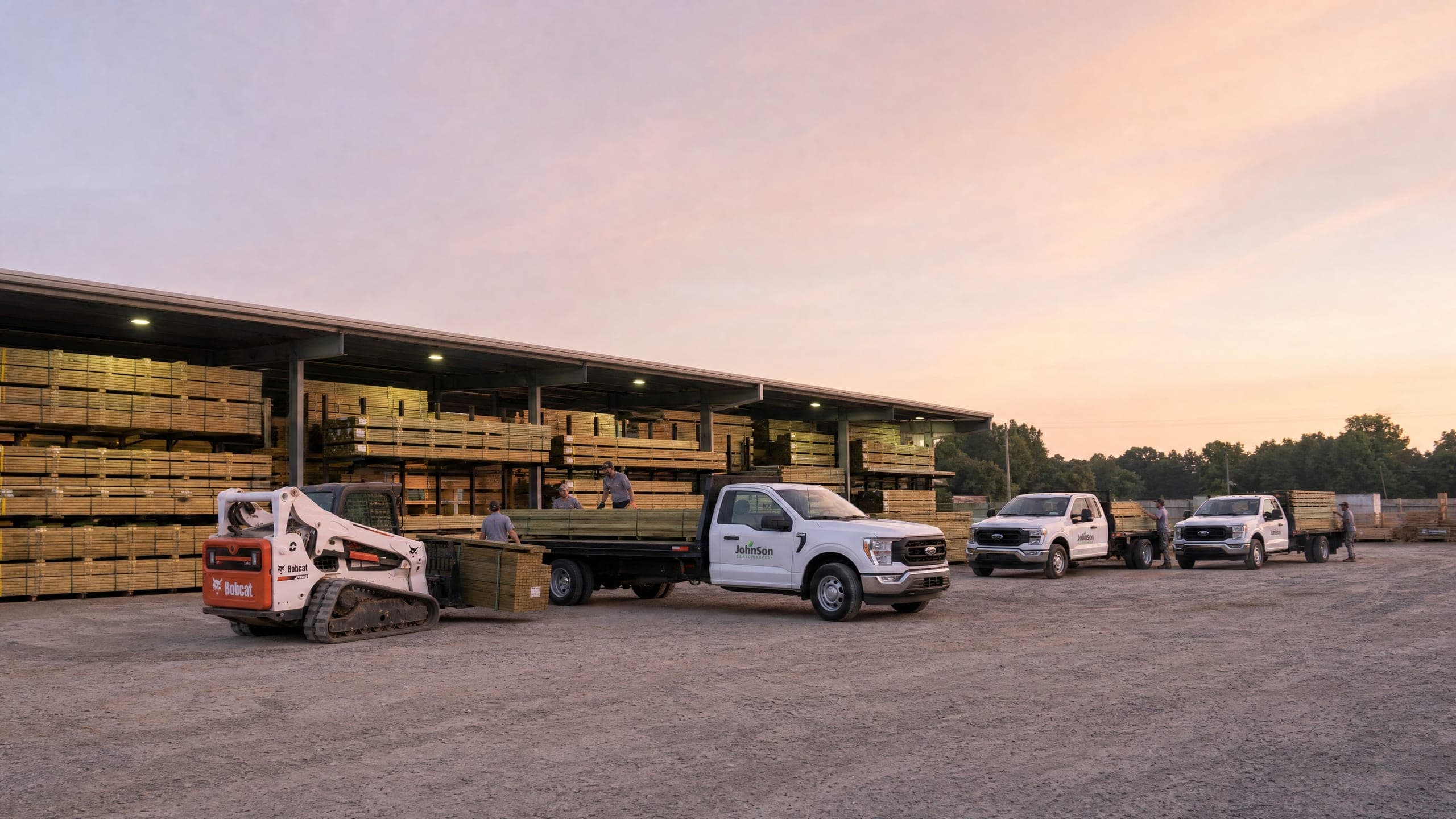
The Johnson yard at dawn, a forklift carrying banded pickets to the trucks

Ask what a fence costs and you get one blended number for the whole country. That number is useless when you are standing at the corner of your lot with 200 feet of failing cedar in front of you.

Your 200 feet has a material, a picket grade, a metro, and a set of site conditions. Price those four things and the honest answer moves by thousands of dollars off the quick version.

Multiply by 200 and the spread shows up immediately. A pressure-treated pine privacy fence lands around $3,600 to $6,000 for the run. The same 200 feet in ornamental steel can reach $18,000. Both come off published Texas installed-cost ranges for a standard 6-foot fence on flat, clear ground, materials and labor together (HomeGuide, 2026).

Material (6 ft residential) Texas installed cost per linear foot 200 feet installed
Pressure-treated pine privacy $18 to $30 $3,600 to $6,000
Cedar privacy $25 to $45 $5,000 to $9,000
Chain link $12 to $28 $2,400 to $5,600
Ornamental steel or wrought iron $45 to $90 $9,000 to $18,000
Vinyl (PVC) $30 to $60 $6,000 to $12,000
Composite (wood-plastic) $30 to $55 $6,000 to $11,000

Read what those ranges leave out. They cover a fence built on flat, clear ground with nothing in the way. Old-fence removal, gates and automation, permits, rocky or heavy clay soil, and slope all sit outside them. Every one of those shows up later in this piece, because every one of them shows up on real Texas quotes.

What Linear Foot and Picket Grade Actually Mean on a Quote

Four words do most of the work on a fence estimate, and a homeowner who knows them can read a quote in about a minute. The one that costs people money is picket grade, because two boards with the same species name can be two different products. The American Wood Protection Association’s Use Category standard puts fence posts in UC4A, general ground contact, which is a treatment level a quote should name (AWPA Standard U1).

Term What it means on your quote
Linear foot The distance your fence covers along the ground. 200 feet of fence line is 200 linear feet at any height.
Picket grade The board’s quality tier, #1 through #3. #1 has the fewest knots and the straightest grain.
Ground contact The preservative treatment level for wood buried in soil, specified for posts, not pickets.
Haul-off Removal and disposal of your old fence, usually priced as its own line.

Ask for the grade number, not the species alone. Cedar is a species. #1 cedar is a spec.

A Texas Fence Costs Less Than the National Number Suggests

Texas wood pricing sits under the national average, so a national calculator overstates your 200 feet. National wood-fence installs run $20 to $50 per linear foot (HomeGuide, 2026). Heavy local competition and nearby pine and cedar supply are why the Texas figure lands lower.

Houston is the clearest example. Wood privacy fences in the Houston area are commonly quoted at $16 to $42 per linear foot, with 6-foot privacy around $19 to $26 per foot at the low-labor end (Angi Houston, 2026). On 200 feet, the difference between the national midpoint and the Houston low end is over $2,000 for the same fence.

That is why the metro matters as much as the material. A quote written against Dallas labor and a quote written against Houston labor are not the same quote, and neither one is the national average.

Two Quotes for Cedar Can Mean Two Different Boards

Grade is where two honest-looking numbers separate. A contractor quoting #3 cedar and a contractor quoting #1 cedar can both write the word cedar on the page and land hundreds of dollars apart on 200 feet. The cheaper board has more knots, more wane, and more cup, and it shows up in the fence line inside two summers.

We quote the grade by name, #1 through #3, so the comparison is real. A buyer who asks all three bidders for the grade number turns three prices into one apples-to-apples decision. A buyer who does not is often paying the same money for a lesser board.

Ask for it in writing. A contractor who will not put a grade number on the page has told you something.

What Removal, Gates, and Clay Add to Your 200 Feet

Five things move a Texas fence quote off the baseline, and they explain most of the gap between the number people expect and the number they get. Higher-than-expected product or service costs are the leading cause of blown renovation budgets, named by 52% of homeowners who exceeded theirs (Houzz, 2026).

  • Old fence removal and haul-off. Tearing out 200 feet of failed fence and disposing of it is labor and a dump run. Ask whether it is in the number and which day it happens.
  • Gates and automation. A gate is hardware, heavier posts, and deeper footings. An automatic operator adds the motor, the access control, and a UL325-compliant install with entrapment protection.
  • Extra corner, end, and gate posts. A straight 200-foot run needs fewer posts than a lot with four turns and two gates. Corners and ends carry more load and get built heavier.
  • Rocky or heavy clay soil. The Blackland Prairie clay running from Dallas south to San Antonio is a shrink-swell soil with 60% to 80% clay content, classified as a limitation for building-site development (NRCS, 2023). Slower post holes and deeper footings cost hours.
  • Slope and limited site access. Stepping a fence down a grade adds panels and cuts. A gate too narrow for a skid steer means every post hole and every picket moves by hand.

Picket Buying Power Holds Wood at the Low End

Wood is where scale changes the number on the page. Master Halco named us its 2026 Largest Volume Customer for the Southwest Region and for the World, and that picket cost goes to the customer instead of into a wider margin. The claim is narrow and we keep it narrow: the same fence for less, because we buy the wood for less.

What it is not is a cheaper board wearing the same name. Buying power lets us hold a grade we would otherwise have to trade away to hit a price, which is the trade most low bids are quietly making. Rita S. wrote in a review on our site that we “charged almost $900.00 less than three other companies for the same metal, coating and paint for my black metal fence in Del Webb of The Woodlands.”

Last year we installed more than 2 million feet of fence across more than 20,000 projects. That volume is the reason the wood math works, and it is not something a one-truck shop can price against.
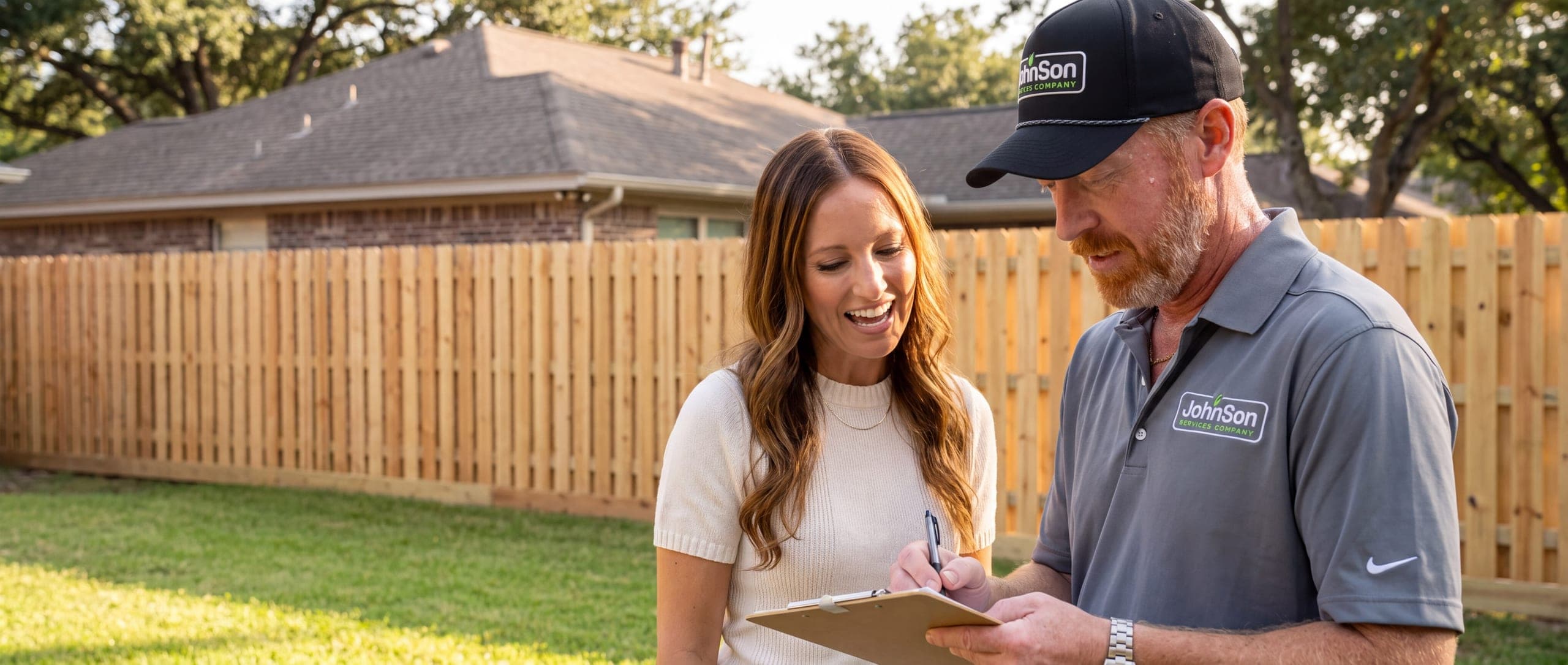
A Johnson estimator writing a fence quote on a clipboard beside a homeowner.

Price a fence before you call

See what a fence costs before anyone quotes you.

Pick the material, the height and how many feet of fence, and the calculator shows the market range for a fence like yours in Texas. Then a salesperson measures the real one in your yard and the number comes back the same day.

The estimate is free and there is nothing to sign.

Price Your Own 200 Feet Before Anyone Quotes It

Walk your line with a tape and a phone, and you can arrive at the first estimate already knowing the range. Measure the run, pick the material, name the grade, then add the site conditions from the list above. Service life belongs in that math too: a wood fence is rated at about 20 years and a vinyl fence at 100-plus (InterNACHI).

Your situation The number that decides it Ask for this in writing
Replacing an old fence on an established lot Removal and haul-off, plus work around trees and irrigation lines Who removes the old fence, and on what day
Screening a backyard on a set budget Pine at the low end of $18 to $30 per foot The picket grade number, #1 through #3
Buying for the longest service life Cost per year, not the 200-foot total The manufacturer’s warranty term on the material
Adding a driveway gate Gate hardware, the operator, and post embedment depth That the operator is installed to UL325 standards

Then get three quotes on the same spec. Different specs produce different prices, and comparing them tells you nothing.

Where Johnson Sits Among Texas Fence Contractors

Most Texas homeowners pricing 200 feet are choosing between contractors who each work one metro, so coverage and crew depth vary far more than the per-foot price does. Here is how we compare on metros served, published crew depth, and the work each company handles beyond fencing, using one established contractor from each of the four metros we serve.

Company Texas metros served Crew depth published Work beyond fencing
Johnson Services Company Houston, Dallas-Fort Worth, Austin, San Antonio, 42 cities and towns Over 100 crews, 25 to 30 in Houston alone Driveway gates, decks, gazebos, softscape landscaping, masonry
Texas Fence Houston metro only Over 20 crews and 30 full-time staff Driveway gates and access control
Austex Fence & Deck Austin and Central Texas only Crew count not published Decks, pergolas, porches, plus a materials showroom
Kodiak Fence Company North Dallas-Fort Worth towns only Crew count not published Fence staining and fence repair
Quality Fence & Welding San Antonio and South Texas only Crew count not published Custom steel fabrication, masonry, decks

Frequently Asked Questions

Yes, on day one: 200 feet of standard residential chain link runs about $2,400 to $5,600 installed in Texas. What happens after that depends on the fabric’s zinc coating class, since Class 2 carries roughly double the zinc of Class 1 and lasts longer for it. Ask which class you are being quoted.

Does the price include tearing out my old fence?

Often it does not. Removal and haul-off of the old fence is usually its own line, and the published per-foot ranges exclude it entirely. Ask who hauls the old fence away and which day it leaves your property.

Do I need a permit for a 200-foot fence?

Length never triggers a fence permit in Texas. Height and material do: Houston requires a permit only above 8 feet, or at any height for masonry and concrete, while Austin requires one above 7 feet. Check your own city before you order material.

Why is one cedar quote thousands higher than another for the same 200 feet?

Grade and post spec explain most of it. A #1 cedar picket and a #3 cedar picket are both sold as cedar, and post depth and spacing vary just as widely between bids. Get both numbers in writing from every bidder.

Does an 8-foot fence cost more per linear foot than a 6-foot?

Yes. A taller fence adds material on every single foot, often needs engineering for the wind load, and above 7 feet it usually needs a permit in Texas cities. The jump is not proportional to the extra height.

How long does 200 feet take to install?

Most of our jobs finish the same day they start. Work starts within about 4 days of an accepted quote, and larger or more complicated lines run longer.

Can I finance a fence this size?

Yes. We offer financing through Synchrony as a third party, at a 5% upcharge to the customer. Most of our customers pay directly instead.

Your 200 Feet Has a Number, and It Is Not the National One

You never needed the national average. You needed six material ranges, a grade number, and an honest list of what your own lot adds on top. Pine at $3,600 and iron at $18,000 are both correct answers to the same question, and the only thing standing between them is a spec.

What no calculator can do is measure your line, count your corners, and look at your soil. That takes someone standing in your yard with a tape.

How Johnson Services Company Measures Your 200 Feet Before Quoting It

The reason our quotes hold is that nobody writes one from a satellite photo. A salesperson meets you on site, measures the linear footage, confirms the fence type and picket grade, and gets a quote out the same day on 95% of real leads. Then we specify and load the materials and crews before install day, which is the unglamorous part that keeps the price on the page from moving after you sign.

Homeowners rate us 4.9 stars across 60 Google reviews, and 4.9 across 170 reviews on SoTellUs. What customers name most is the combination of the price and the follow-through. In a June 2026 SoTellUs review, one wrote: “Their price was competitive and lower than the other 2 but what sealed the deal was Matt called back the same day I initially contacted them for an appraisal. It was a good decision and Matt was quick to reply with the cost estimate and each time I had a question. In addition the crew showed up promptly per schedule and Matt came by early to coordinate some changes I requested after accepting the original quote. The fence was installed in just 2 days and looks great! The job site was cleaned up well b4 the crew left. The original cost was revised making the total cost much less than I expected.” Another, in April 2026, wrote that “the price was fair, the service was excellent, and everything was left clean once the job was done.”

We have held an A+ BBB rating since 2003, and across more than 20,000 jobs last year we took zero craftsmanship warranty callbacks. The estimate is free, in all 42 cities and towns we serve.


Johnson Services Company turns 200 feet of guesswork into a measured number tied to your material, your grade, and your site. Call (877) 956-4676 or ask for a free on-site estimate, and on most jobs the quote goes out the same day.

Get a free on-site estimate for your fence line →

Free estimate

Get your estimate from the largest fence company in Texas

Tell us what you need and where the fence goes, and a salesperson will come out and measure the line before anyone writes a number. You get the picket grade and the total in writing, the visit costs nothing, and there is nothing to sign.

Call (877) 956-4676

Monday to Friday, 7am to 4pm.

What kind of fence?
Which part of Texas?
Roughly how much fence?
How did you hear about us?
  • Free on-site estimate
  • Same-day quote
  • Nothing to sign
  • Work starts in about 4 days