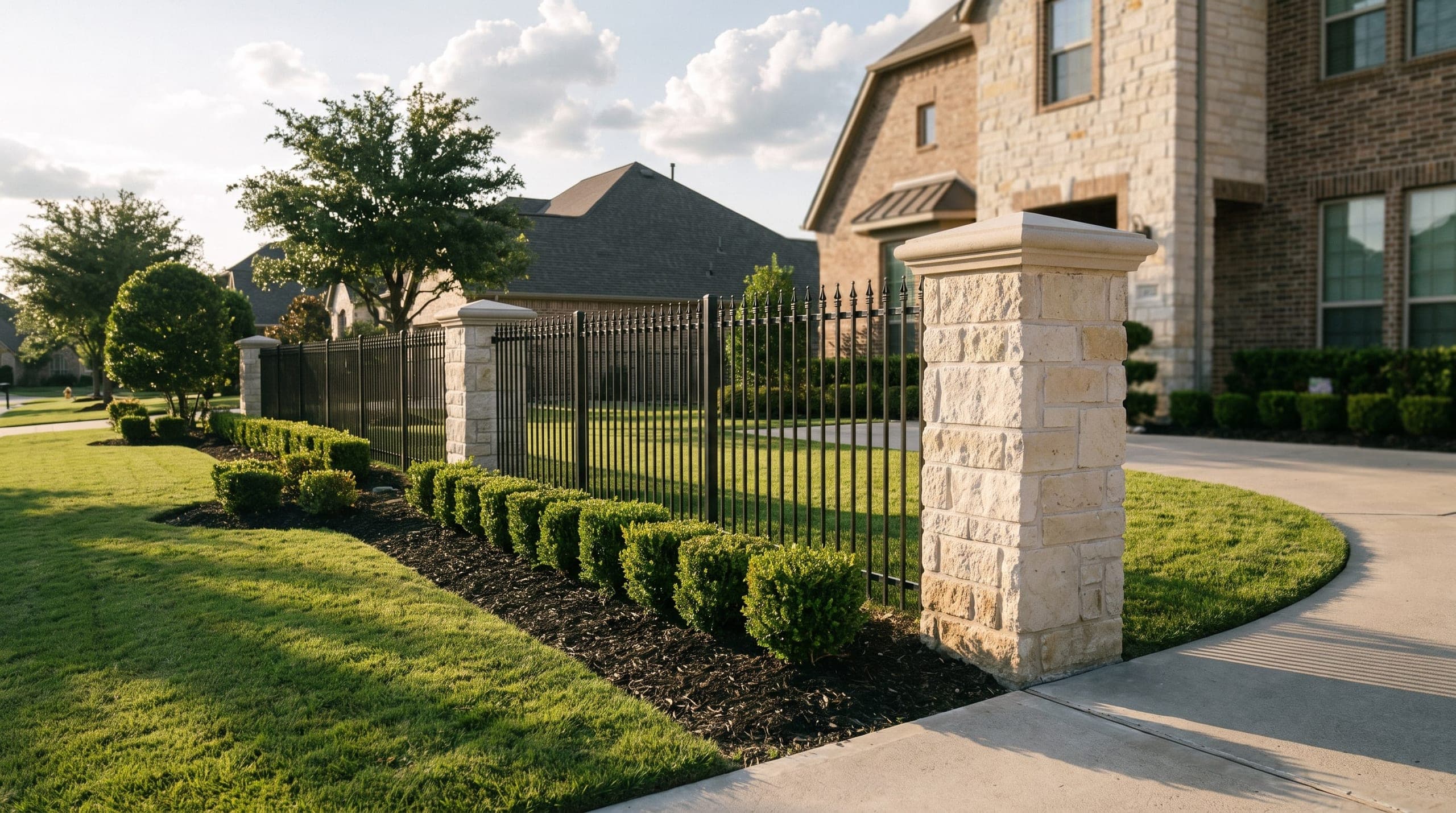
A wrought iron fence in Sugar Land leans for the same reason a brick column cracks. The ground under it moves, and nobody sized the footing for that movement. Iron and masonry are the two lines where a fence stops being carpentry and turns into engineering, and most quotes say nothing at all about the part that decides how long it stands.
Sugar Land’s Clay Moves, and Your Fence Posts Move With It
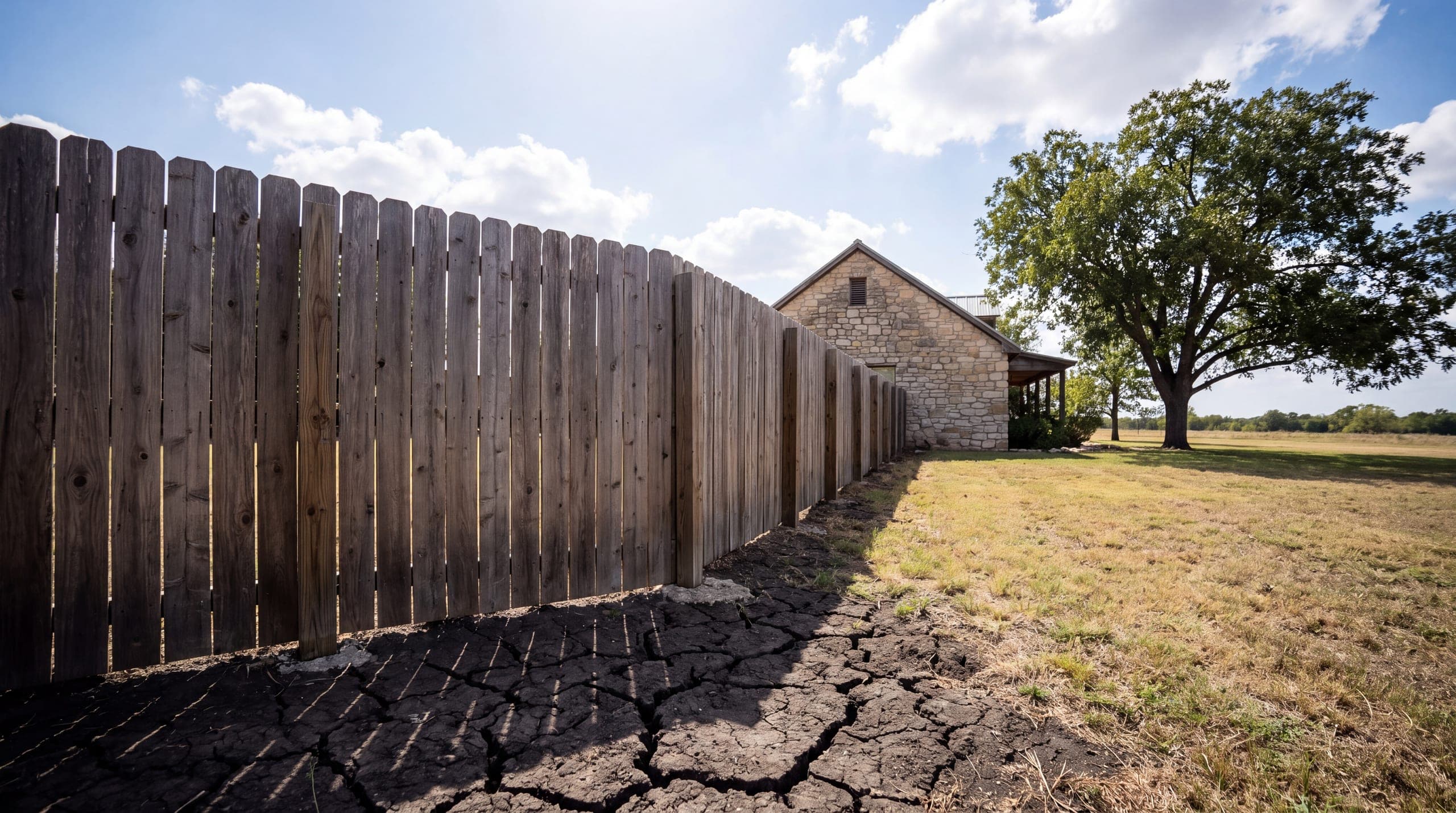
Heavy clay swells when it gets wet and shrinks when it dries, and it drags whatever is buried in it along for the ride. The USDA classifies Texas Blackland clay as a Vertisol running about 60% to 80% clay, with shrink-swell so high that it lists the soil as a limit on building-site development (USDA NRCS, 2023). Sugar Land yards behave that way season after season, wet spring into cracked-open August.
That movement is expensive at scale. A landmark engineering assessment put damage from expansive soils on the order of $2.3 billion a year, more than the average yearly losses from floods, hurricanes, tornadoes, and earthquakes combined (Jones and Holtz, 1973).
Wood forgives some of this. A cedar picket fence racks a little, the pickets flex, and the eye never catches it. A welded iron panel and a mortared brick wall are rigid, so the soil wins the argument and you see it as a lean, a stair-step crack, or a gate that stops latching after the first hard freeze and thaw.
What Actually Holds Up an Iron or Masonry Fence
The part doing the work is underground. An iron panel weighs almost nothing next to the wind it catches, and the load runs panel to post, post to concrete, concrete to soil. Everything above grade is finish. The two numbers that decide the fence’s life are how big the footing is and how deep the post sits in it, and both should exist on paper before a crew shows up.
| Term | What it is | Why it matters in Sugar Land clay |
|---|---|---|
| Footing | The concrete mass around or under the post | Spreads the load into soft clay so the post stops rocking |
| Embedment depth | How far the post is buried below grade | Sets how much soil resists the wind; too shallow means a lean |
| Vertical reinforcement | Steel bar, often No. 4, run up inside a masonry wall | Ties wall to footing so a crack does not become a failure |
| Grade SW facing brick | Brick graded for severe weathering exposure | Resists water soaking in and freezing at the face |
| Lateral load tier | The design wind pressure in psf a wall is sized for | Decides bar spacing and footing size on a masonry fence |
Ask for the Embedment Depth Before You Ask for the Price
The 2021 International Building Code sizes a fence post like a cantilevered pole, and it lets the soil resist that load over only one-third of the embedded depth (2021 IBC, Section 1807.3.2.1). Required depth grows with the wind force and the height that force acts on, and it shrinks as soil gets stronger. Clay is weak soil. The same 6-foot iron fence needs a deeper, wider hole here than it needs in rock.
Three things set that number, and a company that engineers the work can tell you all three on the estimate:
- Height above grade. Every extra foot of post lengthens the lever the wind pushes on.
- The area the fence catches. A tight picket spacing or a privacy insert catches far more wind than an open iron rail.
- The soil. Soft clay drives depth and width up, which is exactly the cost most low bids quietly leave out.
Gate posts are the first place this shows. Wind pressure peaks at ends, corners, and free edges, and a driveway gate hangs its whole weight off one post that also has to swing it a few thousand times. In an April 2026 Google review, Carlos M. wrote about an iron gate install: “The price was fair, the service was excellent, and everything was left clean once the job was done. Communication was great throughout the process, and they really took the time to go over the design with me before starting the work. Highly recommend.”
A Masonry Fence Is a Wall, and Walls Get Sized for Wind
The masonry industry’s prescriptive standard sizes cantilevered fence walls in lateral-load tiers of 15, 20, and 25 psf, and at 20 psf an 8-foot fence calls for No. 4 vertical bars at 16 to 24 inches on center over a 12-by-42-inch footing (NCMA/CMHA, 2007). Those are real dimensions with real cost. A quote for brick columns and a masonry wall that never mentions bar size or footing width was priced as decoration.
The wind side of it is not close. A fence counts as solid once its openings drop below 30% of the face area, and a solid freestanding wall is loaded across that entire face (ASCE/SEI 7-22, 2022). Open iron pickets let most of the air through. Brick and stone catch it all, so a wall and a fence on the same property line are two different engineering problems that happen to share a paint color.
Not Every Brick Survives a Texas Freeze
The masonry code that the building code points to specifies weathering-graded units, including ASTM C216 Grade SW severe-weathering facing brick and ASTM C90 concrete masonry units (TMS, 2022). Grade matters because a softer brick pulls water into its face. When that water freezes, the face spalls, and the wall starts shedding its skin in the fifth year instead of the fiftieth.
Specified correctly, masonry outlasts everything else on the property line. The Brick Industry Association estimates brick walls run 100 to 150-plus years before major repair, with mortar typically needing repointing at 50-plus years and sealant joints every 5 to 20 (Brick Industry Association, 2017). That is the return on a sized footing and the right brick. It is also why the cheap version stings so much: you paid for permanence and bought a repair schedule.
But Every Company Says They Set Posts in Concrete
The difference is whether they can hand you the numbers before install day. Anyone will say posts go in concrete. Very few will tell you how deep, how wide, what bar, what brick grade, and who files the permit, because saying it out loud means owning it later. Ask in that order and the field sorts itself out fast.
| What to ask | A real answer sounds like | A warning sign |
|---|---|---|
| How deep will the posts sit? | A depth in inches tied to fence height and clay soil | “Standard depth” with no number |
| How wide is the footing, and what steel? | Footing size plus bar size and spacing for a masonry wall | Footing never mentioned in the quote |
| What brick grade? | Severe weathering (SW) grade facing brick, named | “Whatever brick you like” |
| Who handles the permit? | They determine whether one is needed and file it | “Fences don’t need permits” |
| Who owns the gate post and operator? | One company sets post, gate, and operator as one system | Fence crew installs, someone else motorizes |
Two more things worth knowing before you sign. Texas has no statewide fence-contractor license, so nobody at the state level has vetted the truck in your driveway; you verify license, bond, and insurance yourself, and you ask for proof in writing. And small work tells you as much as big work. In a March 2026 Google review, Jon B. wrote: “Johnson fence did a great job replacing/repairing several of our fence posts and kick boards. This was a small but necessary job that several fence companies refused to do. Johnson fence company did a fantastic job for a fair price.”