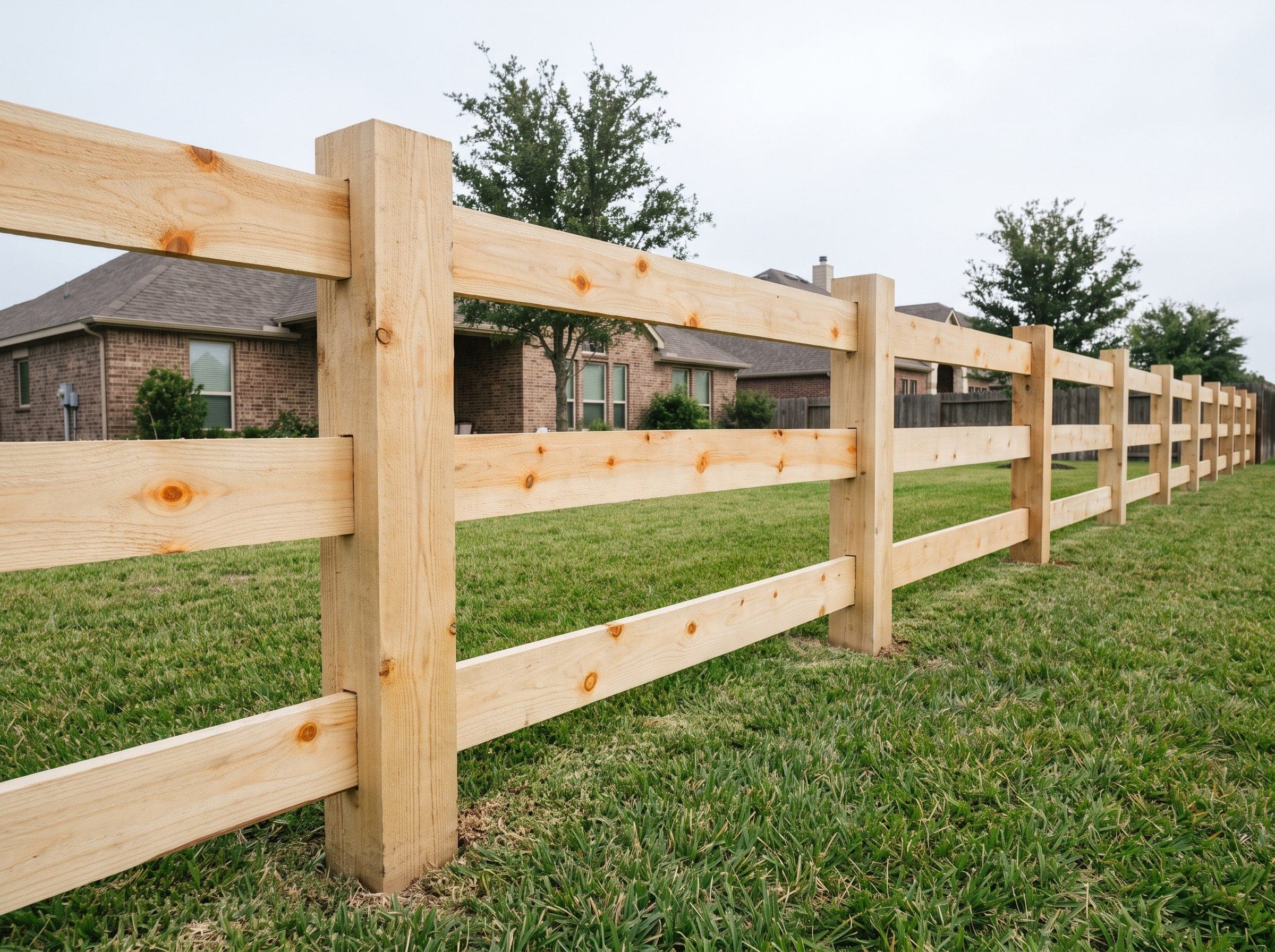
On acreage outside Magnolia, a fence has a harder job than a backyard panel. It has to hold animals, run a quarter mile across ground that rises and falls, and stand through Gulf Coast heat and Texas clay without leaning inside of five years. The contractor question that decides all of it is simple: can the crew quoting your job actually finish a line that long without stalling halfway?
An Acreage Fence Does Three Jobs a Backyard Panel Never Does
A ranch fence has to contain something, cross ground that moves, and stay square over hundreds of posts. A suburban privacy fence has to look good and block a view across 150 feet of flat, cleared lot. Those are different builds, and they fail in different ways. On acreage, a bad post spec does not show up as one crooked panel. It shows up as a quarter mile of lean, all at once, three years in.
The material list on a contractor’s website tells you almost nothing about this. Nearly every fence company in Montgomery County installs wood, iron, and chain link. What separates them is whether they measured your ground before quoting it.
Know These Terms Before You Read a Ranch Fence Quote
Ranch quotes use a vocabulary that suburban fence shopping never teaches you, and the terms are where the money and the service life both hide. Read a quote with these six in hand and you can tell a specified job from a guess.
| Term | What it means | Why it matters on acreage |
|---|---|---|
| Linear foot | One foot of finished fence line, measured on the ground | Every ranch quote is priced this way; 1,320 feet is a quarter mile |
| Ranch rail | Horizontal wood rails set between posts, open by design | Holds livestock and lets wind pass through instead of catching it |
| Ground contact | Lumber treated for direct burial in soil | Posts rot first; above-ground-rated wood buried in dirt fails early |
| Post embedment | How deep the post sits in concrete and soil | Depth has to grow with fence height and with soft clay |
| Corner and brace posts | The heavier posts at corners, ends, and gate openings | They carry the pull of the entire run behind them |
| Coating class | The weight of zinc on galvanized chain link or pipe | A heavier zinc coat buys years before rust starts |
Magnolia Heat and Clay Decide How Long the Line Stands
Wood rot is a climate problem here, and the numbers are not close. The USDA Forest Products Laboratory scores decay hazard on an index where anything above 65 is high risk, and the Houston area comes in at 77.2, against 44.3 for Dallas (USDA Forest Products Laboratory, 2009). Fence lumber that would last two decades in North Texas is under real pressure in Montgomery County, and the pressure runs year round.
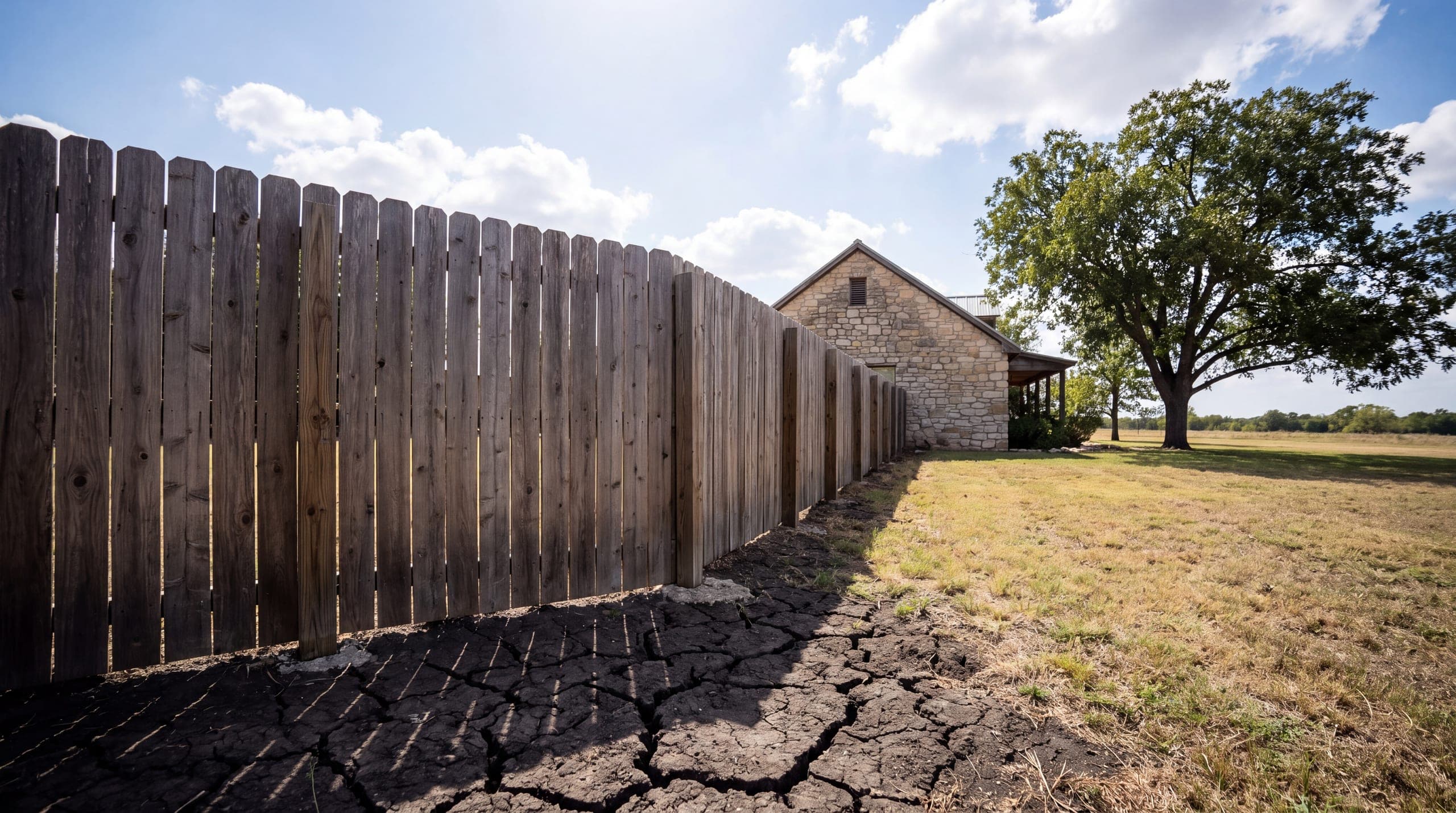
Then there is the ground itself. Texas clay swells when it is wet and shrinks when it bakes, and the state soil, Houston Black, runs 60% to 80% clay with very high shrink-swell (USDA NRCS, 2023). Every one of those cycles works at a post like a lever.
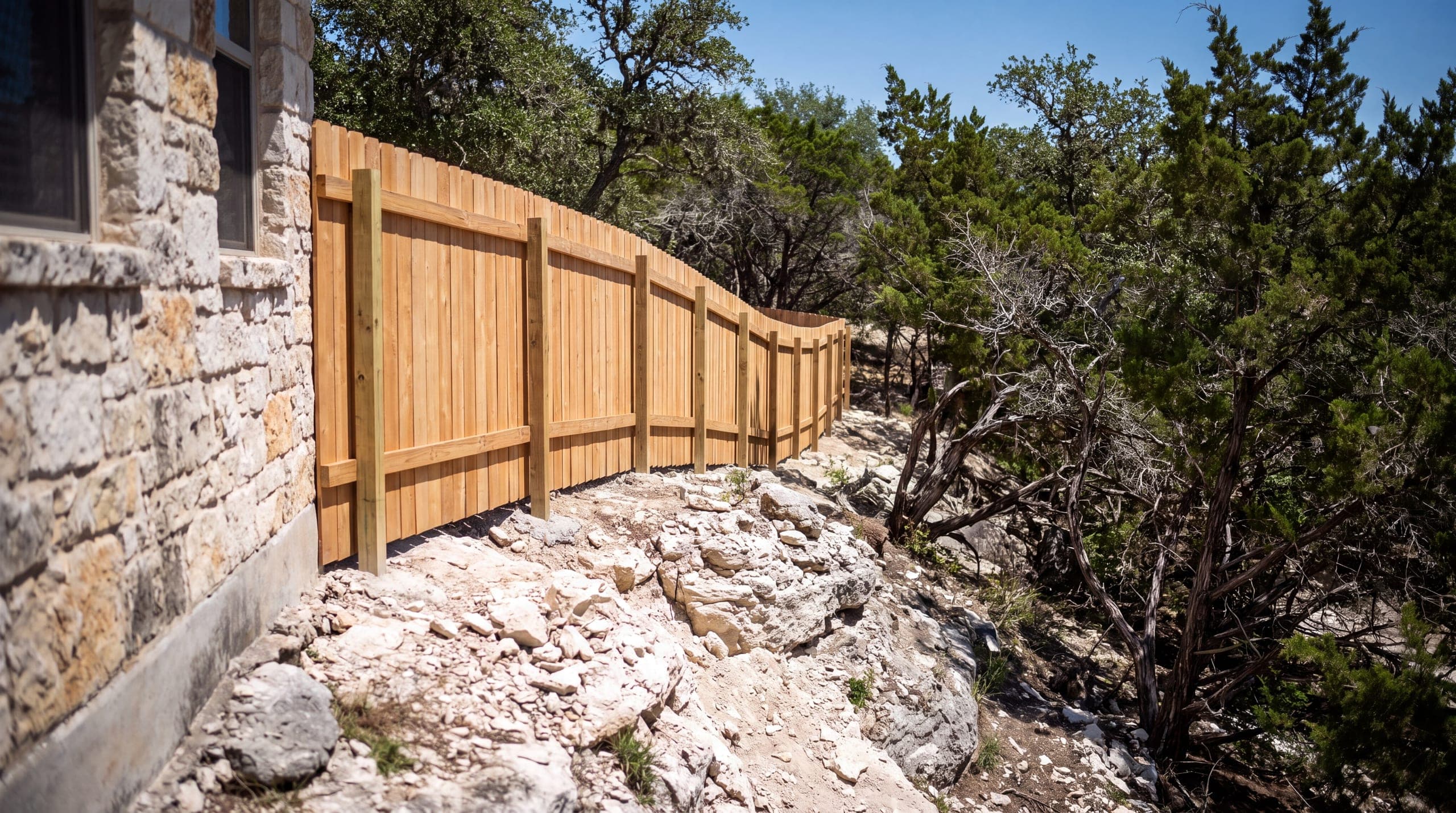
A fence post is engineered as a cantilever. The depth it needs grows with the height of the fence and the wind it catches, and it grows again when the soil holding it is soft. That is why a Magnolia post schedule is a decision, and why a crew that digs the same hole on every job is guessing on yours.
Service Life Is the Number That Should Pick the Material
Buy the material by how long it stands, and the ranking changes fast. In a decades-long in-ground test at a severe-exposure site, USDA researchers found pressure-treated wood with expected durability above 60 years, while untreated stakes in the same soil failed in a year to a few years (USDA Forest Products Laboratory, 2013). The treatment, not the species on the tag, is doing that work.
Here is how the common acreage materials compare.
| Material | How it behaves on a long acreage run | Expected service life | Source |
|---|---|---|---|
| Pressure-treated pine | The standard Texas ranch line; lowest cost over long footage | Decades in ground contact when treated to spec | AWPA Standard U1 |
| Cedar | Heartwood resists decay; best near the house, not the back line | About 20 years | InterNACHI |
| Ornamental steel | Entrances, road frontage, and gate runs | Lifetime residential warranty, 20 years commercial | Ameristar Montage warranty |
| Chain link | Low cost per foot for stock and perimeter work | Class 2 zinc coating outlasts Class 1 | ASTM A392 |
Most Magnolia acreage ends up mixed. Steel and stone at the entrance where people see it, treated pine or ranch rail on the long runs, chain link where the job is containment. One quote should cover all of it.
But a Quarter-Mile Line Is Won Before Install Day
The reason big rural runs stall is arithmetic. There are about 599,000 specialty-trade contracting establishments in the U.S. employing 5.26 million people, which is fewer than ten workers per establishment on average (U.S. Bureau of Labor Statistics, 2025). Most fence companies are one to three crews. A single crew that loses a day to rain, a truck, or a sick hand loses your whole week.
We built the other way around. We measure every job and specify and load the materials before a crew leaves the yard, which is the expensive, unglamorous part nobody sees. Behind that sit over 100 crews in the field and more than 2 million feet of fence installed last year, about 380 miles across more than 20,000 projects. A crew missing a day does not stop a line.
Long runs are the test. In a July 2026 Google review, James H. wrote that we “did a great job over several days (we had a lot of linear feet to install). All looks good.”
How to Tell a Ranch-Capable Crew From a Backyard Crew
Five questions sort it out on the first phone call, before anyone walks your property. None of them are about material.
- Ask how many crews they run. One to three is the norm in this trade. The number tells you what one rainy week does to your schedule.
- Ask who measures, and when. If the number comes from a satellite image or a windshield look, the change order is already coming. Someone should walk the line with you before a price is set.
- Ask where the material comes from. Lead time on 1,300 feet of posts and rail is a real risk. We buy more wood pickets than any other company in the country and were named Master Halco’s largest-volume customer worldwide for 2026, and that buying power is what keeps a long run supplied and priced.
- Ask what happens at the gate. An automatic entrance gate is a system of gate, operator, and sensors. We install gate operators to UL325 standards, and the gate should be engineered with the fence, not bolted on after.
- Ask for the license, the insurance, and the record. We are licensed, bonded, and insured, and we have held an A+ BBB rating with accreditation since March 2003. Ask what the callback rate actually is: across more than 20,000 jobs completed last year, we logged zero craftsmanship warranty callbacks; a 100% record, not a target.
- Ask how fast they actually move. We return calls the same day, deliver a quote the same day on 95% of real leads, get crews on-site within about four days of booking, and most fence and gate jobs finish start-to-finish in a single day.
Trade buyers apply the same filter. In a review on our site, Adam K. wrote: “Johnson Service Co went above and beyond to complete the scope of work we agreed on. I have been a builder for over 20 years and I would highly recommend this company to any clients, friends or family.”