Texas and Local

Seven Signs Your Wood Fence Needs Replacing Not Repair

A split picket and a soft post look the same from the back porch. One is an afternoon and a $20 board.

August 6, 2026

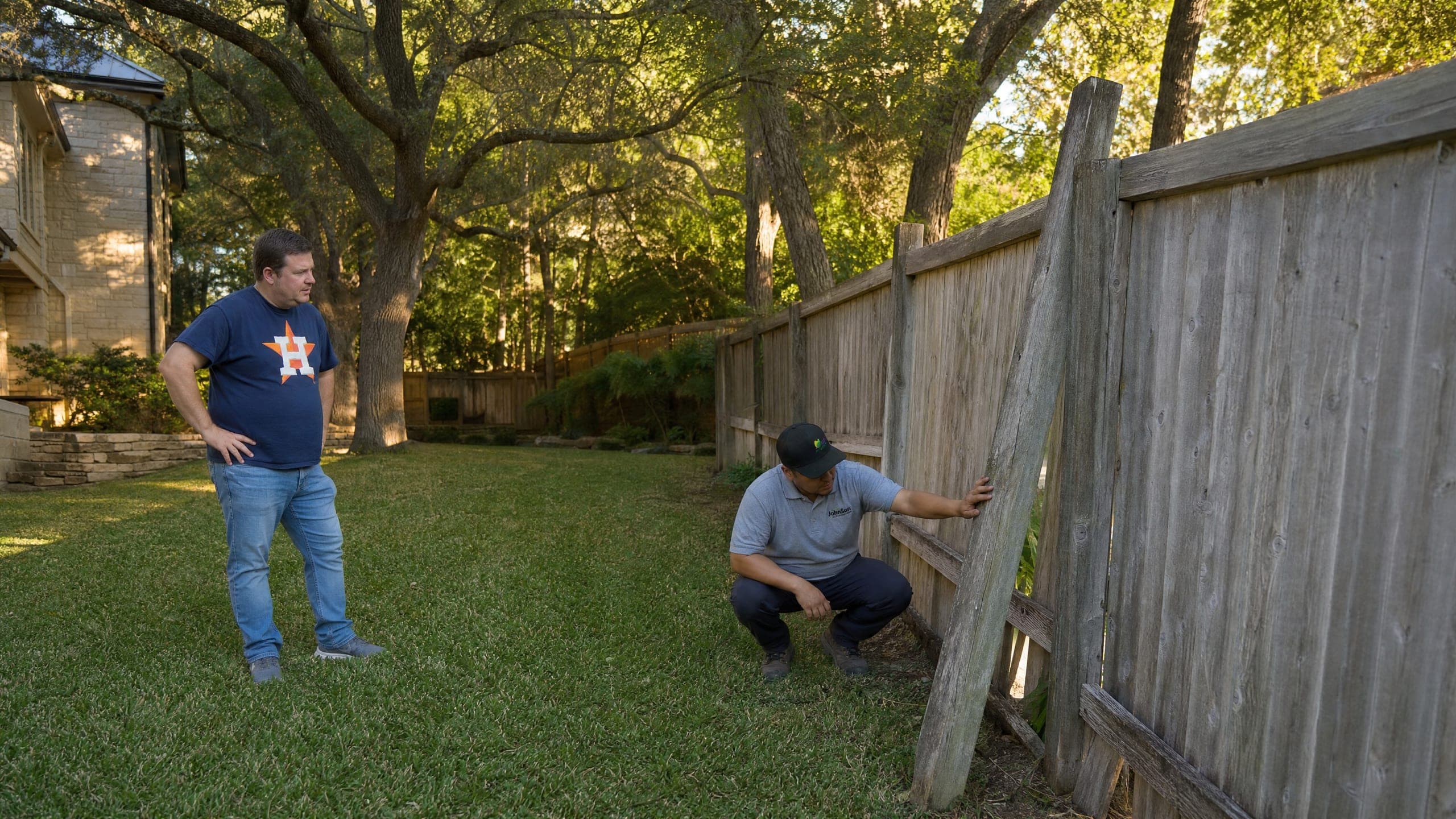
A crew lead checking a leaning post on a tired cedar fence with the homeowner watching

A split picket and a soft post look the same from the back porch. One is an afternoon and a $20 board. The other is a fence that has already lost, and patching it only moves the failure a few feet down the line. Here are the seven signs, in the order you should check them, and what each one tells you about how much fence you have left.

1. One Cracked Board Tells You Almost Nothing

A single split picket is a repair, full stop. Wood dries, shrinks, and splits, and one dry board says nothing about the posts and rails holding the fence up. Hercules Fence GSA puts it the same way: a cracked board or a single missing picket is usually an easy fix, while large sections of broken panels or widespread splintering make replacement the smarter move. So count before you quote.

What you count matters more than what you see first.

  • One board, in one spot. Pull it, replace it, done. Nothing behind it has moved.
  • A line of boards failing at the same height. Something structural behind them is moving, and the boards are just reporting it.
  • Anything soft at the base of a post. Stop counting boards. The problem is below grade.

2. Broken Boards Along One Run Point at the Frame Behind Them

When boards fail in a line, the frame is the patient. Rails sag, pull their fasteners, and the pickets crack in sequence along the same run. Replacing those pickets fixes what you can see and leaves the rail doing the same thing to the next set. Look at the rail and the two posts on either end of the run before you buy a single board.

Here is the practical test. Push on the middle of the run with a flat hand. If the whole section moves as a unit and springs back, the frame is intact and the boards are cosmetic. If the section moves and stays moved, or you hear a fastener let go, you are looking at frame work, and frame work is where the honest repair-or-replace conversation starts.

3. If a Screwdriver Sinks Into the Post Base, That Post Is Finished

Rot at the ground line is the sign that ends the debate. Serious decay only happens when wood stays wetter than about 30% moisture, and air-dried wood usually sits at or under 20%, which the USDA calls a reasonable margin of safety against fungal damage (USDA Forest Products Laboratory, 2021). Soil holds moisture against the post around the clock. That is why the post goes first and the pickets above it still look fine.

Push a screwdriver into the post at grade and just below it. If it sinks, the wood there is gone, and no bracket or concrete collar brings it back.

Term What it means Source
Ground line Where the post enters the soil, the wettest few inches of the whole fence Field term
Ground contact (UC4A) The use category for buried fence posts, with a minimum preservative retention set for long-term in-ground service AWPA Standard U1
Weathering Gray, fuzzy surface wood with sound material underneath, a look problem rather than a strength problem Field term

4. A Lean That Shows Up in Wind Starts at Corners and Gates

Check the ends first, because that is where the wind hits hardest. Full-scale testing on freestanding walls found wind pressure is highest near the free ends and the leading edge, and strongly reduced by return corners (Journal of Wind Engineering and Industrial Aerodynamics, 1996). That is the engineering reason a fence’s end panels, corners, and the tall posts flanking a gate go before the middle of the run.

A gate post carries the worst of it. It holds a solid panel that swings, catches wind on both faces, and hangs its whole weight off one side. When that post leans and the rest of the line stands straight, you have a post sized for less load than it actually carries. Reset it deeper and wider, or it leans again next storm season.

5. A Post That Tilts Every Season Is the Soil Moving It

Seasonal movement is a soil problem, and it does not fix itself. Houston Black, the official Texas state soil, runs about 60% to 80% clay and carries a very high shrink-swell potential that the USDA lists as a recognized limitation for building sites (USDA Natural Resources Conservation Service, 2023). It stretches from Dallas south through San Antonio. Wet clay swells and squeezes the post. Dry clay shrinks and opens a gap around it.

The tell is direction. Storm damage leans one way, once. Clay movement rocks the post back and forth across the year, and the gap at the base opens in August and closes in spring. Straightening that post puts it back in the same hole that has been working it loose for years. The fix is a deeper, wider footing, which means pulling the post and setting a new one, which is most of a replacement already.

6. Rot on Two Posts in One Line Means the Climate Beat the Spec

Two rotted posts in the same line is a spec failure, not bad luck. The USDA’s decay hazard index puts Houston at 77.2 and Port Arthur at 80.7, deep inside the high-hazard band, against Dallas at 44.3 (USDA Forest Products Laboratory, 2009). Anything above 65 is high. Gulf Coast heat and humidity feed the fungus that eats fence posts, all year.

Metro Decay hazard index Risk band Source
Port Arthur 80.7 High USDA Forest Products Laboratory, 2009
Houston 77.2 High USDA Forest Products Laboratory, 2009
Austin 55.2 Moderate USDA Forest Products Laboratory, 2009
San Antonio 52.2 Moderate USDA Forest Products Laboratory, 2009
Dallas 44.3 Moderate USDA Forest Products Laboratory, 2009

Material choice is what loses that fight or wins it. A worldwide durability checklist rates western redcedar as resistant and loblolly pine as only moderately resistant to nonresistant (Oregon State University, 1998). Untreated pine in Houston soil is a short-dated fence. When rot shows on more than one post along the same line, the spec was wrong for the climate, and every remaining post is on the same clock.

7. Two Repairs in Two Years and You Are Buying the Fence Twice

Count the repairs, then count the years. The certified home-inspector association InterNACHI rates a wood fence at about 20 years of service life. A fence in year 18 that needed two post resets in two years is not unlucky. It is finishing, and each repair is a partial payment on the replacement you will buy anyway.

Repairs also age badly in an obvious way. New pickets next to 15-year-old gray ones never match, so you pay for work that looks worse than what you had. The homeowner who called us about a fence that was already rotting and warping at three and a half years old did not need convincing about doing it right. They had already paid once for doing it wrong.
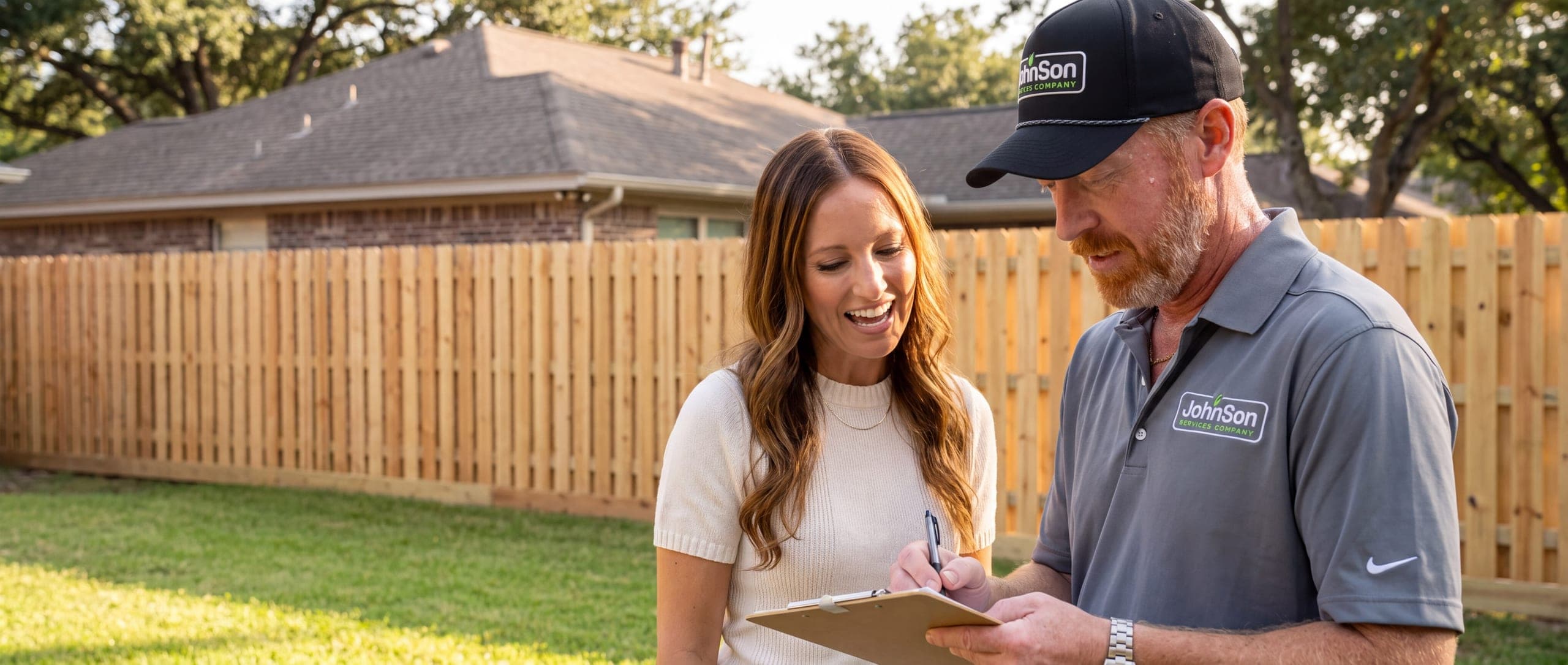
A Johnson estimator writing a fence quote on a clipboard beside a homeowner.

Price a fence before you call

See what a fence costs before anyone quotes you.

Pick the material, the height and how many feet of fence, and the calculator shows the market range for a fence like yours in Texas. Then a salesperson measures the real one in your yard and the number comes back the same day.

The estimate is free and there is nothing to sign.

So Diagnose the Cause Before You Price the Fix

The board that broke is rarely the thing that failed. Every sign above traces back to one of three causes: water sitting in the wood, wind loading the ends, or clay working the posts. Name the cause and the call makes itself.

What you found What it actually means The call
One split or missing picket Wood dried and moved; the posts are sound Repair
Broken boards along one run at one height A rail or post behind them has moved Fix the frame, then judge the rest
A screwdriver sinks into a post at grade That post has already failed below ground Replace the run
Lean at a corner or gate after wind The post is set for less load than it carries Reset those posts deeper and wider
Posts that tilt the same way each season Clay is working the post loose every year Replace with deeper footings
Rot on two or more posts in one line The wood spec lost to the local climate Replace the fence

Cost is the reason people hope for the repair answer, and we take that seriously. Master Halco named us its 2026 Largest Volume Customer for the Southwest Region and for the World, so we buy wood pickets at a price a smaller contractor cannot get, and that price goes straight into the quote. A correct replacement is closer to the repair number than most owners expect.

How Johnson Compares to Other Houston-Area Fence Contractors

A replacement on an established lot has to be scheduled, measured, and crewed around mature trees and buried irrigation, and Houston owners are choosing among a handful of high-volume contractors who work the metro. Here is how we compare on markets covered, crew depth, and what each company has actually built.

Company Texas markets served Crews in the field Volume record
Johnson Services Company Houston, Dallas-Fort Worth, Austin, San Antonio, 42 cities and towns Over 100 total, 25 to 30 in Houston 2 million feet of fence and 20,000-plus projects in the last year
Texas Fence Houston and surrounding areas Over 20 More than 30,000 fences built since 2003
Southland Fence & Supply Houston and surrounding areas Not published Over 30 years in business, and a fence-supply store as well as a contractor
Bayou City Fence Company Southeast Houston and Gulf Coast suburbs including League City, Pearland, Friendswood, Clear Lake, Galveston Not published 1-year workmanship warranty with 36-inch concrete footings

Frequently Asked Questions

Can you replace just one fence post without redoing the fence?

Yes, and it is the right call when the rest of the line tests sound. Pull the post, dig a new hole to proper depth, and reset it; the panels on either side usually come off and go back on. When a second post in the same line tests soft, the single-post fix stops being worth the labor.

How do I check my fence posts for rot myself?

Take a screwdriver and push it into the post at the ground line and an inch below, on all four faces. Sound wood resists the tip; rotted wood takes it like styrofoam. Test every post along the line, because one soft post tells you where to look and three tell you the whole fence is going.

Can a leaning fence be straightened instead of replaced?

Straightening works when the lean came from a single event and the post is still sound. It does not work when the post is rotted at grade or when clay has been rocking it loose for years, because you are putting a good post back in a hole that already failed. Test the post before you pay anyone to push it upright.

How much of a fence has to be damaged before replacing all of it makes sense?

Judge by posts, not by boards. Boards are cheap and quick, so a dozen bad pickets is still a repair; two or more failed posts in the same line means the run is going and the rest is close behind. Matching new material to sun-faded old material is the other practical limit.

Do I need a permit to replace a fence in Houston?

Not for a standard wood fence. Houston requires a building permit for a residential fence only when it exceeds 8 feet above grade, or when it is built wholly or partly of masonry or concrete at any height (City of Houston, 2026). Your HOA rules are a separate question from the city’s.

Does staining or sealing an old fence buy more time?

Stain protects the part of the fence you can see and does nothing for the part that fails. Ground-line rot is fed by soil moisture against buried wood, which no surface coating reaches. Staining sound wood is good maintenance; staining a fence with soft posts is money spent on the wrong end.

How fast can a replacement actually happen?

We give a rough estimate over the phone from your address, then meet you on site to measure, and 95% of real leads get a written quote the same day. Work starts within about 4 days of an accepted quote. Most residential fences finish the same day the crew starts.

Johnson Services Company Same-Day Quotes on 95% of Leads

Every sign above is something a person has to see standing at the fence, which is why we measure the footage on site and test the posts before anyone writes a number. Homeowners rate us 4.9 stars across 60 Google reviews. What they name most often is the callback and the price. In a June 2026 Google review, Randy R. wrote: “Their price was competitive and lower than the other 2 but what sealed the deal was Matt called back the same day I initially contacted them for an appraisal.”

We quote the picket grade by name, #1 through #3, because a fence sold as “cedar” with no grade is a fence you cannot compare to anything. Master Halco named us its 2026 Largest Volume Customer for the Southwest Region and for the World, and we pass that picket price through, so the spec stays right while the number stays competitive. Across more than 20,000 projects in the last year we took zero craftsmanship warranty callbacks, on a one-year craftsmanship warranty that our record says never gets used.

Over 100 crews across Houston, Dallas-Fort Worth, Austin, and San Antonio, with 25 to 30 in Houston alone, is what keeps your install date from moving when someone calls in sick. In a May 2026 Google review, Jess C. called the work “Awesome high quality workmanship and timely.”


Johnson Services Company tests the posts and names the cause before quoting, so you pay for a replacement once instead of a repair that postpones it. Get a free on-site estimate anywhere across our 42 Texas cities and towns, with financing available.

Get a free on-site fence estimate →

Free estimate

Get your estimate from the largest fence company in Texas

Tell us what you need and where the fence goes, and a salesperson will come out and measure the line before anyone writes a number. You get the picket grade and the total in writing, the visit costs nothing, and there is nothing to sign.

Call (877) 956-4676

Monday to Friday, 7am to 4pm.

What kind of fence?
Which part of Texas?
Roughly how much fence?
How did you hear about us?
  • Free on-site estimate
  • Same-day quote
  • Nothing to sign
  • Work starts in about 4 days