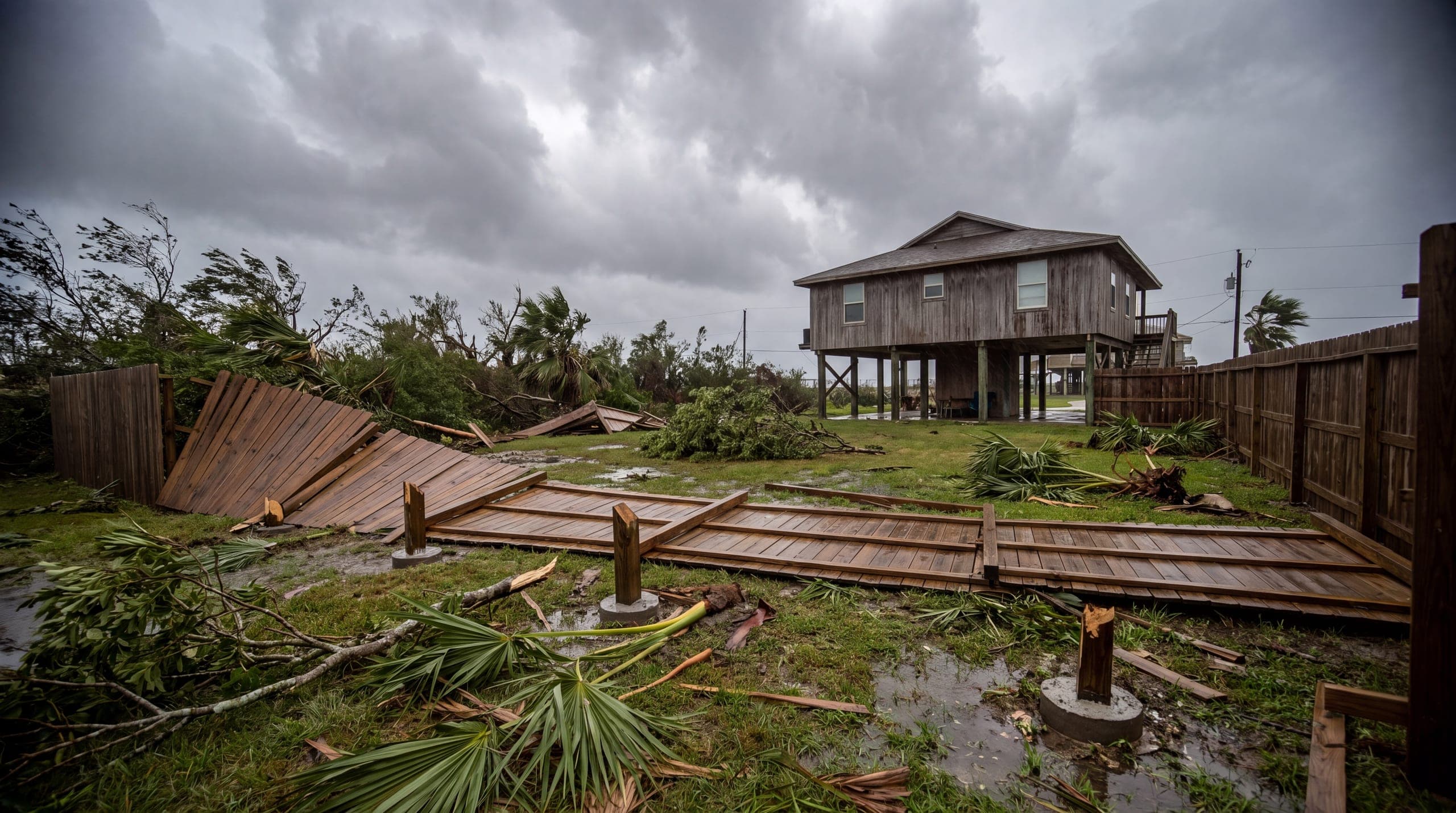
A storm-damaged fence on the Texas coast is rarely worth repairing twice. The same wind and salt air that took down the first one will find the same weak points in whatever replaces it, unless the spec changes. What decides whether the next fence survives the next storm gets decided before install day, in post depth, footing size, and whether the panel catches the wind or lets some of it through.
Why the Same Fence Line Goes Down Twice on the Coast
Coastal Texas asks more of a fence than any other part of the state. ASCE 7-22 maps the Houston metro at basic design wind speeds of roughly 130 to 140 mph for ordinary structures, rising toward 150 mph at the immediate Gulf shoreline (ASCE/SEI 7-22, 2022). A fence rebuilt to the spec that just failed is being handed a test it already flunked.
Wind is the trigger down here, and it never hits a fence evenly. It finds the tallest post, the widest gate, and the corner where the line turns, and it works those first. A fence that lost six panels by the gate and held everywhere else has told you exactly where the design ran out.
That is why the cheap patch is expensive. New pickets screwed onto posts that already moved buys you the time between now and the next named storm, and then you pay for the whole line anyway.
Walk the Damaged Fence Before You Price the Rebuild
Start at the posts. Panels are what you see from the kitchen window, and posts are what actually failed. Push each one with a flat hand at chest height: a post that rocks in its concrete, or a concrete plug that rocks in the soil, has already told you the embedment or the footing was short for this exposure.
Photograph everything before a single board gets hauled off. Your carrier decides what it covers, and the one thing you control is what you can show an adjuster later.
| What to check | What you are looking for | What it means |
|---|---|---|
| Line posts | Post leans, or rocks when pushed | Embedment depth or footing width was undersized |
| Gate and corner posts | Leaning, split, or pulled toward the opening | End and corner zones carried the highest wind load |
| Wood at the ground line | Soft, dark, spongy wood within 2 inches of soil | Rot, so the post snapped rather than pulled |
| Concrete plugs | Plug lifted out of the soil intact | The footing was too small for the soil, not the post |
| Hardware | Rust bleed at nails, screws, hinges, brackets | Salt air reached the fasteners before the wind did |
| Panels and pickets | Boards gone in a run, rails still attached | Fastening failed before the frame did |
A Solid Privacy Fence Catches Wind Like a Wall
Engineers do not treat a solid privacy fence as a screen. ASCE 7-22 designs it as a solid freestanding wall, loading the full solid face area, and a fence counts as solid once its openings drop under 30% of the gross face (ASCE/SEI 7-22, 2022). A 6-foot board-on-board fence has almost no openings, so it catches nearly all of what comes off the water.
Full-scale field tests on freestanding walls found wind pressure runs highest near the free ends and the leading edge, and drops sharply where the wall turns a corner (Robertson and Hoxey, 1996). That is the engineering reason your end panels, your corners, and the tall posts flanking the driveway gate go first, year after year, while the middle of the run stands.
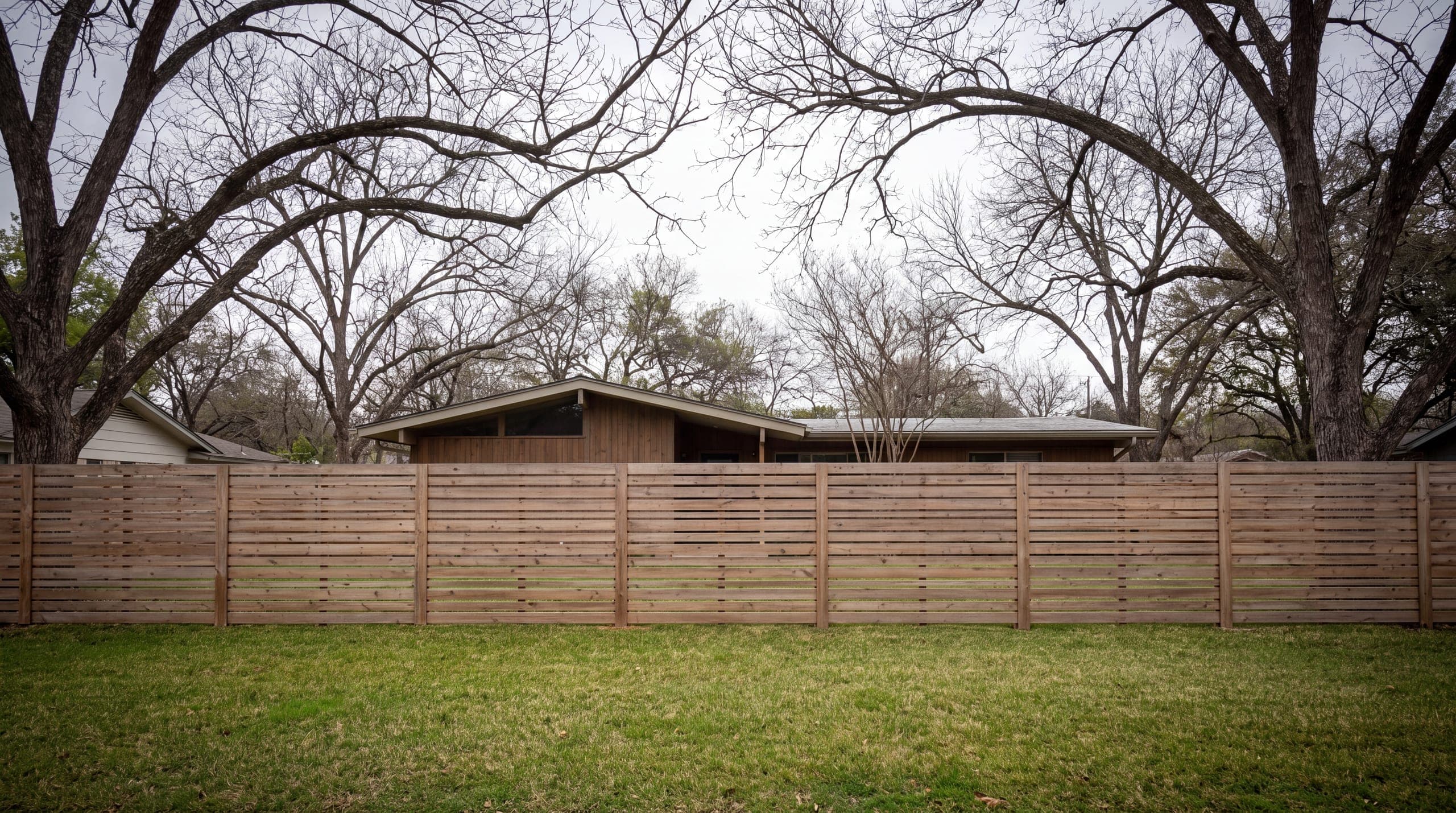
The lever you get to pull is porosity. A shadowbox, spaced picket, or slotted design lets some air through and cuts the load the posts have to carry. You give up a little privacy and you buy back a lot of margin. Where the view matters more than the screen, ornamental iron gives up almost nothing to wind at all.
Salt Air Softens What the Next Wind Pushes On
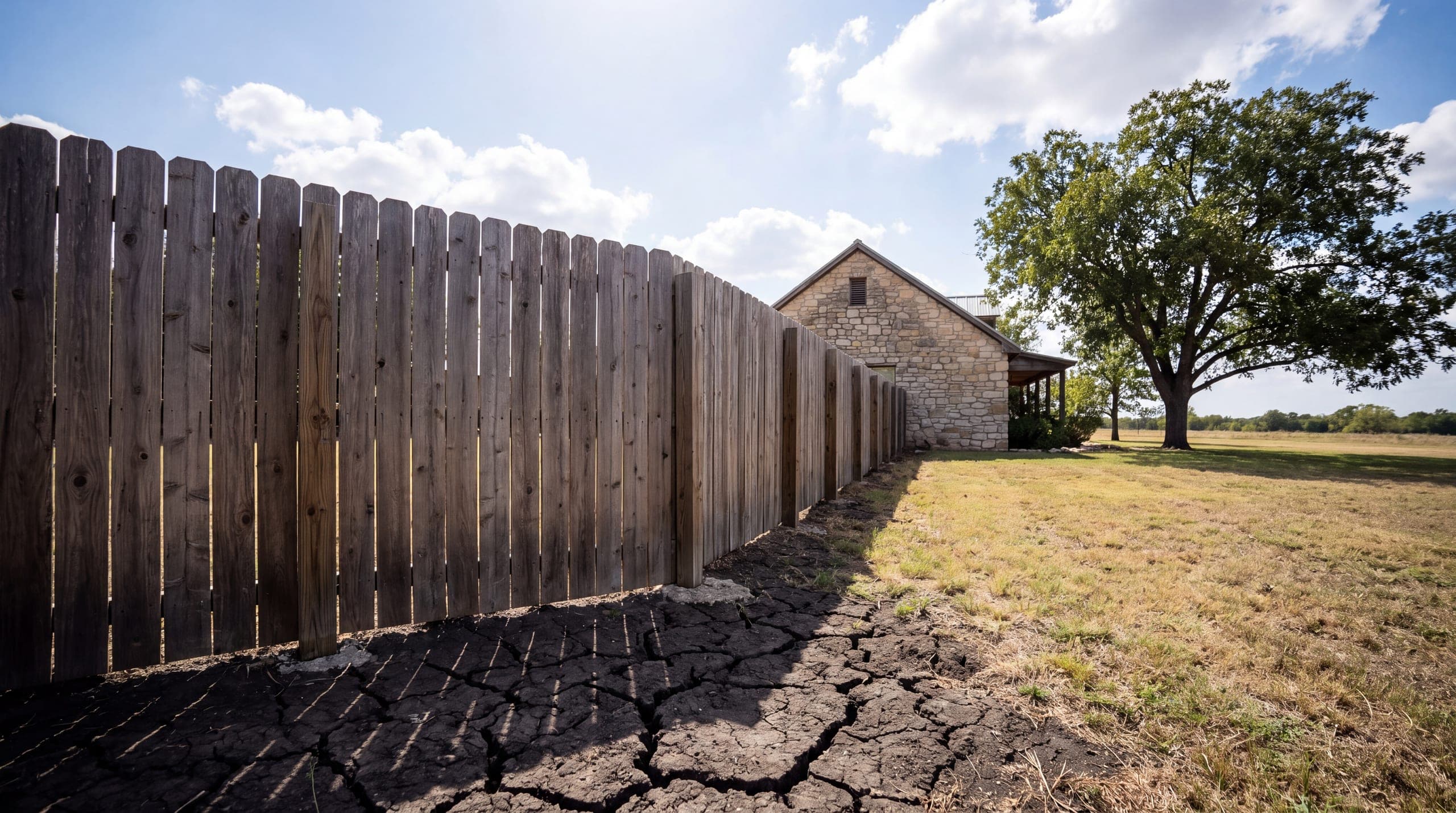
Coastal air attacks the fence between storms. The USDA Forest Products Laboratory’s decay hazard index puts Port Arthur at 80.7 and Houston at 77.2, both deep inside the high band that starts at 65, against 44.3 for Dallas (Carll, USDA Forest Products Laboratory, 2009). Untreated or thinly treated wood at the ground line does not last here on the schedule a national brochure promises.
One homeowner told us their previous fence was already rotting and warping after three and a half years. Nothing exotic went wrong. Damp air, ground contact, and a picket grade nobody named on the quote.
Metal has the same story with a different chemistry. Zinc coatings are consumed faster in salty, humid air than in dry inland air, which is why coating weight is the number that matters on anything galvanized (ISO 9223, 2012). On the coast, ask for heavier galvanizing on posts and fabric, and hot-dipped or stainless hardware. Fasteners are cheap. Replacing a fence because the screws rusted out is not.
Learn These Terms Before You Read a Rebuild Quote
Five words separate a real coastal spec from a page with a price on it. Each one is a line a contractor can either name or dodge, and the dodge is the tell.
| Term | What it means on your quote |
|---|---|
| Embedment depth | How deep the post sits in the ground, in inches, not “in concrete” |
| Footing diameter | How wide the concrete plug is around the post |
| Ground contact | A treatment level (UC4A) for wood buried in soil, higher than above-ground treatment |
| Picket grade | The wood grade, #1 through #3, with #1 having the fewest and smallest knots |
| Class 2 galvanizing | The heavier zinc coating on chain link fabric, 2.0 oz per square foot versus 1.2 for Class 1 |
A quote that says “cedar fence, 6 foot, 180 feet” has named one of these. A quote that names all five can be checked against the next storm.
Post Depth and Footing Size Decide the Next Storm
The code already did this math for exactly your situation. The 2021 IBC sizes a fence post as a cantilevered pole, with required embedment growing as the wind force and its lever arm grow, and shrinking only as the soil gets stronger (2021 International Building Code, Section 1807.3.2.1). Taller fence, wider gate, softer clay: every one of those pushes the hole deeper and wider.
Masonry gets sized the same way, off a published table. The concrete masonry industry’s design guide sets lateral-load tiers of 15, 20, and 25 psf and puts an 8-foot fence in the 20 psf tier on No. 4 vertical bars at 16 to 24 inches on center over a 12-by-42-inch footing (NCMA TEK 14-16B, 2007). Nobody has to guess at a brick or concrete fence on the coast. The numbers are printed.
Here is how the exposure should steer the spec.
| Your situation | What the wind does to it | What the rebuild should change |
|---|---|---|
| Open lot near the shoreline | Full wind on a solid face, no upwind blocking | Deeper embedment, wider footings, and a design that lets air through |
| 8-foot privacy fence | Taller face and longer lever arm on every post | Bigger footings, closer post spacing, engineered design above 8 feet |
| Driveway gate opening | Highest loads at the two posts flanking the gate | Oversized gate posts, deeper embedment than the line posts |
| Wood posts that rotted off | Damp coastal soil beat the treatment level | Ground-contact treated posts or galvanized steel posts in a wood fence |