Most fence advice for this corridor comes down to one number per linear foot. That number gets quoted for a shaded lot in Rollingwood and for a bare pad in Bee Cave as if the ground under them were the same ground.
It is two different jobs. The older streets around Westlake Hills, Rollingwood, and Lake Austin are replacement work on mature, wooded, often steep lots, while the growth corridor toward Lakeway, Bee Cave, and Dripping Springs is new construction, where fencing is frequently left out of the base build and the buyer has to plan for it alone. One price per foot cannot cover both.
Westlake Replaces Fences, Lakeway Builds Them New
Which job you have is set by the age of the neighborhood, and it changes almost everything about the quote. A replacement carries tear-out, haul-off, mature trees, buried irrigation, and grade. A new-build lot carries none of that and instead carries an HOA packet, a builder contract that may exclude fencing, and a schedule tied to landscaping. The same crew does both. The same estimate should not.
| Where the lot is | What the job usually is | What moves the price |
|---|---|---|
| Westlake Hills, Rollingwood, Lost Creek, Tarrytown | Full replacement of an aging wood fence | Tear-out, haul-off, trees, grade |
| Davenport Ranch, Barton Creek, Cat Mountain, Rob Roy on the Lake | Replacement on large wooded lots | Long runs, tight access, tree cover |
| Steiner Ranch and Circle C, earliest phases only | Replacement as first fences age out | Post condition, HOA style rules |
| Lakeway, Bee Cave, Spanish Oaks, Rough Hollow | New construction on a cleared pad | Fencing often excluded from the base build |
| Dripping Springs, Belterra, Headwaters, Caliterra | New construction on larger lots | Total footage, HOA approval, gates |
A wood fence runs about 20 years before it needs replacing (InterNACHI, n.d.). That is the clock ticking under the older zips, and the reason the two lists above will keep drifting apart.
Know These Terms Before You Read a Hill Country Bid
Five words decide whether two bids are even describing the same fence. Estimates in this corridor look alike on the front page and differ by hundreds of dollars in what they leave unsaid. Read these before you read the number at the bottom.
| Term | What it means on your quote |
|---|---|
| Linear foot | The measured distance along the fence line, taken on site with a wheel or tape |
| Embedment | How deep each post sits in the ground, and what it is set in |
| Ground contact | The preservative rating a post needs because it is buried in soil |
| Grade change | The rise or fall across a run, which decides panel layout and legal height |
| Tear-out and haul-off | Pulling the old fence, old posts, and old concrete, and trucking it away |
| Racking or stepping | The two ways panels follow a slope, one flexed, one squared and stepped down |
What Trees, Rock, and Grade Do to a Replacement Line
A replacement on an established lot is harder work than a fence on a builder pad, and the price should say so. The old fence has to come out, old concrete footings included. Live oaks have grown into the line since the last crew was here. Irrigation lines run somewhere under the grass. None of that exists on a cleared lot in Lakeway, which is why a per-foot number borrowed from a new build lands short here.
Three site conditions do most of the damage to a guessed bid.
Trees on the line. A post never goes through a major root, and a fence never gets bolted to a trunk. The line gets boxed around the root zone or the run gets held off the trunk, both of which take extra posts and hand digging.
Rock under the grass. Post holes west of Austin are drilled, not scooped. That slows a crew down, and the honest way to handle it is to say so in the estimate before install day.
Grade across the run. The building code sizes a fence post like a cantilevered pole. Embedment grows with the wind force and the height of the run, and shrinks as the soil gets stronger (International Building Code, 2021). A tall run on a slope with a heavy gate wants a deeper, wider footing than a flat backyard panel.
Slope Decides How Tall Your Fence Can Legally Be
Height is measured from natural grade, so a sloped lot can lose you a foot of fence you assumed you had. Inside Austin city limits, a solid fence along a property line is capped at 6 feet from natural grade, and it may reach 7 feet only where the grade changes by at least 1 foot (City of Austin, 2025). Westlake Hills, Rollingwood, Lakeway, Bee Cave, and Dripping Springs each write their own rules. Confirm with the city that would issue the permit before anyone orders material.
Once height is settled, the layout across the slope is the next decision, and there are three usable answers.
Stepped panels. Each panel stays square and drops down like a staircase. It looks crisp against a formal iron or masonry line, and it leaves triangles of daylight at the bottom of every step.
Racked panels. The panel flexes so the pickets stay plumb and the rails follow the ground. It holds a tighter line on rolling grade and works with wood and many steel systems.
The gap underneath. On steep ground the gap is where dogs get out and where the fence stops doing its job. Closing it with a rot board, stone, or a graded trench is a line item, and it should appear as one.
Your Builder’s Contract Probably Leaves the Fence Out
In the growth corridor, fencing is frequently excluded from the base build, so the fence is your project and your budget from day one. Buyers in Bee Cave, Lakeway, Spanish Oaks, and the Dripping Springs communities regularly close on a house with a bare lot line and a neighbor who has already fenced. Ask your builder in writing which lines, if any, are included, and how tall.
The HOA is the other half of the new-build job. Since September 1, 2025, a Texas property owners’ association may not prohibit an owner from installing a perimeter fence, though it keeps limited say over type and material, may require a driveway gate to sit at least 10 feet back from a laned right-of-way, and may bar fencing forward of the front building line (Texas Property Code, 2025). Get the architectural packet approved before the crew is scheduled.
Sequence matters too. Set the fence before final landscaping and after irrigation is mapped, so nobody drills a post through a lateral line. On a shared line, talk to the neighbor first. Two owners splitting one run is cheaper than two fences 6 inches apart.
Which Fence Material Holds Up Best in the Hill Country?
Austin sits at 55.2 on the decay hazard index, inside the moderate band, well under the Gulf Coast readings that drive most Texas wood-rot advice (FPL, 2009). Wood is a reasonable material here, and heavy tree cover is what changes the math on a given lot, because shade keeps the ground line damp longer. Sun exposure, tree cover, and what the fence has to do decide the material.
| Material | Where it fits on these lots | The trade-off |
|---|---|---|
| Cedar or treated pine | Privacy runs, back and side yards, long footages | Needs the ground line detailed right; shortest service life of the four |
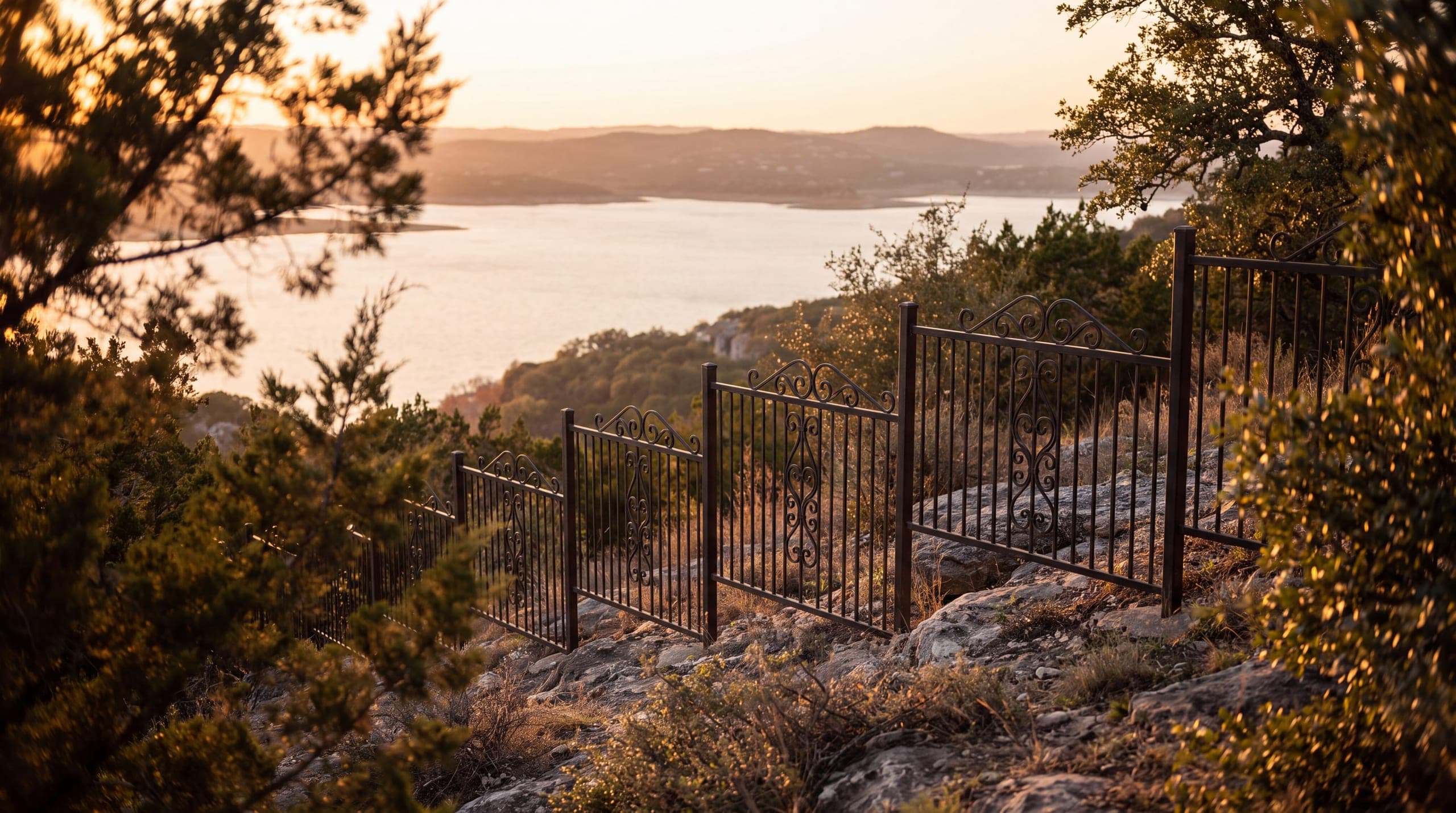
| Ornamental iron or steel | View lines toward the lake and hills, pool enclosures | No privacy, and the price per foot is higher |
| Masonry with iron panels | Front entries, street frontage, HOA-heavy neighborhoods | Engineered like a wall, so it costs and takes the most |
| Trex composite | Privacy where the owner wants no staining schedule | Higher material cost up front |
Masonry is the one people underestimate. A fence wall gets sized for lateral load like a structure, and an 8-foot wall in the 20 psf tier calls for No. 4 vertical bars at 16 to 24 inches on center over a 12-by-42-inch footing (NCMA, 2007). Any bid for a stone or brick fence that skips reinforcement and footing size is pricing a picture of a wall.