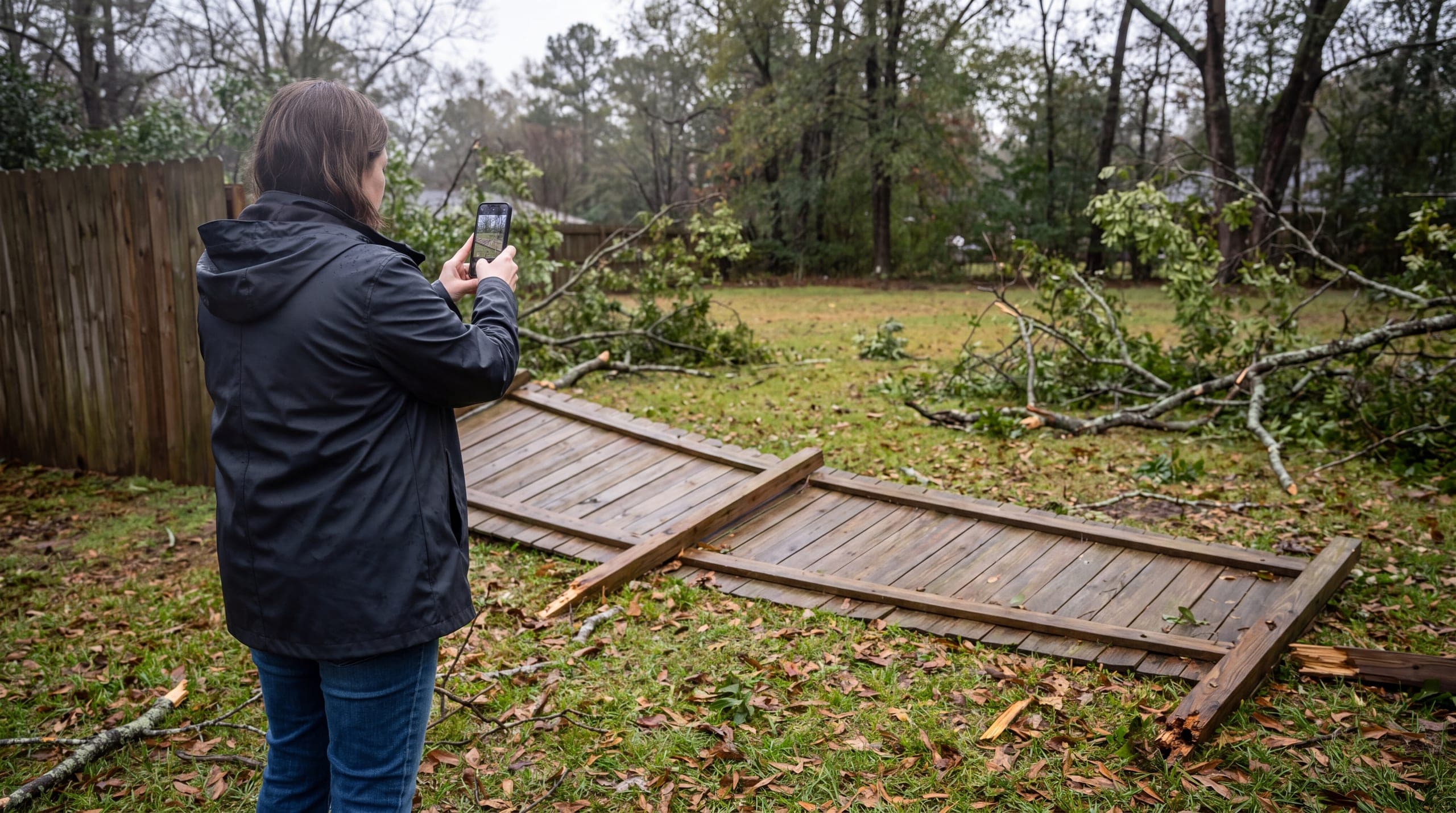
Wind takes fences down across Texas every year, and most homeowners treat the insurance claim as the plan. The Texas Department of Insurance is blunt about what that plan actually pays: fence coverage exists only if your policy covers wind, and it is usually capped at actual cash value, so depreciation and your deductible come out before any check does. That gap between covered and worth filing is where the way the fence was built stops being a detail and starts deciding the outcome.
Wind Coverage on a Texas Fence Comes With Two Deductions
Only if your policy covers wind, and even then the check is smaller than most people expect. The Texas Department of Insurance says that if your policy provides coverage for wind, you likely have some coverage for the fence, and that fence coverage is usually limited to actual cash value. Depreciation comes off what the company pays. Then your deductible comes off too.
A fence loses paper value every year it stands. The certified home inspectors’ reference chart rates a wood fence at about 20 years of service life (InterNACHI), so a fence ten years into that life has already shed a large share of its value on an adjuster’s worksheet.
Run the arithmetic on a real yard. Say the rebuild is $4,000, the fence is a decade old, and your deductible is $1,000. Depreciation takes a bite, the deductible takes the next one, and what is left may not be worth the phone call. That is the outcome we see most often after a windstorm.
Photograph the Damage Before You Move a Single Board
Take pictures first, before anyone touches the pile. The Texas Department of Insurance is direct about the order: take pictures of the damage before doing any work, and your policy should pay for the materials and labor you used to make repairs. TDI also says it is generally OK to make temporary repairs, but not to make permanent repairs until you have talked to your insurance company.
That order protects the only evidence you have. A crew that hauls off the wreckage on Saturday has hauled off your proof.
| Step | What to do | Why it matters |
|---|---|---|
| 1. Document | Photograph the fallen fence from both sides before moving anything | TDI says to take pictures of the damage before doing any work |
| 2. Secure | Prop or brace the line, close off the yard for pets and kids | TDI says temporary repairs are generally OK |
| 3. Wait | Hold off on permanent rebuild until the insurer has been contacted | TDI says not to make permanent repairs before talking to the company |
| 4. Keep receipts | Save invoices for materials and labor on temporary work | Your policy should pay for the materials and labor used in those repairs |
Read These Four Terms Before the Adjuster Calls
Four words decide the size of your check, and three of them subtract. Actual cash value is the one that catches homeowners off guard, because it is the replacement cost of the fence minus every year of age and wear the adjuster can defend. Learn the vocabulary before the call and the conversation gets shorter.
| Term | What it means on a fence claim |
|---|---|
| Actual cash value | What the fence was worth the day the wind hit, after age and wear are subtracted |
| Depreciation | The dollars taken off for the years the fence already stood |
| Deductible | The amount you pay yourself before the insurance company pays anything |
| Other structures coverage | The part of a homeowners policy covering detached items like fences, commonly limited to 10% of the amount the house is insured for |
| Temporary repair | Bracing or securing work done to prevent more damage, which TDI says is generally OK before the insurer signs off |
Call Your Agent, Because Fence Wording Changes Policy to Policy
Two houses on the same street can carry very different fence language. The Texas Department of Insurance says policies have different language, and tells homeowners to check the policy or call the agent or company with questions about what is covered. Nobody can answer this for you from the curb, and neither can we.
Three questions get you the whole picture in one call.
- Does my policy cover wind at all, and is there a separate windstorm deductible? Coastal policies often handle wind differently from the rest of the policy.
- Is my fence paid at actual cash value or replacement cost? This single answer is usually the difference of thousands of dollars.
- What is my other structures limit, and what else shares it? A detached garage, a shed, and the fence may be drawing on the same pool.
On the Coast, the Wind Part of the Policy May Not Be There at All
Everything above assumes your policy covers wind. Along the Texas coast, many of them do not. The Texas Department of Insurance explains that in the 14 seacoast counties and parts of Harris County on the bay side of Highway 146, insurers commonly write homeowners policies that exclude windstorm and hail entirely, and homeowners buy that coverage separately through the Texas Windstorm Insurance Association. TWIA is the state-created insurer of last resort for exactly this gap, and a TWIA policy is what pays when wind takes a fence down in those designated areas.
That matters on a fence claim in a specific way. If your homeowners policy carries a wind and hail exclusion and you never added TWIA, a wind-flattened fence is not a small check after depreciation. It is no check. And a TWIA policy carries its own deductible, calculated as a percentage of the insured amount rather than a flat dollar figure, which on most residential policies lands well above what a fence run costs to rebuild.
The other exclusion catches inland homeowners just as often. Insurance pays for sudden damage, not for the years leading up to it. Rot at the ground line, wood already soft from decay, termite damage, posts loosened season after season by shrink-swell clay: an adjuster who finds any of that has found a maintenance issue, not a windstorm. The fence has to have been sound the day before the storm for the storm to be the cause of loss.
| Situation | What the policy usually does |
|---|---|
| Inland county, wind covered | Pays actual cash value on the fence, minus depreciation, minus your deductible |
| Seacoast county, wind excluded, no TWIA | Pays nothing for wind damage to the fence |
| Seacoast county, TWIA policy in force | Pays under the TWIA policy, subject to a percentage deductible |
| Posts already rotted or loose before the storm | Denied or reduced as wear, rot, or neglect rather than sudden loss |
But a Fence Sized for Texas Wind Never Starts the Claim
A solid privacy fence catches nearly the entire wind that hits it. Boundary-layer wind-tunnel testing puts the normal force coefficient on a wall standing on the ground at about 1.45, and it barely changes as the wall gets longer (Letchford, 2001). Your fence is not a screen. It is a sail with posts.
Engineers already treat it that way. The national design-load standard handles a solid privacy fence as a solid freestanding wall and loads the whole face of it, using a force coefficient that climbs as the wall runs longer relative to its height (ASCE/SEI 7-22, 2022). The same standard maps the Houston area at basic design wind speeds on the order of 130 to 140 mph for ordinary structures, rising toward roughly 150 mph at the shoreline (ASCE/SEI 7-22, 2022).
Built to that reality, a fence stops being a claim waiting to happen. In a Google review, Celeste T. wrote that her “Fence didn’t budge an inch when severe storms came through the next day!”
How Deep the Posts Go Decides What Is Standing on Monday
Post embedment is the number that survives the storm, and almost no quote lists it. The residential code sizes a fence post as a cantilevered pole, with required depth growing as the wind force and its lever arm grow, and shrinking only as the soil gets stronger. Because the code credits the soil over just one-third of the embedded depth, a tall solid fence in soft ground drives a deep, wide concrete footing (2021 International Building Code, Section 1807.3.2.1).
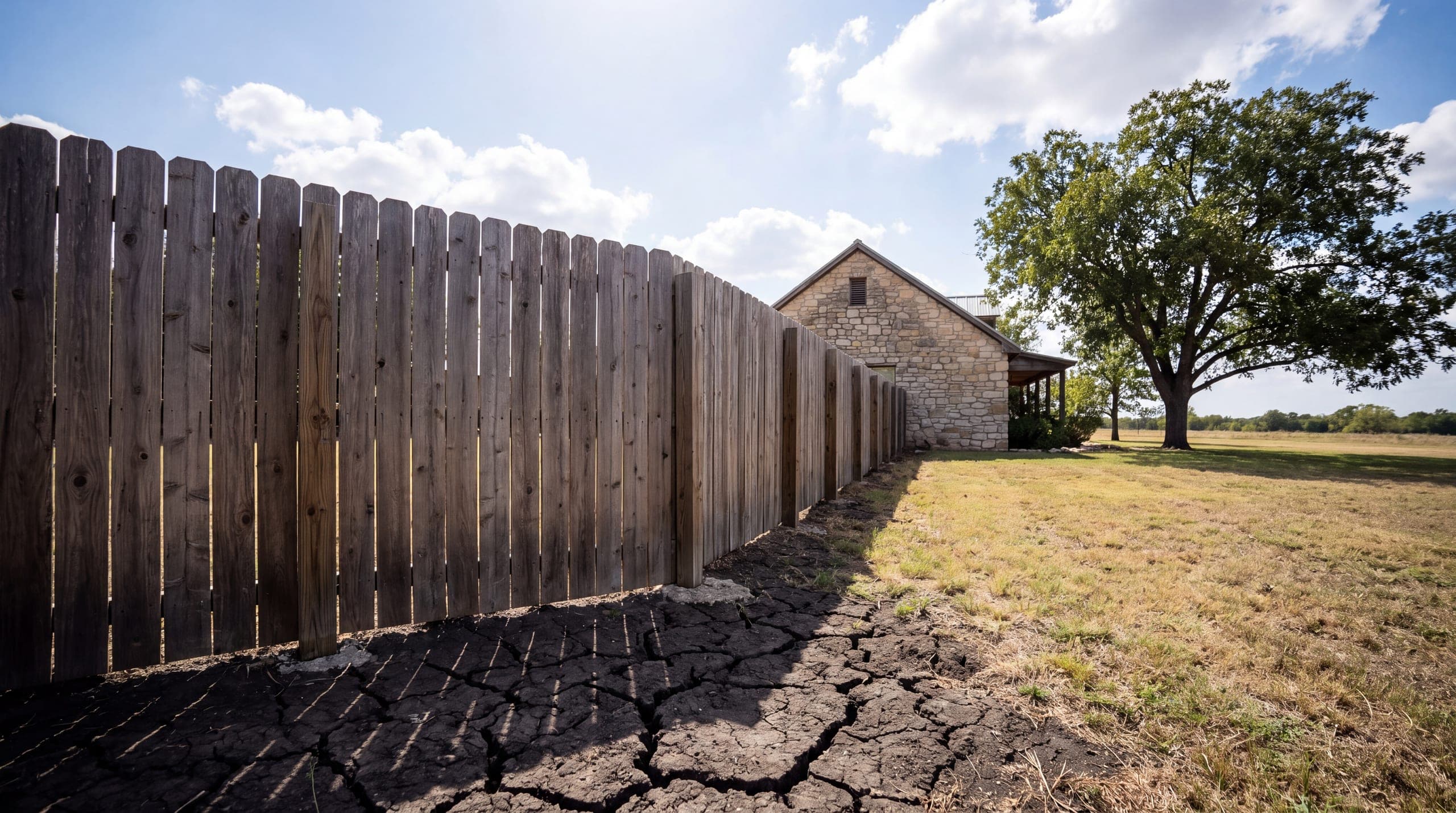
Texas ground is the hard part. The state soil, Houston Black, runs roughly 60% to 80% clay across the Blackland Prairie from Dallas south to San Antonio, and its shrink-swell behavior is a recognized limit for building sites (USDA NRCS, 2023). Clay that swells wet and pulls away dry loosens a shallow post a little more every season. Then one windy night finishes it.
| Where it fails | What the storm found | What prevents it |
|---|---|---|
| End panels | A free end with no return corner catching full pressure | Corner bracing and deeper end-post embedment |
| Gate posts | A heavy swinging gate on a post set like a line post | Oversized gate posts with a larger concrete footing |
| Post at ground line | Wood already soft where soil meets air | Ground-contact rated posts, concrete crowned to shed water |
| The whole run leaning | Posts spaced too far apart for the wind area they carry | Tighter post spacing sized to fence height |