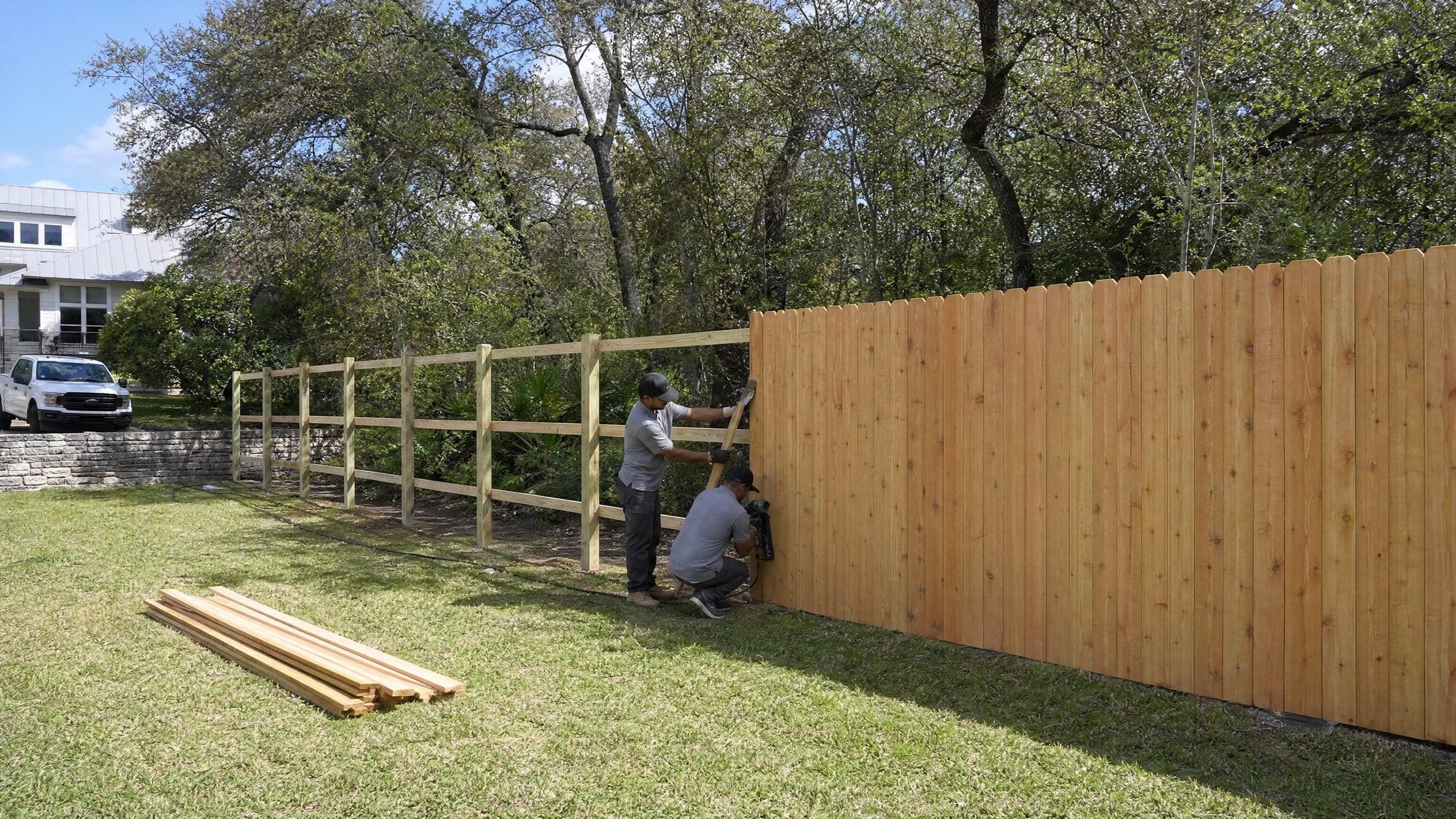
Walk a brand new Texas home at the final walkthrough and the backyard is usually bare dirt all the way to the property line. Most buyers read that one of two ways: a fee the builder buried, or a fence somebody forgot to order.
Neither one happened. The fence is the last thing that can go on that lot, and that timing is the reason it sits outside the base price on most Texas builder spec sheets.
Your Base Price Buys the House, and the Options Sheet Buys the Yard
The base price covers the house and the standard features list attached to it. Almost everything outside the slab moves to the options addendum or lands on you after closing. Builders hold that line hard right now, because construction costs equal 64.4% of the average new-home sales price, a record high in a series running back to 1998 (NAHB, 2025). A backyard fence is one of the easiest items to move off the advertised number.
| Item | Where it usually shows up | Who signs for it |
|---|---|---|
| House shell, roof, standard interior finishes | Base price | Builder, per the standard features list |
| Front yard sod and street trees | Base price or a curb-appeal package | Builder |
| Sprinkler system | Options addendum on many plans | Buyer, before closing |
| Backyard privacy fence | Rarely in the base price on a Texas spec sheet | Buyer, usually after closing |
| Driveway gate and operator | Outside the builder contract | Buyer |
| Deck, pergola, or gazebo | Outside the builder contract | Buyer |
Read the standard features list line by line. If the word fence is not printed on it, assume the fence is yours to buy.
Fencing Is the Last Trade on the Lot Before You Can Close
A fence crew works after the yard is graded, after the irrigation is trenched, and after the lots on either side are done being built on. 2024 single-family completions averaged 9.1 months from authorization to completion, and 7.6 months from permit to completion for homes built for sale (U.S. Census Bureau, 2025). Exterior site trades sit at the tail end of that run, close to the certificate of occupancy.
We know that sequence from the inside. From 2002 to 2019 we fenced entire new neighborhoods for regional and national builders in Houston, and the backyard fence was the last trade on site before a home could close.
The order is physical, not administrative. A framing crew, a plumber, and a concrete truck all need to reach the back of the lot. A fence set before final grade gets dug up when the dirt work finishes. Posts set over an untrenched irrigation run get pulled when the sprinkler crew arrives. Builders leave the fence loose because building it early means building it twice.
Learn These Five Terms Before You Read the Spec Sheet
Builder paperwork uses a small vocabulary, and the fence question is decided inside it. Here is what each word means on a Texas new-construction contract.
| Term | What it means on your paperwork |
|---|---|
| Base price | The advertised price of the house with only the standard features attached |
| Standard features list | The printed list of what the base price includes; if fencing is absent, it is excluded |
| Options addendum | The signed page of upgrades added to the base price before closing |
| Final grade | The last dirt work that sets yard drainage; fence posts go in after it |
| Linear foot | The unit a fence is measured and priced in, measured along the run |
Confirm These Five Things in Writing Before You Sign
Get every fence answer on paper before closing, because a verbal answer from a sales office does not survive the walkthrough. Five items settle almost every new-build fence surprise.
- Whether any fence is included at all. Point at the standard features list and ask for the line. A fence promised in conversation and missing from the list is not included.
- Which lot lines the builder fences. Some builders fence a subdivision perimeter, a detention pond edge, or a park boundary and leave the interior lot lines to owners. Ask which runs are yours.
- The final grade date. Ask when the yard reaches final grade and when the sod goes down. That date is the earliest your fence can be set correctly.
- Where the irrigation lines run. Ask for a marked plan or an as-built before anyone digs a post hole. A post hole through a lateral line is a repair you pay for twice.
- What the HOA architectural rules require. Height, material, stain color, and which way the finished face points are usually decided for you. Get the approved spec before you collect quotes.
A New-Build Fence and a Replacement Fence Are Two Different Jobs
A builder lot is the easiest fence a crew will ever set, and an established lot is the hardest. There is no old fence to tear out and haul off, no 40-year live oak with roots under the line, and no irrigation already in the ground. That gap shows up in the price, the schedule, and the crew size.
| What the crew faces | New-build lot | Established lot |
|---|---|---|
| Old fence removal | None; nothing to tear out or haul off | Full demolition and disposal of the old line |
| Trees on the line | Young landscape trees, if any | Mature root systems the crew has to work around |
| Irrigation | Often not yet installed | Existing lines to locate and protect |
| Site access | Open lot, gates and equipment reach the back easily | Access through a side yard, often by hand |
| Grade and drainage | Freshly graded and flat | Settled soil, slope, and old post holes |
One warning about price talk. Builder fence pricing and homeowner fence pricing are built from different math: volume across many lots, no haul-off, and no trees. The number a builder pays per lot is not the number a homeowner pays for one backyard, and a quote that blurs the two is not describing your job.
Your City and HOA Decide the Fence Before You Do
Since September 1, 2025, a Texas property owners’ association may not stop an owner from installing a perimeter fence or another security measure, though it keeps limited authority over fence type and material and may require a driveway gate set back at least 10 feet from a laned right-of-way (Texas Property Code, 2025). Fences installed before that date are grandfathered. Your architectural review packet still controls style, so file it early.
City rules run alongside the HOA rules, and they differ by metro.
| City | When a residential fence needs a permit | Source |
|---|---|---|
| Houston | Above 8 feet, or any masonry or concrete fence at any height | City of Houston, 2026 |
| Dallas | Above by-right limits; 4 feet max in a required front yard, 9 feet in any required yard | Dallas Development Code, 2025 |
| Austin | Above 7 feet, above 6 feet along a public right-of-way, or any height in a floodplain | City of Austin, 2025 |
| San Antonio | Front-yard solid fence capped at 3 feet, open fence at 4 feet, 8 feet maximum residential | San Antonio UDC, 2025 |
A standard 6-foot wood privacy fence in Houston, Austin, or a typical Dallas back yard is permit-exempt. That exemption covers paperwork only. The wind load on the fence does not change.