A first fence is a guess. A replacement is not, because the fence you are tearing out already showed you exactly how it fails in your yard. Choose the contractor who reads that evidence and specifies against it, since the same fence rebuilt the same way fails on the same schedule.
Your Old Fence Already Told You Why It Failed
Walk the line before you call anyone. Three signs carry almost all of the information: where the wood is soft, which sections lean, and whether the posts moved with the seasons. Each one points at a different cause, and each cause calls for a different fix in the new spec. Ten minutes with a screwdriver puts you ahead of most people collecting bids in Tomball.
Here is what to check, and what each finding means.
- Soft wood right at the ground line. Push a screwdriver into a post 2 inches above the dirt. If it sinks, moisture and fungi ate the post from the outside in while the top 5 feet still looked fine.
- Sections racked or leaning at corners and gates. Wind loads are not even across a fence. When the middle runs stand straight and the ends lean, wind pulled the ends apart.
- Posts that tilt one season and partly right themselves the next. That is soil movement, not rot. The post is fine and the hole is the problem.
- Rust bleeding down chain link fabric or hardware. The coating class was too light for the exposure, or the hardware was a grade below the fence it was holding.
What “Ground Contact” and “Class 2” Mean on a Fence Bid
A replacement bid is a materials list, and the words that decide how long the fence lasts are usually the ones buyers skim past. Style and color are easy to compare. Treatment class, coating weight, and embedment depth are the lines that separate a 20-year fence from a 7-year one. Learn four terms and you can read any bid in town.
| Term | What it means for your replacement |
|---|---|
| Ground contact (UC4A) | The treatment class for wood buried in soil. Fence posts belong here. |
| Heartwood | The dense inner wood that resists decay. Sapwood on the same board does not. |
| Embedment | How deep the post sits in concrete, sized from wind load and soil strength. |
| Class 2 galvanized | Chain link fabric with the heavier zinc coating, which outlasts Class 1. |
Rot at the Ground Line Is Our Climate Beating the Spec
Greater Houston sits deep in the high-risk band for wood decay. The decay-hazard index for Houston is 77.2, where anything above 65 counts as high risk, against 44.3 for Dallas and 25.8 for El Paso (USDA Forest Products Laboratory, 2009). A fence that rotted here in 7 years was not badly built by accident. It was built to a spec that would have been fine in a drier part of Texas.
Wood only rots when it stays wet. Around Tomball it stays wet, so the fix is in the details at the bottom of the fence: posts treated for ground contact, pickets held up off the dirt, and a gap that lets air move behind the boards. If your last fence had pickets sitting in the soil, that single detail explains the failure.
Cedar buys you time because its heartwood resists decay. The knot-free grades cost more per foot, and mixed sapwood in the same bundle rots on roughly the schedule pine does.
Leaning Corners and Gate Posts Point to Wind Load
A solid privacy fence behaves like a wall in the wind, catching nearly the whole gust across its face. The national design-load standard maps the Houston area at basic design wind speeds of about 130 to 140 mph for ordinary structures (ASCE/SEI 7-22, 2022). A 6-foot fence in Tomball is a 6-foot sail, and the posts are the only thing arguing with it.
The load is not spread evenly. Full-scale tests on freestanding walls found pressure peaks near the free ends and the leading edge (Journal of Wind Engineering and Industrial Aerodynamics, 1996). That is why end panels, corners, and the tall posts flanking a gate are almost always the first things to go, and why the fix is bigger posts and deeper concrete in those spots rather than a heavier picket everywhere.
Shadowbox and board-on-board styles let some air through. If storm damage is what put you in the market, the porosity of the design belongs in the conversation with the contractor.
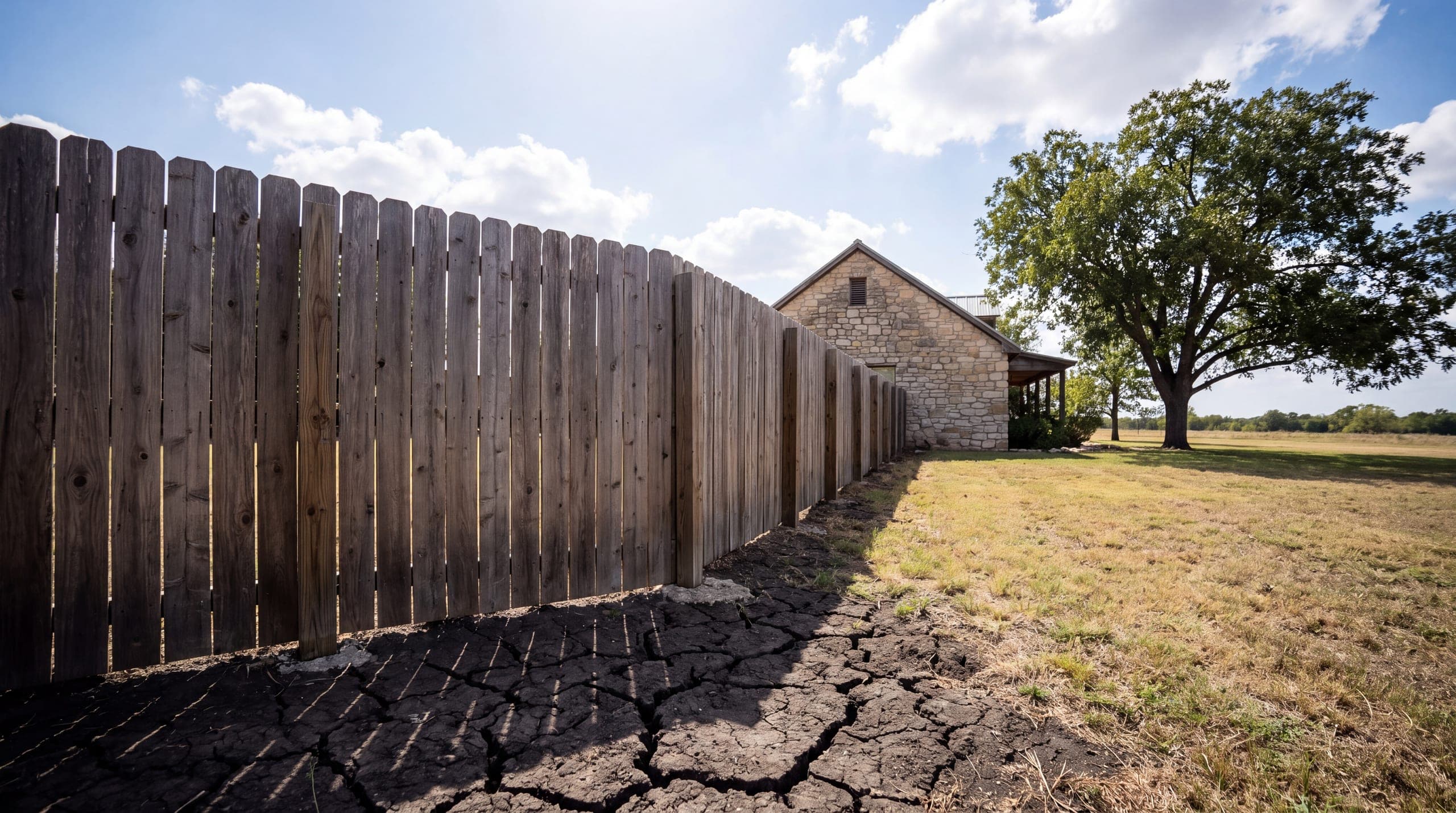
Posts That Tilt Each Season Are the Clay Moving
Expansive clay is the quiet, expensive one. Shrink-swell soils were estimated to cause about $2.3 billion in annual damage to U.S. structures, more than floods, hurricanes, tornadoes, and earthquakes combined in an average year (Civil Engineering, ASCE, 1973). Clay swells when it rains and pulls back when it dries, and a shallow post footing rides that movement all year.
Post depth is an engineering number. The building code sizes an unbraced post from the wind force, the height of that force above grade, and the strength of the soil holding it, and it lets the soil resist over only part of the buried depth (2021 International Building Code, Section 1807.3.2.1). Soft clay and a tall gate together drive a deep, wide footing. A contractor who quotes the same hole for every post on every lot has not done that math.
But Rebuilding the Same Fence Buys You the Same Failure
Most replacement bids describe the fence you already had. Same height, same pickets, same post spacing, same hole. If the first one failed early, that bid is a plan to do this again in the same number of years, and the second teardown costs what the first one did. The useful bid names the cause and changes something specific because of it.
| What failed | What actually caused it | What has to change this time |
|---|---|---|
| Posts soft at the ground line | Wet ground contact in a high decay-hazard climate | Ground-contact treated or steel posts, pickets held above the dirt |
| Panels racked at corners and gates | Wind pressure peaking at ends and gate posts | Deeper, wider footings on end and gate posts, heavier gate hardware |
| Posts tilting and shifting seasonally | Shrink-swell clay working a shallow footing | Footings sized to the soil and fence height, set below the active layer |
| Rusted chain link fabric | Zinc coating too light for the exposure | Class 2 galvanized or vinyl-coated fabric, matching hardware grade |
Ask These Five Questions Before You Sign a Replacement Bid
The questions below sort contractors faster than any price comparison, because they force the bidder to commit to a cause. In a December 2025 survey of 1,000 U.S. property owners, 70% went over budget on their most recent renovation and 10% specifically regretted choosing the wrong contractor (Clever Real Estate, 2026). Regret on a fence usually starts with a bid nobody questioned.
- “Why do you think the old one failed?” A contractor who answers with the material, the water, and the wind has looked at your yard. A contractor who answers “they just wear out” has not.
- “How deep are the post holes on my lot, and why that depth?” You want a number tied to fence height and soil, and a reason it differs at the gate and the corners.
- “What treatment class are the posts?” Ground contact for anything buried. Get it written on the bid, not said in the driveway.
- “Who is accountable if a crew does not show?” Ask for the name and the phone number of the person who fixes a schedule problem.
- “What does the warranty actually cover?” Workmanship and materials are two different promises with two different terms. Fence companies serving the Tomball area publish one-year workmanship warranties on the install, and manufacturer coverage on the materials is a separate document.