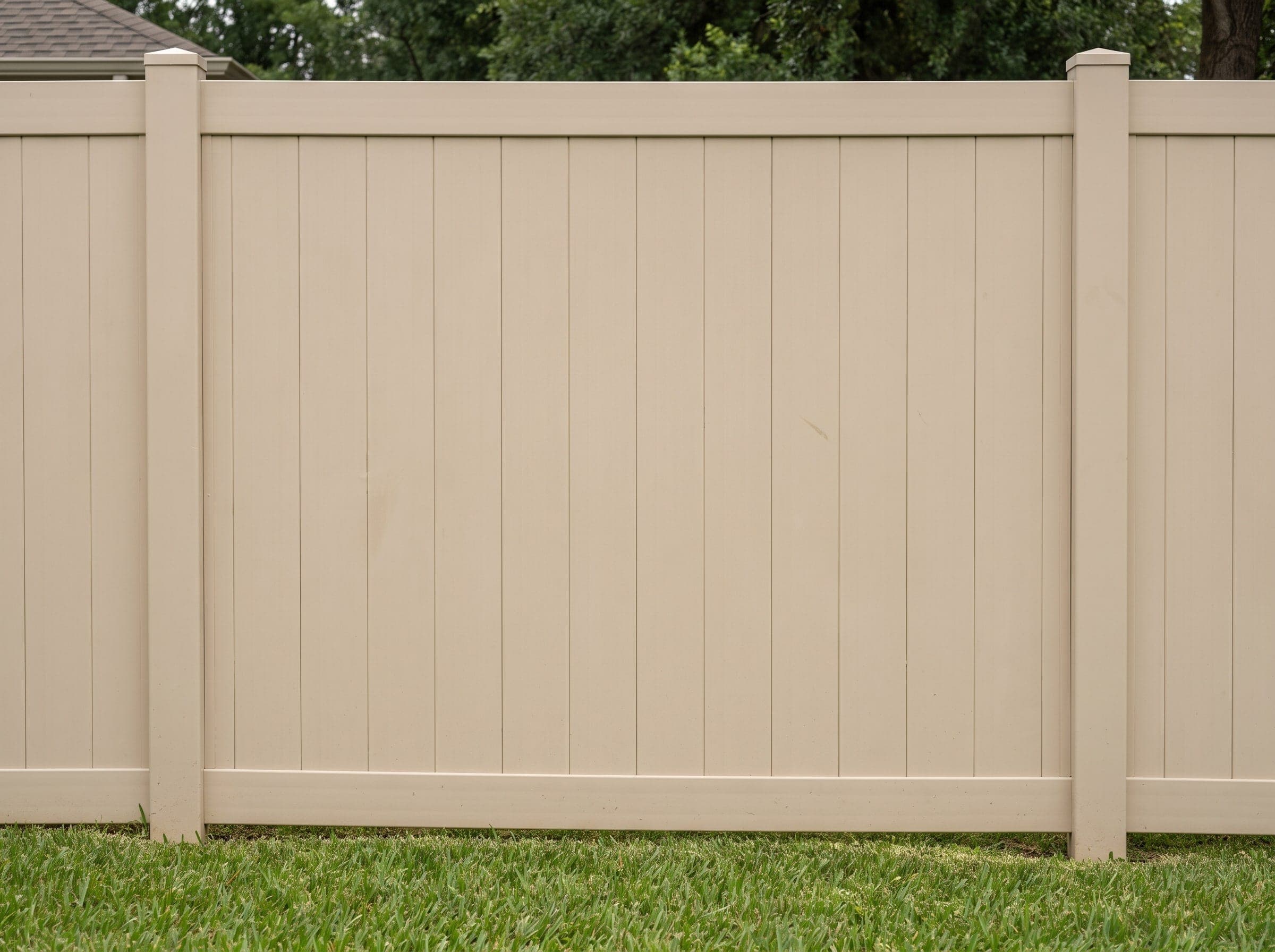
Yes, for most families, and the reason is plain: a vinyl panel has no splinters, no nail heads, and no stain or preservative for a child or a dog to touch. What that answer leaves out is the part that fails. Spacing, gate hardware, and panel strength decide whether the fence actually holds a toddler or a 90-pound dog, and all three get settled before anyone digs a hole.
So the safety is written into the spec, weeks before the panels reach your yard.
Vinyl Panels Stay Smooth Where a Wood Fence Cracks and Splinters
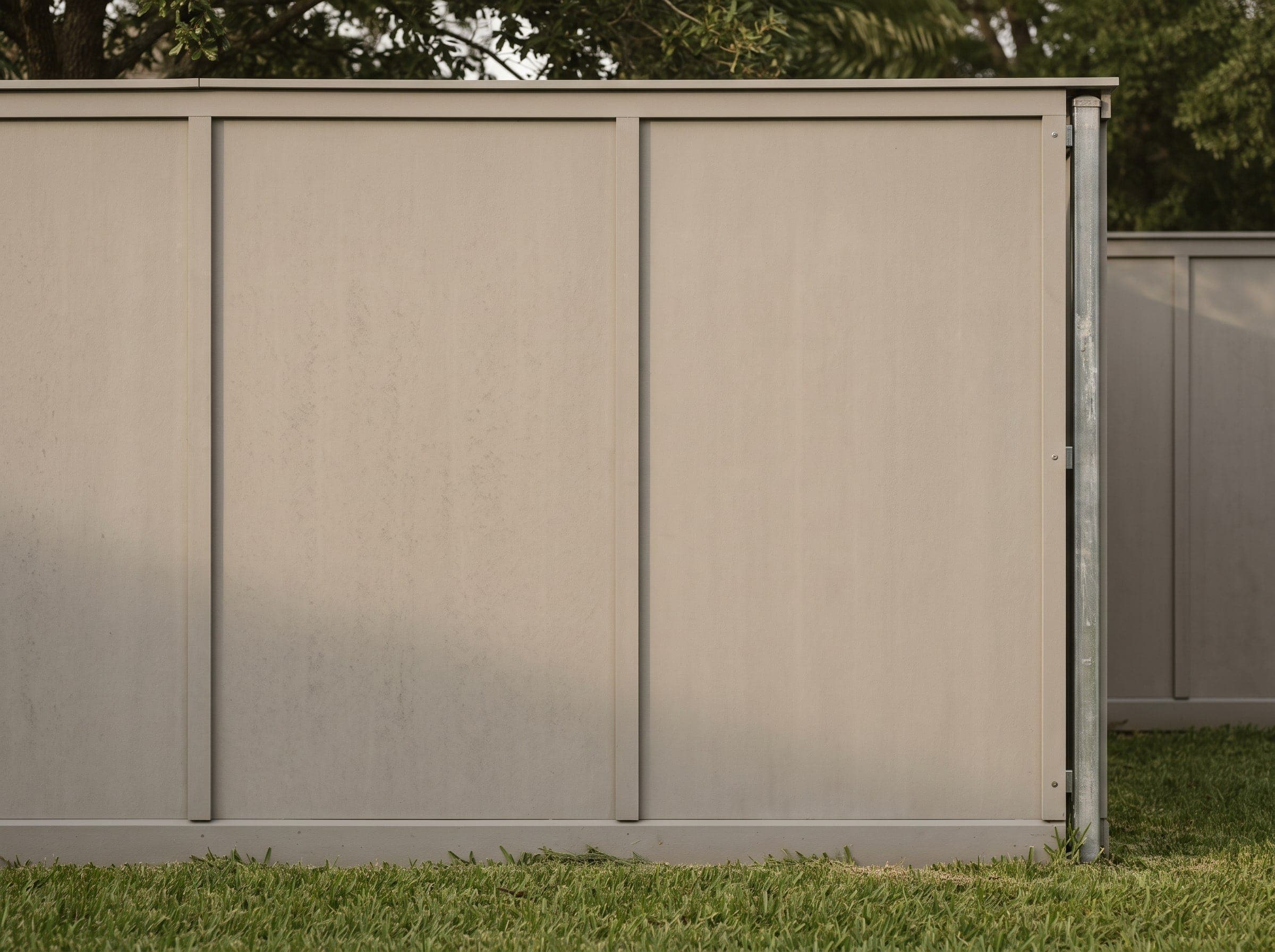
A vinyl panel has no grain, so there is nothing in it for a splinter to peel away from. Wood gets there in time. Sun and wet cycles raise the grain, boards check along the edge, and a hand run down the top rail finds it. InterNACHI’s life-expectancy chart rates a wood fence at about 20 years and a vinyl fence at 100-plus (InterNACHI, n.d.).
That matters most at the two heights nobody looks at. A crawling child touches the bottom 18 inches of your fence more than you ever will. A dog that patrols the line drags a flank along the same run every day for a decade.
Smoothness is the one safety property vinyl brings on its own. It survives a mediocre install, a wrong post depth, and a gate hung an inch off. Everything else on this page does not.
No Nail Heads or Sharp Edges for a Child to Catch
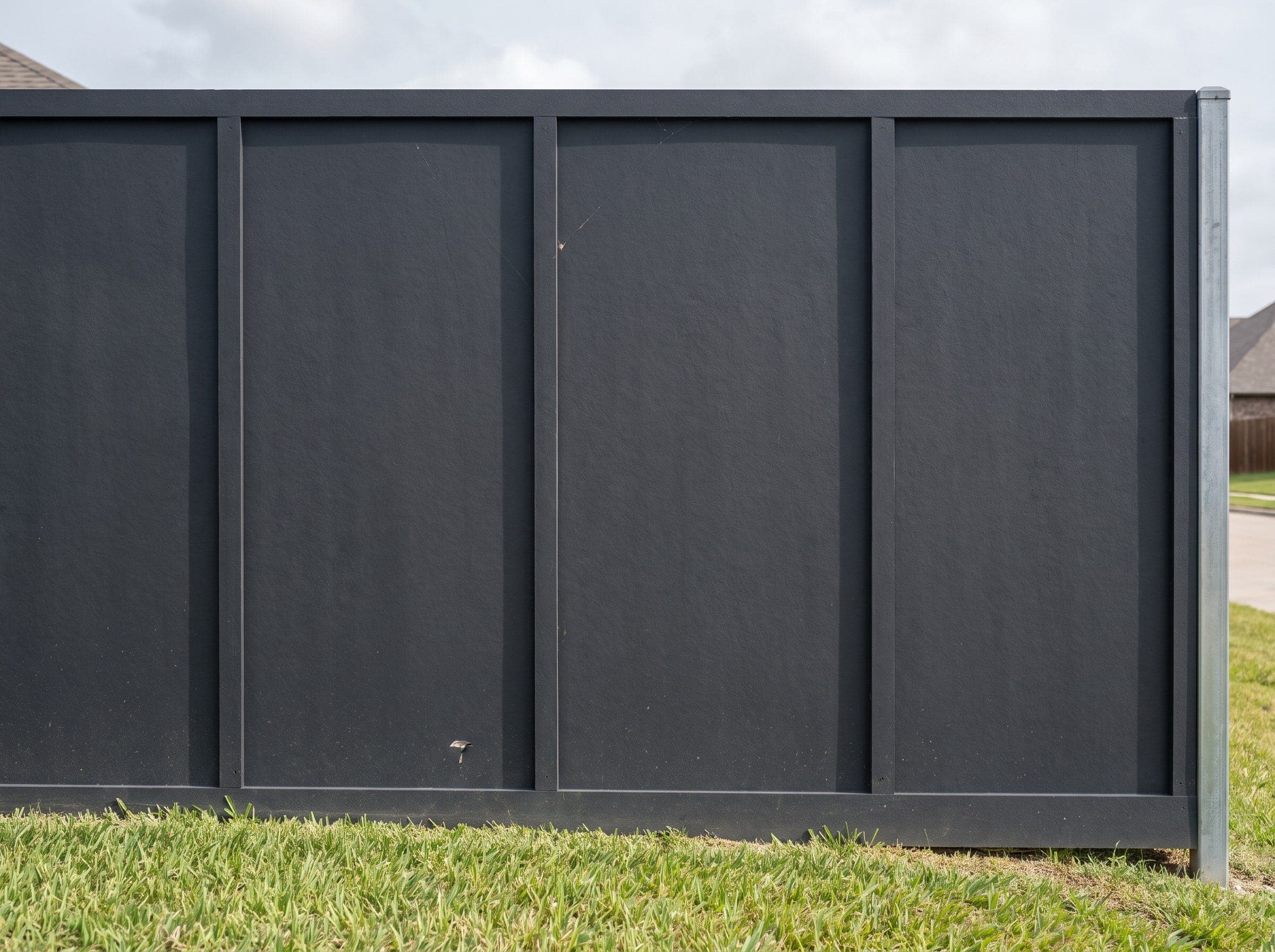
Vinyl pickets slide into routed slots in the rails, so a properly built panel shows no screws or nail heads at kid height. A wood fence hangs its boards on fasteners, and Texas heat cycling works those loose over the years until one backs out proud of the board. The place vinyl still needs attention is the gate, where the hardware is metal and the gaps are real.
| Term | What it means on a vinyl fence quote |
|---|---|
| Routed rail | Rails with cut slots the pickets sit in, so no fasteners show |
| Wall thickness | How thick the PVC is on a picket, rail, or post |
| Post spacing | Distance between post centers, which sets the panel span |
| Self-closing hinge | A hinge that pulls the gate shut on its own |
| Ground gap | The space between the bottom rail and the dirt |
Ask for three things on the gate and you have covered most of what goes wrong with small children. A self-closing hinge, so the gate shuts when a 4-year-old walks off and leaves it. A latch mounted high and facing the yard side, out of easy reach from the street. And a hinge gap tight enough that a small hand or a small dog cannot work through it.
Nothing on a Vinyl Panel Gets Stained, Painted, or Chewed Off
The color in a vinyl fence runs through the material, so there is no coat on the surface to flake, chalk onto hands, or come off in a puppy’s mouth. A wood fence is a different situation. It gets a stain or a sealer every few years, its posts carry preservative because they are buried in ground contact, and both of those live on the face your dog chews.
This is the cleanest single advantage vinyl has for a household with a mouthy dog or a toddler in the teething stage. It does not make the panel chew-proof. It means that when a dog does work at a rail, what comes off is plain PVC with nothing painted on it.
Vinyl Does Not Hold Heat the Way Chain Link or Iron Does
Metal moves heat fast and hands it to whatever touches it, which is why a black iron rail in a Houston July is a rail nobody leans on. Vinyl conducts heat poorly, so the same sun leaves a panel warm instead of scorching. The Office of the Texas State Climatologist projects 100-degree days becoming roughly four times as common by 2036 as they were in the 1970s and 1980s (Office of the Texas State Climatologist, 2024).
Two honest limits. A dark vinyl panel in full afternoon sun still gets hot, and light colors run cooler. And a dog that flops against the fence line all summer is going to pick the shaded run whatever it is made of.
A Garden Hose Handles Most of the Cleaning
Dirt, pollen, and dog nose prints come off vinyl with water and a soft brush, which is the whole upkeep story for the first several years. What the fence does over the long run is a slower kind of change, and it is worth knowing before you buy rather than after.
- Everyday grime. Rinse it down when you water the beds. Mud at the bottom rail after a wet week is the most common thing you will clean.
- Chalking and gloss loss. A two-year outdoor exposure study across the USA, France, and Belgium found that titanium dioxide loading near 2% preserved more than 90% of ultimate tensile strength in rigid PVC, while its photocatalytic action still drove surface chalking, gloss loss, and color change (Gao, Bolt, and Feng, 2008). The panel stays strong. The finish softens.
- Scuffs at dog height. A dark scuff on a light panel usually wipes off. A gouge from a claw is permanent, and it is cosmetic.
But a Big Dog and a Digger Both Find Vinyl’s Limits
ASTM F964 requires the rigid PVC compound in a vinyl fence to hold a minimum impact resistance of 0.6 in.-lb/mil after weathering at hot-dry, hot-humid, and temperate test sites (ASTM International, 2019). That is a genuine engineering bar, and it is the reason vinyl earns its reputation. It is also a test of the compound, run on flat sections in a lab.
The standard says so itself. ASTM D4226 notes that impact values from flat sections do not necessarily indicate the impact resistance of the whole profile (ASTM International, 2019). Your dog does not hit a flat coupon. It hits a routed panel spanning between two posts, at whatever spacing the crew set them.
Wind loads the same parts. Boundary-layer wind-tunnel tests on freestanding walls measured a normal-force coefficient of about 1.45, nearly independent of the wall’s length (Letchford, 2001). A solid privacy fence catches close to the full wind, so the posts under a vinyl fence are already carrying a load before a dog ever leans on one. Digging is the other failure, and it has nothing to do with the panel: a dog works the soft dirt at the ground gap until there is a way under.
| What your dog or child does | What to specify before install | Why it holds |
|---|---|---|
| Digs at the fence line | Concrete mow strip or a buried barrier under the bottom rail | Takes away the soft gap a dog works at |
| Leans or charges the panel | Closer post spacing and a heavier wall thickness | Shortens the unsupported span the dog loads |
| Jumps or climbs | Full-height privacy panels with no rails on the yard-side face | Gives a climber no toehold |
| Bolts through an open gate | Self-closing hinge, latch high on the yard side | Shuts the gate when a child forgets |
| Slips a small gap | Solid privacy panels instead of spaced pickets, tight ground gap | Leaves no picket gap for a small dog |
Get those decisions onto the estimate in writing. A quote that says “6-foot vinyl privacy fence” and a price has told you almost nothing about whether it contains your animal.
| Line on the estimate | What it should name |
|---|---|
| Panel style | Solid privacy, semi-private, or spaced picket, by name |
| Post spacing | The center-to-center distance, in feet |
| Bottom of the fence | Ground gap, plus any concrete or buried barrier |
| Gate hardware | Hinge type, latch type, and which side the latch faces |
| Warranty | What the crew’s work covers, and for how long |