
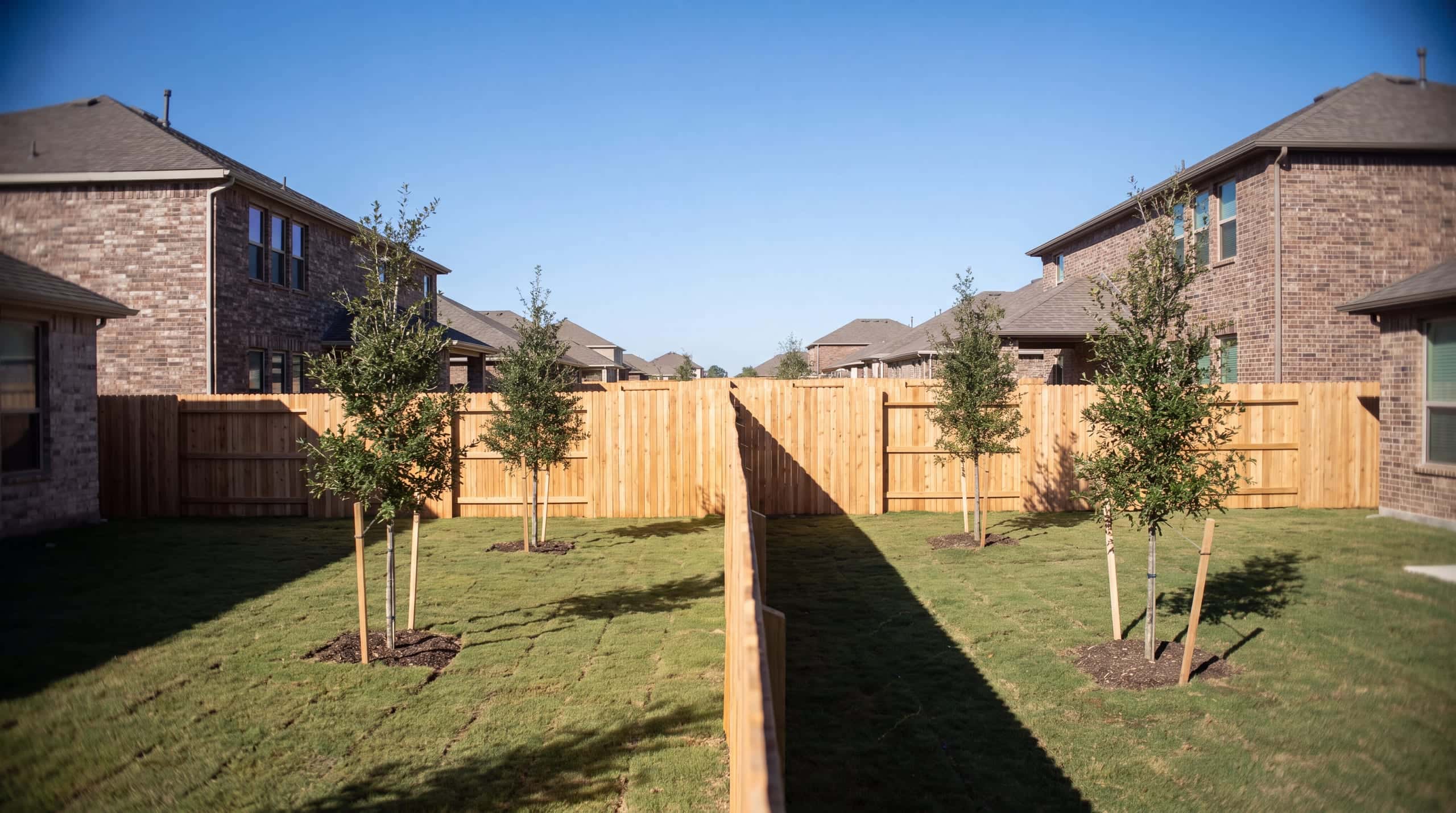
Ask a Cedar Park or Round Rock fence contractor six things: how deep it sets the posts, who pays if the auger hits rock, how it keeps the line straight in clay, which wood and picket grade the price assumes, who confirms the city rule and the HOA packet, and whether tear-out is in the number. Johnson Fence works both cities from its Austin office in Round Rock, rated 5.0 stars across 32 Google reviews (October 2026).
Most fence shopping here ends with three numbers on three pieces of paper, and the three numbers are almost never for the same job.
The ground under these two cities changes as you drive across them. Hill Country limestone sits close to the surface on the west side, deep prairie clay takes over as you move east, and those two soils break a fence post in opposite ways. A bid that never mentions your dirt has not priced your fence.
Why Does Soil Matter So Much for a Cedar Park or Round Rock Fence?
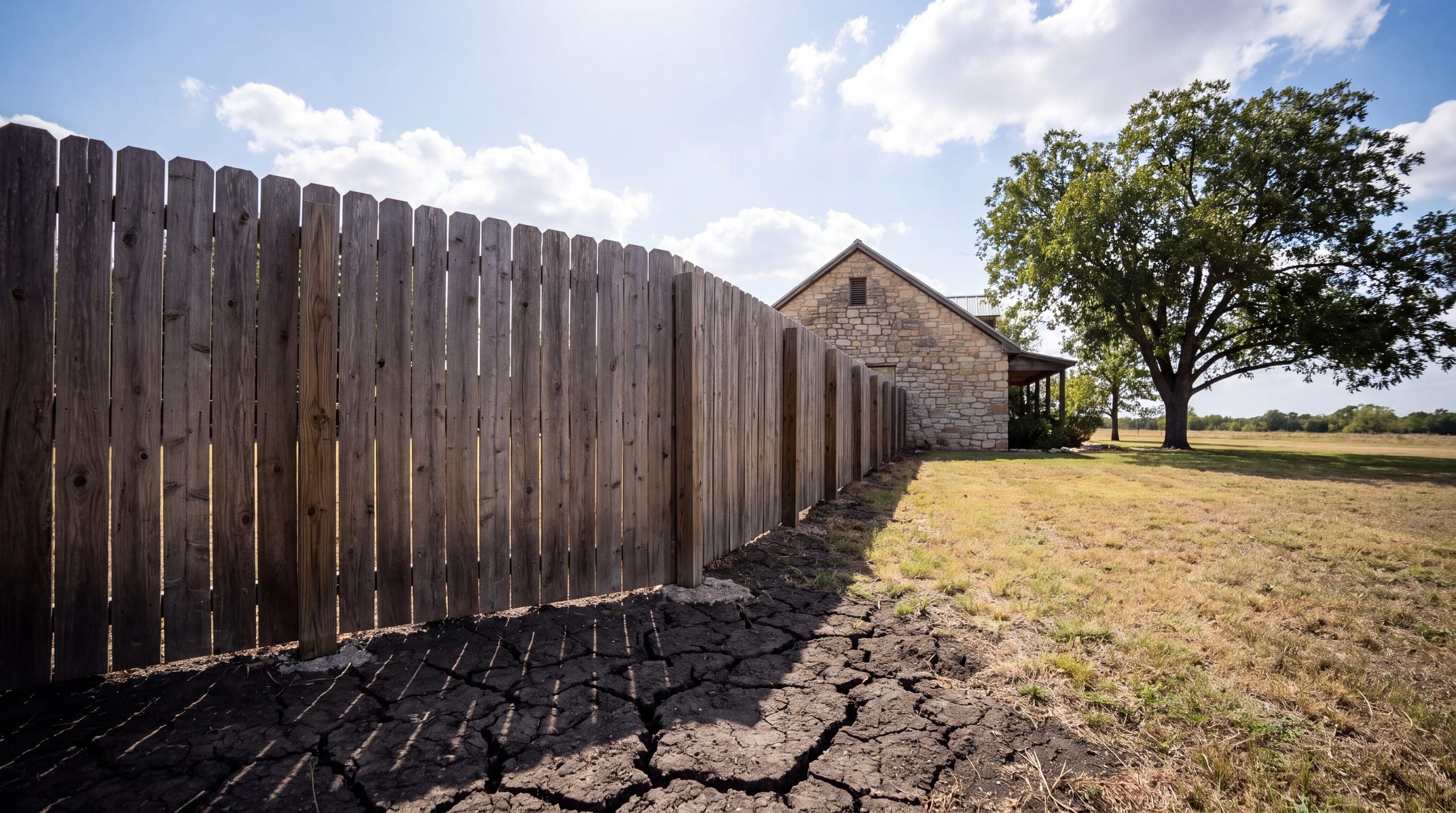
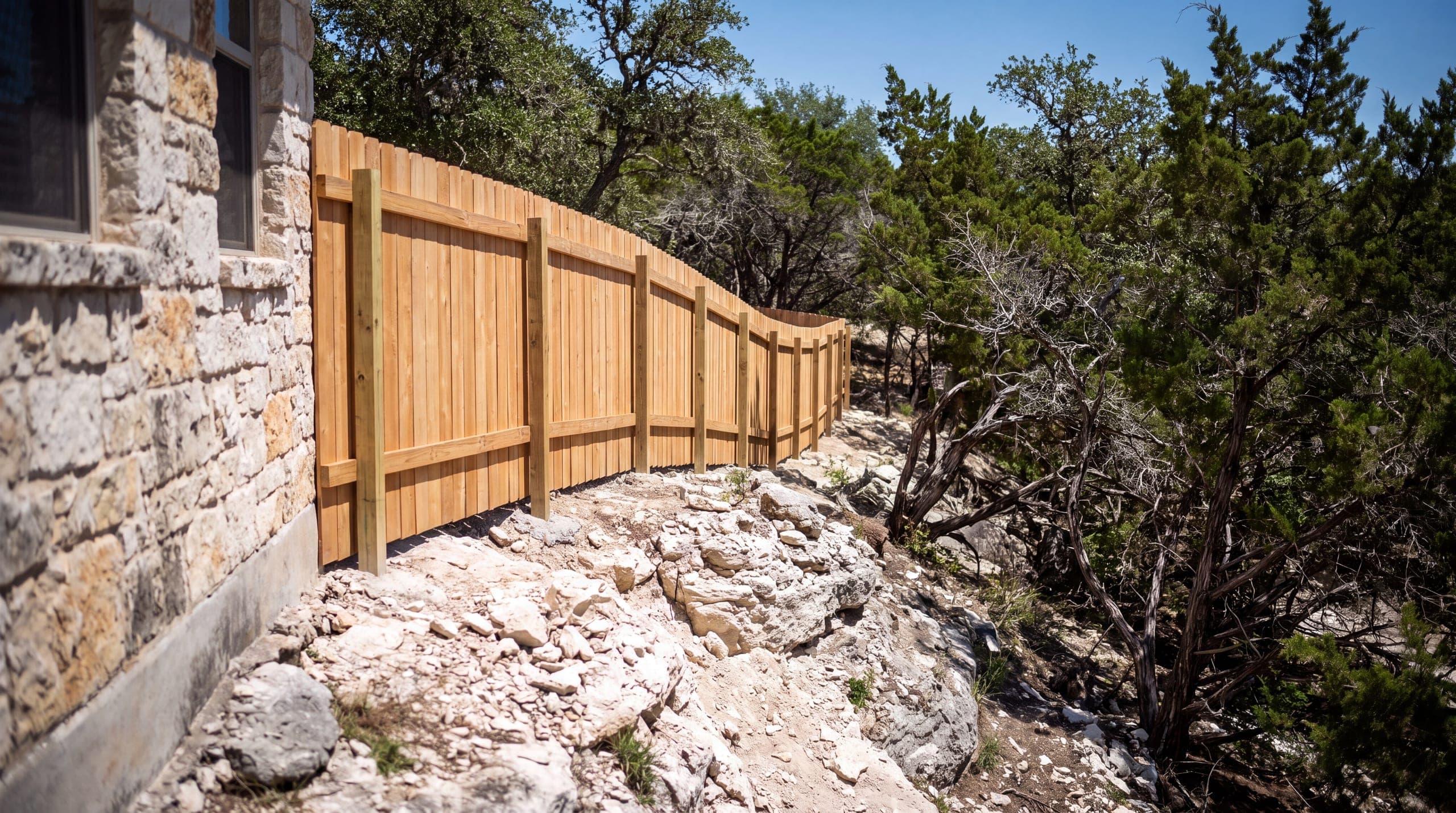
Because two soils meet under these cities: rock to the west and shrink-swell clay to the east. West of the change, the auger hits rock before it hits depth. In Central Texas soils of this kind, the cemented caliche layer can start around 13 to 22 inches down (USDA NRCS, Gruene series). East of it, the ground is deep clay that swells when it rains and shrinks when it bakes, working a post loose a little each season. One fence, two failure modes, two very different amounts of labor in the hole.
That is why a price per foot tells you so little here. Two crews can quote the same 200 feet of cedar and mean two different amounts of digging. Here is how the ground maps to the question you should be asking.
| Where the lot sits | What the ground does | What the bid has to name |
|---|---|---|
| West Cedar Park, limestone side | Rock or caliche can stop an auger short of the planned depth | Rock drilling method, and the price if the crew hits refusal |
| The transition ground between them | Rock depth can change inside one fence line | Who confirms depth on site, and what changes if it does |
| Round Rock, Pflugerville, Hutto prairie clay | Clay swells and shrinks, prying at every post | Hole depth, hole width, and concrete footing, in writing |
What Terms Should You Know Before Reading a Local Fence Bid?
Five words decide whether two bids can even be compared. Bidders use them loosely, and a homeowner who reads them the same way twice can catch a spec gap in about a minute. None of them are technical once someone says what they mean.
| Term | What it means | Why it matters here |
|---|---|---|
| Linear foot | One foot of finished fence line, measured on the ground | Two bids for “200 feet” may be two different measurements |
| Picket grade | The mill’s quality rating, #1 through #3 | “Cedar” is not a spec until the bid names a grade |
| Embedment | How much of the post sits below grade | This is the number a cheap crew shortens first |
| Rock refusal | The auger stops on rock above the planned depth | Common on the limestone side of Cedar Park |
| Shrink-swell clay | Soil that expands wet and contracts dry | The reason east-side posts tilt season after season |
How Deep Should the Posts Go, and Who Pays If the Auger Hits Rock?
Get the depth in writing, and get the rock answer in the same breath. Post depth is engineering, and the code treats a fence post as a cantilevered pole: required embedment grows with the wind force and the height of the post, and shrinks as the soil gets stronger (2021 International Building Code, Section 1807.3.2.1). Rock is strong soil. Reaching it is the expensive part.
Three questions get a real answer out of a bidder on the west side.
What depth are you setting posts to on this job? What do you do when you hit rock above that depth? And is that work inside this number, or does it come back to me later as a change?
A crew that works this ground has heard all three before and answers fast. A crew that has not will give you a depth and go quiet on the second question. That silence is the part of the bid you cannot compare, because it is the part that shows up after the contract is signed.
What Keeps a Fence Straight in Round Rock Clay?
Posts set deep enough to ride out the clay’s movement. On the east side the post fights the soil every year, year after year. Blackland Prairie clay runs roughly 60% to 80% clay, and the NRCS lists its very high shrink-swell potential as a recognized limitation for building sites (USDA NRCS, Houston Black series, 2023). Every wet season it presses in. Every dry season it pulls away.
So the questions change. How wide is the hole? Is the post set in a full concrete footing, or backfilled with dirt and a bag of mix at the top? How far apart are the posts, and what is the post material?
Then ask about the two spots that always go first: the corners and the gate. A gate hangs its whole weight and swings its whole weight off one post, and a corner post carries pull from two directions. If a bid gives every post on the property the same treatment, nobody looked at where your gate is.
Which Wood and Grade Should the Quote Name?
Cedar or treated pine, with the picket grade written down. Wood choice sets your service life, and this metro is kinder to it than the coast is. The nearest published decay-hazard station, Austin, scores 55.2 on the Scheffer index, inside the moderate band and well below Houston at 77.2 (USDA Forest Products Laboratory, 2009). Wood still fails here. It just fails slower, which makes what goes in the ground the deciding spec.
Cedar resists rot in its heartwood, and the pale sapwood on the same board does not. Pressure-treated pine is built for the part you bury. Ask which wood is going in the ground, which is going on the face, and which picket grade the price was written against.
The bands below are a modeled planning estimate for a standard 6-foot Texas residential fence, triangulated from published national and Texas cost ranges (HomeGuide, Angi, HomeAdvisor, and Ergeon, 2025 to 2026). They exclude tear-out, gates, and rock.
| Fence type, 6 ft residential | Modeled Texas installed cost per linear foot | What moves it |
|---|---|---|
| Pressure-treated pine privacy | $18 to $30 | Picket grade, post spacing, gate count |
| Cedar privacy | $25 to $45 | Heartwood content and knot-free grades |
| Ornamental steel or iron | $45 to $90 | Custom welded panels and gate hardware |
| Chain link | $12 to $28 | Height and coating class |
A low number is not automatically a thin spec. It can mean the builder buys wood cheaper. We buy pickets as Master Halco’s largest-volume customer, and that is where our number comes from. Ask any bidder with a low price which of those two things it is, and listen for whether they name a grade.
Who Confirms the City Rule and the HOA Packet?
The contractor should, in writing. Since September 1, 2025, a Texas property owners’ association cannot stop you from installing a perimeter fence, though it keeps limited say over fence type and material, and it can require a driveway gate to sit at least 10 feet back from a laned right-of-way (Texas Property Code, Section 202.023, 2025). Fences installed before that date are grandfathered. Your covenants still matter, and so does your city.
Cedar Park, Round Rock, Pflugerville and Hutto each write their own height and permit rules, so the answer for your address comes from your city. That is a phone call somebody has to make. Ask the bidder which one of you is making it, who files a permit if the height or material triggers one, and who assembles the HOA submittal. Then ask what happens to your install date if the approval takes two weeks.