
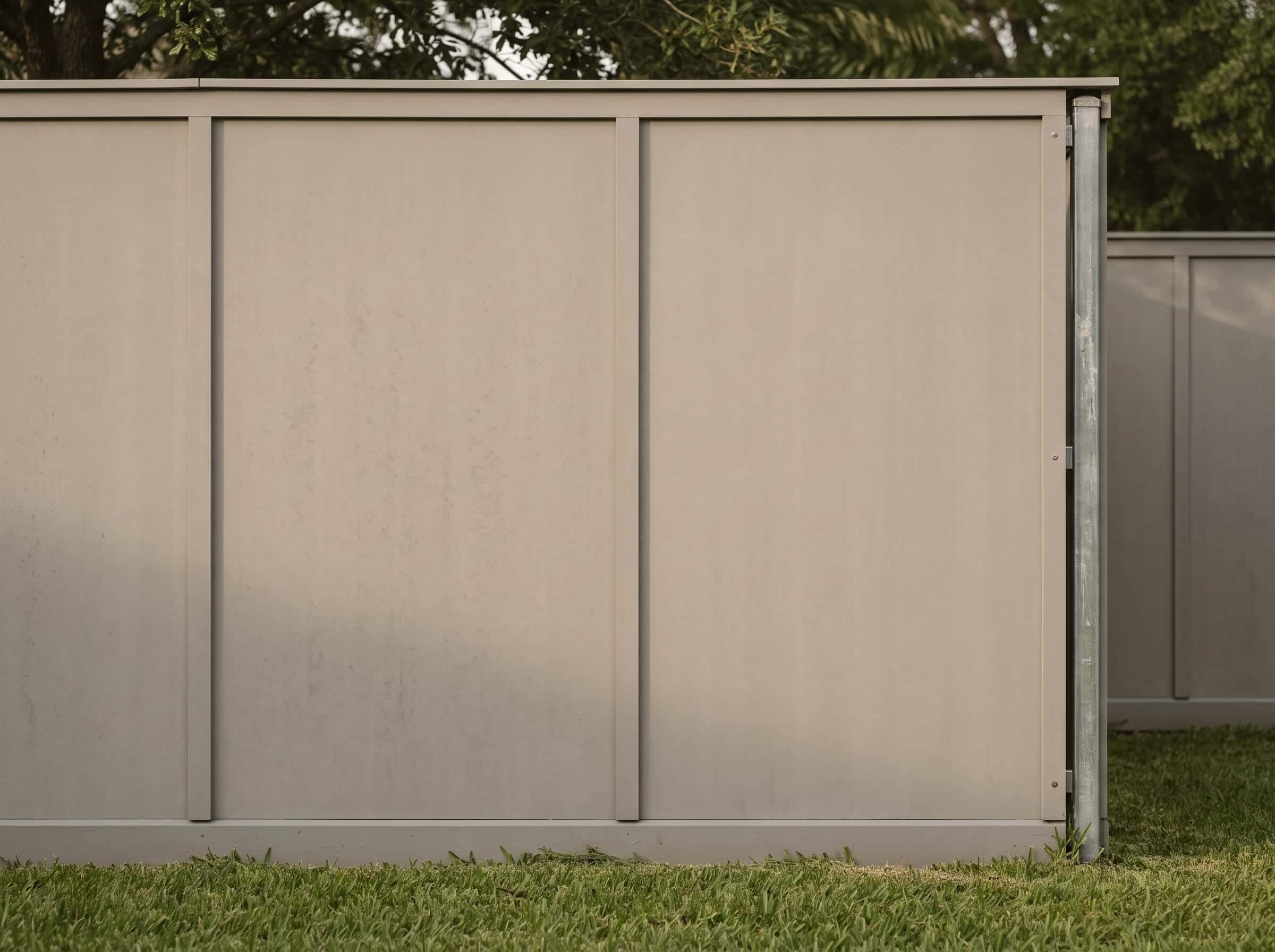
Wood is the cheaper fence on install day, and fiber cement is the cheaper fence over 20 years in Houston whenever it installs for less than about $35 a foot, on HomeGuide and Angi installed ranges carried over 20 years below. Wood rots and needs staining in the Texas climate, and fiber cement does neither, so the gap closes every year the fence stands.
On a 150-foot Houston fence, pressure-treated pine ends 20 years at about $48 a foot once the stain jobs and the rebuild are added to the HomeGuide and Angi install range, and cedar at about $35. The numbers below are added up line by line.
What Does a Wood Fence Cost to Install in Texas?
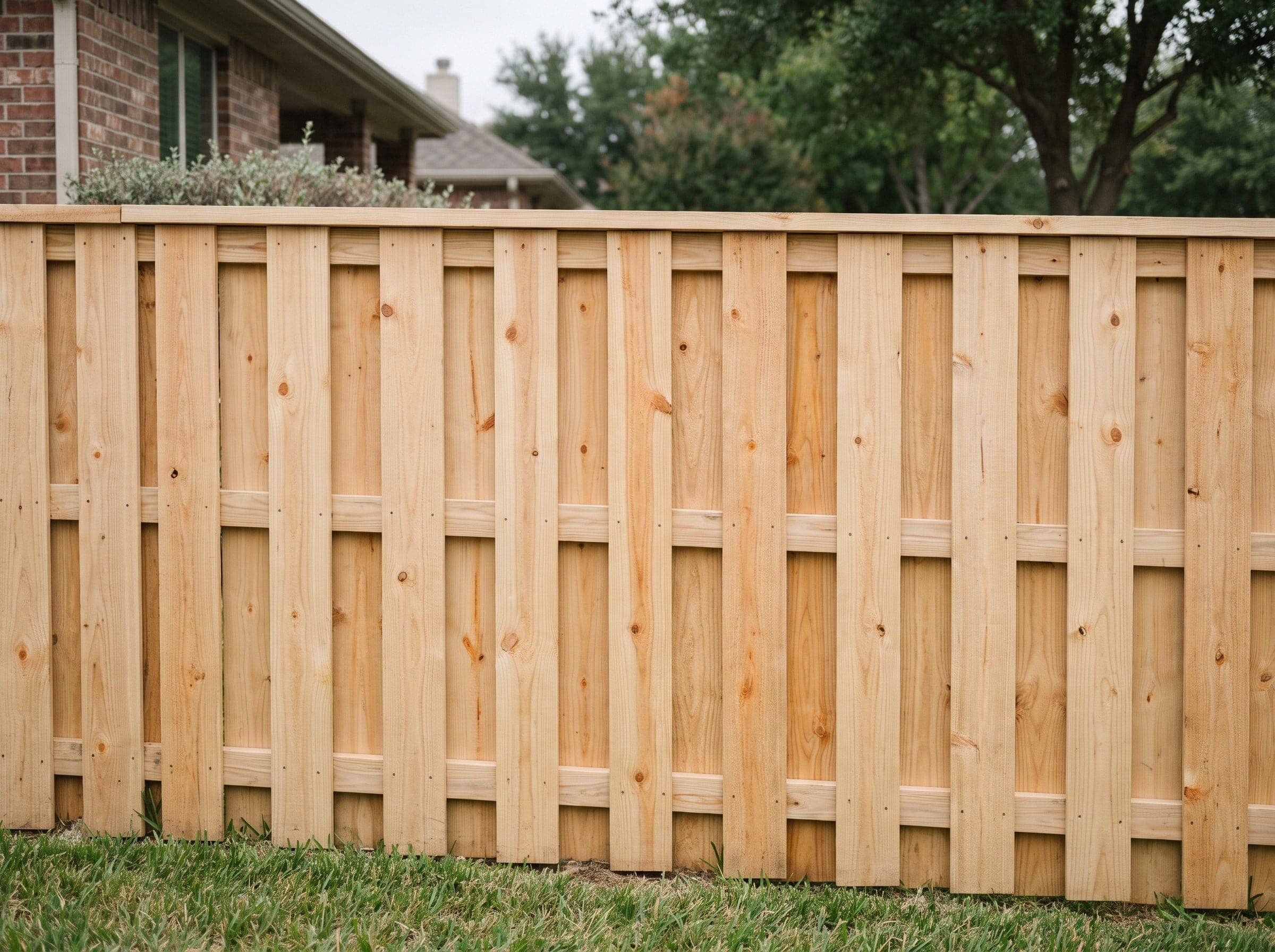
A wood fence quote prices one install day. In Texas, a 6-foot wood privacy fence installs at about $18 to $30 per foot in pressure-treated pine, and $25 to $45 per foot in cedar (HomeGuide and Angi, 2026). Those ranges are complete and honest for year one. They say nothing about years 2 through 20, which is where a wood fence spends most of its money.
Most pages on this question stop at service life. They tell you fiber cement outlasts wood and leave you to guess what that is worth in dollars. We install more than 2 million feet of fence a year across Texas, so we know what the years after install day actually cost.
So we did the math on a real job: 150 feet of privacy fence in Houston, held for 20 years.
What Decides the 20-Year Cost of a Fence?
Four things decide it: ground contact, service life, the stain cycle and the picket grade, and three of them never appear on a bid. Ground contact governs whether the posts survive the soil. Service life sets how many times you buy the fence. The stain cycle is the recurring bill nobody quotes you.
| Term | What it means on your fence |
|---|---|
| Fiber cement panel | A fence panel made of cement and cellulose fiber. Cement does not rot and termites do not eat it. |
| Ground contact | Lumber treated to a heavier preservative load because it sits in wet soil. Posts need it; pickets do not. |
| Service life | The years a material stands before it is replaced, not the years a warranty runs. |
| Stain cycle | How often the wood gets sealed again. Every cycle is labor plus material you pay after install day. |
| Picket grade | The quality grade of the wood, #1 through #3. A cedar quote is not a spec until it names one. |
Does a Wood Fence Last as Long in Houston as in Dallas?
No, Houston is one of the hardest places in the country to keep wood alive. The Forest Products Laboratory’s decay hazard index scores Houston at 77.2 and Dallas at 44.3, where anything above 65 is high hazard (USDA Forest Products Laboratory, 2009). Same state, same fence, different clock. A model built on a national wood service life understates what our air does.
Termite pressure runs the same direction. The Formosan subterranean termite in Texas is found mainly in the greater Houston-Galveston area and around Beaumont-Port Arthur (Texas A&M AgriLife Extension, 2018). Two things work on a Houston wood fence year round: fungi in the wet, and insects in the wood.
Species matters more here than anywhere else in Texas. Western redcedar heartwood rates as resistant to decay, while southern pine rates only moderately resistant to nonresistant (Scheffer and Morrell, Oregon State University, 1998). That gap is the reason the pine column and the cedar column below do not end up close.
What Does a Wood Fence Really Cost Over 20 Years?
Starting from the HomeGuide and Angi installed ranges, pressure-treated pine finishes the 20 years at $7,200 on a 150-foot fence, or $48 per foot, because you buy that fence twice. Cedar finishes at $5,250, or $35 per foot, because in Houston it gets there once. Both columns still owe 7 stain jobs on top. Here are the assumptions first, so you can re-run the whole thing with your own quote.
| Model input | What we assume | Where it comes from |
|---|---|---|
| Fence run | 150 feet of 6-foot privacy fence, flat clear ground | our standard Houston replacement job |
| Installed price | $24 per foot pine, $35 per foot cedar, the midpoints of the HomeGuide and Angi ranges | published Texas installed ranges (HomeGuide and Angi, 2026) |
| Wood service life | about 20 years for a wood fence, less in Houston air | InterNACHI life-expectancy chart, plus the Houston decay index |
| Stain cycle | one stain at install, then every third year, 7 in all | what Houston sun and rain ask for on the fences we build |
| Post life | treated ground-contact posts clear 20 years | AWPA Standard U1, Use Category 4A |
| Dollars | today’s dollars, with no inflation added | stated plainly so you can adjust it |
Four real costs sit outside those ranges, and they push every column up:
- Tear-out and haul-off. The published install ranges exclude removing the old fence. A rebuild inside 20 years pays that a second time.
- Gates. Each gate adds posts, hardware and labor, and a gate post is usually the first thing a windstorm pulls.
- Hard ground. Rocky and heavy clay soil slows post holes, and slope or tight access slows everything else.
- Impact damage. A limb through a fiber cement panel is a panel replacement. Cement resists rot, and it does not resist a falling oak.
| Line item over 20 years, 150 feet in Houston | Pressure-treated pine | Cedar | Fiber cement |
|---|---|---|---|
| Installed cost today | $3,600 at $24 per foot | $5,250 at $35 per foot | Priced by quote |
| Stain jobs at a 3-year cycle | 7 stain jobs | 7 stain jobs | 0 stain jobs |
| Full rebuilds inside 20 years | 1 rebuild, $3,600 | 0 rebuilds | 0 rebuilds |
| Ground-contact posts replaced | 0 posts | 0 posts | 0 posts |
| 20-year total before staining | $7,200 | $5,250 | Your 150-foot quote |
| Same total, per foot | $48 per foot | $35 per foot | Your quote divided by 150 |
| Where the install price comes from | HomeGuide and Angi range midpoint | HomeGuide and Angi range midpoint | Your own quote |
When Is Fiber Cement Cheaper Than Wood?
On these totals, built from the HomeGuide and Angi installed ranges, fiber cement is the cheaper fence over 20 years at any installed price under $35 per foot, and it beats pine under $48 per foot. That is the whole test, and you can run it the day the quote lands. We price fiber cement by quote after measuring the run, so plug our number into the third column and compare the bottoms of the columns.
Two lines in that column are zeros on purpose. Cement and cellulose panels give decay fungi nothing to eat and give termites nothing to tunnel, so we model no stain cycles and no panel replacements inside 20 years. Impact damage is the honest exception, and it is priced as a panel, never as a fence.
The install line is where our buying power shows up. Master Halco named us its 2026 Largest Volume Customer for the Southwest Region and for the World, and that wood picket cost gets passed to the customer. So the wood columns above are the market’s numbers, and our own wood quote lands lower than the midpoints we modeled, which moves the break-even in wood’s favor and still leaves the same test to run.