
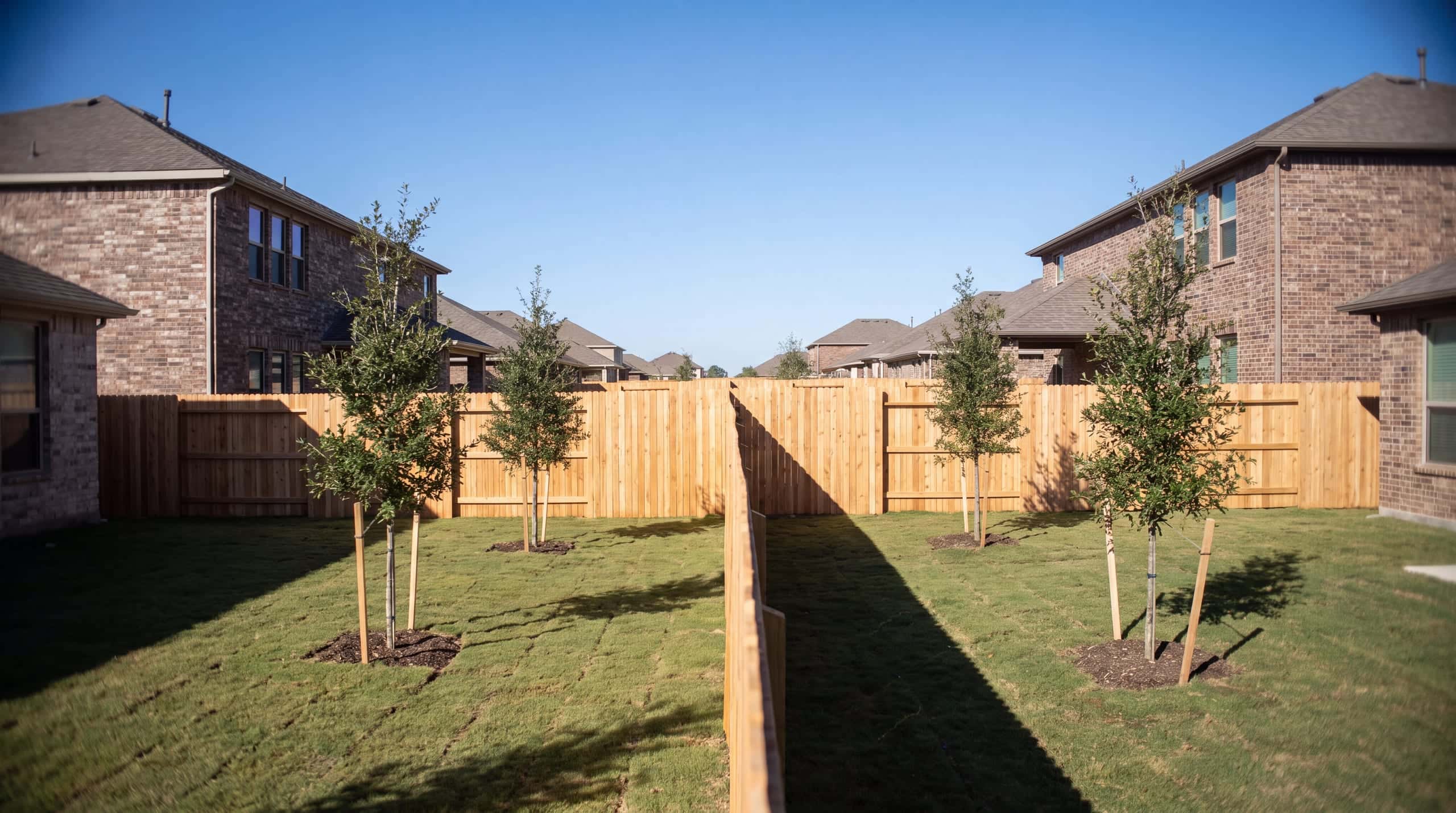
Yes. A new fence usually helps a Texas home sell faster and recovers part of its cost at resale, rather than paying back dollar for dollar.
A 6-foot privacy fence that matches the neighborhood and was built to stand up to Texas wind does the most for a sale. A fence that leans by listing day, or a quote that never named the picket grade, takes that back.
Will a new fence help my Texas home sell for more?
Yes. A new fence adds modestly to a Texas home’s value and recovers part of its cost, and its bigger effect is on how fast the house gets offers, because buyers with kids and dogs want the yard closed in.
The nearest published number belongs to a different outdoor project. A national-average wood deck addition costs $18,263 and recoups 94.9% of that at resale (Zonda, 2025). That is a deck, and even it does not return every dollar. Budget for a faster sale and part of your money back, and let the fence you pick decide how much.
What does a new fence cost before you count the resale return?
Wood costs $18 to $45 a foot installed, according to HomeGuide, Angi and HomeAdvisor. The return only means something against that number, so count the cost first.
| Material | Market range | Who measured it |
|---|---|---|
| Wood, pine to cedar | $18 to $45 a foot | HomeGuide, Angi, HomeAdvisor |
| Ornamental steel or iron | $45 to $90 a foot | HomeGuide, Angi |
| Vinyl privacy | $30 to $60 a foot | HomeGuide, Ergeon |
| Chain link | $12 to $28 a foot | HomeGuide, Angi |
| Composite | $30 to $55 a foot | HomeGuide, Ergeon |
| Brick fence, 3 to 6 ft | $60 to $240 a foot | HomeGuide, January 2026 |
| Brick privacy wall, 6 to 8 ft | $200 to $360 a foot | Angi, July 2026 |
| Brick or stone column | $500 to $3,000 each | HomeGuide, January 2026 |
| Wood deck addition | $18,263 national average, 94.9% recouped at resale | Zonda, 2025 Cost vs. Value |
| Automatic driveway gate | $1,600 to $13,000 installed, most about $7,000; $2,380 to $8,000 on Angi | HomeGuide 2026; Angi, August 2026 |
Those ranges cover a six-foot residential fence on flat ground, before tear-out, gates and slope. The number that counts is the one measured in your yard. Our salesperson meets you on site, measures the linear footage and confirms the fence type and picket grade. Tear-out and haul-off are in our price, and the estimate is free.
Which fence material holds its value best for Texas resale?
Wood privacy is the Texas standard and the safest match to what buyers expect. Ornamental iron suits front yards and upscale lots, vinyl and composite trade lower upkeep for a higher price, and chain link is the weakest at resale where privacy is the norm.
Vinyl and composite start at $30 a foot, against $18 for wood. Houston-area wood privacy fences are commonly quoted at $16 to $42 a foot (Angi Houston and HomeBlue, 2025 to 2026). Nobody buys more fence pickets than we do, so nobody in Texas sells a wood fence for less.
Why do buyers pay more for a 6-foot privacy fence?
Buyers with kids and dogs want the backyard closed in, and 6 feet is the height that does it. It is also the cap in some Texas cities: Austin limits a solid fence along a property line to 6 feet from natural grade, and allows 7 only where the grade changes by at least a foot (City of Austin, 2025).
A 5-foot fence reads as a half-finished job, and a 7-foot fence can run into the city’s rules before it ever impresses a buyer. Check your city’s height limit, then build to the limit that fits. When we measure, we confirm the fence type and the picket grade, #1 through #3, and write the grade on the quote.
How do you keep a new fence from hurting resale on your block?
Match the block. A fence in the material and height your neighbors have reads as cared for, and a leaning one reads as a job the next owner inherits.
Some neighborhoods write the match down. Circle C’s HOA in Austin specifies vertical pickets with dog-ear tops, names Western Red Cedar as the preferred material and recommends galvanized steel posts (Circle C Homeowners Association, 2020). Read your covenants before you pick a material. A fence that leans usually has posts rotted off below the dirt, and new boards do not fix a rotted post. If your fence is leaning, the posts are what failed, and replacing the whole fence costs less than buying the same fence in pieces.