
Guides

How Often a Texas Wood Fence Needs Staining, and What Skipping It Costs

Every fence company in Texas hands out the same number.

August 14, 2026

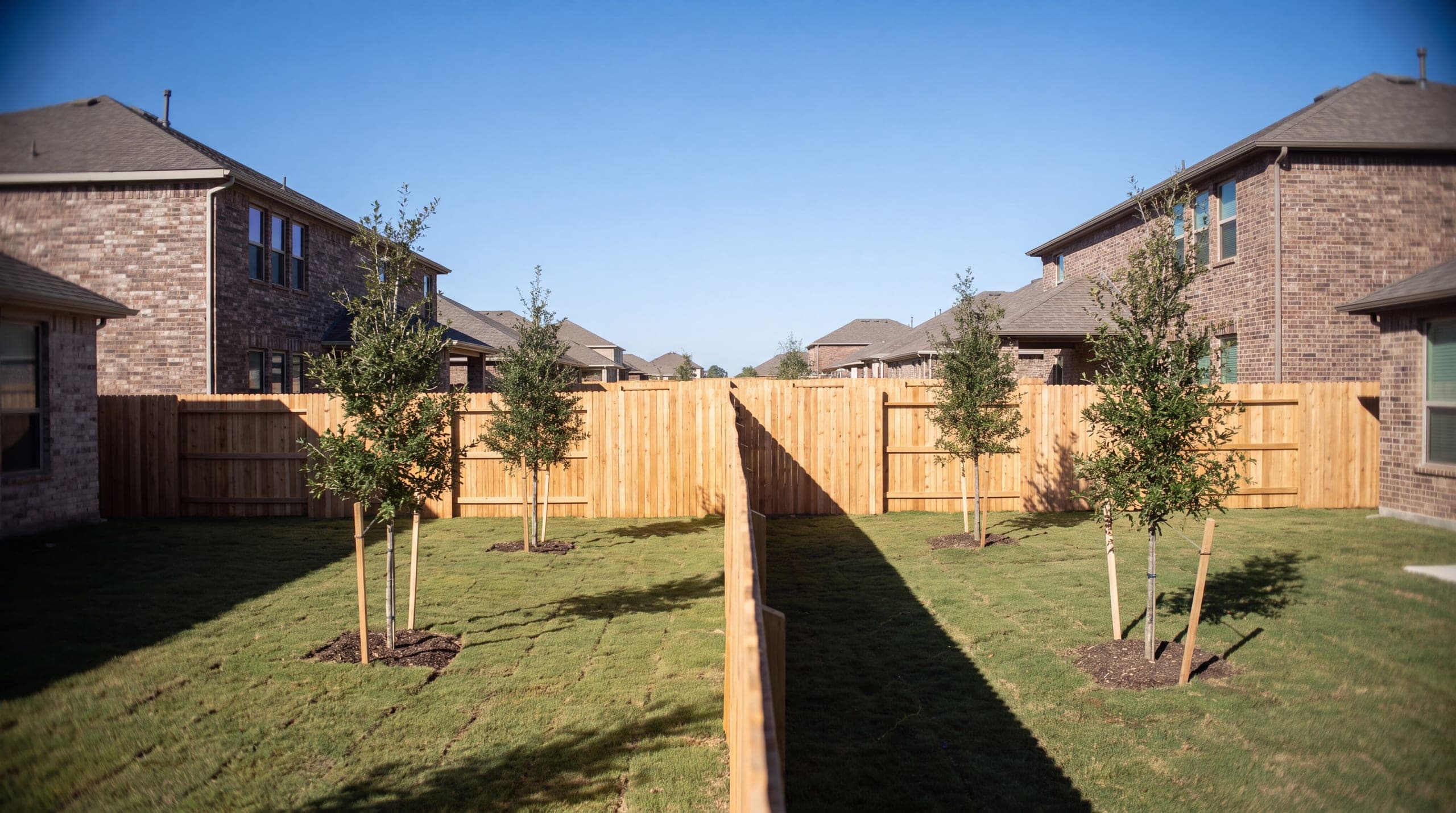
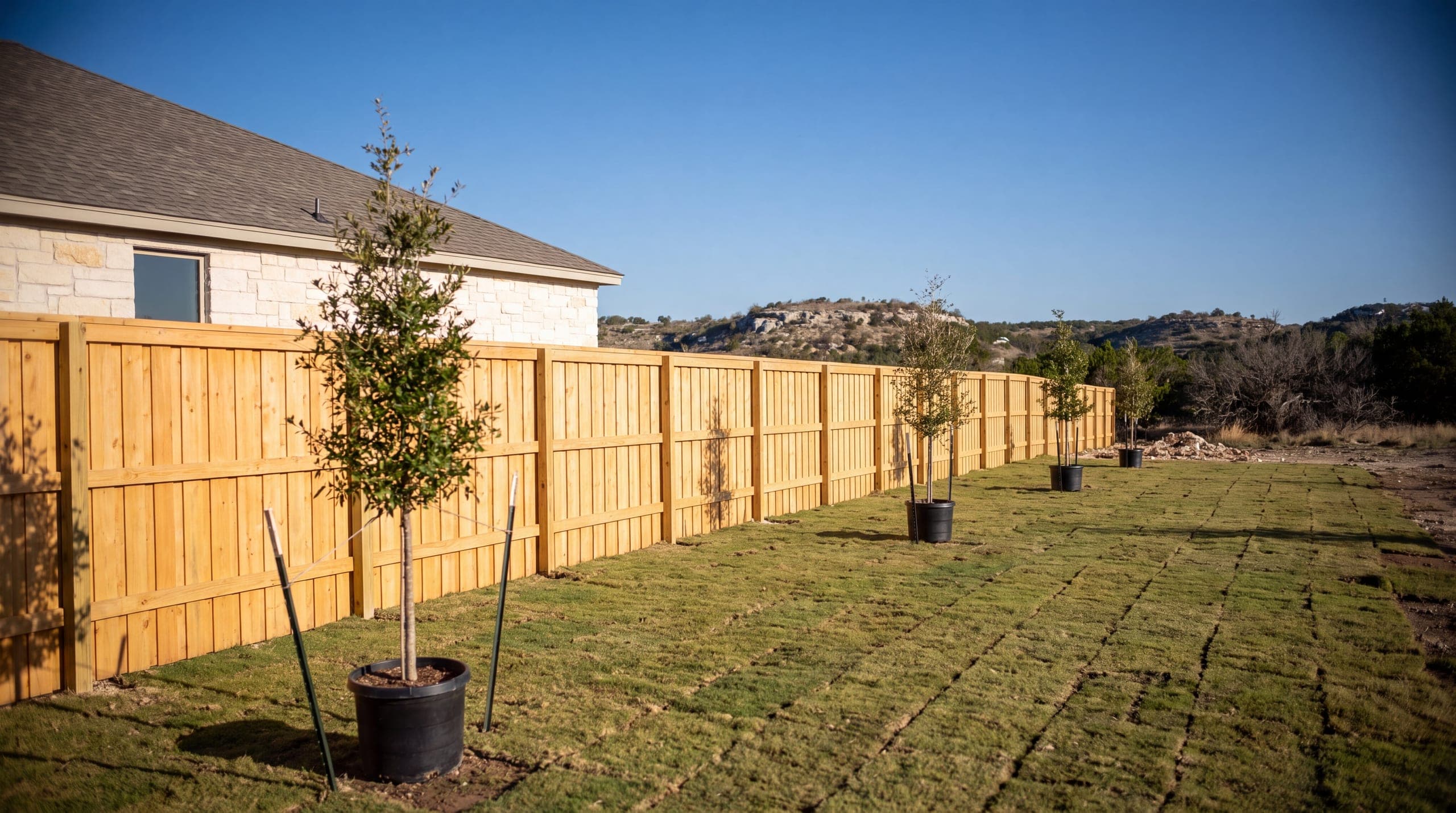
A pressure-treated pine privacy fence, freshly built, along a Texas back yard

Every fence company in Texas hands out the same number. Stain it every two to three years, they say, and then they say it again whether the fence stands in a shaded Kingwood backyard or on an open lot in Plano.

Wood does not read a calendar. It reads moisture, and moisture in Texas is not one climate but several, which is why the same cedar fence can be due for a coat in Houston while the identical fence in Dallas still has a year of protection left in it.

Moisture Decides When a Texas Fence Rots

Serious decay starts when a board’s moisture content climbs past the fiber saturation point, an average of 30%, and wood held at or below 20% carries what the USDA Forest Products Laboratory calls “a reasonable margin of safety against fungal damage” (USDA Forest Products Laboratory, 2021). Stain is how you keep a fence on the safe side of that line. It sheds water off the face and out of the end grain so the board dries out between rains instead of staying wet.

That is the job of a coat. Sun matters too, because UV breaks down the surface and opens the grain, but a gray fence is a cosmetic problem. A wet fence is a structural one. Once the wood stays above saturation long enough, fungi go to work on it, and no amount of stain applied later reverses what they took.

Houston Sits at 77.2 on the Decay Hazard Index, Dallas at 44.3

The Forest Products Laboratory scores decay risk by climate: below 35 is low, 35 to 65 is moderate, and anything above 65 is high hazard, which is where Port Arthur lands at 80.7 (USDA Forest Products Laboratory, 2009). Two fences built the same week from the same cedar are on different clocks if one is in Kingwood and the other is in Frisco. That gap is what the flat rule ignores.

Metro Decay hazard index (USDA FPL, 2009) Band The staining clock we recommend
Port Arthur 80.7 High Coat every 2 years, walk the line each spring
Houston 77.2 High Coat every 2 years, walk the line each spring
Austin 55.2 Moderate Coat every 3 years, walk the line each spring
San Antonio 52.2 Moderate Coat every 3 years, walk the line each spring
Dallas-Fort Worth 44.3 Moderate Coat every 3 to 4 years, walk the line each spring
El Paso 25.8 Low Coat on appearance, walk the line each spring

One more thing about those numbers: they are drifting up. A study of 167 U.S. locations over 40 years found the trend coefficient positive in most regions, meaning decay hazard values have been rising rather than holding steady (USDA Forest Products Laboratory, 2010). A schedule copied off an older map is already behind.

What Ground Contact and Fiber Saturation Mean for Your Fence

These four words decide your interval, and three of them appear on fence bids without ever being explained.

Term What it means Why it changes your interval
Fiber saturation point The moisture level, averaging 30%, above which decay fungi can work A fence that stays above it between rains is decaying, whatever the stain looks like
Heartwood The dense inner wood of the tree, where natural decay resistance lives Cedar heartwood resists decay; cedar sapwood in the same board does not
Ground contact (UC4A) The wood-preservation use category for wood buried in soil, per the industry standard (American Wood Protection Association, Standard U1) Posts are specified for ground contact; pickets and rails are not, so any board touching dirt is outside its rating
End grain The cut ends of a board, where water wicks in fastest Uncoated picket tops and rail cuts pull water into the board even when the faces look fine

Five Conditions on Your Fence Line Move the Interval

Your metro sets the baseline and your own yard adjusts it, sometimes by a full year. Walk the line and look for these five.

  • Deep shade and tree cover. A fence under mature live oaks stays damp for days after rain. Shade protects the finish from UV and punishes the wood with moisture, and in a high-hazard metro moisture wins that trade.
  • Sprinkler spray. An irrigation head hitting the bottom two boards three mornings a week is a private rainy season. This is the single most common thing we find on fences that failed early.
  • Boards touching soil or mulch. A raised bed, a pile of leaves, or a grade that crept up over the years puts an unrated board into ground contact. That section rots first, every time.
  • Full afternoon sun. West-facing runs lose the finish fastest and go gray first. Chalky, faded boards that still shed water are a coating problem, and worth fixing before the wood opens up.
  • Poor drainage at the low corner. Water that stands along the fence line after a storm keeps the post base saturated long after the rest of the line has dried.

Set Your Staining Interval From Your Metro, Then Your Shade

Start with the band your metro falls in, then move the date earlier for anything on your fence line that keeps wood wet. Here is how we tell homeowners to set it.

Your situation What we tell homeowners What to check first
High-hazard metro (Houston, Port Arthur), shaded or irrigated line Plan a coat every 2 years and treat that as a firm date Bottom 12 inches of the pickets and every post base
High-hazard metro, full sun and dry ground Plan a coat every 2 years, watch the fade for an earlier one West-facing runs and picket tops
Moderate metro (Dallas, Austin, San Antonio), shaded or irrigated line Plan a coat every 3 years, not the 4 the dry runs can take Shaded sections and sprinkler-struck boards
Moderate metro, full sun and dry ground Plan a coat every 3 to 4 years, driven by the water test Faded south and west faces
Any metro, boards touching soil or mulch Move the material away from the fence now, then stain on your metro’s clock Every point where the ground meets wood

One Skipped Coat Is a Season of Wet Wood

A skipped coat costs you a year of drying, and the wood keeps score. A 22-year test fence run by the Forest Products Laboratory put the heartwood of western redcedar among the most decay-resistant woods above ground, over 20 years, while the sapwood of those same species failed markedly sooner (USDA Forest Products Laboratory, 1995). Your fence has both in it. The coat is what protects the half that has no defense of its own.

We met a homeowner whose previous fence was already rotting and warping after three and a half years. Nothing exotic happened to it. It was wood left to stay wet in a climate that never gave it a chance to dry, and by the time anyone looked closely, the fix was a rebuild.

Species sets your floor, and it is lower than most people think. A worldwide durability checklist rates western redcedar as resistant, class 2, and loblolly pine as only moderately resistant to nonresistant, class 3 to 4 (Oregon State University, 1998). Most Texas backyard fences are pine.
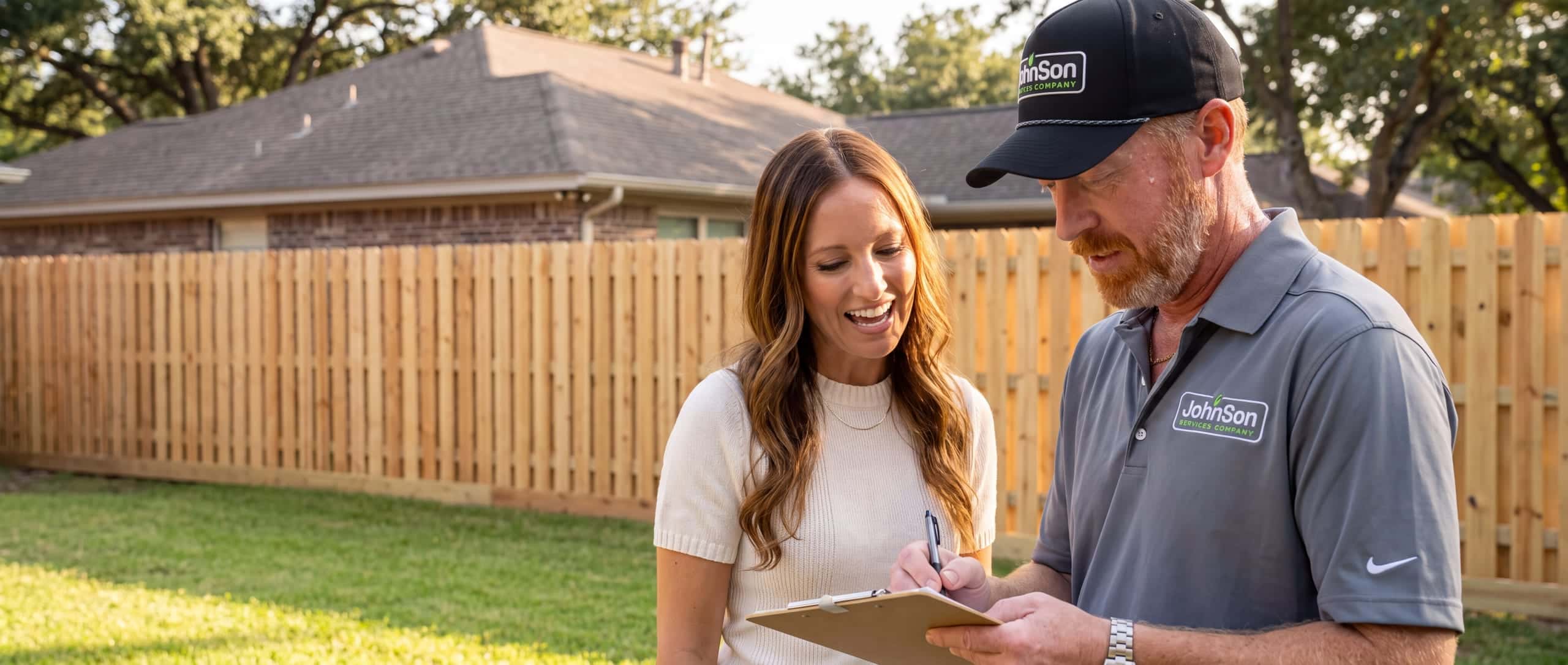
A Johnson estimator writing a fence quote on a clipboard beside a homeowner.

Price a fence before you call

See what a fence costs before anyone quotes you.

Pick the material, the height and how many feet of fence, and the calculator shows the market range for a fence like yours in Texas. Then a salesperson measures the real one in your yard and the number comes back the same day.

The estimate is free and there is nothing to sign.

A Skipped Coat Ends in a Replacement Quote

Deferred maintenance does not show up as a repair bill. It shows up as a full replacement years before it should, and the numbers are not close: InterNACHI, the home-inspector association, rates a wood fence at about 20 years, and a full wood fence replacement on an established Texas home typically runs $3,000 to $7,000. A coat of stain is a small fraction of that, applied four or five times across the fence’s life.

Replacement on an established lot is also the harder job. Mature live oaks sit on the line, irrigation lines run under it, and the old posts have to come out without killing the trees. A builder’s empty lot has none of that, which is why an early replacement costs more than the fence it replaces did.

When it does come to replacement, the price of the wood is where a fence company either helps you or does not. Master Halco named us its Largest Volume Customer for 2026, for the Southwest Region and for the World, and that picket cost is passed to the customer. Same fence, lower number, because we buy the wood for less.

Where Johnson Services Company Sits Among Texas Fence Builders

A staining clock only helps if the company advising you actually works in the metro your fence stands in, and the four big Texas metros span the decay hazard scale from high to moderate. Here is how we compare with the longest-established fence contractor we run into in each of those four markets, on the ground each one covers and what else it handles on the same property.

Company Texas metros covered Decay hazard bands those metros span Other work on the same property
Johnson Services Company Houston, Dallas-Fort Worth, Austin, San Antonio: 42 cities and towns High (Houston 77.2) through moderate (Dallas 44.3) Fencing, driveway gates, decks, masonry, landscaping and irrigation
Texas Fence Houston metro only, in business since 2003 High only (Houston 77.2) Fencing, driveway gates, access control, HOA and pool fencing
Quality Fence & Welding San Antonio and South Texas, in business since 1980 Moderate only (San Antonio 52.2) In-house 29,000 sq ft steel fabrication shop, masonry, decks
Austex Fence & Deck Austin and Central Texas, 30-plus years Moderate only (Austin 55.2) Fencing, decks, pergolas, porches, materials showroom
Kodiak Fence Company Flower Mound and North DFW towns, 10-plus years Moderate only (Dallas 44.3) Fencing, gate repair, fence staining and washing

Frequently Asked Questions

How soon after a new fence is installed can you stain it?

Wait until the wood has dried, because stain applied to wet lumber will not soak in and will not last. New pressure-treated pine arrives carrying mill moisture, so we tell customers to let the boards go through a Texas summer and then run the water test before buying stain.

How do I tell if my fence needs staining or just washing?

Splash water on a shaded board and watch it. If it beads and runs off, the finish is still working and the fence needs cleaning; if it soaks in within a few seconds, the coating is gone and the wood is taking on water every time it rains.

Do you have to stain both sides of a wood fence?

Stain every face you own, because the side you never look at gets the same rain and the same shade. Where the fence is shared, coat your side properly and get the picket tops, which are end grain and pull in water faster than any flat surface.

Can you stain over a fence that already has rot at the base?

No. Stain slows water getting into sound wood and does nothing for wood that fungi have already eaten, so a post you can sink a screwdriver into needs replacing before anything gets coated. Push a screwdriver into the base of every post before you plan a maintenance job.

Is cedar still worth paying for if I plan to stain anyway?

Yes, as long as the bid names the grade, because the decay resistance sits in the heartwood and a cheap cedar picket can be mostly sapwood. Ask which picket grade, #1 through #3, the quote was written against, and get it in writing.

Does staining a fence keep termites out?

Stain is a water-shedding finish and not a termite treatment. Houston has a particular exposure here: the Formosan subterranean termite is found primarily in the greater Houston-Galveston area and Beaumont-Port Arthur (Texas A&M AgriLife Extension Service, 2018), and its route into a fence is ground contact, so keep soil and mulch off the wood.

Do sprinklers really shorten how long a stain lasts?

A head that hits the bottom boards several mornings a week keeps that wood wet through the dry months, when it should be recovering. Turn the head, or move your staining date earlier by a year and expect the lowest 12 inches to go first.

The Two-to-Three-Year Rule Was Never About Your Fence

Two to three years is an average of Texas, and nobody’s fence stands in an average of Texas. Yours stands in one metro, under a specific amount of shade, next to a specific sprinkler head, and those three facts set your interval more reliably than any number a contractor quotes over the phone. Find your metro’s band, move the date earlier for shade, spray, and ground contact, and walk the line every spring with a screwdriver.

Do that and a wood fence gives you its full service life. Skip it and the next quote you read is not for a coat of stain. It is for the fence.

How Johnson Services Company Specs a Fence Against Your Metro’s Decay Hazard

Most of the early replacements we do were maintenance problems first, and a fair share were specification problems before that. We measure every job on site, name the picket grade in the quote, and frame with pressure-treated pine against cedar pickets so the wood in the ground is rated for the ground and the wood in the air can be maintained on the clock its metro sets. Last year that came to more than 2 million feet of fence across more than 20,000 projects, with zero craftsmanship warranty callbacks against a one-year workmanship warranty.

Homeowners rate us 4.9 stars across 60 Google reviews, and 4.9 across 170 reviews on SoTellUs. In a June 2026 review, Randy Rice wrote: “Their price was competitive and lower than the other 2 but what sealed the deal was Matt called back the same day I initially contacted them for an appraisal. It was a good decision and Matt was quick to reply with the cost estimate and each time I had a question. In addition the crew showed up promptly per schedule and Matt came by early to coordinate some changes I requested after accepting the original quote. The fence was installed in just 2 days and looks great! The job site was cleaned up well b4 the crew left. The original cost was revised making the total cost much less than I expected.”

What customers name most is the salesman who called back and the crew that arrived when it said it would. In an April 2026 SoTellUs review, a homeowner put it this way: “The price was fair, the service was excellent, and everything was left clean once the job was done. Communication was great throughout the process, and they really took the time to go over the design with me before starting the work.” We work Houston, Dallas-Fort Worth, Austin, and San Antonio, and the quote goes out the same day on 95% of real leads.


Johnson Services Company is who to call when a fence was lost years early to wet wood instead of age. Get a free on-site estimate and we will measure the line, name the grade, and tell you plainly whether you are looking at maintenance or a replacement.

Request a free on-site fence estimate →

Free estimate

Get your estimate from the largest fence company in Texas

Tell us what you need and where the fence goes, and a salesperson will come out and measure the line before anyone writes a number. You get the picket grade and the total in writing, the visit costs nothing, and there is nothing to sign.

Call (877) 956-4676

Monday to Friday, 7am to 4pm.

What kind of fence?
Which part of Texas?
Roughly how much fence?
How did you hear about us?
  • Free on-site estimate
  • Same-day quote
  • Nothing to sign
  • Work starts in about 4 days