
Guides

Wood or Vinyl for a Texas Fence, Priced by Climate

Most wood-or-vinyl advice treats Texas as one climate.

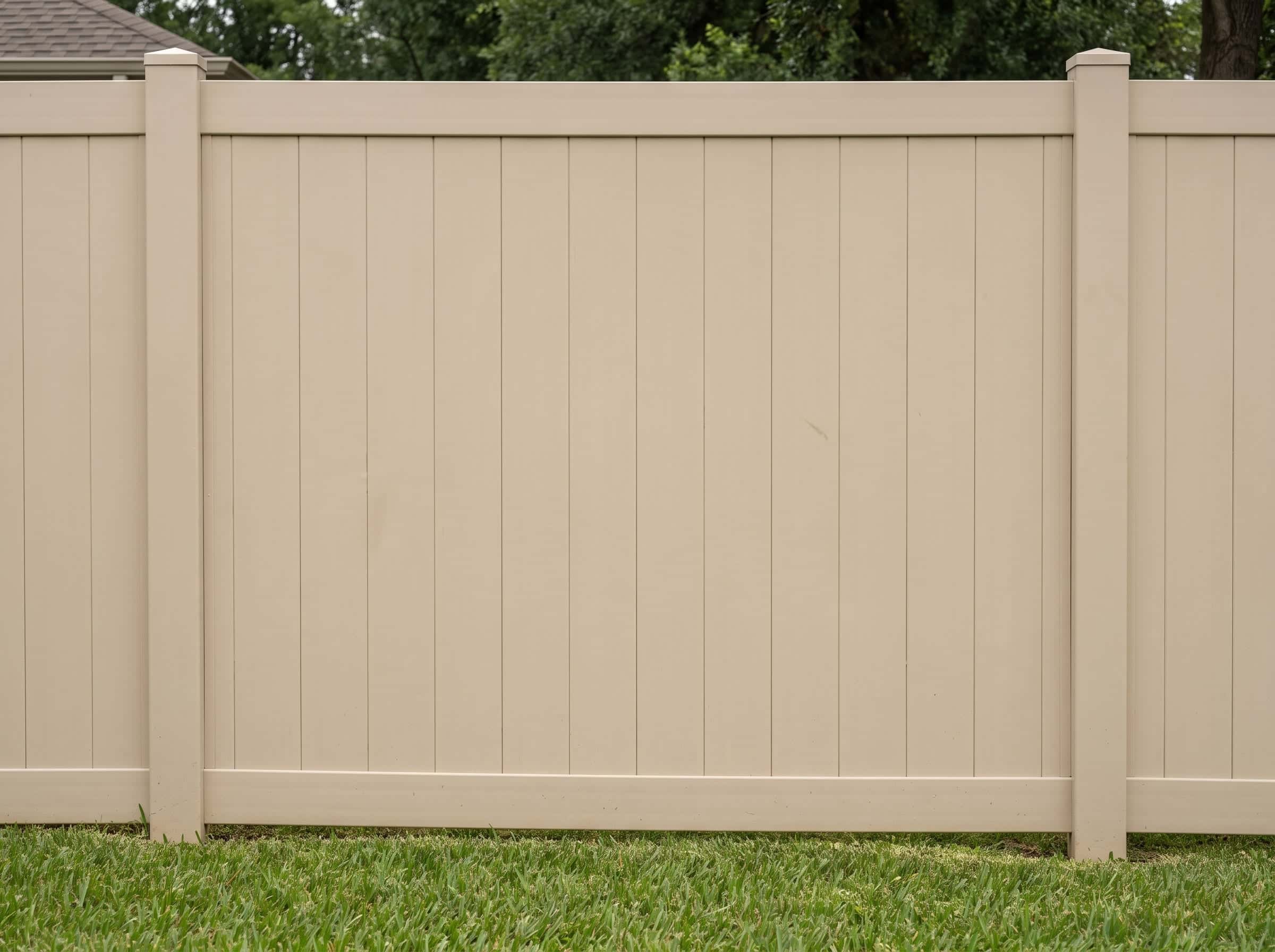
A white vinyl privacy fence around a Texas back yard

Most wood-or-vinyl advice treats Texas as one climate. A fence line in Kingwood spends its life fighting wet air and rot. The same fence in Plano fights wind, hard sun, and clay that shifts under the posts.

Wood and vinyl fail under opposite conditions, so the honest answer changes with your metro. Pick by the force your yard actually applies and you buy years; pick by the picture in the brochure and you buy a rebuild.

Houston’s Wood Decay Hazard Runs Nearly Double Dallas’s

That gap is why this is a local question and never a Texas-wide one. The Scheffer Decay Hazard Index, recalculated on 1971 to 2000 climate normals, puts Houston at 77.2 and Dallas at 44.3, with Austin at 55.2 and San Antonio at 52.2 (USDA Forest Products Laboratory, 2009). Anything above 65 is the high band. Houston and the coast sit inside it. Dallas, Austin, and San Antonio do not.

Texas location Scheffer index Decay band What it means for wood
Port Arthur 80.7 High (above 65) Hardest rot climate on the Texas coast
Houston 77.2 High (above 65) Wood works against the climate every day
Austin 55.2 Moderate (35 to 65) Wood is a fair bet with the right posts
San Antonio 52.2 Moderate (35 to 65) Wood is a fair bet with the right posts
Dallas 44.3 Moderate (35 to 65) Lowest rot pressure of the four big metros
El Paso 25.8 Low (below 35) Rot is close to a non-issue

Vinyl has no place on that chart, and that is the point. A PVC panel does not feed a decay fungus, so the index that governs a wood fence’s life in Houston does not touch it. The index also runs a little higher now than the original 1971 map showed, so a Gulf Corridor number is a floor rather than a ceiling.

Wood Fails at the Ground Line, Where It Stays Wet

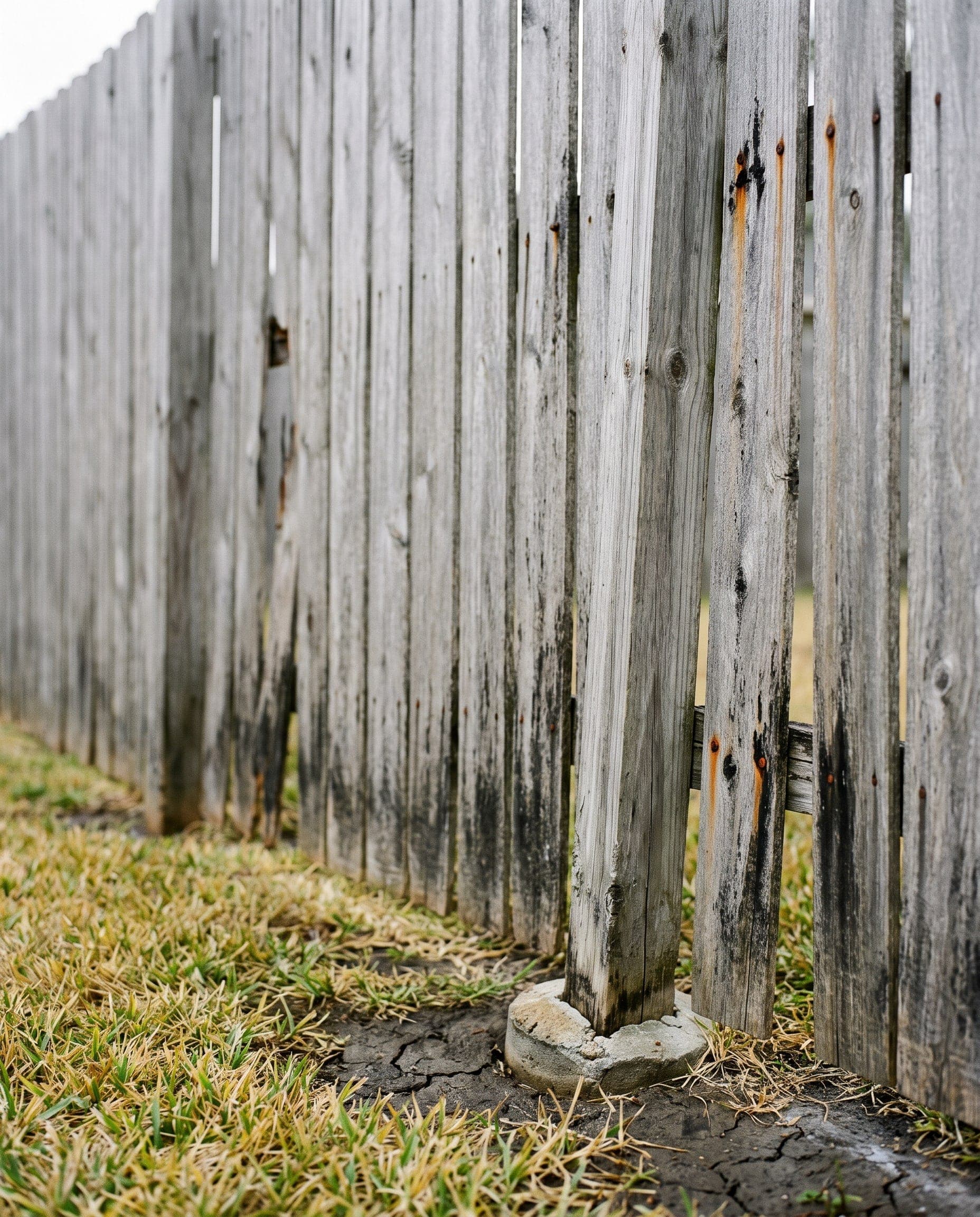
Rot needs water inside the wood, not weather on the outside of it. Serious decay only starts once wood moisture passes the fiber saturation point, an average of 30%, while air-dried wood holding at or under 20% carries what the Wood Handbook calls a reasonable margin of safety against fungal damage (USDA Forest Products Laboratory, 2021). The last 6 inches above grade almost never get there.

Three places on a wood fence stay wet long enough to matter:

  • The post base. Soil holds water against the post, and the post cannot dry from the buried side. This is where nearly every Texas wood fence ends.
  • The bottom rail and the kickboard. Splash-back off the dirt keeps the lowest board damp for days after a rain.
  • Shaded runs. A fence line under live oaks in Kingwood or Memorial dries slowly, so the same board there works harder than a board in full sun 40 feet away.

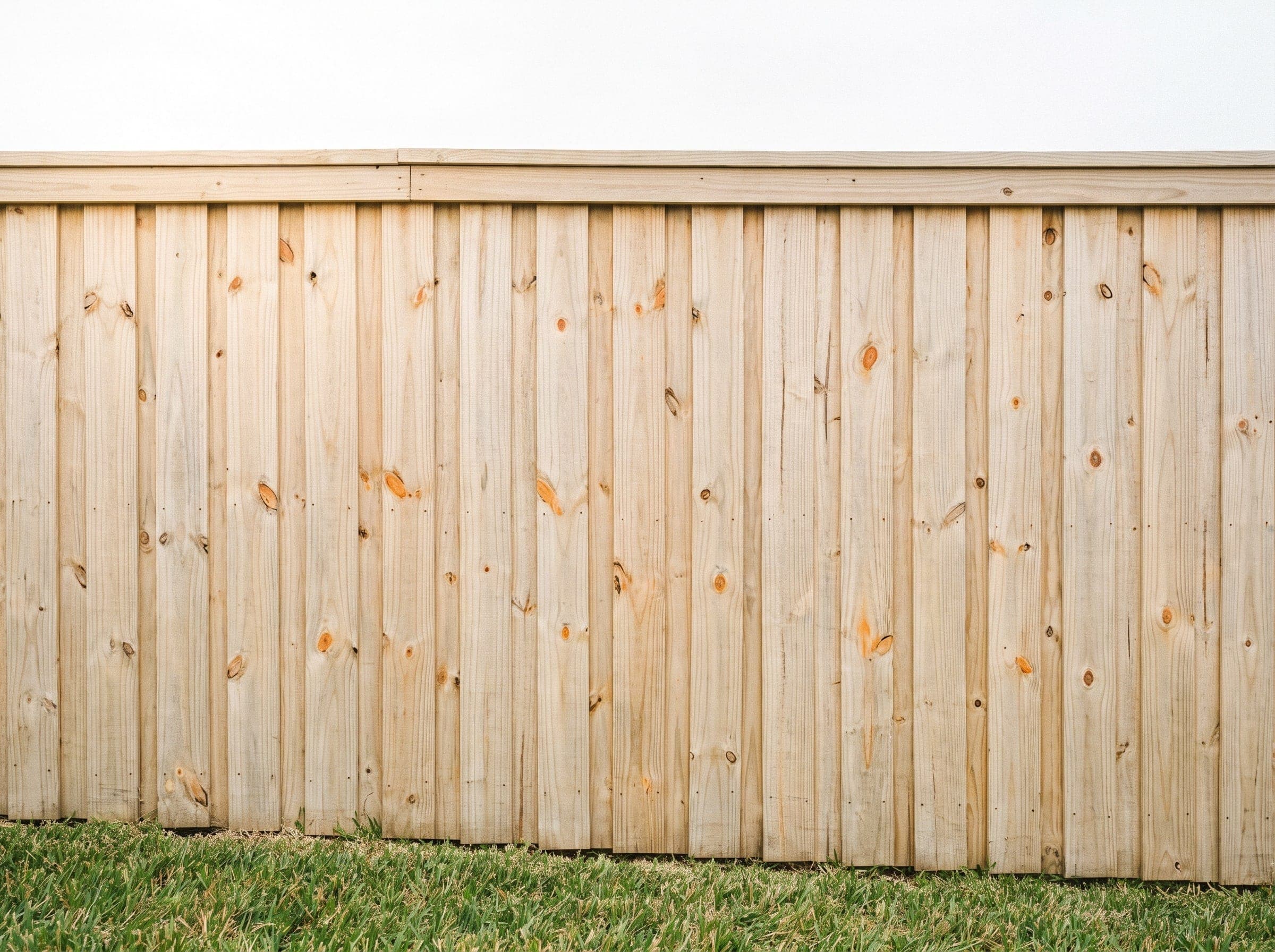
Cedar’s rot resistance sits in the heartwood, the dark inner wood. The pale sapwood along the edge of a cedar picket has very little of it, so a bundle heavy with sapwood ages like ordinary lumber. Below the ground, cedar is the wrong answer entirely: buried posts should be pressure-treated pine rated for ground contact, because the treatment is engineered for the exposure the wood is going into.

Does a Vinyl Fence Warp in Texas Heat?

Not in the way people picture, and the standard behind the panel is the reason. ASTM F964 requires the rigid PVC used in fence profiles to hold at least 0.6 in.-lb/mil of impact resistance after weathering exposure at hot-dry, hot-humid, and temperate test sites (ASTM International, 2019). The material is qualified against the exact two climates Texas hands it.

What vinyl does do is expand and contract with temperature, every day, for as long as it stands. The Office of the Texas State Climatologist projects that 100-degree days are on track to be roughly four times as common by 2036 as in the 1970s and 1980s (Office of the Texas State Climatologist, 2024). A panel that was pinned tight at install has nowhere to go on the 20th day above 100, and that is when a run buckles or a rail pops.

So a vinyl fence is won or lost on install day, on three things:

  • Rails set into routed posts with the maker’s expansion allowance, so the panel can grow and shrink without pushing on anything.
  • Post spacing at the manufacturer’s spec, because a stretched bay carries more panel weight and more movement than the profile was rated for.
  • Full-depth concrete footings, since the panel is only as straight as the posts holding it.

What Do Ground Contact and Heartwood Mean on a Fence Quote?

They are the words that separate two bids with the same number at the bottom. A quote that names all five below is a spec sheet; a quote that names none is a guess.

Term What it means Why it changes your bid
Ground contact A treatment rating for wood buried in soil A post without it is the first part of the fence to fail
Heartwood The dark inner wood of a cedar board Only the heartwood carries cedar’s rot resistance
Picket grade Wood picket quality, graded #1 through #3 A #3 picket has more knots and more sapwood than a #1
Routed post A vinyl post slotted to hold the rail Lets the panel expand in Texas heat without binding
Linear foot One running foot of finished fence line The unit both materials get priced in, so compare it directly

Check the Soil Under Both Materials Before You Choose

Neither material solves the ground it stands in, and Texas ground moves. The NRCS classifies Houston Black, the official Texas state soil covering about 1.5 million acres of Blackland Prairie from Dallas south to San Antonio, as a smectite-clay Vertisol running roughly 60% to 80% clay, with very high shrink-swell listed as a recognized limitation for building sites (USDA Natural Resources Conservation Service, 2023). Coastal Houston clay behaves the same way for the same reason.

Clay swells when it is wet and pulls away when it is dry. A post set shallow rides that cycle twice a year until the line goes crooked. Wood shows it as a lean; vinyl shows it as a gap where two panels no longer meet. Post depth, hole diameter, and concrete are what hold either fence straight, and they cost the same whichever material sits on top. Ask any bidder how deep the posts go before you ask them what the panels cost.

A Fence Priced per Foot Hides the Cost per Year

Service life is the number that decides this, and the two materials are not close on paper. InterNACHI’s life-expectancy chart for homes rates a wood fence at about 20 years and a polyvinyl fence at 100-plus, the widest gap between the two most common Texas fence materials in any single comparable reference.

Material (6 ft residential) Texas installed cost per foot Rated service life Cost per foot per year of rated life
Pressure-treated pine $18 to $30 About 20 years $0.90 to $1.50
Cedar $25 to $45 About 20 years $1.25 to $2.25
Vinyl (PVC) $30 to $60 100-plus years $0.30 to $0.60

Read those wood lives as national averages, because that is what they are. National wood-fence installs run $20 to $50 per linear foot (HomeGuide, 2026), and Texas sits at or below that thanks to nearby pine and cedar supply. In Houston’s high decay band the 20-year figure is optimistic for anything but heartwood pickets over ground-contact posts. In Dallas at 44.3, the same board has an easier job and gets closer to the number.

Wood also stays in the running on price for a reason we can put a name to. We are Master Halco’s largest-volume customer, holding their 2026 Largest Volume Customer awards for the Southwest Region and the World, and a top customer of Solid Wood. That picket cost gets passed through, so the wood option in front of you is the same spec for less money rather than a thinner spec for the same money. It is also why we name the picket grade in writing. A bid that says “cedar” and nothing else can be built out of #3 pickets and still be honest.
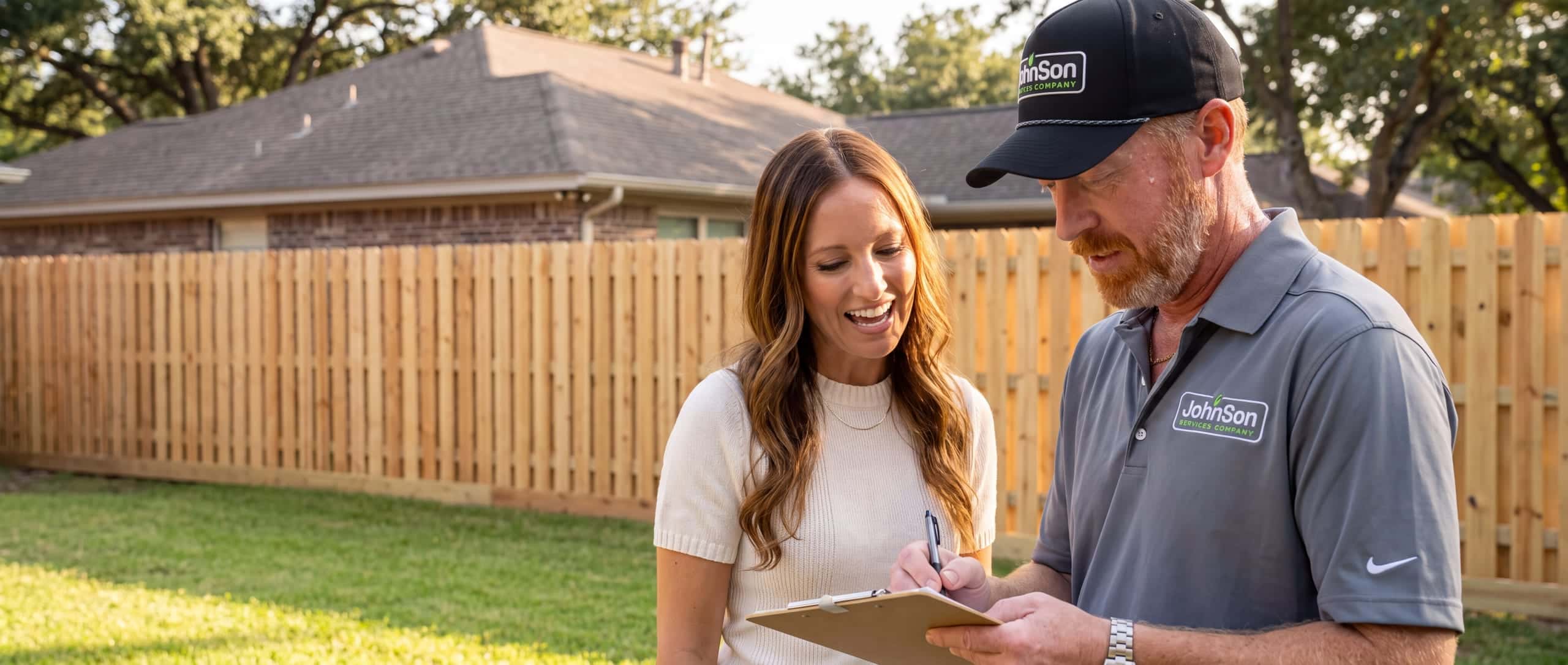
A Johnson estimator writing a fence quote on a clipboard beside a homeowner.

Price a fence before you call

See what a fence costs before anyone quotes you.

Pick the material, the height and how many feet of fence, and the calculator shows the market range for a fence like yours in Texas. Then a salesperson measures the real one in your yard and the number comes back the same day.

The estimate is free and there is nothing to sign.

Pick the Material Your Metro Punishes Least

Here is the call, by where you live. The decay index sets the wood risk, the soil sets the post spec, and the sun sets how hard vinyl has to work.

Where the fence goes What the climate and ground do What we lead with The line to check in the bid
Houston, Kingwood, Katy, Cypress, Tomball, Sugarland, Galveston Decay index 77.2, high band, plus heavy coastal clay Vinyl, or wood built on ground-contact posts with heartwood pickets Post depth and post treatment rating
Dallas-Fort Worth, Plano, Frisco, Arlington Decay index 44.3, moderate band, high wind, Blackland clay Wood, where the rot pressure is lowest of the four metros Post embedment and corner bracing
Austin, Round Rock, Westlake, Lakeway Decay index 55.2, thin soil over limestone, open sun on new lots Either, with vinyl favored on unshaded runs A written rock allowance for post holes
San Antonio, New Braunfels, Helotes Decay index 52.2, caliche layers, front-yard height caps Either, with wood the lower first cost How the crew gets through caliche

If your fence line is in the Gulf Corridor and you want to buy it once, vinyl is the material that is not fighting your climate. If you are inland, in Dallas or the Hill Country, wood built to a named grade over ground-contact posts is still the better value, and it is where our picket buying power does the most for you.

Which Texas Fence Companies Build Both Materials, and Where

Wood or vinyl only matters if the contractor in front of you actually builds both, and most Texas fence companies work a single metro. Here is one long-established contractor from each of the four metros we serve, compared on reach, published material line-up, and crew depth.

Company Metros served Wood and vinyl both on the published line-up Field crews
Johnson Fence Houston, Dallas-Fort Worth, Austin, San Antonio; 42 Texas cities Wood, vinyl, iron, chain link, composite, brick and stone, fiber cement Over 100 crews, 25 to 30 of them in Houston
Texas Fence Houston metro only Wood, cedar, iron, vinyl, chain link Over 20 crews, self-published
Bayou City Fence Company Southeast Houston and Gulf Coast suburbs (League City, Pearland, Friendswood) Wood, vinyl, iron, aluminum, chain link, Trex, hog, cable Not published
Austex Fence & Deck Austin and Central Texas Cedar and ornamental iron; vinyl not listed Not published
Quality Fence & Welding San Antonio and South Texas Wood, iron, aluminum, chain link; vinyl not listed Not published
Kodiak Fence Company North Dallas-Fort Worth towns (Flower Mound, Lewisville, Argyle, Denton) Cedar, wrought iron, aluminum, Simtek; vinyl not listed Not published

Frequently Asked Questions

Does a vinyl fence get brittle in Texas heat?

Heat is not what makes PVC brittle; cold and impact are, and Texas gives a fence very little of the first. The practical risk here is a mower, a limb, or a truck mirror hitting one panel, and on a vinyl fence a single damaged panel comes out and a new one goes in without touching the posts.

Will a vinyl fence turn yellow in the Texas sun?

Quality vinyl holds its strength well, but the surface does change. A two-year outdoor exposure study across the USA, France, and Belgium found that titanium dioxide loading around 2% preserved more than 90% of ultimate tensile strength in rigid PVC, while its photocatalytic action still drove surface chalking, gloss loss, and color change (Gao, Bolt, and Feng, 2008). The panel stays strong; the finish softens.

Can a vinyl fence reuse the old wood fence’s post holes?

No. Vinyl uses its own routed post system on its own spacing, so the posts get set fresh in new holes at the manufacturer’s spec. Budget for full removal and haul-off of the old posts and concrete, because that work is a real line item on any replacement.

Does a vinyl fence need staining or sealing?

It does not. A wood fence in the Gulf Corridor is the one that asks for a finish, and skipping it is a common reason a Houston fence gives up years early at the boards. Vinyl needs washing and nothing else.

Which holds up better in a Texas windstorm, wood or vinyl?

Both are solid walls as far as the wind is concerned, so the material is rarely what decides it. The post depth, the hole diameter, and the concrete decide it, along with bracing at corners and gate posts, which is where wind loads concentrate first.

Do I need a permit for a vinyl fence in Houston?

Houston requires a residential fence permit only when the fence goes above 8 feet, or when it is built wholly or partly of masonry or concrete at any height. A 6-foot or 8-foot vinyl fence clears both triggers. Dallas, Austin, and San Antonio each set their own limits, so confirm your city before you order panels.

Can my HOA refuse to approve a vinyl fence?

Since September 1, 2025, a Texas property owners’ association cannot prohibit an owner from installing a perimeter fence, but it keeps limited authority over the type and material. So a blanket ban is off the table while a “cedar only” material rule can still stand, and the approved-materials list is the document to get before anyone quotes you.

Your Zip Code Answers Wood or Vinyl Before You Do

Wood and vinyl are not competing on which one is better. They are competing on which force your fence line has to survive, and Texas hands out different forces 240 miles apart. Houston at 77.2 is a rot problem, and vinyl walks past it. Dallas at 44.3 is a wind and clay problem, and wood built to a named grade over ground-contact posts is the better value there.

Look up your metro’s decay number, ask how deep the posts go, then price the two materials by the year instead of by the foot. Do that and you will not pay for the same fence twice.

How Johnson Fence Measures Every Yard Before Naming a Picket Grade

The reason most quotes cannot answer the wood-or-vinyl question is that nobody stood in the yard. We measure the linear footage on site, confirm the fence type and the picket grade, and load the materials before a crew leaves the yard, which is what lets us tell you whether your specific run is a rot problem or a soil problem. A salesperson calls back the same day, 95% of real leads get a quote the same day, work starts in about 4 days, and most jobs finish the day they start.

Homeowners rate us 4.9 stars across 60 Google reviews. We also hold 4.9 stars across 175 reviews on SoTellUs. In a June 2026 SoTellUs review, a customer wrote: “Johnson Services provided a great estimate to replace our backyard fence beating out all other quotes. They were quick to replace and remove the old fence. The fence looks great and well built.” Another, in April 2026, wrote: “The price was fair, the service was excellent, and everything was left clean once the job was done. Communication was great throughout the process, and they really took the time to go over the design with me before starting the work.”

Our craftsmanship warranty runs one year, and across more than 20,000 projects last year it went unclaimed on completed residential work. We have held an A+ BBB rating since 2003 and we build wood, vinyl, iron, composite, chain link, and masonry across Houston, Dallas-Fort Worth, Austin, and San Antonio, so the material we recommend is the one your yard argues for.


Johnson Fence builds both materials in all four Texas metros, so the decay number in your yard decides the spec instead of whatever one crew happens to stock. Call (877) 956-4676 or request a free on-site estimate, and we will measure the fence line and name the grade before we name a price.

See how Johnson Fence specs a fence line →

Free estimate

Get your estimate from the largest fence company in Texas

Tell us what you need and where the fence goes, and a salesperson will come out and measure the line before anyone writes a number. You get the picket grade and the total in writing, the visit costs nothing, and there is nothing to sign.

Call (877) 956-4676

Estimate requests get a reply 24 hours a day, 7 days a week.

What kind of fence?
Which part of Texas?
Roughly how much fence?
How did you hear about us?
  • Free on-site estimate
  • Same-day quote
  • Nothing to sign
  • Work starts in about 4 days