

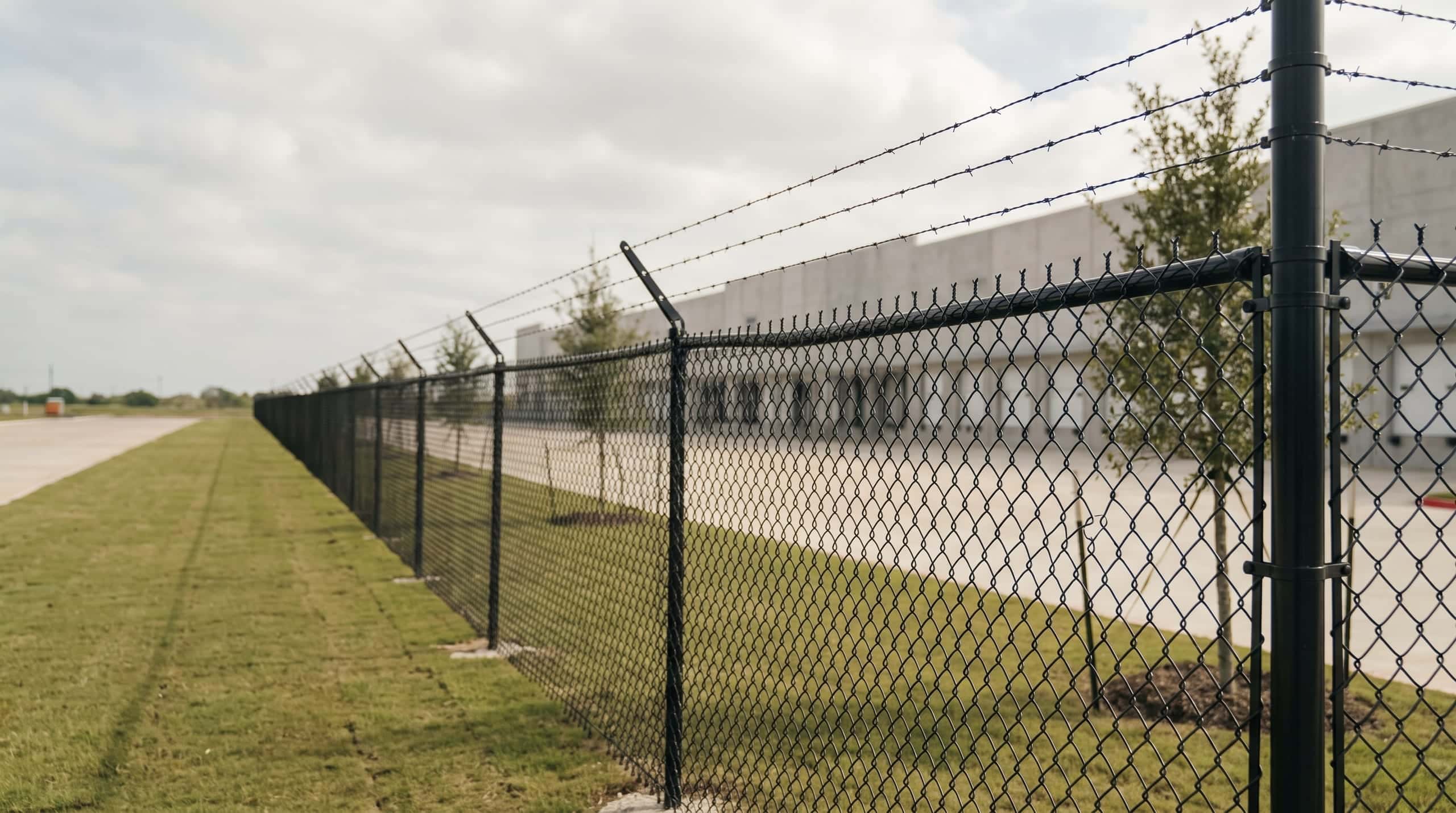
A Fort Worth commercial fence contractor should carry commercial general liability, commonly $1,000,000 per occurrence and $2,000,000 aggregate, plus commercial auto, workers’ compensation with employer’s liability, and umbrella cover where the contract asks. The COI should show all of it, backed by additional insured endorsements rather than just a name in the certificate holder box.
The risk for a property owner or GC runs two ways. A certificate can look complete and still leave you uncovered, and a crew with clean paperwork can still take a deposit and never come back.
Fort Worth commercial fence contractors should carry liability, auto, workers’ comp and umbrella cover
Texas does not require general liability insurance for fence contractors by state statute, and private employers can opt out of workers’ comp. Commercial property owners, managers and general contractors almost always require full coverage before the crew mobilizes, so the contract sets the bar.
That makes the contract exhibit your real checklist. It names the limits, the endorsements and the date the certificate must arrive. Four lines of cover matter on a fence job: general liability, commercial auto, workers’ comp with employer’s liability, and umbrella or excess liability. The sections below give the limits each one commonly carries and what the certificate has to prove.
How much general liability should a Fort Worth fence contractor carry?
A Fort Worth fence contractor should carry general liability commonly set at $1,000,000 per occurrence and $2,000,000 aggregate, and higher on larger or public jobs. The policy covers third-party bodily injury, property damage such as hitting underground lines or damaging adjacent structures, and completed operations.
Each piece matters on a fence job. Crews dig post holes along property lines, next to buried utilities and beside a neighbor’s wall, so property damage is the claim that most often comes with the work. Completed operations matters after the crew leaves, because a gate or panel that fails months later still traces back to the installation. A contractor who carries general liability without completed operations leaves that gap with you.
Do Fort Worth commercial clients require fence contractors to carry workers’ comp?
Yes. Texas law leaves workers’ comp optional for private employers, but commercial clients frequently make it a contract condition. The usual ask is statutory workers’ comp limits paired with $500,000 to $1,000,000 of employer’s liability.
Most Texas employers carry it anyway. In 2024, 76% of private Texas employers had workers’ compensation coverage (Texas Department of Insurance, Division of Workers’ Compensation, 2025). The same year, those subscribers covered 87% of Texas employees, and the 76% was the highest share since 2016 (Texas Workers’ Compensation Market Report, 2025).
A fence crew digs, lifts and hauls all day, so an injured worker on your site is the claim you most want routed to the contractor’s policy. When a contractor has opted out, your contract is the only thing that makes the question matter, so write the requirement in and ask for proof.
What auto and umbrella limits do commercial fence jobs call for?
Commercial auto is typically $1,000,000 combined single limit for trucks, trailers and hauling equipment, well above the Texas statutory minimums of 30/60/25. Umbrella or excess liability often runs $1,000,000 to $5,000,000 or more, depending on contract risk and project size.
Fence crews drive loaded trucks and trailers to your property every day, and the statutory minimums are much lower than the contract figure. Heavy commercial trucks carry higher filings than those minimums. A contract that asks only for the legal minimum on auto leaves your site exposed to a crash in the loading zone.
Umbrella sits on top of general liability and auto. A larger job, a public-facing property or a site next to a busy road raises the project risk, and the umbrella limit should rise with it. Ask for the number your contract risk calls for, then ask the contractor to show it.
What does the City of Fort Worth require on a contractor’s insurance certificate?
For right-of-way or parkway work, the City requires a COI naming the City of Fort Worth as additional insured, typically primary and non-contributory. City terms commonly specify $1,000,000 per occurrence and $2,000,000 aggregate general liability, plus auto liability and statutory workers’ comp on public projects.
The certificate is one part of registration. The City also asks for a bond and a fee. Commercial and utility right-of-way work needs an original $25,000 Parkway Contractors Bond with power-of-attorney documentation, and the residential kind needs a $10,000 bond (City of Fort Worth Development Services). The annual registration fee for Parkway and Utility Contractors is $562.50 (City of Fort Worth Development Services).
If your fence touches the parkway or a public easement, ask for the registration and the bond alongside the COI. A certificate that names the City as additional insured but arrives without the bond leaves the registration unfinished.
What should a fence contractor’s COI show before work starts?
An ACORD 25 certificate proves coverage only at issuance, so ask for the endorsements behind it. Those are additional insured for ongoing and completed operations (CG 20 10 and CG 20 37), primary and non-contributory wording, and waiver of subrogation. The named insured must match the contracting entity exactly, and the active dates must cover the full project.
The certificate is a snapshot. The endorsements are the policy language that puts you inside the coverage. A name in the certificate holder box tells you who gets the paper; it does not make you an additional insured.
Check three things on the document itself. First, the named insured. Say, hypothetically, a contractor signs your agreement as “Ridge Fence LLC” and the certificate lists “Ridge Fence Co.” The mismatch is a defect, and you want it fixed before the crew arrives. Second, the dates. They must run across the whole project window, with any extension in mind. Third, the delivery terms. Contracts often specify notice of cancellation and delivery of the certificate before mobilization, so write both in.