
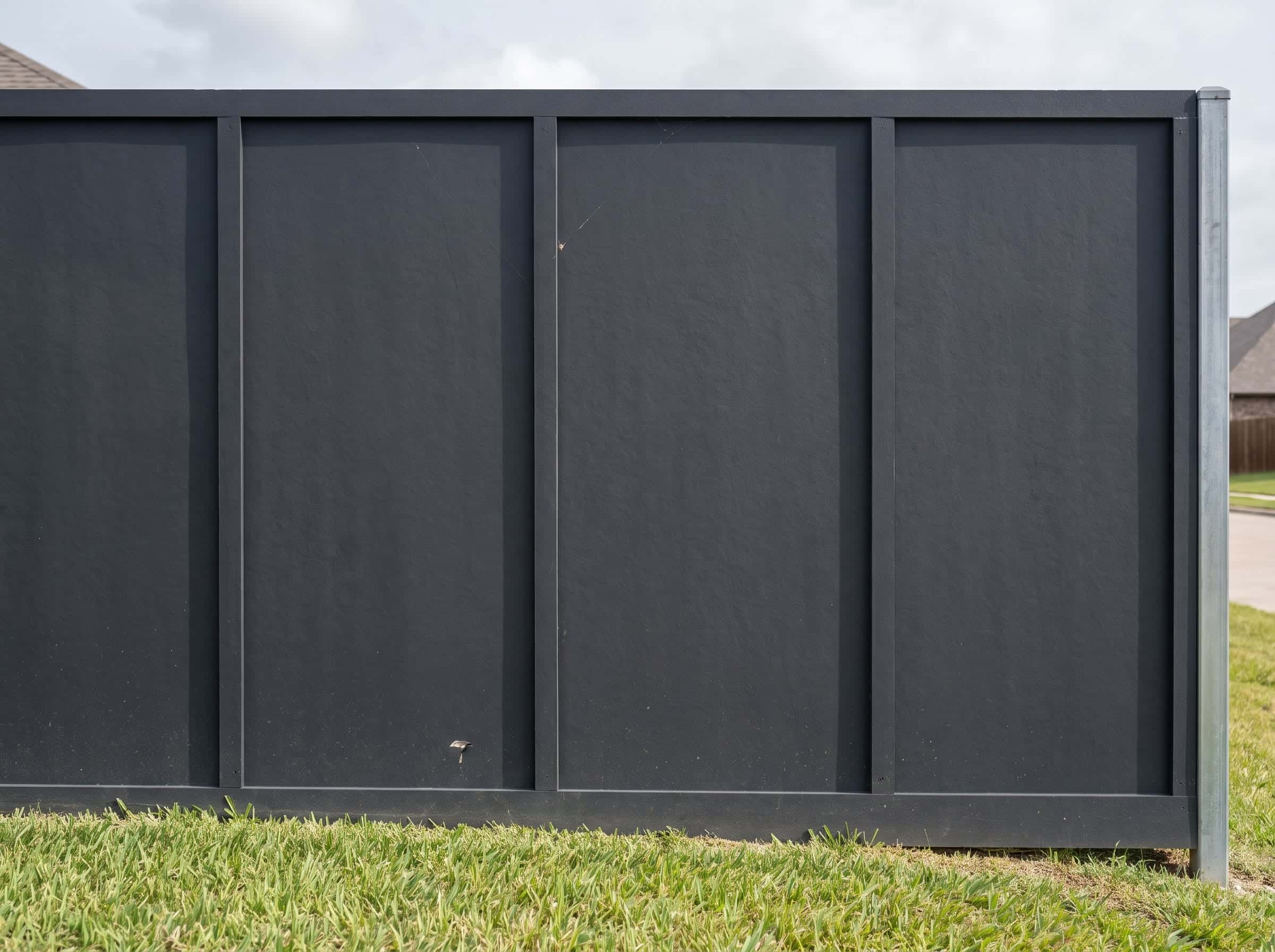
Most homeowners ask whether their HOA allows a fiber cement fence. That is the wrong question, and asking it is how a packet comes back denied.
Texas law changed on September 1, 2025, and it took the outright ban off the table. What it left standing is your board’s say over material, and with a fence material most Texas neighborhoods have never seen, approval turns on what your paperwork says about it.
SB 711 Stops a Fence Ban and Keeps the Material Rule
Your HOA can no longer stop you from fencing your yard. Since September 1, 2025, Senate Bill 711 has barred a Texas property owners’ association from prohibiting a perimeter fence or other security measure, while leaving it limited authority over fence type and material (Texas Property Code, 2025). Material is where the argument happens now, because most approved-materials lists in Texas were written when the only real choices were wood and iron.
Three carve-outs survived the bill, and all three show up in fiber cement denials. A board can still regulate fence type or material. It can require a driveway gate set back at least 10 feet from a laned right-of-way. And it can bar fencing forward of the front building line. Fences installed before September 1, 2025 are grandfathered, which protects what is already standing in your yard and does nothing for what you want to build.
Know These Five Terms Before You Read Your Deed Restrictions
Read your covenants with these five words in hand, because every one of them shows up in a denial letter. Your deed restrictions are the rulebook the committee applies, and the terms below are the ones a homeowner skips and then loses a round over.
| Term | What it means on your packet |
|---|---|
| Architectural review committee (ARC) | The HOA committee that approves or denies your fence submission before work starts |
| Restrictive covenant | The recorded rule in your deed that sets fence material, height, and placement for your lot |
| Front building line | The line your house front sits on; a Texas HOA can bar fencing forward of it |
| Grade | The ground level a fence height is measured from, which changes on a sloped lot |
| Fiber cement | A cement-and-cellulose panel, sold for fencing as Hardie Plank, that neither rots nor burns |
A Like-for-Like Swap Can Skip Review, and a Material Switch Cannot
A fiber cement fence goes to review because it changes the material, even when the fence line never moves an inch. Where your covenants exempt a replacement in the same material, that exemption covers wood for wood and iron for iron. Trade either one for a cement panel and you are asking for a change of material, which is the exact thing the new law left your board free to regulate.
That catches people out, because the reason to switch is usually a fence that already failed. One homeowner told us their last fence was rotting and warping after three and a half years. Nobody in that position needs convincing about material. They need a submission that survives a committee reading it for the first time.
Five Things Your Fiber Cement Packet Has to Name
A complete packet names the product, the place, and the numbers, so the committee has no blank to fill in with a question. Every item below is something an ARC will ask for if you leave it out, and each round trip costs a week or more.
- The material spec. Manufacturer, product name, panel dimensions and thickness, and the factory finish.
- A site plan or survey with the fence line drawn on it. Property lines, the front building line, and every gate location marked.
- Height, measured from grade. State the height at the high end and the low end where the ground slopes.
- Color and finish. Name the color, and say whether it comes factory-finished or gets painted on site.
- Posts, frame, and footings. Post material, post spacing, embedment depth, and concrete footing size.
Where a Texas HOA Can Still Legally Deny Fiber Cement
Five denials hold up under the new law, and four of them are cured by paperwork you can send with the first submission. Only the first one is a real fight, and it is a fight about a list rather than about your fence.
| Where a denial holds | What your board can require | What defuses it in the packet |
|---|---|---|
| Material not on the approved list | A specific fence type or material for the neighborhood | Name the manufacturer, product, and finish, and request a written variance |
| Fence forward of the front building line | No fencing in front of that line | Draw the front building line on the site plan and keep the fence behind it |
| Driveway gate set too close to the street | A gate set back at least 10 feet from a laned right-of-way | Dimension the setback on the plan and label it |
| Height above the covenant limit | A maximum fence height for the lot | Give the height from grade at both ends of any slope |
| Color or finish outside the palette | An approved color and finish range | Name the exact color and state factory finish or field paint |
Your City Permit Rule Runs Alongside the HOA, and Neither Waives the Other
Houston requires a building permit for a residential fence over 8 feet above grade, and at any height when the fence is built wholly or partly of masonry or concrete (City of Houston, 2026). That second trigger matters for a cement-based panel, so call the Houston Permitting Center and ask where your product falls before you order material. An HOA approval is not a permit, and a permit is not an HOA approval.
| City | Permit trigger for a residential fence | Front-yard limit | Source |
|---|---|---|---|
| Houston | Over 8 feet above grade, or any height in masonry or concrete | No zoning, so no by-right front-yard height rule | City of Houston, 2026 |
| Austin | Over 7 feet, over 6 feet along a public right-of-way, or any height in a floodplain | Solid fence on a property line capped at 6 feet from natural grade | City of Austin, 2025 |
| Dallas | Permit required above the by-right height limits for the yard | 4 feet in a required front yard, 9 feet in any required yard | Dallas Development Code, 2025 |
| San Antonio | Any new fence, or replacing more than 25 percent of one | 3 feet solid, 5 feet predominantly open in a front yard | City of San Antonio, 2025 |
But an Approved Panel Still Has to Carry Texas Wind
Approval settles how the fence looks, and the wind settles whether it stays up. ASCE 7-22 treats a fence as a solid freestanding wall once its openings drop under 30% of the gross face area, which loads the full solid face with wind force (ASCE/SEI 7-22, 2022). A fiber cement privacy fence is solid by that definition, so the posts and footings under it are doing structural work.
The national design-load standard maps the Houston metro at basic design wind speeds on the order of 130 to 140 mph for ordinary structures in open exposure (ASCE/SEI 7-22, 2022). Post spacing, embedment depth, and footing size are what answer that number. Putting those three figures in the packet does two jobs at once: it satisfies the committee member who asks how a new material gets held up, and it commits your contractor to a spec in writing before anyone digs.