
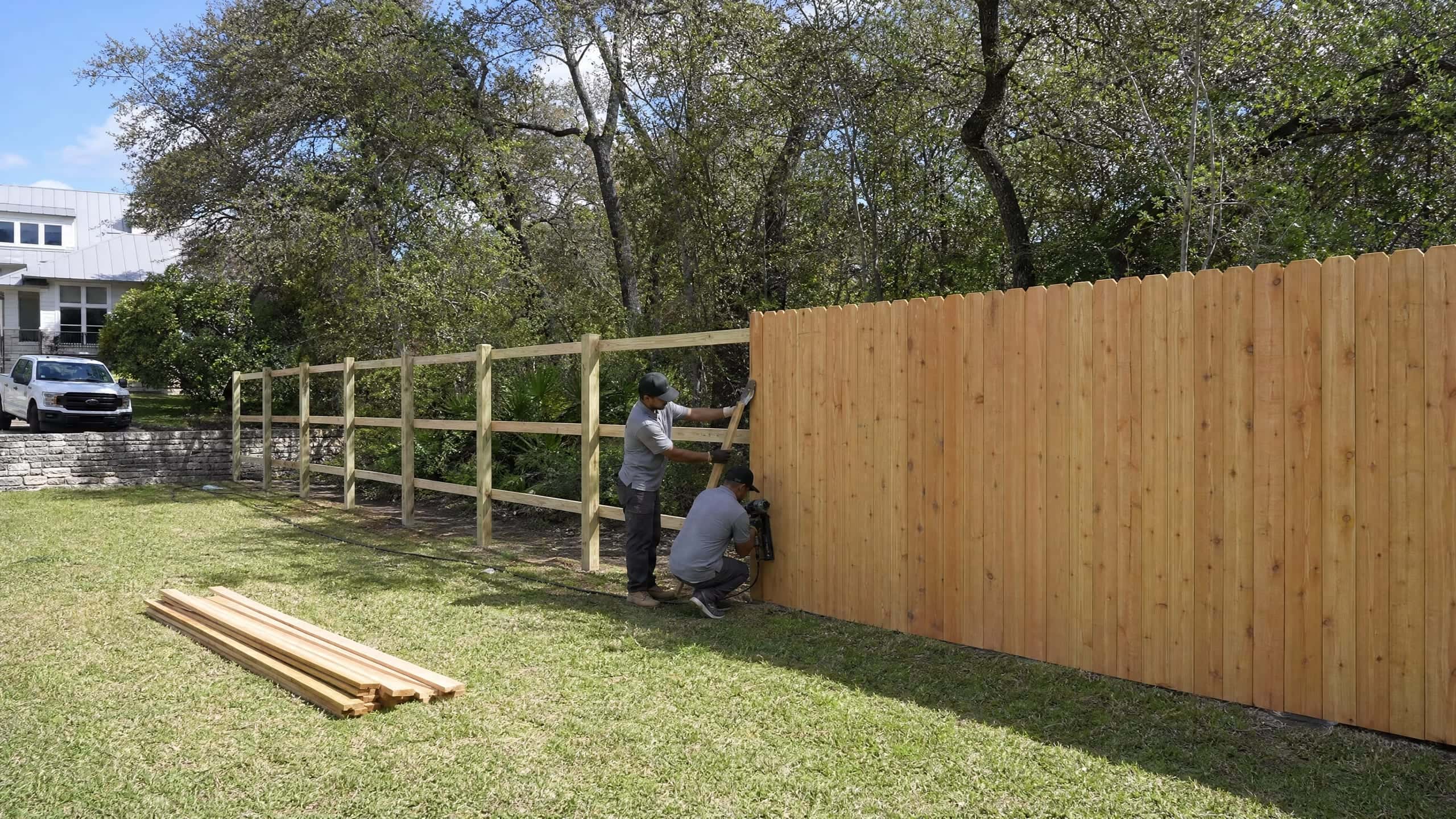
A Texas wood fence turns grey because sunlight breaks down the lignin in the surface of every board. It warps and cups because rain and heat swell and shrink each board unevenly, over and over, and Gulf Coast humidity runs both harder than the rest of the state.
The two are separate problems, and only the grey is fixed with a brush. A cupped board or a soft post means the wood was the wrong spec for the yard. One homeowner told us their last fence was already rotting and warping after three and a half years. They had paid once for a fence nobody specified.
Why Does a Wood Fence Turn Grey?
A wood fence turns grey because sunlight breaks down lignin, the compound that binds wood fibers together and carries the color, in the top layer of every exposed board. Redwood, southern yellow pine and Douglas-fir all lost surface brightness within the first month of outdoor exposure, then declined again past 180 days, in Forest Products Laboratory testing (USDA Forest Products Laboratory, 1984).
That change is shallow. A grey picket with hard wood under it has lost color and almost nothing else, which is why a fence can look ten years older than it is and still be sound.
What the degraded layer does cost you is bond. Once the surface fibers have broken down, a stain or sealer has less to grip, so the coating you buy to fix the grey performs worse than the same coating applied to sound wood.
Why Do Fence Boards Warp and Cup?
A board cups because it takes on water and gives it back unevenly, over and over. Gulf rain wets one face and the edges, heat pulls the moisture back out, and the board curls across its width. The same cycling starts the decay clock: serious decay only begins once wood moisture climbs past the fiber saturation point, an average of 30%, while air-dried wood usually holds at or under 20% (USDA Forest Products Laboratory, 2021).
So the two numbers to care about are wetness and drying. A picket that dries out fast between storms moves and stays sound. A post buried in clay that holds water sits above the decay threshold for weeks at a time.
That is why fences fail from the bottom. The ground line stays damp longest, and it is the one part of the fence nobody looks at.
Why Does a Wood Fence Age Faster in Houston Than in Dallas?
A wood fence ages faster in Houston because the climate is wetter and warmer. Houston scores 77.2 on the Forest Products Laboratory’s decay hazard index and Port Arthur 80.7, both deep inside the band the Laboratory calls high decay hazard, while Dallas scores 44.3 (USDA Forest Products Laboratory, 2009). The index scores how hard a climate works on exposed wood, using rainfall and temperature. Below 35 is low risk, 35 to 65 is moderate, and above 65 is high.
| Texas location | Decay hazard index | Band |
|---|---|---|
| Port Arthur | 80.7 | High |
| Houston | 77.2 | High |
| Austin | 55.2 | Moderate |
| San Antonio | 52.2 | Moderate |
| Dallas | 44.3 | Moderate |
| El Paso | 25.8 | Low |
The same fence, same wood, same crew, ages on two different clocks in Houston and Dallas. A wood spec that holds up for a Plano backyard is not automatically the right call in Kingwood or Memorial. And the trend runs the wrong way: a Laboratory analysis of 167 U.S. locations across 1969 to 2008 found the fitted time coefficient positive in most regions, so an older map understates today’s risk.
Does Cedar Resist Warping and Rot Better Than Other Wood?
Cedar heartwood does, and the pale cedar sapwood does not. In a Laboratory test fence exposed for up to 22 years, the heartwood of western redcedar, redwood and Douglas-fir rated among the most decay-resistant woods above ground, estimated at over 20 years, while the sapwood of those same species failed markedly sooner (USDA Forest Products Laboratory, 1995).
That is the part “cedar” hides. A cedar picket streaked with pale sapwood is partly a cedar picket. It greys at the same rate as the heartwood beside it and rots faster.
Species still matters on top of that. A worldwide durability checklist rates western redcedar as resistant, class 2, and loblolly pine as only moderately resistant to nonresistant, class 3 to 4 (Oregon State University, 1998). Pine earns its place on a Texas fence through treatment, and cedar earns its place through heartwood content.
What Should a Wood Fence Quote Name?
Almost every argument about a Texas wood fence comes down to five terms, and a quote that names none of them has priced hours and boards rather than a fence.
| Term | What it means | Why it lands on your quote |
|---|---|---|
| Heartwood | The darker inner wood, where decay resistance sits | Cedar heartwood pickets outlast pale cedar sapwood pickets |
| Sapwood | The pale outer wood, still moving water in the living tree | Pale streaks in a cedar picket fail first |
| Cupping | A flat board curling across its width | Tells you that board took on water unevenly |
| Ground contact (UC4A) | The use category for wood set in soil | Posts need it; pickets above the soil do not |
| Picket grade (#1 to #3) | Mill grade covering knots, wane and straightness | Two bids can quote different grades at the same price |
Ask which grade the number was written against. That single question changes what a bid means, because #3 pickets and #1 pickets are both honestly called cedar.
How Long Do Treated Pine Fence Posts Last?
Pine posts treated for ground contact last decades, against a year to a few years for untreated wood in the same soil. AWPA Standard U1 places fence posts in Use Category UC4A, general ground contact, and pairs that exposure with a minimum preservative retention engineered for long-term in-ground service. Correctly treated southern yellow pine posts are specified for decades in the soil.
The gap it buys is not small. At a severe-exposure in-ground test site in southern Mississippi, pressure-treated wood showed expected durability beyond 60 years while untreated stakes in the same soil lasted a year to a few years (USDA Forest Products Laboratory, 2013).
Price is where most buyers stop reading, so it matters how a company gets there. Master Halco named us its 2026 Largest Volume Customer for both the Southwest Region and the World, and we are a top customer of Solid Wood. We buy pickets at a cost a one-to-three-crew shop does not get, and that shows up as the same fence for less. It never shows up as a thinner spec, because the grade goes in the quote by number.
When Should You Seal a New Wood Fence?
Seal it once treated wood has dried and before the surface weathers, because sealing works on sound wood and struggles on weathered wood. Forest Products Laboratory research found that siding left to weather for as little as one to two weeks before painting has a degraded surface that cannot form a durable paint bond, even though little visible change has happened yet. The window is shorter than it looks.
- Let treated wood dry first, then coat it. Fresh pressure-treated lumber holds too much moisture to take a finish, and a coating applied over wet wood peels.
- Coat while the surface is still sound. A sealer put on early cuts UV reaching the lignin and slows how fast the board takes on and gives back water.
- Re-coat before the grey comes back through. Sealing is upkeep on a schedule, and each coat is easier than stripping a surface that already broke down.
Sealing slows both failure modes at once, and it hides neither. Nothing you brush on reaches the buried part of the post, which is where the fence actually decides how long it stands.