
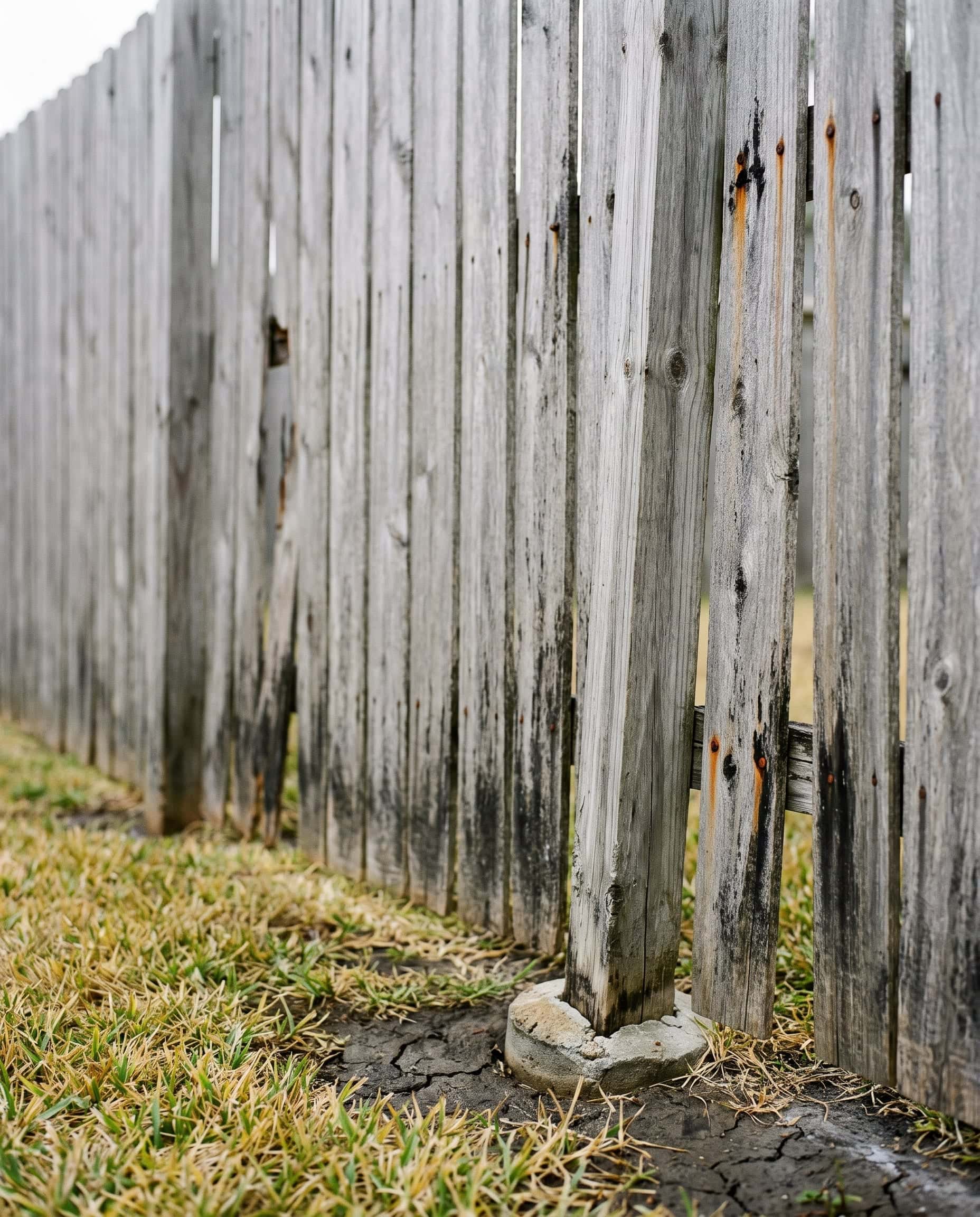
Fence repair costs about $304 to $948, with most homeowners spending around $618; a replaced post averages about $270 and a replaced panel $150 to $300 (HomeAdvisor, 2026). Those numbers hold when one or two posts have failed. In Houston the posts usually go first, and once about a third of them are soft at the ground line, a new fence costs less than paying for the same repair again and again.
A leaning post, a rotted ground line and a wind-broken panel are three different jobs, and only one of them is really about panels.
Houston carries one of the highest wood decay hazards of any big city in the country, and that shows up at the base of the post long before it shows up in the boards. A quote worth signing starts at the failed post and works outward.
Why Does One Price Per Panel Not Fit Every Damaged Fence?
Because a lean, a rot and a broken panel are three different jobs. Three separate failures hide behind that one question, and each carries its own cost driver. Houston-area wood privacy fences are commonly quoted at $16 to $42 per linear foot to build new (Angi Houston and HomeBlue, 2026), and a repair rate borrowed from that spread tells you nothing about which part of your fence quit. Posts, rails, and pickets fail for different reasons, and they cost different money to put right.
So the first job on a repair call is diagnosis. Here is what the three common Houston failures actually are, and what moves the number on each.
| Failure you can see | What actually failed | What drives the price |
|---|---|---|
| Fence leans in one spot | The post lost its grip below grade | Digging out one footing, plus new concrete |
| Boards sag near the dirt | Rot at the ground line | How many posts and rails test soft, counted one by one |
| A panel blew out in wind | Rails and pickets, or the post beside them | Picket count, rail count, and whether the end post held |
Same fence, same 8 feet of damage, three different bills. A crew that quotes all three off one per-foot rate has not looked at your fence yet.
What Do the Terms on a Fence Quote Mean?
A quote for a damaged fence is a short document, so every word in it is carrying weight. Most of the argument between a $400 fix and a $1,400 one lives in five terms, and a homeowner who knows them can read a bid in about a minute.
| Term | What it means on a Houston fence quote |
|---|---|
| Ground line | The few inches of post right at the soil, where wood stays wet longest |
| Ground contact | The treatment level specified for wood set in the dirt, Use Category UC4A (AWPA Standard U1) |
| Rail | The horizontal board behind the pickets, which the pickets are nailed to |
| Kickboard | The wide board along the bottom of the fence that touches the dirt |
| Post reset | Re-setting the existing post in fresh concrete instead of pulling and replacing it |
If a quote says “repair fence, 40 feet” and names none of these, it is a price without a spec.
Why Do Fence Posts Fail First in Houston?
The climate. Posts go first here because the ground line stays wet. On the standard wood decay hazard index, Houston scores 77.2 against 44.3 for Dallas and 52.2 for San Antonio, and anything above 65 sits in the high-hazard band (Carll, USDA Forest Products Laboratory, 2009). A fence in Katy is being attacked harder than the same fence in Plano, built the same week by the same crew.
The reason is water and time. Serious decay needs wood moisture above about 30%, and wood that dries out stays safe (USDA Forest Products Laboratory, 2021). A picket in the air dries after every rain. The 4 inches of post sitting in wet Gulf Coast clay does not.
That is why the damage you notice is rarely where the problem started. The panel sags, so you look at the panel. The post beside it has been softening at the dirt line for two or three years.
How Do You Check Whether a Fence Post Is Rotten?
Push a screwdriver into the base of every post. The test takes five minutes and it decides your whole quote. Walk the line and push a screwdriver into the wood at the soil on every post. Sound wood stops it. Soft wood takes it in like cork, and that post is finished no matter how good the pickets above it look.
Three things to note as you walk:
- How many posts are soft. One or two soft posts on a 100-foot run is a repair. Most of them soft is a rebuild wearing a repair’s clothing.
- Where the soft posts sit. Corners, ends, and gate posts carry more load than a post in the middle of a run.
- Whether metal posts are rusting at the same place. Iron fails at the ground line too, and it is fixable. We repaired rust-damaged wrought iron posts for Vi Garcia, who wrote in a June 2026 SoTellUs review: “We are very satisfied with the finished work. It was done skillfully and neatly. Office personnel are accommodating.”
Bring that count to the phone. A salesperson who hears “6 of my 14 posts are soft at the base” can give you a far more honest rough number than one who hears “my fence is falling down.”
Is Resetting a Fence Post Cheaper Than Replacing It?
Yes, because a reset re-uses wood that is still sound. Resetting a post and replacing a post are priced differently because the work is different, and the choice between them is made below grade. A reset re-uses wood that is still sound. A replacement admits the wood is done. Guessing wrong costs you the whole repair, because a reset post that is rotten at the base will lean again after the next wet season.
| Repair | What the crew does | When it holds |
|---|---|---|
| Post reset | Breaks out the old footing, plumbs the post, pours new concrete | The wood below grade is still solid |
| Post replacement | Pulls post and footing, sets a new ground-contact treated post | The base is soft or the post has snapped |
| Full run rebuild | Replaces posts, rails, and pickets down the whole line | Most posts on the run test soft |
The good news on replacement is the material. Correctly treated wood in ground contact has been measured at a severe test site with expected durability past 60 years (Lebow and colleagues, USDA Forest Products Laboratory, 2013). A properly specified new post is not a patch. It outlives the fence around it.
What Does a Panel Replacement Include That a Panel Repair Skips?
A panel repair buys boards. A panel replacement buys the frame behind them, and that is where the price separates. Swapping six cracked pickets is fast work with cheap material. Replacing a panel means new rails, new pickets, and often the kickboard, and it only holds if the two posts on either side are sound.
This is the point where a lot of Houston quotes quietly get expensive for no benefit. A crew that replaces panels without testing the posts has sold you new boards nailed to failing wood. The pickets will look right for a season, then lean with the post.
The order matters and it never changes. Posts first, then rails, then pickets. Any quote that runs it the other way is pricing what you can see.
Why Did Wind Break Only the End Panels and the Gate?
Because that is where the wind load concentrates. Full-scale testing on freestanding walls found pressure is highest near the free ends and the leading edge of a wall, and much lower where a return corner braces it (Robertson, Hoxey and colleagues, 1996). A solid privacy fence behaves like that wall, which is why your end panels, corners, and the posts flanking a gate come down while the middle of the fence stands.
For the quote, that has one practical result. The wind-damaged panel is usually a symptom, and the post next to it took the same load and may be cracked below the concrete. A gate post carries the panel load plus the swinging weight of the gate, every day, so it is the single post most worth testing before anyone prices boards.