

A composite fence looks like the grown-up choice. The brochure promises no staining and no rot, and the price matches the promise. Then the quote from the next contractor leaves out the picket grade and the post depth, and the fence that fails too soon turns out to be the one with shallow posts, in either material.
For a Texas homeowner pricing a fence, a properly specified wood fence is the better value. Composite earns its higher price only for the owner who will not touch a fence again for decades, and either material fails early when the install is wrong.
Which lasts longer in the Texas climate, Trex composite or a wood fence?
Composite gives the lowest upkeep, and wood gives the lowest price for the same spec. Trex backs its composite fence with a 25-year residential limited warranty, and wood-plastic composite fence parts are performance-rated for durability under ASTM D7032 (ASTM D7032, 2021).
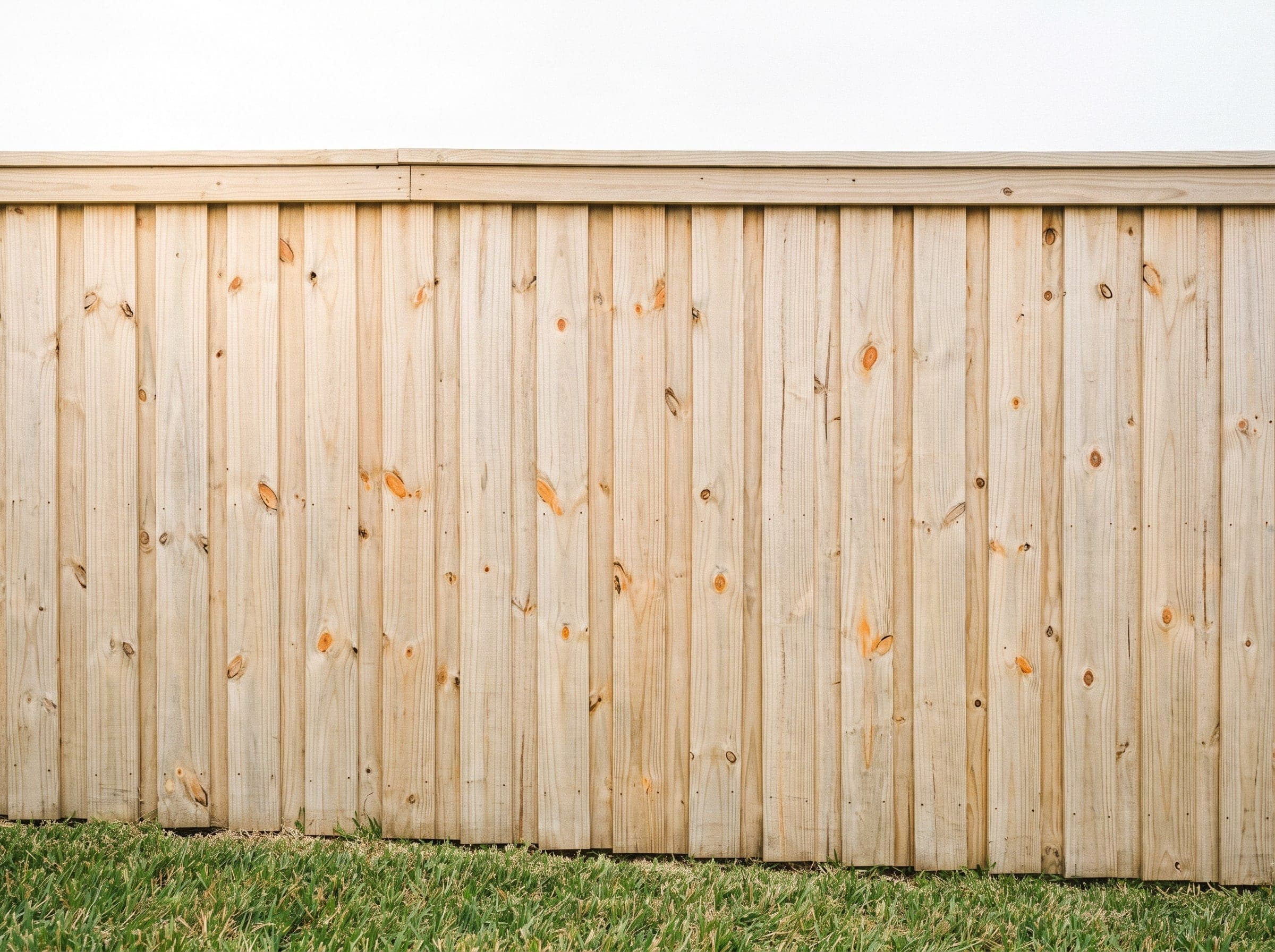
Wood has a long record where it matters most, in the ground. A decades-long USDA Forest Products Laboratory study in southern Mississippi found pressure-treated wood with expected durability beyond 60 years, against a year to a few years for untreated stakes in the same soil (Lebow et al., 2013). The American Wood Protection Association’s Standard U1 places fence posts in Use Category UC4A, general ground contact, so a correctly treated pine post is specified for decades underground. We build with pressure-treated framing and cedar pickets, and a wood fence put in properly should give you about twenty years.
How much does a composite fence cost compared with wood in Texas?
Wood costs $18 to $45 a foot, measured by HomeGuide, Angi and HomeAdvisor, and composite costs $30 to $55 a foot, according to HomeGuide and Ergeon. Both ranges are installed prices for a six-foot fence on flat ground, before tear-out, gates and slope.
Several things push a quote above those ranges: a taller fence, old-fence removal and disposal, gates, extra corner and gate posts, rocky or heavy-clay soil that slows the post holes, and slope. That is why we price every project by custom quote after a free on-site estimate, with no fixed price list. You pay nothing for the on-site estimate and sign nothing, and the quote arrives that same day.
The price lead on wood comes from the picket. Master Halco named us its Largest Volume Customer for the Southwest Region and for the World in 2026, and that wood-picket buying power is passed on to you. You pay less for the same spec, not less for a thinner one.
What does a wood fence need in upkeep to last in Texas?
The USDA Forest Products Laboratory puts Houston at 77.2 on its decay hazard index, deep in the high band above 65, against Dallas at 44.3 (Carll, 2009).
San Antonio sits at 52.2 and Austin at 55.2, both in the moderate band of 35 to 65. A Houston owner who skips the seal pays for it sooner than a Dallas owner does. Composite removes the sealing step, and for an owner who will never reseal, that is the real value of the extra cost per foot. For everyone else, a seal every few years is a small price against the money wood saves up front.
How do termites, humidity and storms affect composite and wood fences in Texas?
Wind is what takes down most fences in a Texas storm, and it depends on how deep the posts are set and how the fence is built, not on the picket material alone. The national design-load standard maps the Houston area at basic design wind speeds of 130 to 140 mph for ordinary structures in Exposure C (ASCE/SEI 7-22, 2022).
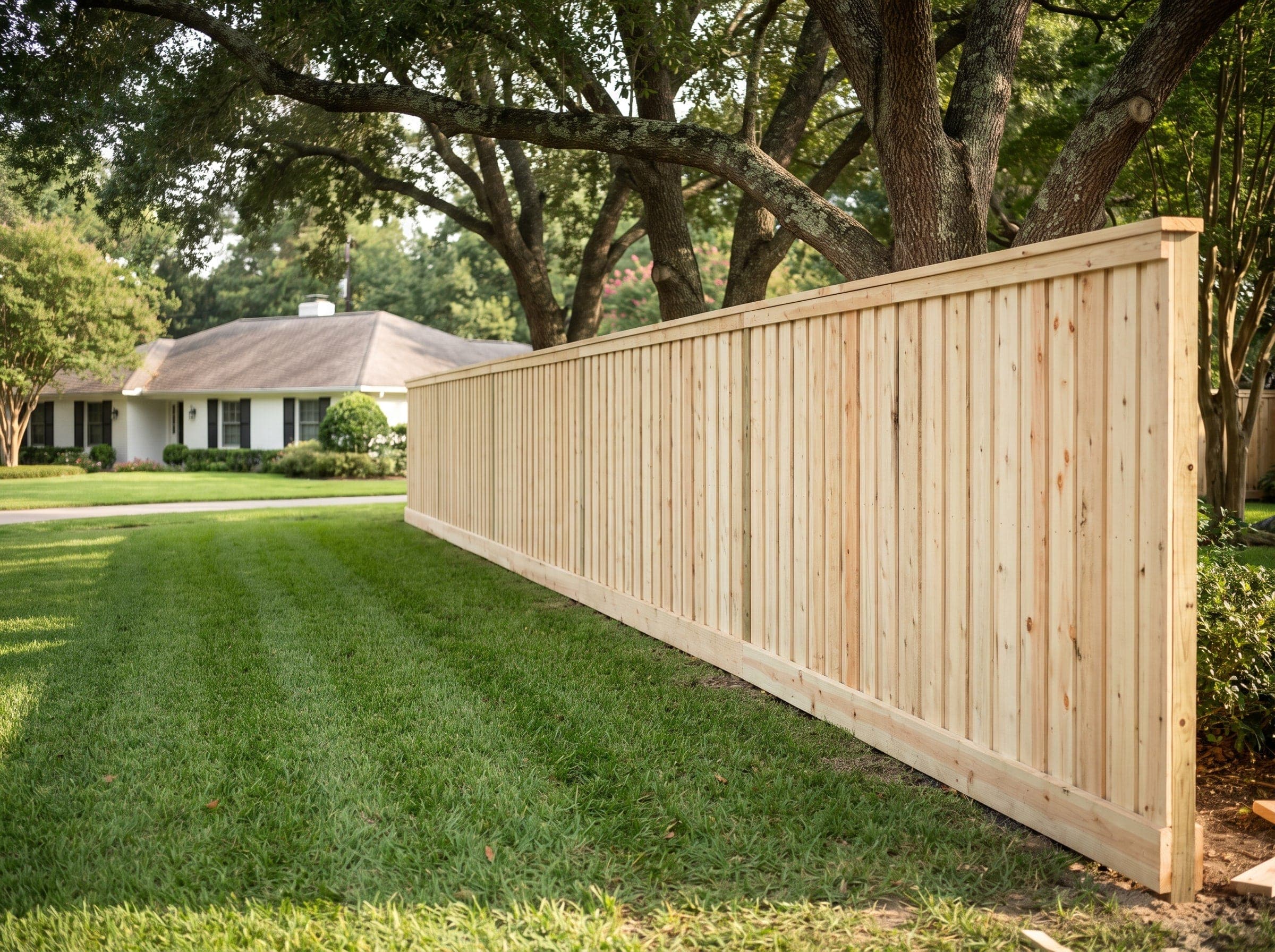
A 6-foot solid fence, and any gate or wall above 7 feet, has to resist the design wind pressure for its location. A solid face catches the same gust in composite or wood. Humidity works on the wood side, as the decay index above shows, and a treated post specified for ground contact is the answer to it.
What should the quote say about post depth and picket grade?
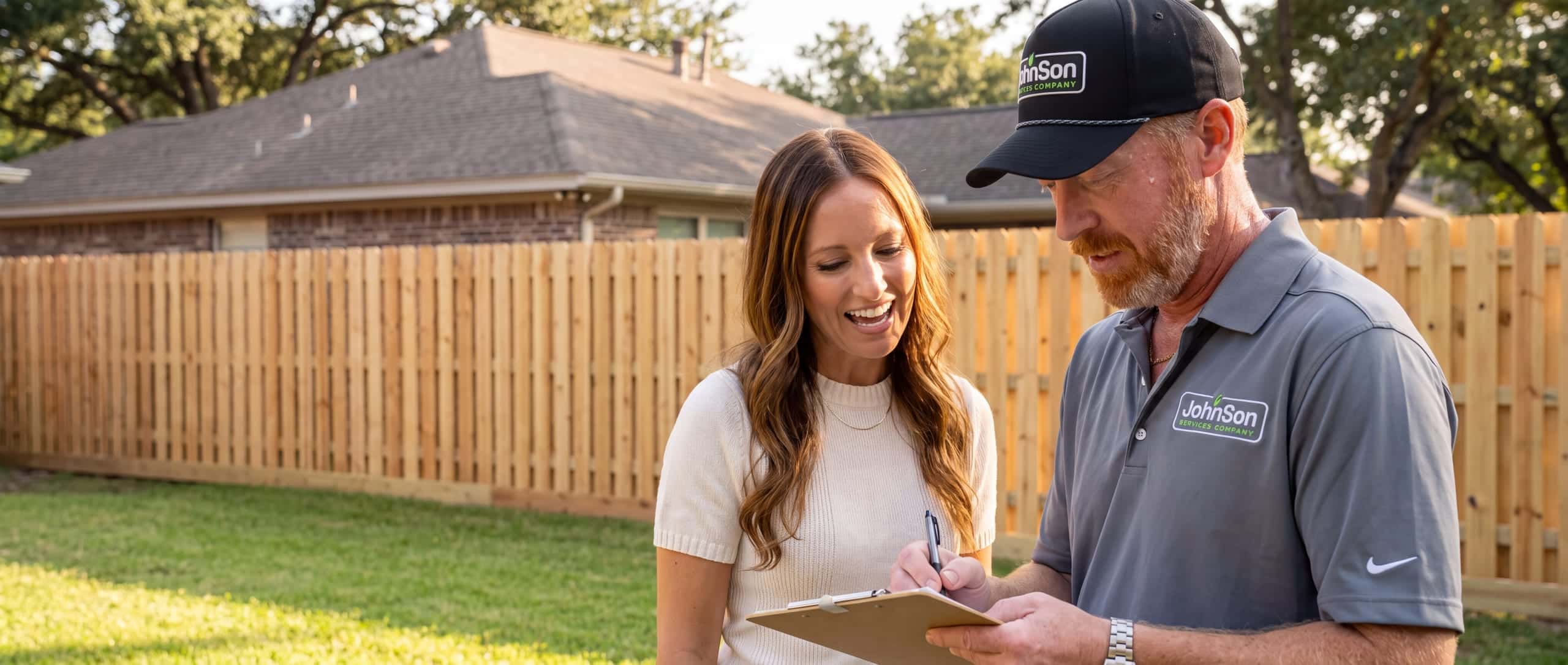
A fair quote names the picket grade (#1, #2 or #3), the post depth and spacing, the material for the posts, and what tear-out and haul-off cost, because a low number can hide a thinner spec. Our salesperson meets you on site, measures the linear footage and confirms fence type and picket grade, and we quote the grade by name, so you compare the same fence at both prices.
Post depth comes from the soil and the wind. Under the 2021 International Building Code, Section 1807.3.2.1, a fence post is sized as a cantilevered pole, and embedment grows with wind force and lever arm and shrinks with stronger soil. The USDA Natural Resources Conservation Service classifies Houston Black, the Texas State Soil from Dallas south to San Antonio, as a smectite-clay Vertisol of about 60 to 80 percent clay with very high shrink-swell (2023). A heavy solid gate on a tall post in that clay needs a deep, wide concrete footing.
In an August 2025 Google review, Celeste T. wrote: “Excellent experience beginning to end! Wouldn’t hesitate to use them again or recommend to others! Options were presented to work within our budget. Supervisor confirmed timeline, crew arrived promptly, confirmed work scope, worked efficiently and left the property clean. Fence didn’t budge an inch when severe storms came through the next day!”
Who should choose composite and who should choose wood for a Texas fence?
Choose composite if you want no staining and plan to stay a long time. Choose wood if you want the lowest price for the same spec and the look of real grain, and accept a seal every few years. A fence installed to the right spec in either material beats a cheap one in the other.
The spec is also where other buyers get burned. A one-star Google review from March 27, 2026 reads: “No showing an initial evaluation and quote with no notifications”. A fence is a promise about a date and a spec, and a crew that never arrives breaks both. We had zero craftsmanship warranty callbacks across 20,000-plus jobs last year, and our warranty is one year of craftsmanship.