
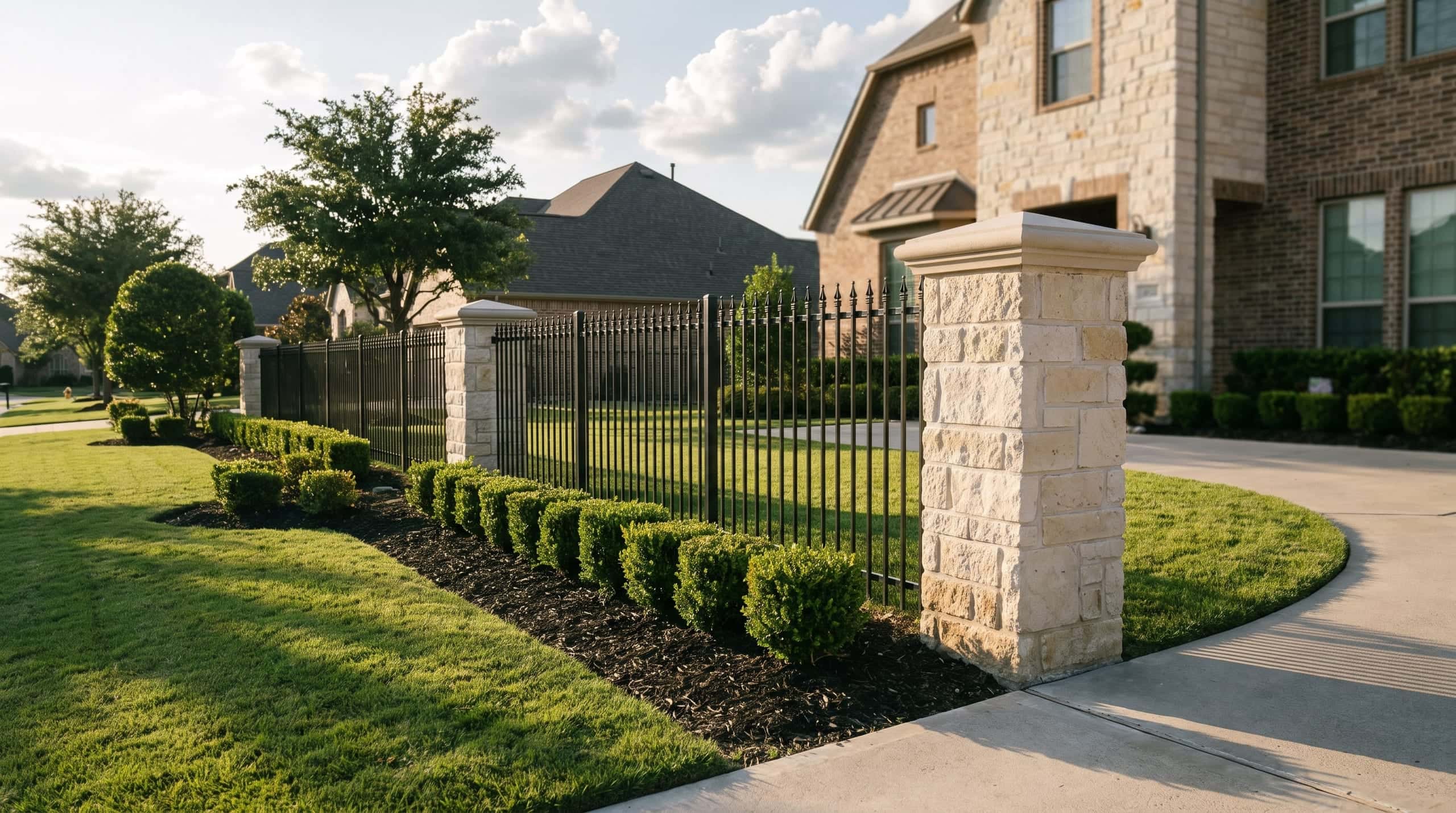
Ask what a driveway gate costs in Texas and you get a range for install day. That number is real, and it answers about a third of the question.
Two lines decide what the gate costs you over the next ten years, and most quote sheets never print either one. One is the entrapment-protection hardware UL325 requires. The other is the operator’s duty cycle, measured against how many times a day your gate actually swings.
A Gate Quote Prices Install Day and Stops There
Labor on a single Houston gate install runs about $180 to $300 for 4 to 6 hours of work (Angi, 2026). That figure already assumes a straightforward automatic opener going onto ground that cooperates. Two other lines decide the next ten years. One is the sensor pair the code requires. The other is the operator’s rated cycles against your real traffic.
Neither one shows up as a line item on most quotes, because neither one changes what the crew does that afternoon. They change what happens in year three, when a motor rated for a quiet drive has been opening 40 times a day, or when a photo eye loses signal and nothing in the system notices.
So read a gate quote the way you would read a spec sheet with a price at the bottom. The price tells you about install day. The spec tells you about ownership.
Know These Five Terms Before You Read a Gate Quote
Five words carry almost all of the cost difference between two gate quotes, and four of them are hardware terms a buyer has no reason to already know. Learn them once and the quotes stop looking interchangeable.
| Term | What it means | Why it moves your cost |
|---|---|---|
| Duty cycle | Cycles the operator is rated to run per day or per hour | An underrated motor is the first part to fail |
| Entrapment protection | Sensing and reversing that stop a gate on contact or a blocked path | UL325 requires two different types in each direction |
| Monitored sensor | A sensor the operator watches for faults and lost signal | An unmonitored photo eye misses the current rule |
| Usage class | ASTM F2200’s four classes, Class I residential to Class IV restricted | The class sets which gate and operator may be paired |
| Embedment | How deep the gate post sits in concrete below grade | Gate weight, wind, and soil set depth and concrete volume |
A quote that names all five is not automatically the cheapest one. It is the one you can hold someone to.
UL325 Requires Two Different Entrapment Protections in Each Direction
Every entrapment zone on an automated gate needs at least two independent, different-type protections in each direction of travel, an inherent reversing system plus an external non-contact photo eye or a contact edge, and since August 1, 2018 those external sensors must be monitored so the operator drops to constant-pressure or manual on any fault, broken wire, or lost signal (DASMA, 2018). That pair is not an upgrade. It is what makes the installation code-correct.
The rule came out of a casualty record. The Consumer Product Safety Commission reported 32 deaths related to automatic gates since 1985, 20 of them children, and about 25,000 people involved in automatic-gate injuries from 1990 to 2000 (CPSC, 2001). Two independent protections in each direction is the answer the standards bodies landed on.
Here is what that means for two quotes on your desk. If one of them is cheaper and does not name the sensors, ask which sensors, and ask whether the operator monitors them. A single unmonitored eye is a cheaper bill of materials and a gate that does not meet the standard it was sold under.
Match the Operator’s Duty Cycle to Your Daily Gate Count
Count your cycles before you pick a motor. LiftMaster classifies operators as light-duty at about 25 cycles a day, medium-duty at about 50 a day, and industrial-duty at about 25 an hour, and warns that running past the cycle spec cuts the operator’s life (LiftMaster, 2025). A gate is one cycle out and one cycle back, so a household making a dozen round trips a day is already at the top of light-duty.
| Duty class | Rated volume | What that covers | Source |
|---|---|---|---|
| Light-duty | about 25 cycles a day | a single-family drive with one or two vehicles | LiftMaster, 2025 |
| Medium-duty | about 50 cycles a day | a shared drive or a small multi-family entrance | LiftMaster, 2025 |
| Industrial-duty | about 25 cycles an hour | commercial traffic moving in and out all day | LiftMaster, 2025 |
The gate itself gets sorted the same way. ASTM F2200 defines four usage classes matching UL325, Class I residential, Class II commercial and multi-family, Class III industrial, and Class IV guarded or restricted access, and requires the whole gate system to comply with both standards (ASTM, 2024). A Class I operator on a Class II entrance is a spec error that reads as a saving on the quote.
Texas Clay and Caliche Decide What the Gate Posts Cost
The posts flanking a driveway gate are sized as cantilevered poles, and the 2021 International Building Code sets required embedment from the wind force, the height of that force above grade, and the strength of the soil holding the post (IBC, 2021). A heavy solid leaf on a tall post in soft Houston clay drives a deeper, wider concrete footing than the same gate on firm ground. That concrete is real money, and it is the line a thin quote shortens first.
West of I-35 the problem inverts. Angi’s Austin fence-cost page reports that clearing, leveling, or removing rock adds $200 to $1,000 to a project, and that limestone yards often need extra equipment to dig post holes and set footings (Angi, 2026). Shallow rock is not a reason to set a shorter post. It is a reason the hole costs more to make.
Ask one question about this before you sign: how deep are the gate posts going, and what happens to the price if the auger hits rock at 18 inches. A crew that has an answer has thought about your yard.
Five Line Items That Move a Texas Gate Quote After You Sign
Five things routinely change a gate number between the estimate and the finished install, and every one of them is knowable in advance if somebody stands in your driveway first.
- Power to the gate. An operator needs a circuit at the gate, and the run has to get there. A long trench across a finished yard is work nobody priced from a satellite photo.
- Post and footing size. Leaf weight, span, and soil set the post diameter and the concrete volume. A wider leaf is not a wider gate alone; it is a bigger footing at both ends.
- The setback your HOA can require. Texas Property Code Section 202.023, as amended by SB 711 effective September 1, 2025, lets an association require a driveway gate to sit at least 10 feet back from the right-of-way where the driveway meets a laned roadway (Texas Property Code, 2025). Ten feet of setback can mean a different layout and a different price.
- Monitored sensors. Where an older operator is already on the property, the sensor pair may need to be brought up to the monitored requirement. That is hardware and wiring, and it belongs on the quote in writing.
- Access control. A keypad, an intercom, or phone entry each add hardware and each add a wiring path. Decide before the crew is scheduled rather than after.