
Ask what a fence costs and you get one blended number for the whole country. That number is useless when you are standing at the corner of your lot with 200 feet of failing cedar in front of you.
Your 200 feet has a material, a picket grade, a metro, and a set of site conditions. Price those four things and the honest answer moves by thousands of dollars off the quick version.
The Same 200 Feet Runs $2,400 in Chain Link or $18,000 in Iron
Multiply by 200 and the spread shows up immediately. A pressure-treated pine privacy fence lands around $3,600 to $6,000 for the run. The same 200 feet in ornamental steel can reach $18,000. Both come off published Texas installed-cost ranges for a standard 6-foot fence on flat, clear ground, materials and labor together (HomeGuide, 2026).
| Material (6 ft residential) | Texas installed cost per linear foot | 200 feet installed |
|---|---|---|
| Pressure-treated pine privacy | $18 to $30 | $3,600 to $6,000 |
| Cedar privacy | $25 to $45 | $5,000 to $9,000 |
| Chain link | $12 to $28 | $2,400 to $5,600 |
| Ornamental steel or wrought iron | $45 to $90 | $9,000 to $18,000 |
| Vinyl (PVC) | $30 to $60 | $6,000 to $12,000 |
| Composite (wood-plastic) | $30 to $55 | $6,000 to $11,000 |
Read what those ranges leave out. They cover a fence built on flat, clear ground with nothing in the way. Old-fence removal, gates and automation, permits, rocky or heavy clay soil, and slope all sit outside them. Every one of those shows up later in this piece, because every one of them shows up on real Texas quotes.
What Linear Foot and Picket Grade Actually Mean on a Quote
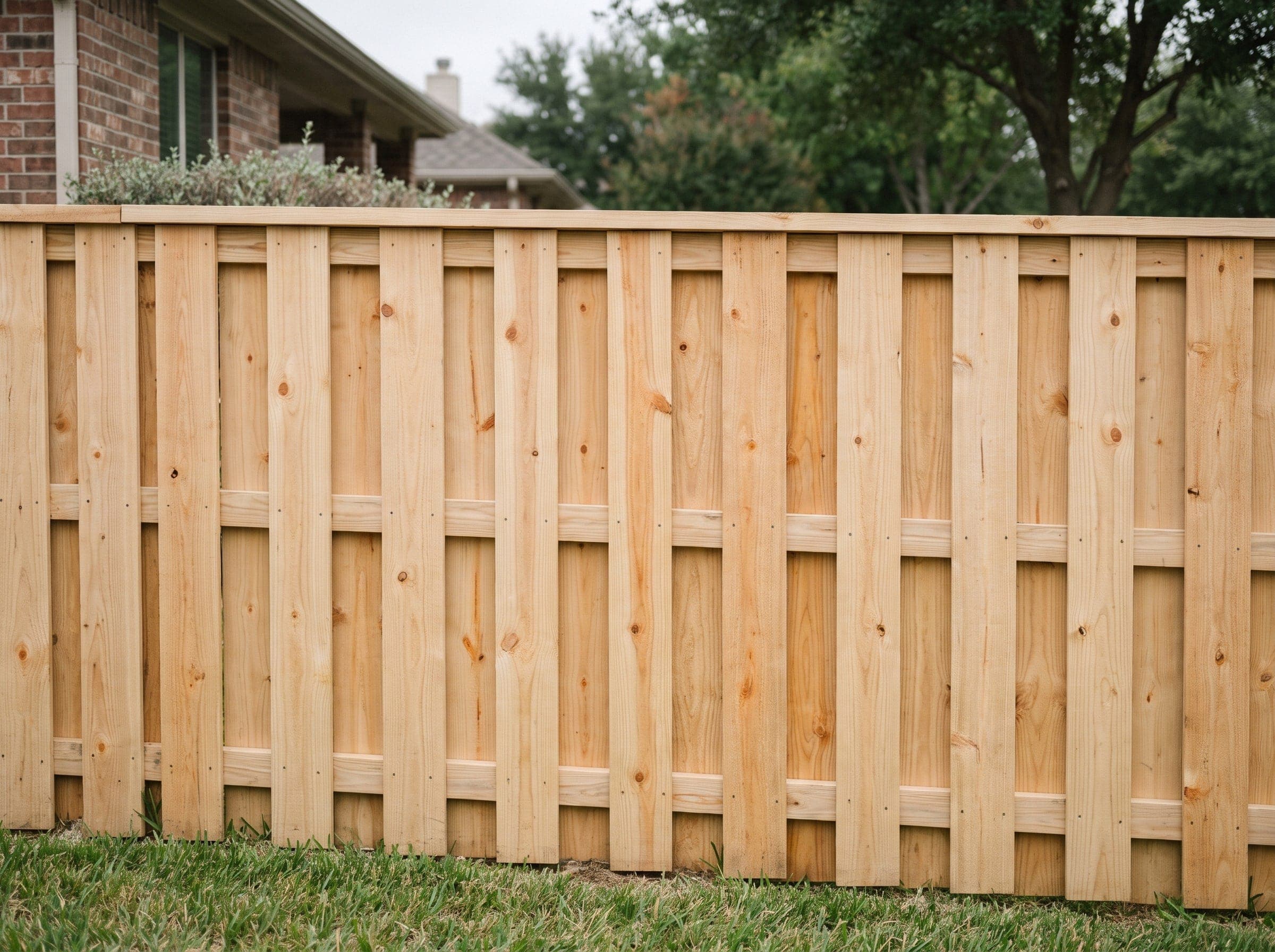
Four words do most of the work on a fence estimate, and a homeowner who knows them can read a quote in about a minute. The one that costs people money is picket grade, because two boards with the same species name can be two different products. The American Wood Protection Association’s Use Category standard puts fence posts in UC4A, general ground contact, which is a treatment level a quote should name (AWPA Standard U1).
| Term | What it means on your quote |
|---|---|
| Linear foot | The distance your fence covers along the ground. 200 feet of fence line is 200 linear feet at any height. |
| Picket grade | The board’s quality tier, #1 through #3. #1 has the fewest knots and the straightest grain. |
| Ground contact | The preservative treatment level for wood buried in soil, specified for posts, not pickets. |
| Haul-off | Removal and disposal of your old fence, usually priced as its own line. |
Ask for the grade number, not the species alone. Cedar is a species. #1 cedar is a spec.
A Texas Fence Costs Less Than the National Number Suggests
Texas wood pricing sits under the national average, so a national calculator overstates your 200 feet. National wood-fence installs run $20 to $50 per linear foot (HomeGuide, 2026). Heavy local competition and nearby pine and cedar supply are why the Texas figure lands lower.
Houston is the clearest example. Wood privacy fences in the Houston area are commonly quoted at $16 to $42 per linear foot, with 6-foot privacy around $19 to $26 per foot at the low-labor end (Angi Houston, 2026). On 200 feet, the difference between the national midpoint and the Houston low end is over $2,000 for the same fence.
That is why the metro matters as much as the material. A quote written against Dallas labor and a quote written against Houston labor are not the same quote, and neither one is the national average.
Two Quotes for Cedar Can Mean Two Different Boards
Grade is where two honest-looking numbers separate. A contractor quoting #3 cedar and a contractor quoting #1 cedar can both write the word cedar on the page and land hundreds of dollars apart on 200 feet. The cheaper board has more knots, more wane, and more cup, and it shows up in the fence line inside two summers.
We quote the grade by name, #1 through #3, so the comparison is real. A buyer who asks all three bidders for the grade number turns three prices into one apples-to-apples decision. A buyer who does not is often paying the same money for a lesser board.
Ask for it in writing. A contractor who will not put a grade number on the page has told you something.
What Removal, Gates, and Clay Add to Your 200 Feet
Five things move a Texas fence quote off the baseline, and they explain most of the gap between the number people expect and the number they get. Higher-than-expected product or service costs are the leading cause of blown renovation budgets, named by 52% of homeowners who exceeded theirs (Houzz, 2026).
- Old fence removal and haul-off. Tearing out 200 feet of failed fence and disposing of it is labor and a dump run. Ask whether it is in the number and which day it happens.
- Gates and automation. A gate is hardware, heavier posts, and deeper footings. An automatic operator adds the motor, the access control, and a UL325-compliant install with entrapment protection.
- Extra corner, end, and gate posts. A straight 200-foot run needs fewer posts than a lot with four turns and two gates. Corners and ends carry more load and get built heavier.
- Rocky or heavy clay soil. The Blackland Prairie clay running from Dallas south to San Antonio is a shrink-swell soil with 60% to 80% clay content, classified as a limitation for building-site development (NRCS, 2023). Slower post holes and deeper footings cost hours.
- Slope and limited site access. Stepping a fence down a grade adds panels and cuts. A gate too narrow for a skid steer means every post hole and every picket moves by hand.
Picket Buying Power Holds Wood at the Low End
Wood is where scale changes the number on the page. Master Halco named us its 2026 Largest Volume Customer for the Southwest Region and for the World, and that picket cost goes to the customer instead of into a wider margin. The claim is narrow and we keep it narrow: the same fence for less, because we buy the wood for less.
What it is not is a cheaper board wearing the same name. Buying power lets us hold a grade we would otherwise have to trade away to hit a price, which is the trade most low bids are quietly making. Rita S. wrote in a review on our site that we “charged almost $900.00 less than three other companies for the same metal, coating and paint for my black metal fence in Del Webb of The Woodlands.”
Last year we installed more than 2 million feet of fence across more than 20,000 projects. That volume is the reason the wood math works, and it is not something a one-truck shop can price against.