

Most advice on this choice stops at the look of the fence: privacy from every angle versus privacy straight on, and the rest left to taste. In Texas the two styles also differ in how long they stand, and a bid that never says so hides the real price.
We build both, and we walk each criterion in order below: privacy, lumber and cost, rot, wind, and the picket grade the price was written against.
Board-on-Board Hides You From Every Angle, a Shadowbox Only Straight On
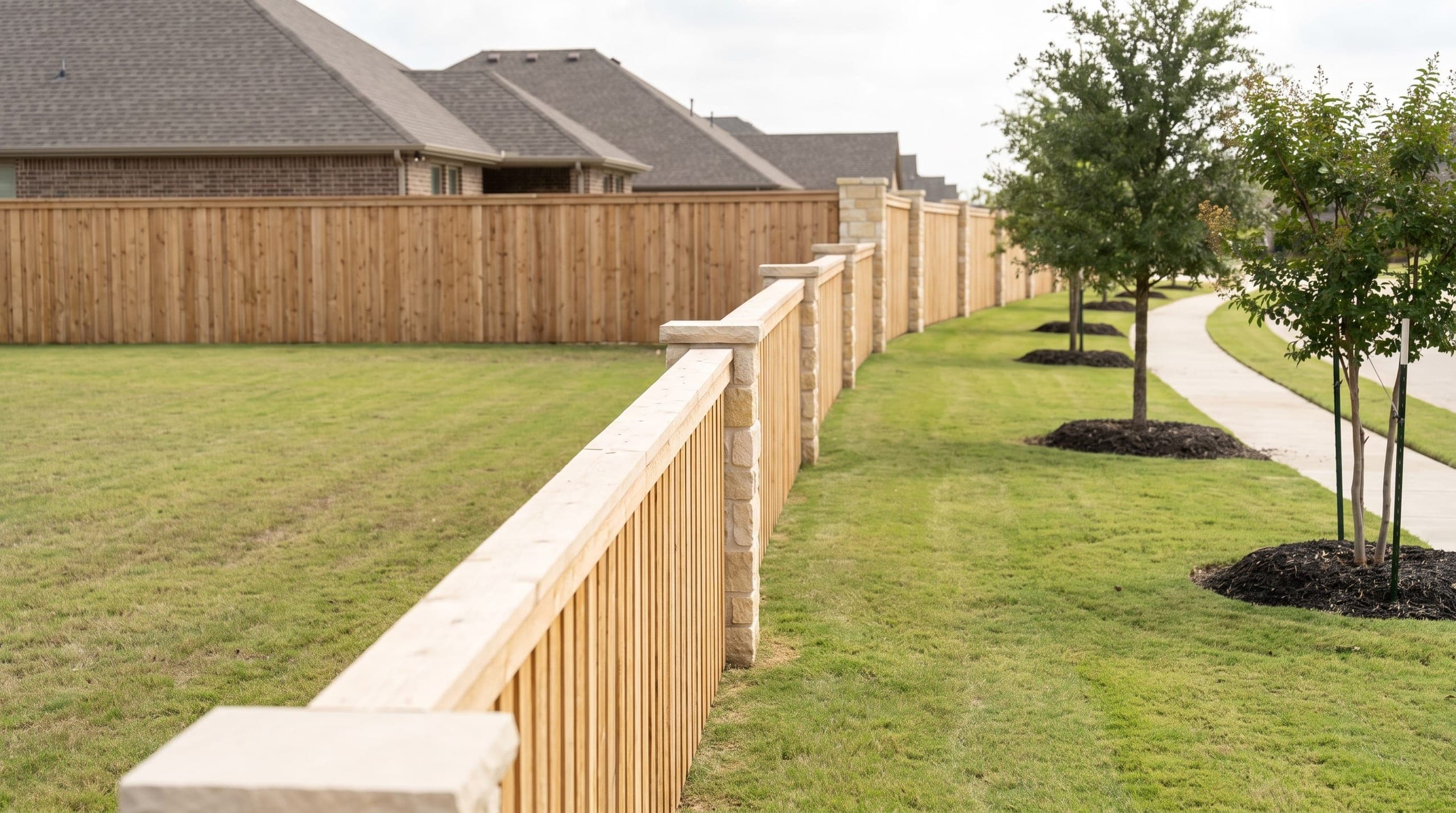
Board-on-board leaves no line of sight at any angle, because the boards overlap across the rails. A shadowbox hides the yard when someone looks straight at it. It opens a sliver of view through its gaps when someone looks along the fence at a sharp angle.
That is the privacy difference, and it is the one most guides stop at. If a neighbor’s second-story window or a sidewalk runs parallel to your line, the angle matters and board-on-board wins. If your neighbors face the fence head on, a shadowbox gives the privacy you need.
Both styles alternate boards on opposite sides of the rails, so each shows a finished face to you and to the next yard. Privacy is the first criterion. It is not the one that decides how long the fence stands.
Board-on-Board Puts More Lumber on the Same Fence Line
Board-on-board lays more boards on every foot of line than a shadowbox does, so it costs more before a crew arrives. HomeGuide (2026) puts national installed wood fences at $20 to $45 a foot for pressure-treated pine and $35 to $80 for cedar, and the style you pick moves a quote within those ranges.
The extra boards also add more wood to dry out after every Texas rain. More boards mean more nails, more labor, and more weight on every post. A shadowbox spends less on all of it.
| Criterion | Board-on-board | Shadowbox |
|---|---|---|
| Boards per foot of line | More, overlapped | Fewer, spaced |
| Lumber in the bid | Higher | Lower |
| Weight carried by each post | Heavier | Lighter |
A lower bid for a shadowbox is a fair price for less wood. It is only a fair comparison when both bids name the same grade of picket, which is the last section’s point.
Overlapped Boards Hold Water Against Texas Posts
Wood rots when it stays wet, and the overlap in board-on-board gives water more places to sit. The USDA Forest Products Laboratory (2021) reports that serious decay needs wood moisture above 30%, while air-dried wood holds 20% or less, which it calls a reasonable margin of safety. Anything that slows drying moves a fence toward that 30% line.
The overlap does exactly that. Water runs between two layers of boards and sits against the rails and posts behind them. A shadowbox lets air reach those same surfaces through the gaps, so they dry faster.
Texas decides how much that matters. The federal decay index puts Houston at 77.2, deep in the high-hazard band, against Dallas at 44.3 (Carll, USDA Forest Products Laboratory, 2009). San Antonio sits at 52.2 and Austin at 55.2. In Houston, a fence that dries slowly pays for it. In Dallas, the same overlap costs far less.
Species matters here too. Western redcedar heartwood rates as resistant, while southern pine rates as only moderately resistant to nonresistant (Scheffer and Morrell, 1998). A board-on-board fence in pine, in Houston, in shade, is the build that rots first.
A Solid Overlapped Face Loads Wind Like a Wall
Engineers treat a solid privacy fence as a solid freestanding wall, and board-on-board is solid. ASCE 7-22 counts a fence as solid when its openings are under 30% of the gross face, and a solid face takes the full wind force across its area.
Wall tests show how much. Boundary-layer wind-tunnel work found a wall standing on the ground carries a normal-force coefficient of about 1.45, nearly independent of its length (Letchford, 2001). A solid fence catches almost the whole gust.
A shadowbox lets part of the gust through its gaps. That lowers the push on every post. It does not make the fence wind-proof, and the corners and gate posts still take the most force.
The wind figure for a Texas address is high. ASCE 7-22 maps the Houston area at roughly 130 to 140 mph for ordinary structures. A solid face has to be built for that, and a bid should say how.
Post Depth and Footing Have to Be Sized for the Solid Face
A fence post is a pole fixed in the ground, and the building code sizes it that way. The 2021 International Building Code, Section 1807.3.2.1, gives the embedment depth from the wind force, the height of that force above grade, and the strength of the soil. A bigger force and softer soil mean deeper posts and wider concrete.
So a board-on-board fence needs a deeper, wider footing than a shadowbox of the same height on the same soil. In soft Texas clay the gap grows. A crew that sets both styles at one standard depth has built one of them wrong.
Two habits tell you whether a bid sized the post. The estimator measured the line on site, and the quote names a post depth and footing instead of “concrete set.” Our crews work from a measured job with materials counted before anyone leaves the yard, and we quote a depth for the face we are building.
Ask Which Picket Grade the Price Was Written Against
A picket grade is the quality tier of the board, from #1 to #3, and two bids for the same style can use different tiers. The lower the grade, the more knots, splits and waste in the board. A bid that says “cedar privacy fence” has named a species and nothing else.
That is why a cheaper style built from a lower grade is not the same offer as a pricier style built from a higher one. A shadowbox in #3 pickets bid against a board-on-board in #1 compares two different fences. The price gap may be the grade, not the style.
We quote the grade by name. We are Master Halco’s 2026 Largest Volume Customer for the World, and we buy pickets for less than a small crew can, so a named #1 grade from us does not need a thinner spec to hit a price. Ask every contractor for the grade in writing, and expect a straight answer.