
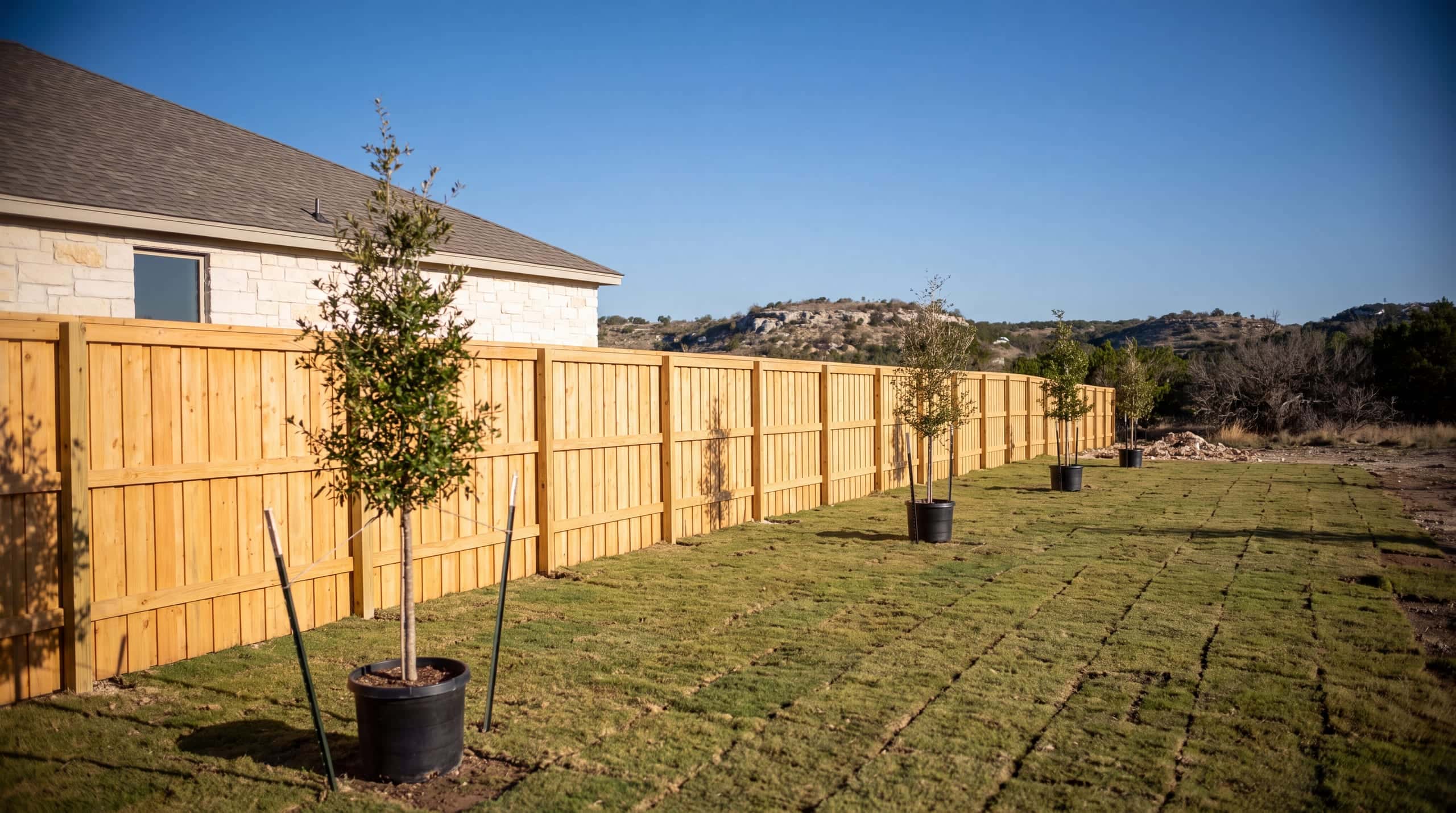
To choose a fence contractor for a new Bee Cave home, start with your builder’s contract and your community’s design rules, then hire the contractor that has cleared that design review before, prices the caliche in your post holes, and itemizes the quote. Johnson Fence works Bee Cave from its Austin office in Round Rock, rated 5.0 stars across 32 Google reviews (October 2026).
Your builder hands over the keys and the back yard is open ground. In this corridor that is normal: fencing sits outside the base build for most builders here, and whether any of it is included changes by builder and even by phase inside one community. So the fence contractor is the first trade you hire on your own.
Three bids will come back at three prices. Those three numbers are not describing the same job, because in Bee Cave the lot sets the price long before the fence style does.
Do Bee Cave Builders Include a Fence?
Most leave the yard fence out. Ask your sales office, in writing, which fence runs come with your phase and which ones do not. Fence inclusion moves by builder and by phase, so a neighbor two streets over is not evidence about your contract. Sweetwater, Provence, Serene Hills, Spanish Oaks, Bella Colinas, Canyon Ranch, Loraloma and The Homestead all handle this differently, and inside a single community the answer can change between an early phase and a later one.
Ask a second question while you have them: does the greenbelt-facing run carry its own required style? That one answer can change your material, your price per foot, and which contractors are even eligible to build it.
What Terms Should You Know Before Reading a Bee Cave Fence Bid?
A bid only becomes comparable once you can read it, and six words do most of the work. Two quotes that both say “cedar fence, 180 feet” can describe very different fences once you know what is missing from that line.
| Term | What it means on your quote |
|---|---|
| Linear foot | The measured run of fence, in feet, that the price is multiplied against |
| Picket grade | The board quality, named #1 through #3, with #1 the tightest and cleanest |
| Ground contact | Wood treated for burial in soil, the spec that belongs on posts |
| Embedment | How deep each post is set into the ground before concrete |
| Caliche | The cemented limestone layer under much of this corridor, which slows post holes |
| Approved materials list | Your community’s written list of fence styles and materials the review committee accepts |
Does a Bee Cave Fence Contractor Need a License?
No, Texas does not license fence contractors at all. The state’s licensing authority regulates roughly 40 occupations, mostly trades like electricians and air-conditioning contractors, and residential fencing is not among them (Texas Department of Licensing and Regulation, 2026). Anyone can quote your fence today. That means the vetting is yours to do.
The federal consumer guidance is the practical checklist: confirm any license with your city or county, require proof of insurance, and get a written estimate that lists the work, the materials, the completion date, and the price, then never pay the full amount up front (Federal Trade Commission, 2024). Ask for the certificate of insurance itself, with the company named on it. A contractor who cannot produce one in a day is telling you something about how the rest of the job will run.
Should Your Fence Contractor Know Your Community’s Design Review?
Yes. Ask each bidder to name the last packet they submitted in a Bee Cave community, and ask who files yours. Architectural review with an approved-materials list is the norm here, and it cuts both ways. It can stop an unfamiliar vendor cold. It also means that once a style is approved, the spec is defined and repeatable, so a contractor who has already built to it is quoting a known job.
Texas law changed the ground under this in 2025. A property owners’ association can no longer prohibit an owner from installing a perimeter fence or other security measure, and it keeps only limited authority over fence type and material, plus the ability to require a driveway gate set back at least 10 feet from a laned right-of-way (Texas Property Code Chapter 202, Section 202.023, 2025). Your right to the fence is protected. The committee still gets a say in what it is made of, which is exactly where the approved-materials list lives.
How Does Caliche Change the Cost of a Bee Cave Fence?
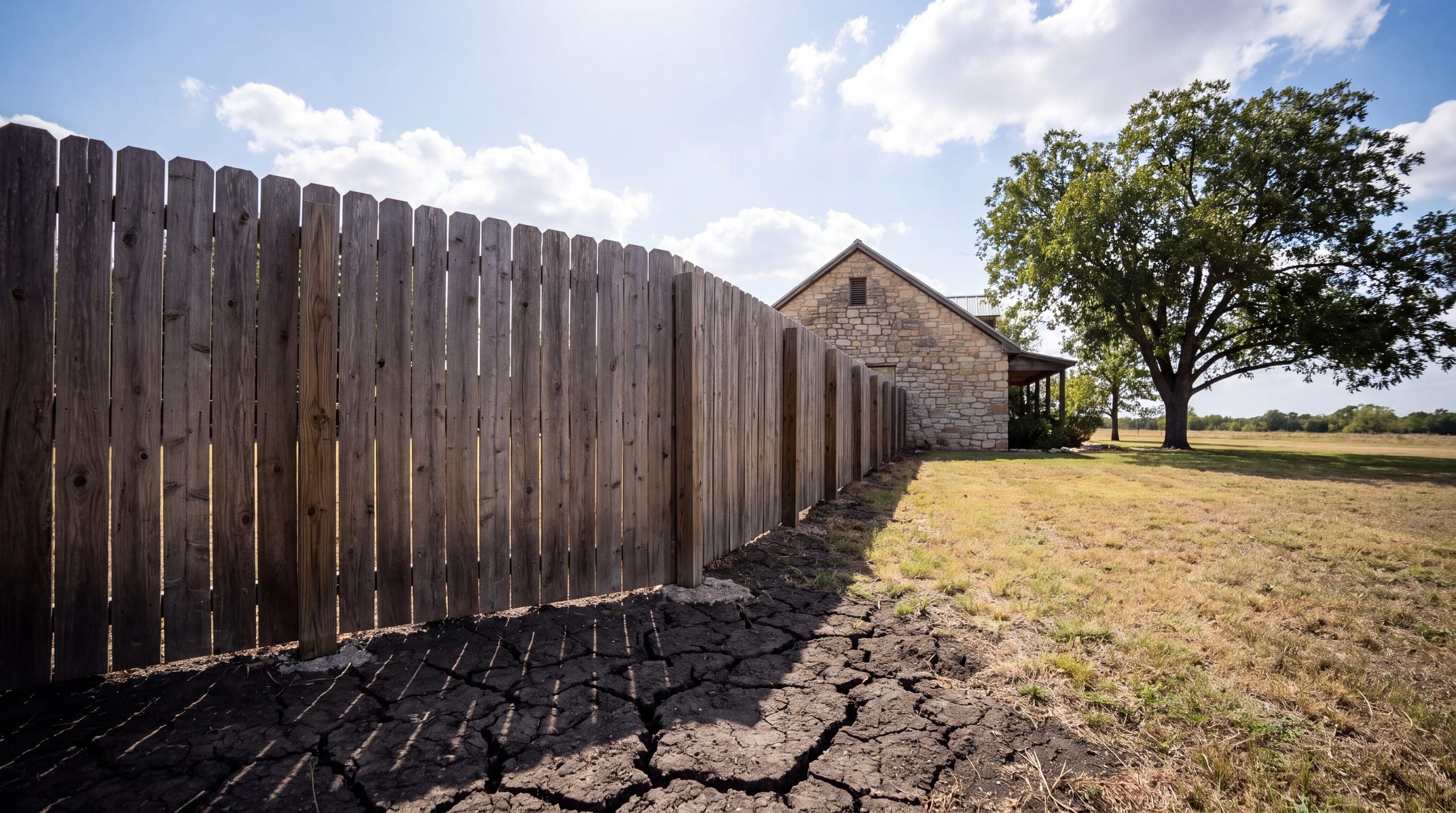
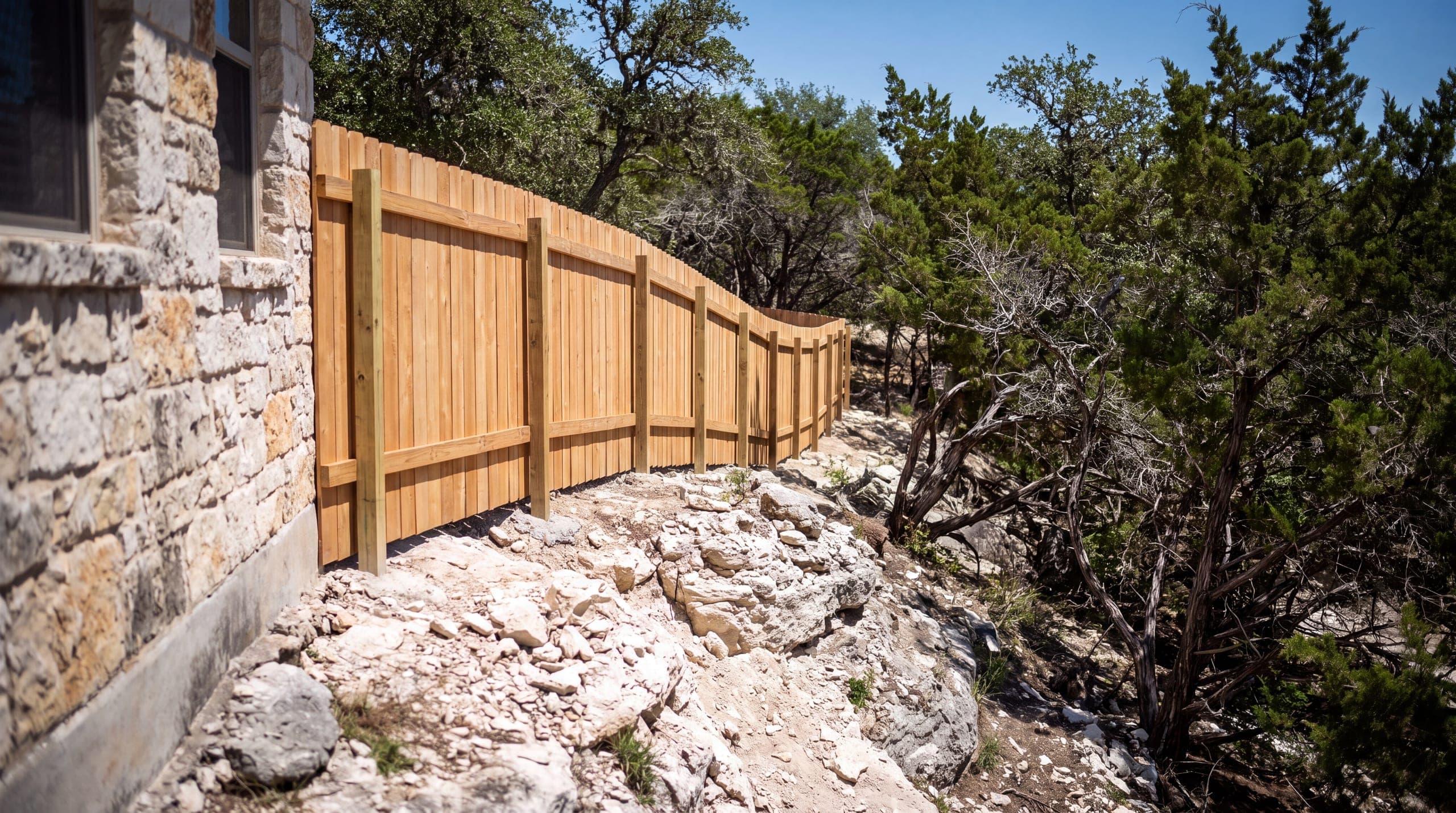
It decides what each post costs. Rock depth changes across a single yard, and the post budget changes with it. In the Lacoste soil series, the depth to the cemented caliche layer runs 10 to 20 inches, and that whole range commonly turns up within 25 horizontal feet (USDA Natural Resources Conservation Service, Official Series Description). One corner of your line can be easy digging while the next corner needs different equipment.
That is why a price quoted from an address is a starting number and nothing more. A contractor who walks the line sees the rock, the slope, the trees your builder left standing, and the irrigation already in the ground. A contractor who never came out is pricing an average lot, and Bee Cave lots are not average.
Ask the direct version of the question: what did you find when you walked my line, and what did it change about this number?
What Should a Bee Cave Fence Quote Include?
A quote you can compare names five things. If any one is missing, you are comparing a price against a guess.
- Measured footage. The linear feet should come from someone standing in your yard with a tape, and the quote should say so.
- Picket grade by name. “Cedar” is not a spec. #1, #2, or #3 is.
- Post spec and embedment depth. What the posts are made of, how far apart they sit, and how deep they go before concrete.
- Gates, counted and described. Each gate listed on its own line, with width, hardware, and whether any operator is included.
- What the warranty covers. Most fence warranties cover the workmanship or the material, and almost never both. Ask which half you are being offered.
Two bids that all five lines match are finally the same job. Then, and only then, the lower number means something.
What Does a Fence Cost for a New Bee Cave Home?
A 6-foot wood privacy fence runs about $18 to $30 a foot installed in pressure-treated pine and $25 to $45 in cedar on flat, clear ground (HomeGuide and Angi, 2026), and rock, slope and tear-out add to it. Statewide cost bands are a sanity check on a bid, and they are a modeled planning estimate rather than a quote. The figures below are triangulated from published survey ranges for a standard 6-foot residential fence on flat, clear ground, materials plus labor (HomeGuide and Angi, 2026).
| Fence type (6 ft residential) | Modeled Texas installed cost per linear foot | What sits at the top of the band |
|---|---|---|
| Pressure-treated pine privacy | $18 to $30 | The standard Texas builder fence; basic grade sits at the low end |
| Cedar privacy | $25 to $45 | Clear, knot-free grades and Western red cedar |
| Ornamental steel or iron | $45 to $90 | Custom welded designs |
Read what those bands exclude, because in this corridor it is most of the job: old or temporary fence removal, gates and automation, permits, slope, limited access, and rocky ground. A Bee Cave bid that lands above the band is not automatically high. A bid that lands below it may simply have left the rock out.