
Guides

How Long a Wood Fence Actually Lasts in Texas

Ask how long a wood fence lasts in Texas and you get one number back: 10 to 20 years.

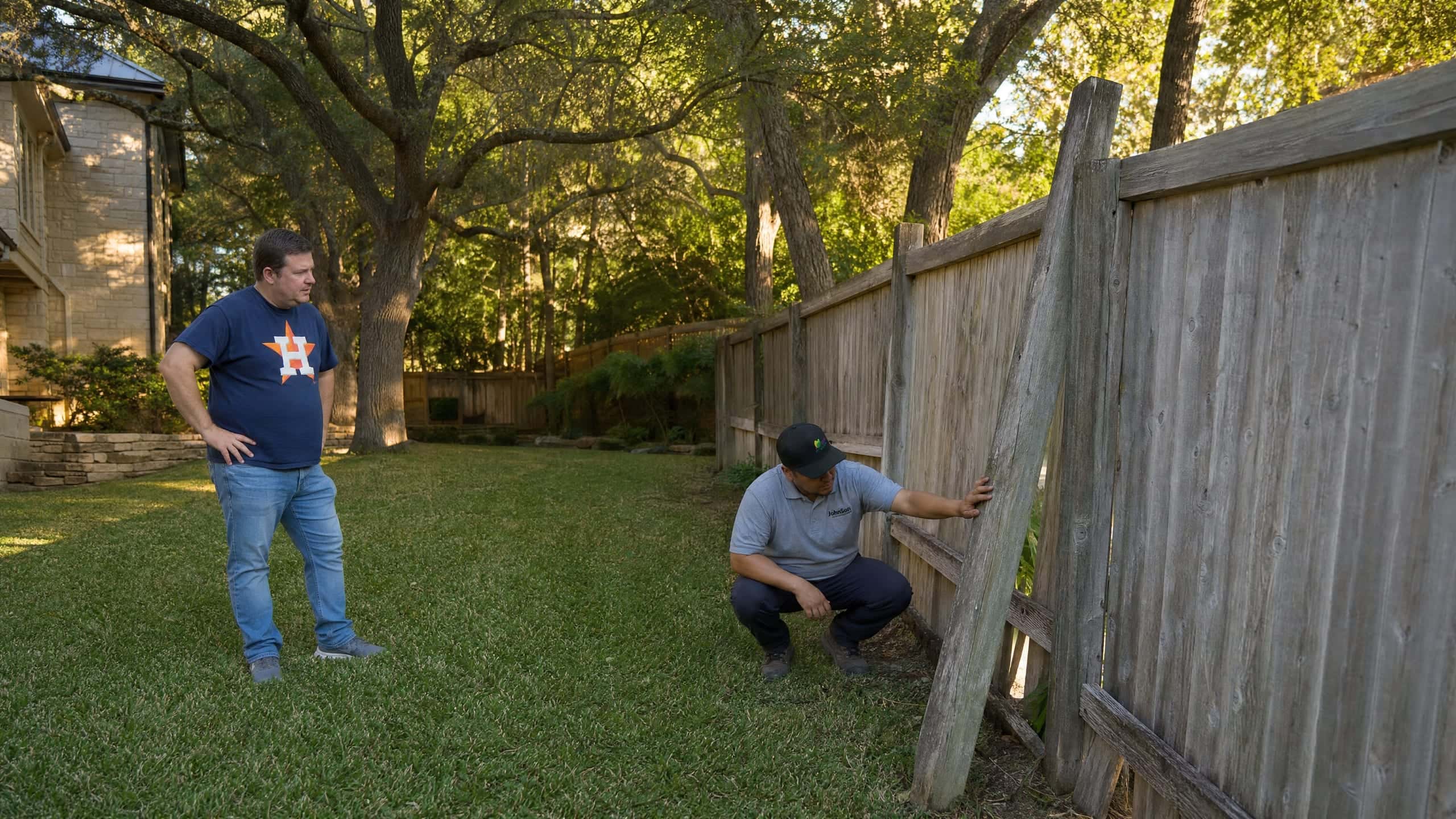
A crew lead checking a leaning post on a tired cedar fence with the homeowner watching

Ask how long a wood fence lasts in Texas and you get one number back: 10 to 20 years. That number comes off a national chart. It does not know whether your fence stands in Kingwood or in Plano, whether the boards are heartwood, or how deep the posts went.

A fence that failed in three years did not get unlucky. It got built to a national default in a place that punishes one.

The 20-Year Wood Fence Number Is a National Average

That figure starts life on a life-expectancy chart for house parts. Certified home inspectors rate a wood fence at about 20 years (InterNACHI), which is a fair average for the material across the whole country. An average is built to blend El Paso with Port Arthur. Your fence stands in one of them.

Averages are useful when the range behind them is narrow. Fence wood has a wide one. The same 6-foot cedar fence can hold its line for two decades inland and be soft at the base in five years near the coast. Nothing about the boards changed. The exposure did.

Houston and Dallas Are Not the Same Rot Climate

The federal wood lab scores locations on a decay hazard index, and the Texas spread is wide. Houston reads 77.2, deep inside the high-hazard band, while San Antonio reads 52.2 and Dallas reads 44.3 (USDA Forest Products Laboratory, 2009). Same pickets, same crew, two different clocks running on them.

The bands are simple. Below 35 is low decay risk, 35 to 65 is moderate, and above 65 is high.

Metro Decay hazard index What the score means Source
Port Arthur 80.7 High hazard, above the 65 line USDA Forest Products Laboratory, 2009
Houston 77.2 High hazard, above the 65 line USDA Forest Products Laboratory, 2009
Austin 55.2 Moderate, upper half of the band USDA Forest Products Laboratory, 2009
San Antonio 52.2 Moderate, middle of the band USDA Forest Products Laboratory, 2009
Dallas 44.3 Moderate, lower half of the band USDA Forest Products Laboratory, 2009

A Houston fence and a Dallas fence built to the same spec are two different bets. That is the first thing a quote should be able to tell you.

Know These Five Words Before You Read a Fence Quote

A quote that uses these five words is describing a fence. One that says “cedar, 6 foot, 200 feet” is describing a price. Ground line, heartwood, sapwood, ground contact, and embedment are the words that decide whether you see year 15.

Term What it means Why it sets service life
Ground line Where the post meets the soil Wettest point on the fence, so rot starts here
Heartwood The dense inner wood of the log The part rated decay resistant, and the part you pay for
Sapwood The pale outer wood of the same tree Same species, far less resistant to decay
Ground contact Treatment level specified for wood buried in soil An above-ground post buried in clay is the early failure
Embedment How deep the post sits below grade Sized from the soil and the wind, so no national default fits

Rot Starts at the Ground Line, Where Wood Stays Wet

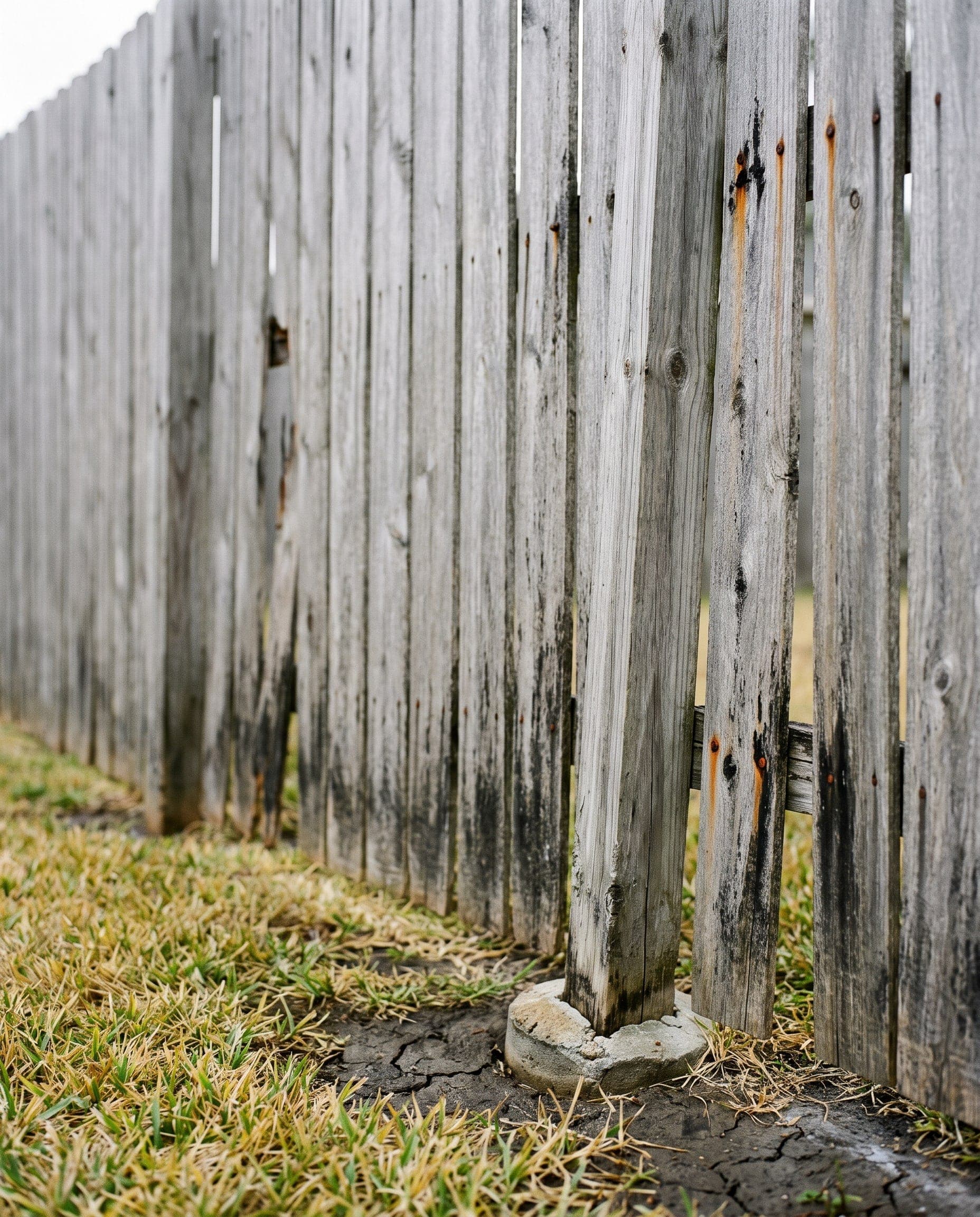
Decay needs water more than it needs time. Serious decay happens only above the fiber saturation point, an average of 30% moisture, while air-dried wood usually holds at 20% or less, which the federal wood lab calls a reasonable margin of safety against fungal damage (USDA Forest Products Laboratory, 2021). The bottom 6 inches of your fence is the part that never gets to dry out.

So an early failure has an address. It is the post base and the bottom rail, and five ordinary yard conditions keep both of them wet.

  • A sprinkler head aimed at the boards. Every cycle re-wets the same 18 inches of wood, year round, whether it rained or not.
  • Soil or mulch banked against the pickets. Wood buried by a raised bed is in ground contact without being treated for it.
  • A flower bed watered daily along the line. The bed keeps the soil at the post base saturated through a Texas summer.
  • Deep shade that never dries the wood. Boards under heavy tree cover stay damp for days after a storm.
  • A low spot where water stands. Water that sits for hours after every rain does more damage than the rain did.

None of that shows on a bid sheet. All of it shows at year three.

Cedar Resists Rot Only Where the Board Is Heartwood

Cedar earns its reputation from heartwood, the dense inner wood of the log. A worldwide durability checklist rates western redcedar as resistant and southern pine as only moderately resistant to nonresistant (Scheffer and Morrell, 1998). A cedar picket sawn from the outer sapwood of the same tree does not carry that rating.

The federal wood lab tested this on an actual fence. Over exposures running up to 22 years, the heartwood of western redcedar, redwood, and Douglas-fir came in among the most decay-resistant woods above ground, while the sapwood of those same species failed markedly sooner (Highley, 1995).

“Cedar” on a quote names a species. It does not name a grade. Pickets sell by grade, #1 through #3, and the grade is what tells you how much clear heartwood you are buying. Two bids can both say cedar and mean two different boards, which is why we quote the grade by name and put the number on it.

A Treated Post Can Outlast Three Sets of Pickets

The buried part of the fence is where you can buy real durability. In a decades-long study at a severe-exposure test site in southern Mississippi, pressure-treated wood showed expected durability beyond 60 years, while untreated stakes in the same soil lasted a year to a few years (USDA Forest Products Laboratory, 2013).

The word that carries that difference is ground contact. It is a treatment level, written for wood that sits in soil, and it is the line to look for on a spec sheet. Posts rated for above-ground use will hold a fence up fine in the air. Buried in wet Houston clay, they are the three-year failure most homeowners blame on the pickets.

Ask which posts are rated for ground contact and what the pickets are attached to. A fence with sound posts is a fence you re-board. A fence with soft posts is a fence you replace.

But Houston Clay Moves Posts That Never Rotted

Sound posts still tilt, because the ground under them changes size. Houston Black clay, the official Texas state soil, runs about 60% to 80% clay and carries very high shrink-swell potential across the Blackland Prairie from Dallas south to San Antonio (USDA Natural Resources Conservation Service, 2023). It swells wet and pulls back dry, and the post rides along with it.

That is why post depth is a soil question. The building code sizes embedment from the strength of the soil and the wind force on the fence, so a crew that digs the same hole in Katy clay and Hill Country limestone is guessing in one of those yards.

A post that tilts a little more every season is telling you the hole was too shallow or too narrow for the ground it went into. Ask for the depth and the hole diameter in writing before install day, because nobody can check it afterward.

Corners and Gate Posts Are Where Wind Finds a Fence

Wind does not press evenly along a fence line. Full-scale tests on free-standing walls found pressure highest near the free ends and the leading edge, and strongly reduced by return corners (Robertson and Hoxey, 1996). The corner posts and the two posts flanking a gate take the worst of it, years before the middle of the run shows anything.

A solid privacy fence has almost no way to shed that wind. It catches the air across its whole face like a wall, which is exactly how an engineer treats it. Add a gate that swings its weight off one post every day, and you have the three posts that decide when the line goes down.

Those posts should be deeper, thicker, or braced. When a bid prices every post the same, the fence has a weak point built into it on paper.
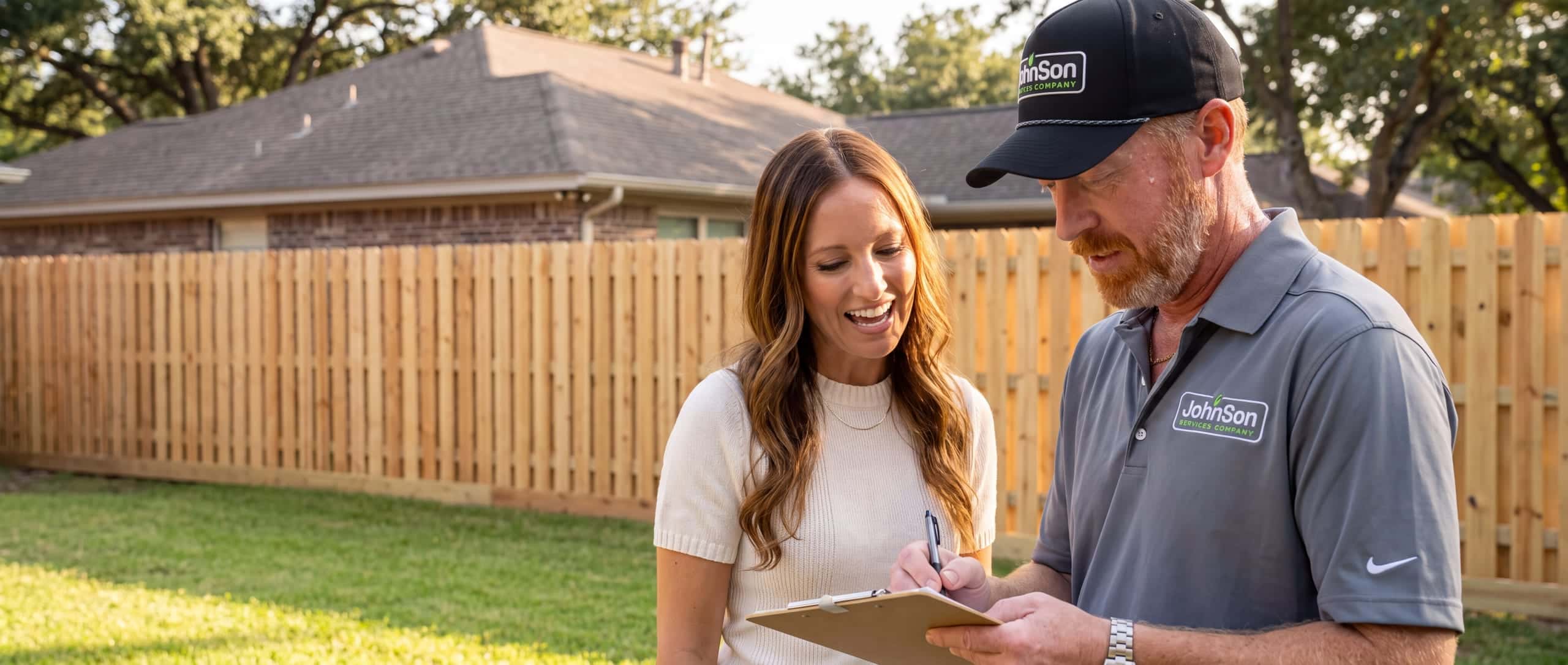
A Johnson estimator writing a fence quote on a clipboard beside a homeowner.

Price a fence before you call

See what a fence costs before anyone quotes you.

Pick the material, the height and how many feet of fence, and the calculator shows the market range for a fence like yours in Texas. Then a salesperson measures the real one in your yard and the number comes back the same day.

The estimate is free and there is nothing to sign.

Ask a Quote Three Questions Before You Compare Prices

Three questions turn a price back into a spec. Which decay band is this fence being built in, which grade of wood is the number written against, and how deep are the posts going in this soil. A bid that answers all three can be compared to another bid. A bid that answers none is a number with a fence attached to it.

Ask this A real answer names Why it decides service life
Which decay band? Your metro’s decay hazard score and what it changes Houston at 77.2 needs more wood than Dallas at 44.3
Which grade? Species plus picket grade, #1 through #3 Heartwood content is what carries the rot rating
How deep, in what soil? Post depth, hole diameter, and ground-contact rating Clay and limestone size the hole differently
What about corners and gates? Deeper or braced posts at ends and gate openings Wind loads those posts hardest, so they fail first

Price still belongs in the conversation. The honest place to take cost out is the material, and Master Halco named us its Largest Volume Customer for both the Southwest Region and the world in 2026, so our picket cost is one a three-crew shop cannot get and we pass it through. That buys a lower number on the same spec. It never buys a thinner one.

Where Johnson Sits Among Texas Fence Builders

A wood fence has to be specified for the metro it stands in, and most Texas fence companies specify for one metro because one metro is all they serve. Here is how coverage, crew depth, and published wood options compare across one established builder in each of the four metros we work.

Company Texas metros served Crews in the field Wood options published
Johnson Fence Houston, Dallas-Fort Worth, Austin, San Antonio Over 100 crews, 25 to 30 of them in Houston Picket, privacy, ranch rail, stainable
Texas Fence Houston metro only Over 20 crews Wood, horizontal, cedar
Kodiak Fence Company North Dallas-Fort Worth towns (Flower Mound, Lewisville, Denton) No crew count published Cedar, board-on-board, horizontal
Sierra Fence Austin metro only Describes itself as a small operation Cedar privacy, horizontal, board-on-board, shadowbox
Quality Fence & Welding San Antonio and South Texas No crew count published Wood, alongside iron, aluminum, chain link

Frequently Asked Questions

Does cedar last longer than pressure-treated pine on a Texas fence?

Above ground, cedar heartwood outperforms pine, and in the ground, treated pine outperforms cedar. That is why the strongest build puts ground-contact treated pine in the soil as posts and framing, with cedar heartwood carrying the pickets you actually see.

Does staining a fence actually make it last longer?

Stain slows the UV greying and surface checking on the boards, and the boards are rarely the first thing to fail here. Plenty of well-stained Texas fences come down at year six because the post bases were rotting the whole time, underground, where no stain reaches.

Why did my fence fail after only three years?

Three years almost always means water plus the wrong wood in the ground. Push a screwdriver into the base of each post: if it sinks in, the post was not rated for ground contact, was set too shallow, or was sitting in soil kept wet by a sprinkler or a flower bed.

How deep should fence posts go in Texas clay?

There is no single depth, because the code sizes embedment from the soil and the wind force on the fence. Ask the contractor for the depth and the hole diameter they are pricing, and ask what changes if the auger hits rock or fill.

Is a 10-year-old fence worth replacing, or can I just re-board it?

Test every post base before anything else. Sound posts with tired pickets is a board job, and soft posts along the run means the frame is finished and the line should be replaced, because new pickets on failing posts buy you a season or two.

Does a privacy fence last longer than a picket fence?

A solid privacy panel takes the full wind across its face, while an open picket fence lets some air through, so the solid fence puts more load on its posts. Height and post depth matter more than style, and a tall solid fence with shallow posts is the shortest-lived build of the two.

Does a fence warranty cover rot?

Almost never, because rot is a material question and most fence warranties cover the crew’s work. Ours is a one-year craftsmanship warranty, and across more than 20,000 projects last year we had zero craftsmanship callbacks, so the material spec is the part you should be reading hardest.

So the Answer Depends on Your Yard, and It Is Knowable

A Texas wood fence can hold 20 years or fail in three, and both of those outcomes are built on install day. What separates them is measurable before anyone digs: the decay band you are in, how much heartwood is in the board, whether the buried wood was rated for soil, and how deep the posts went for the ground you actually have. Every one of those belongs in a quote, in writing, where you can compare it.

The 10 to 20 years was never wrong. It was just never about your yard.

How Johnson Fence Writes a Fence Spec for Your Decay Band and Your Soil

Those four answers are what an estimate from us has to contain, which is why a salesperson stands in your yard and measures the line before a number gets written. We name the species and the picket grade, we set post depth against the soil on your lot, and we load the materials and the crew before anyone leaves the yard. Last year that ran to more than 2 million feet of fence across more than 20,000 projects, and it came with zero craftsmanship warranty callbacks.

Homeowners rate us 4.9 stars across 60 Google reviews. We are also rated 4.9 across 175 reviews on SoTellUs. What customers write about most is the part before install day. In an April 2026 SoTellUs review, a customer wrote: “The price was fair, the service was excellent, and everything was left clean once the job was done. Communication was great throughout the process, and they really took the time to go over the design with me before starting the work.”

Buying power is what keeps a proper spec affordable. As Master Halco’s largest-volume customer we buy pickets at a cost a one-to-three-crew shop cannot reach, and that shows up in the quote. A June 2026 SoTellUs reviewer put it this way: “Johnson Services provided a great estimate to replace our backyard fence beating out all other quotes. They were quick to replace and remove the old fence. The fence looks great and well built.”


Johnson Fence measures the line, names the picket grade, and sets the post depth for the soil your fence is actually standing in, so the service life is a spec you can read. Free on-site estimates run across Houston, Dallas-Fort Worth, Austin, and San Antonio, and you can start with a call to (877) 956-4676.

Get a free on-site fence estimate →

Free estimate

Get your estimate from the largest fence company in Texas

Tell us what you need and where the fence goes, and a salesperson will come out and measure the line before anyone writes a number. You get the picket grade and the total in writing, the visit costs nothing, and there is nothing to sign.

Call (877) 956-4676

Estimate requests get a reply 24 hours a day, 7 days a week.

What kind of fence?
Which part of Texas?
Roughly how much fence?
How did you hear about us?
  • Free on-site estimate
  • Same-day quote
  • Nothing to sign
  • Work starts in about 4 days