
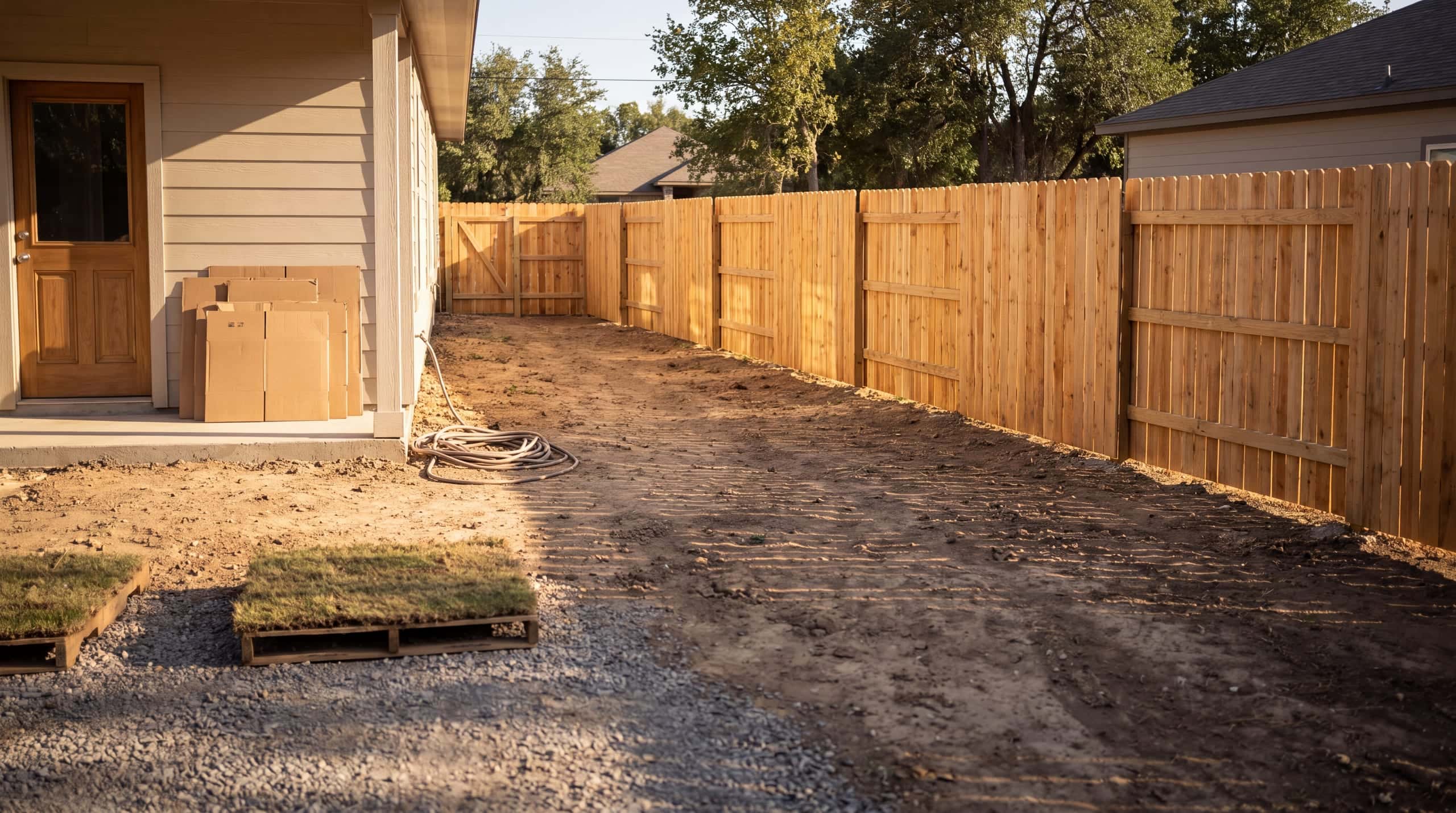
In the Dripping Springs and Bee Cave growth corridor, the base build covers the house and stops at the yard. Fencing is frequently left out of it, so the decision lands on your desk in the first weeks after closing, while the boxes are still stacked in the garage.
That timing is the problem. A fence picked under move-in pressure gets picked by habit, and habit out here means the same suburban privacy panel that worked fine on a shaded quarter acre in town. Your new lot is a different site, and it deserves its own decision.
Most Corridor Builders Leave Fencing Out of the Base Build
So the fence is a separate purchase with its own budget, and it shows up at the worst possible moment. In the growth zips along this corridor, 78738 in Bee Cave and Lakeway, 78734, 78737, and 78620 in Dripping Springs, buyers routinely close on a finished house with a bare property line. The dog needs containing, the neighbor is already staked out, and the first quote that arrives fast starts to look like the right one.
We have spent two decades on the builder side of this. Johnson fenced entire new neighborhoods for national builders including D.R. Horton, LGI, Lennar, and Pulte, which means we know exactly what a builder lot hands you and what it does not. A builder lot has no old fence to tear out and no mature trees along the line. Those are real savings on your side of the ledger.
What it also has is open sun, fresh fill in places, and a perimeter nobody has measured yet. Take the money the corridor saved you on demolition and spend part of it on getting the spec right the first time.
Walk the Lot Before You Price a Single Foot
Footage is the first number in every quote, and on a new build nobody has walked it yet. Suburban residential lots in Dripping Springs generally run from 5,000 square feet up to 1 acre, while estate residential starts at 5 acres (Dripping Springs City Planning, 2026). Those are two different fences with two different budgets, and a phone quote cannot tell them apart.
Five things to look at before anyone prices the job:
- Perimeter footage. Walk the line yourself with a wheel. A number you have checked is a number a salesperson cannot round up.
- The grade the builder left. Rough grading and drainage swales put gaps under a solid fence run. Someone has to decide whether the fence steps down or racks with the slope.
- Easements and utilities. Transformer pads, meter loops, and drainage easements all sit inside somebody’s fence line. Find them now.
- Rock and fill. Hill Country post holes hit rock, and new lots hold imported fill. Both change how long a crew is on your job.
- The front building line. It decides how far forward your fence can come, and it is usually written into your community’s rules.
Know These Four Terms Before You Read a Quote
Four words on a fence quote decide how long the line stands, and “ground contact” is the one that carries the most weight. The wood-preservation industry’s consensus standard puts fence posts in Use Category UC4A, general ground contact, and pairs that exposure with a minimum preservative retention engineered for long-term in-ground service (AWPA Standard U1). A post treated for above-ground use in a UC4A hole is a short fence with a long invoice.
| Term | What it means on your quote |
|---|---|
| Ground contact (UC4A) | The post is treated for permanent burial, at the retention the standard sets |
| Picket grade | Wood pickets sort into #1 through #3; fewer knots and less wane at #1 |
| Embedment | How deep the post sits in the ground, and how wide the concrete around it runs |
| Heartwood vs sapwood | Decay resistance in cedar lives in the heartwood; the pale sapwood fails much sooner |
Ask which of these appear on the written quote. A contractor who names all four is quoting a fence. A contractor who names none is quoting a price.
Texas Law Now Protects Your Right to a Perimeter Fence
Most of this corridor is master-planned, so your community’s rules arrive before your first quote does. Since September 1, 2025, a property owners’ association may not prohibit an owner from installing a perimeter fence or other security measure, keeping only limited authority over fence type and material, a required 10-foot driveway gate setback from a laned right-of-way, and a bar on fencing forward of the front building line (Texas Property Code, Chapter 202, Section 202.023).
Read that as a floor under your rights and a fence around your choices. The association can still tell you cedar instead of vinyl, or 6 feet instead of 8, and in a new community those style rules are usually strict and specific. Get the approved materials list in hand before you take bids, because a quote written against the wrong picket is a quote you will pay twice for.
Permits are a separate question from the association. Confirm the fence rules with the City of Dripping Springs or the City of Bee Cave before anyone digs, and confirm them again if the design carries masonry columns or an automatic gate.
Open Hill Country Sun Ages a Fence Faster Than Shade
Your new lot has no canopy over it, which changes which failure you should plan for. On the published decay-hazard index, Austin scores 55.2, inside the moderate band, well under the 77.2 that Houston carries (USDA Forest Products Laboratory, 2009). Rot is a slower enemy here than it is on the Gulf Coast. Ultraviolet light, heat, and moving clay are the fast ones.
That reorders the material argument. In a two-year outdoor exposure study across three countries, rigid PVC with a titanium dioxide loading around 2% held more than 90% of its tensile strength, and the same photocatalytic action still drove surface chalking, gloss loss, and color change (Gao, Bolt, and Feng, 2008). Vinyl in full corridor sun keeps its strength and changes its face.
Wood on an unshaded run behaves the same way in reverse. It dries hard and fast, which slows decay and speeds up cupping, checking, and gray-out. A stain schedule matters more here than it did on the shaded lot you came from.
Match the Material to the Lot Size You Actually Bought
The lot decides the material, and lot sizes in this corridor range from a compact suburban yard to five acres and up. Nationally, wood fence installs run $20 to $50 per linear foot (HomeGuide, 2026), and Texas sits at the low end of that because pine and cedar supply is close and the competition is heavy. On acreage, footage is what drives the bill, so the per-foot decision is the whole budget.
| Lot you actually bought | What the fence has to do | Materials that fit |
|---|---|---|
| Suburban lot under a quarter acre | Screen close neighbors and hold a dog on a short perimeter | Cedar or treated pine privacy, vinyl, composite |
| Half acre to 1 acre | Cover more footage on a budget, often with a view worth keeping | Wood privacy on the screened runs, ornamental steel where the view is |
| Estate acreage of 5 acres or more | Mark a long boundary and control animals over open ground | Ranch rail, with wire mesh added where a dog or livestock is in play |
| Pool yard area | Meet the pool barrier rules and stay see-through from the house | Ornamental steel or aluminum |
Service life sorts the same list a second way. The certified home inspectors’ life-expectancy chart rates a wood fence at about 20 years and a polyvinyl fence at 100-plus (InterNACHI), the widest gap between the two most common residential materials in one comparable reference. Wood costs less today and asks for stain and a replacement conversation inside a normal ownership span.
Wind Sizes the Fence and Soil Sizes the Post
Post depth comes out of arithmetic. The code sizes a fence post as a cantilevered pole, where the required embedment grows with the wind force and the height that force acts on, and shrinks only when the soil is strong (2021 International Building Code, Section 1807.3.2.1). Soft ground and a tall solid fence push that number deeper. Nobody can eyeball it from a truck window.
A solid privacy fence catches wind the way a wall does, across its whole face. That load lands hardest on corners, on the end of a run, and on the tall posts flanking a gate, which is why those are the posts that lean first on a young fence. On an open corridor lot with nothing upwind of you, that is not a rare event.
Ask two questions of every bidder: how deep the posts go, and how wide the concrete is. Then ask whether gate posts and corner posts get the same treatment as the line posts. On a cheap bid, they usually do, and that is the problem.