
Guides

Commercial Fencing in Austin, Security Grade to Approval

A commercial fence bid in Austin usually gets read as a style question.

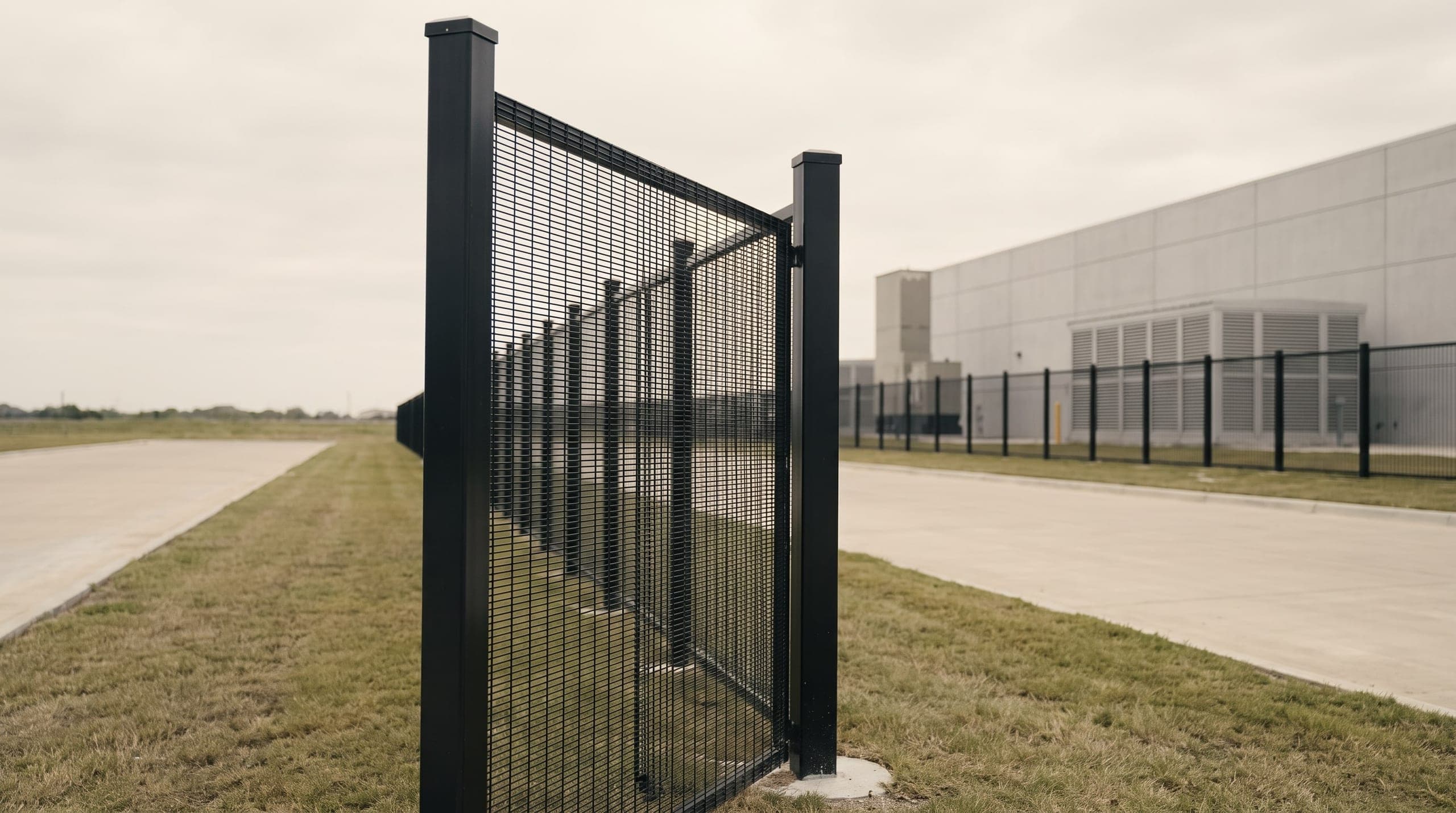
An ornamental steel perimeter along a Texas commercial campus at midday

A commercial fence bid in Austin usually gets read as a style question. How tall, how solid, what material, and whether the city will allow it. For a non-residential site, Austin has already answered most of that in writing.

The part that can cost a general contractor a close date sits further down the page. The permit trigger, the wind design, and whether the fence sub has cleared either one before are what move a schedule. Vetting a fence sub for commercial work means vetting whether they can carry the approval path without stalling your job.

Austin’s Safe-Fencing Rules Exempt Commercial Fences at 6 Feet

The exemption is written into the rules themselves. Austin’s Safe Fencing requirements, adopted July 20, 2023, do not apply to fences that are at least 6 feet high and located on a property with a non-residential use (City of Austin Development Services, 2023). For most commercial sites, that removes the style question from the table before the first bid comes in.

What is left is the part that actually takes time. You spec the fence for what the site has to stop, then find out what the city wants to see before anyone digs. Being outside one rule is not being outside all of them. Height, floodplain, and wind load are still live, and they are the three that decide whether approval stays a paperwork exercise.

Learn These Five Terms Before You Read an Austin Commercial Fence Spec

Five words carry most of the weight on a commercial fence spec, and a bid that uses them loosely is a bid you cannot compare. Each one changes either your legal height, your permit path, or your footing size.

Term What it means Why it decides your job
Non-residential use How the property is actually used, not just how it is zoned Sets whether the safe-fencing exemption at 6 feet applies to your fence
Solid fence A fence whose openings are under 30% of its gross face area A solid fence is wind-designed as a freestanding wall
Natural grade The existing ground level at the fence line, before fill or cut Height is measured from natural grade, so a graded pad can change it
Floodplain Mapped flood hazard area on the site Triggers an Austin permit at any fence height
Embedment How deep the post is set below grade in concrete Sized against wind force and soil, so tall panels need deeper holes

Your Neighbor’s Zoning Sets the Height Ceiling Before Security Does

Adjacency decides your ceiling before your security plan gets a vote. A solid fence may be built up to 8 feet high along the line between a residentially-zoned property and an adjoining property that is zoned or used for commercial or industrial purposes (City of Austin Development Services, 2023). The same 8-foot screen allowed along one boundary of your site can be over the limit along another.

Austin’s land development code sets the rest of the ceiling, and it measures from the ground you started with. Here is how the common conditions compare.

Condition at the fence line Height ceiling What it changes in the spec
Boundary with a residentially-zoned property Solid fence up to 8 feet The tallest solid screen most commercial sites can get
Solid fence on a property line, level ground 6 feet from natural grade Screening height has to be planned around it
Solid fence with a grade change of at least 1 foot 7 feet Slope buys height that flat ground does not
Any fence over 7 feet at any point Additional city regulation applies Moves the job into permit and engineering review

Walk the boundary before you settle on a number. One site can carry three different ceilings on three different sides, and the fence sub who measures it is the one who finds that out first.

Three Conditions Trigger an Austin Development Services Permit

A fence of any material up to 7 feet is permit-exempt outside floodplains, and a permit is required above 7 feet, above 6 feet along a public right-of-way on residential property, or within a floodplain at any height (City of Austin, 2025). Two of those three have nothing to do with how the fence is built. They are facts about where it sits.

Run the check against your own site before the bid walk, so the answer is settled before anyone quotes a start date.

Site condition Permit needed What the bid has to say
6-foot commercial fence, outside a floodplain No Names the exemption and the start date it holds
8-foot solid screen on a commercial site Yes Names who files with Development Services
Any fence height inside a mapped floodplain Yes Names who files and who confirms the flood map
Fence above 6 feet along a public right-of-way, residential property Yes Names the right-of-way condition and the filing party

We determine whether a commercial project needs a permit and we file it. That is a line item worth confirming in writing, because a permit nobody owns is a permit nobody pulls.

Over 7 Feet, an Austin Fence Needs Engineered Wind Design

Above 7 feet you are past the range a stock spec covers. Engineers treat a solid privacy fence as a solid freestanding wall, with a design wind force loading the full solid face and a coefficient that rises as the wall grows longer relative to its height, checked under three load cases including an eccentric end-zone case (ASCE/SEI 7-22, 2022). A fence counts as solid when its openings are under 30% of the gross face area.

That is not a formality on an Austin commercial line. Wind-tunnel work on freestanding walls found a normal-force coefficient of about 1.45 that barely changes with wall length (Letchford, 2001), which is another way of saying a solid screen catches close to the full wind. The load has to go somewhere, and it goes into the posts and the footings. Post embedment gets sized like a cantilevered pole, so a taller solid panel drives a deeper, wider concrete footing than the same fence at 6 feet.

Being exempt from a permit was never an exemption from wind. Ask the bidder who seals the design and when it gets submitted, because that answer sets your real start date.

An Automated Gate Is Regulated Harder Than the Fence It Closes

Access control carries the tightest rules on the whole job. Every entrapment zone on an automated gate has to be protected by at least two independent, different-type entrapment-protection means in each direction of travel, and since August 1, 2018 all external sensors must be monitored, so the operator drops to constant-pressure or manual operation on any fault, wiring break, or lost signal (DASMA, 2018).

Read that as a system, and price it as one. The gate leaf, the operator, the sensors, and the wiring get specified together, and the operator’s duty class has to match how many times a day the gate cycles. A light-duty operator on a delivery entrance is a service call waiting to happen. We install gate operators to UL325, and on a commercial perimeter the gate is usually where the security spec is either delivered or quietly lost.

But West Austin Limestone Decides How Deep a Post Actually Goes

Your engineered embedment depth still has to fit the ground you have. On the dissected plateaus of the Texas Hill Country, depth to limestone bedrock in the Eckrant soil series runs 4 to 20 inches (USDA NRCS, 2018). West of the Balcones fault, an auger sized for a 36-inch hole can meet rock at knee depth, and the fix is equipment and time.

That cost is real and it is routinely left out of a bid. Clearing brush, leveling ground, or removing rock adds $200 to $1,000 to an Austin fencing project (Angi, 2026), and limestone yards often need extra equipment to dig post holes and set footings. Ask who eats that on your job. A bidder who has never dug in Bee Cave or Lakeway will find out on your schedule.
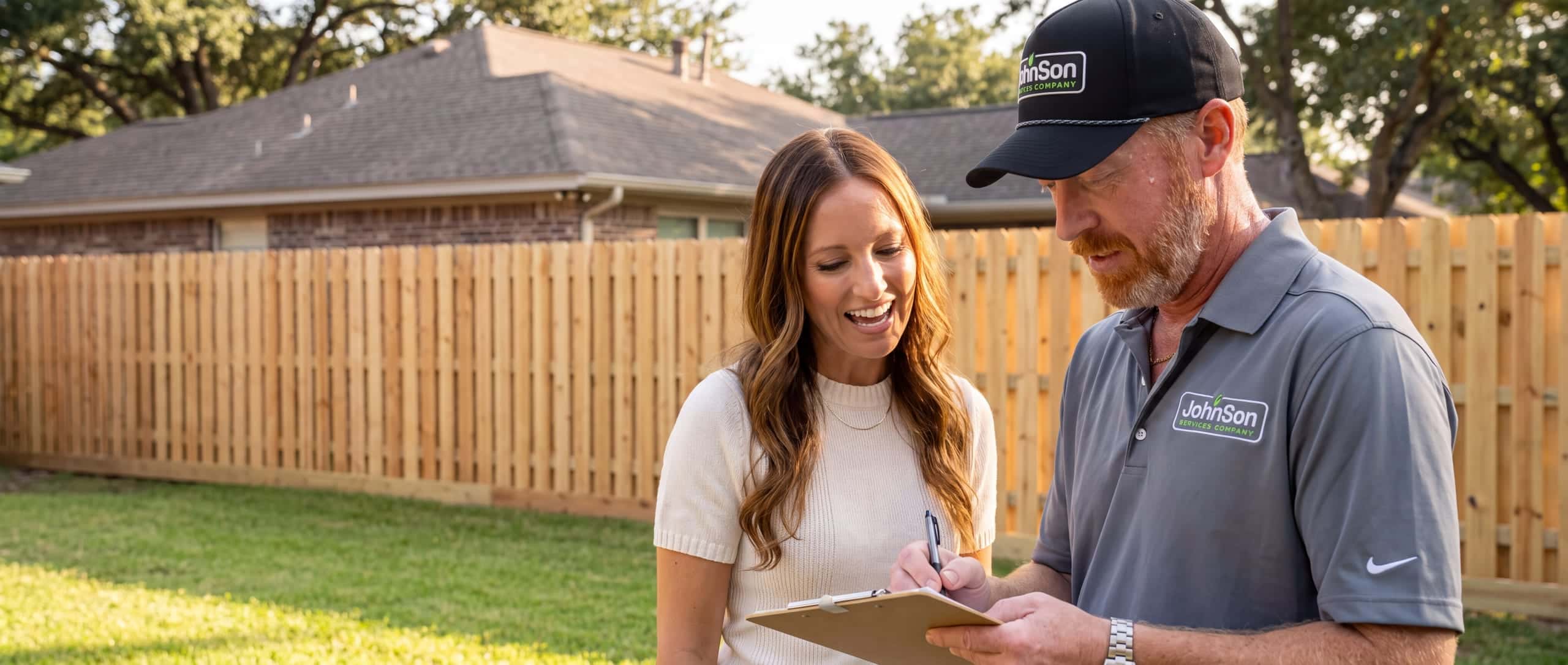
A Johnson estimator writing a fence quote on a clipboard beside a homeowner.

Price a fence before you call

See what a fence costs before anyone quotes you.

Pick the material, the height and how many feet of fence, and the calculator shows the market range for a fence like yours in Texas. Then a salesperson measures the real one in your yard and the number comes back the same day.

The estimate is free and there is nothing to sign.

Make the Bid Name the Permit, the Engineer, and the Crew Count

A commercial bid proves the contractor can clear the approval path by naming the parts of it. Six lines separate a bid you can hold someone to from a number on a page.

  • Who files the permit. Name the party who submits to Development Services and the date they submit. If the line is missing, the answer is nobody.
  • Who seals the wind design. On anything over 7 feet, name the engineer and when the sealed design lands. A stock detail is not a design.
  • The picket grade or the fabric class. Wood gets a named grade, #1 through #3. Chain link gets a named coating class. “Cedar” and “galvanized” are categories.
  • Rock, clearing, and haul-off. Say who pays when the auger stops short, and who removes the old fence line and on what day.
  • Crews behind the start date. Ask how many crews work this market. We run 5 to 15 crews in the Austin market and over 100 statewide, so a crew missing a day does not stop your job.
  • Material lead time. Ask where the wood comes from. We hold Master Halco’s 2026 Largest Volume Customer awards for the Southwest Region and the World, which means we buy pickets at a price a three-crew shop does not get, and that shows up in the price rather than in a thinner spec.

Those six lines are also the honest way to compare two bids that look $2,000 apart. The cheaper one is usually cheaper because it left one of them out.

How Austin Commercial Fence Contractors Compare on Reach and Scope

A commercial fence job in Austin is decided by whether one company can carry permitting, engineering, and install without handing the job off. The Austin-metro companies on our comparison list divide on three things worth checking: where they work, how many crews stand behind a start date, and whether they handle commercial permits and gate operators.

Company Where they work Crews behind a start date Commercial permit and gate scope
Johnson Fence Austin metro from the Round Rock office, plus Houston, DFW, and San Antonio, 42 Texas cities 5 to 15 crews in the Austin market, over 100 statewide Determines and files commercial permits; installs entrance gates and operators to UL325
Sierra Fence Austin and the surrounding area only Family-owned since 2012 and describes itself as a small operation Cedar privacy, ornamental steel, chain link, cattle panel, and pool fencing
FenceMaxx Austin and surrounding areas only Public profile states no crew count or company history Residential and commercial fencing, gate replacement, Trex and Simtek
Austex Fence & Deck Central Texas and the Austin metro only More than 30 years in Central Texas, with no published crew count Fencing plus decks and pergolas, with a full materials showroom

Frequently Asked Questions

Who pulls the fence permit on a commercial job, the GC or the fence sub?

Put it on the fence sub in writing, and confirm they have filed with Austin Development Services before. We determine whether a commercial project needs a permit and we file it, which keeps the approval on the same schedule as the material order.

No. A fence is treated as a solid freestanding wall only when its openings are under 30% of the gross face area, and chain-link fabric is well past that. The posts and gates still carry load, and anything over 7 feet still goes through the same city review.

Can a commercial fence in Austin have barbed wire on top?

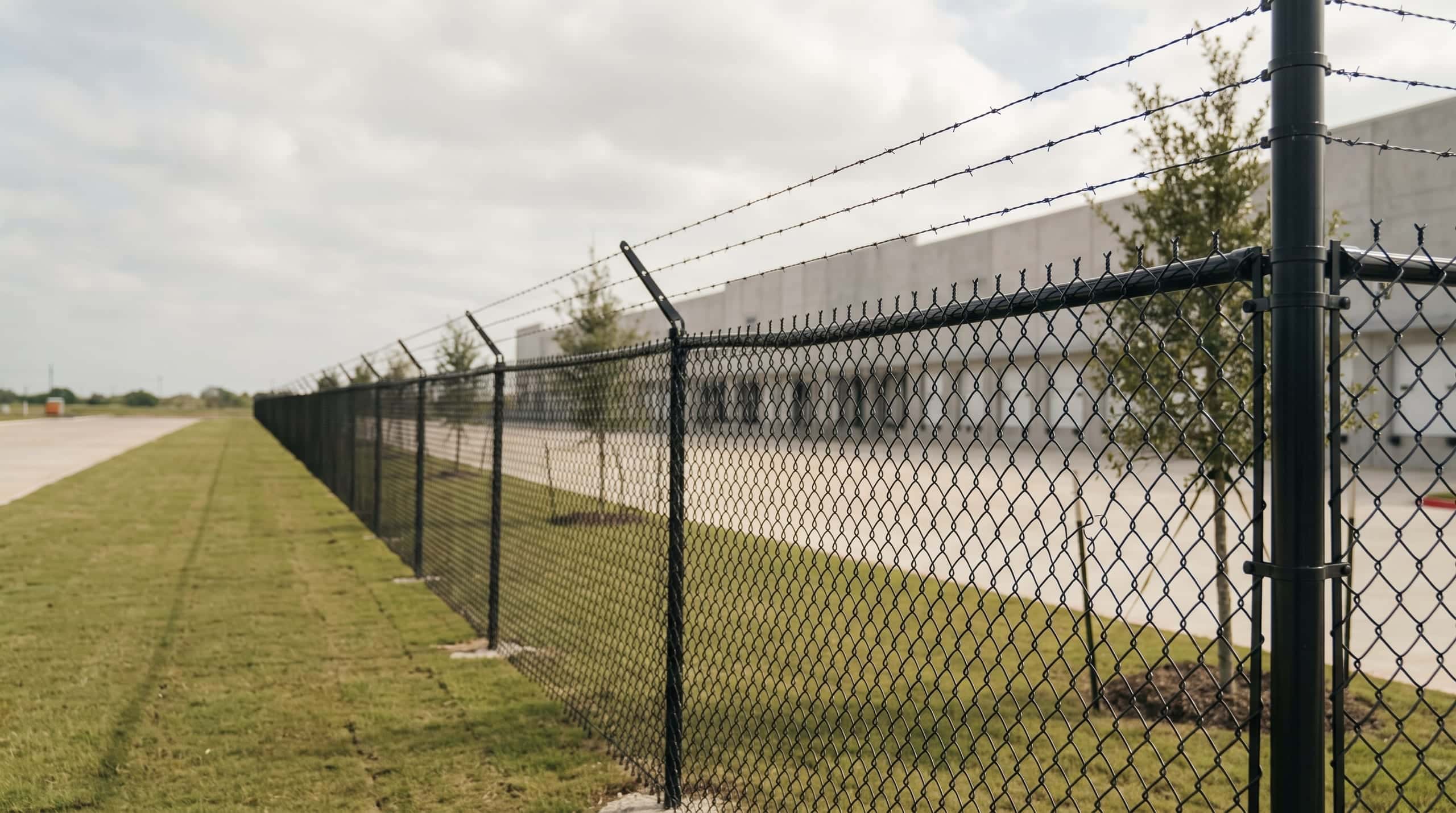
Ask Development Services about your specific address before the spec is written, which is what we do on a commercial walk. A fence at least 6 feet high on a non-residential property sits outside Austin’s safe fencing requirements, so the answer usually turns on your zoning and what the fence adjoins.

How fast can a commercial fence job in the Austin metro actually start?

On a real lead we call back the same day and get a quote out the same day about 95% of the time, with work starting in about 4 days on a job that needs no permit. A permitted or engineered commercial line runs on the review timeline instead, which is why we file early rather than after the contract is signed.

Which Austin-area cities do you cover for commercial fencing?

Round Rock, Cedar Park, Pflugerville, Georgetown, Buda, and Hutto, plus the west and southwest corridor through Westlake Hills, Lakeway, Bee Cave, and Dripping Springs. Our Austin office is in Round Rock, and the model works out to roughly 30 miles from an office because we physically measure every job.

Does replacing an existing commercial fence change the permit answer?

The permit question follows the same three conditions on a replacement as on a new fence, so a like-for-like line under 7 feet outside a floodplain is usually exempt. What changes is the scope around it, because tear-out, haul-off, and old footings all take crew hours that a new build never spends.

The Style Question Was Already Answered, So Judge the Schedule Instead

Austin settled the style question for commercial fences the day it exempted 6-foot fences on non-residential property, which leaves the buyer one real decision. Not what the fence looks like, but whether the company building it can clear a permit, get a wind design sealed, and still hold the date it gave you. Those three run in order, and each one is a place a job stalls when nobody owns it.

So read the bid for who files, who seals, and how many crews stand behind the start. The city answered the style question. Your contractor answers the schedule question.

How Johnson Fence Files the Permit and Holds the Install Date

The approval path only stalls when a piece of it has no owner, so we take all of it. We determine whether a commercial project needs a permit and file it, install entrance gates and operators to UL325, and run 5 to 15 crews in the Austin market against over 100 statewide, which is why a crew missing a day does not push your date. Customers rate us 4.9 stars across 60 Google reviews, and 4.9 across 175 reviews on SoTellUs.

What people write about most is the speed of the response and the price. In an August 2025 SoTellUs review, a customer wrote: “Chance and his team were able to work quickly to get us a quote and on their schedule in a short amount of time.” In a June 2026 SoTellUs review, another wrote: “The crew at Johnson Services Company provided outstanding service at a very competitive price. They went above and beyond our expectations, and we truly appreciated the extra effort and attention to detail they put into the job.”

The price part is not luck. We hold Master Halco’s 2026 Largest Volume Customer awards for the Southwest Region and the World, so we buy wood at a cost a small shop cannot reach and pass it through in the bid. Last year we installed more than 2 million feet of fence across more than 20,000 projects, with zero craftsmanship warranty callbacks.


Johnson Fence takes the permit, the engineered design, and the install date as one job, so an Austin commercial fence line clears approval without stalling your schedule. Call (877) 956-4676 or ask for a free on-site estimate, and we will walk the boundary and name the approval path before we price it.

Get a free on-site commercial fence estimate →

Free estimate

Get your estimate from the largest fence company in Texas

Tell us what you need and where the fence goes, and a salesperson will come out and measure the line before anyone writes a number. You get the picket grade and the total in writing, the visit costs nothing, and there is nothing to sign.

Call (877) 956-4676

Estimate requests get a reply 24 hours a day, 7 days a week.

What kind of fence?
Which part of Texas?
Roughly how much fence?
How did you hear about us?
  • Free on-site estimate
  • Same-day quote
  • Nothing to sign
  • Work starts in about 4 days