
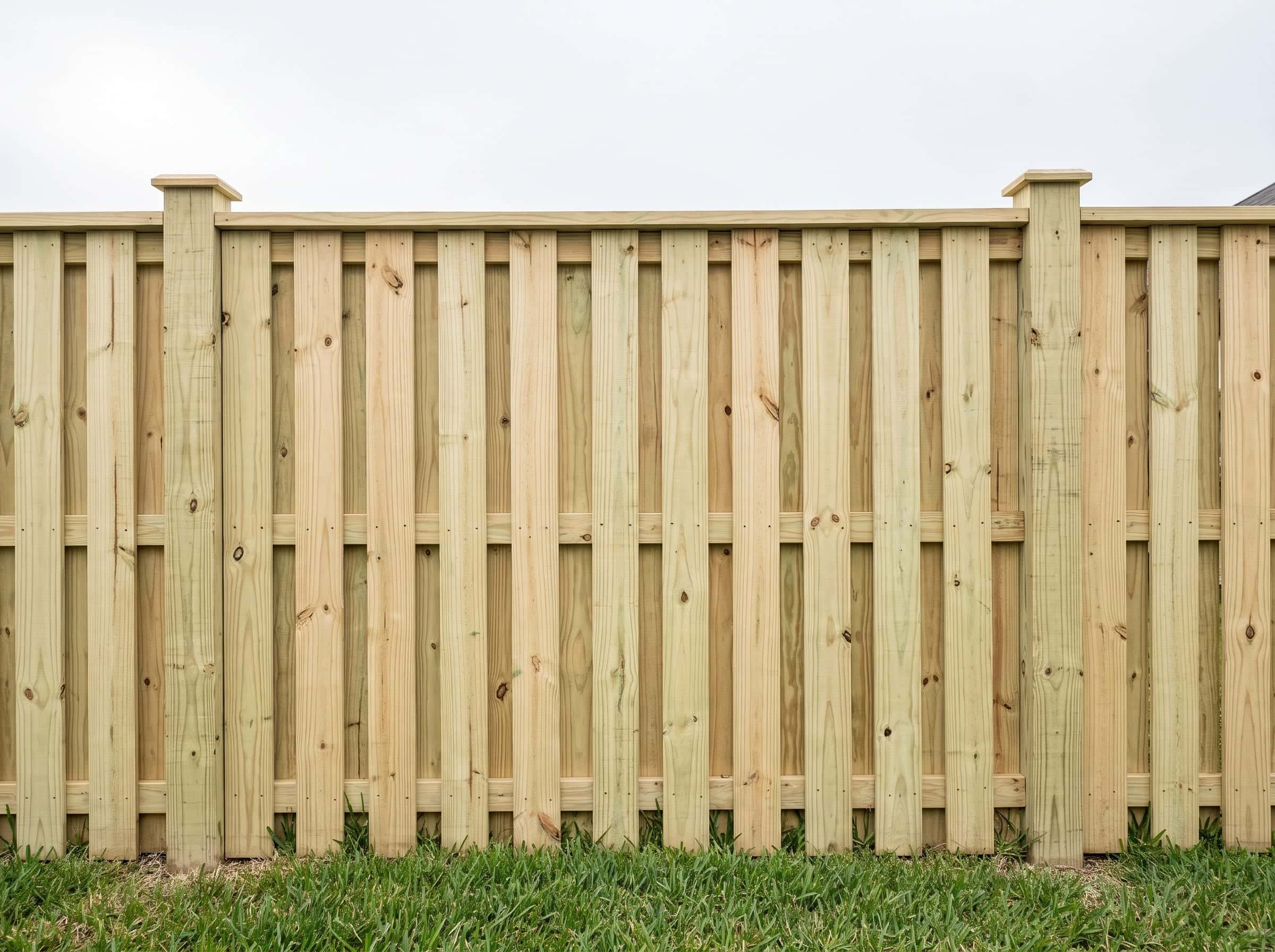
Ask what wood lasts in Houston and one answer comes back: cedar, sealed every couple of years. It is not wrong, and it does not touch the part of the bid that decides whether your fence is straight in year 15 or finished at year 8.
Houston air rots fence wood faster than almost any other city in Texas. A spec that works fine in Dallas comes down here and fails early. The picket style is the easiest thing to compare and the least likely to matter, and what matters is whether the bid names the grade, the treatment, and the post depth against the moisture this city carries.
Houston Rots Fence Wood Faster Than Any Big Texas Metro
The Forest Products Laboratory scores decay risk by climate, and Houston lands at 77.2 against 44.3 in Dallas (USDA Forest Products Laboratory, 2009). Anything above 65 sits in the high-hazard band, and Houston is well inside it. So the same fence, built by the same book, is fighting a load here that a North Texas crew never has to price for.
| City | Decay hazard index | Band |
|---|---|---|
| Port Arthur | 80.7 | High |
| Houston | 77.2 | High |
| Austin | 55.2 | Moderate |
| San Antonio | 52.2 | Moderate |
| Dallas | 44.3 | Moderate |
The index is warmth plus rain, and those two together are what feed decay fungi. Houston supplies both for most of the year. That is the reason a Houston fence buyer has to read a bid differently than a Plano fence buyer does.
Learn These Five Words Before You Read a Houston Fence Bid
Five words carry most of what a wood fence will cost you over 20 years, and four of them describe wood you will never see once the fence is standing. Two bids can use the same species name and mean two different products. These are the words that tell them apart.
| Term | What it means on your bid |
|---|---|
| Heartwood | The dark inner wood of the tree, where the natural rot-resisting extractives are |
| Sapwood | The pale outer wood of the same board, with far less rot resistance |
| Picket grade | The mill’s sort, written #1 through #3; “cedar” alone does not name it |
| Ground contact | The treatment class for wood buried in soil, Use Category 4A |
| Fiber saturation point | About 30% moisture content, the level wood has to pass before it can rot |
Ask for all five in writing. A company that will not write them down is quoting you a picture of a fence.
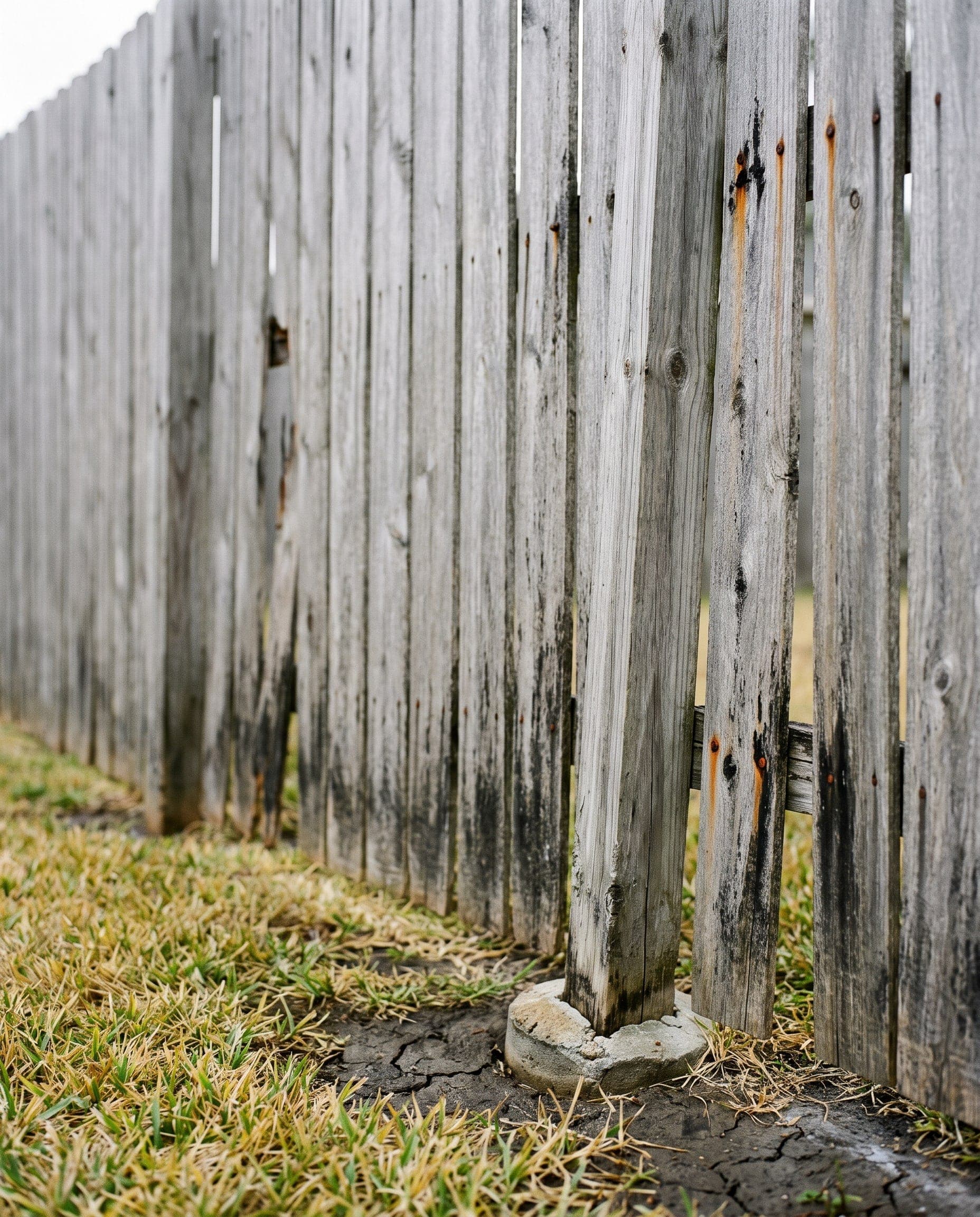
Your Fence Fails at the Ground Line, Where the Wood Stays Wet
Wood only rots when it stays wet. Serious decay needs a moisture content above the fiber saturation point, an average of 30%, while air-dried wood usually holds at or under 20%, which the Wood Handbook calls a reasonable margin of safety against fungal damage (USDA Forest Products Laboratory, 2021). Houston’s job is to hold the bottom of your fence above that line for weeks at a stretch.
Three places on a Houston fence line stay wet the longest.
- The ground line. The last few inches of post above grade and the first few below it. Water wicks up, drains slowly out of clay, and never fully dries.
- The shaded run. A fence under mature live oaks gets less sun and less air. Same boards, longer drying time, shorter life.
- Anything touching soil or turf. A bottom rail or picket resting on dirt is a wick. Grade and a gap fix it, and only at build time.
None of those three are reached by a finish on the face of the fence. They are decided by the wood you buy and how it is set.
Cedar Only Beats Pine Where the Board Is Heartwood
Cedar earns its reputation in the heartwood. A worldwide durability checklist covering 1,500 species rates western redcedar as resistant, class 2, and loblolly pine only moderately resistant to nonresistant, class 3 to 4 (Oregon State University, 1998). That gap belongs to the dark inner wood. The pale outer wood of the same board is a different product.
A Forest Products Laboratory test fence made the difference measurable. Exposing 19 species for up to 22 years, it put the heartwood of western redcedar among the most decay-resistant woods above ground, over 20 years, while the sapwood of those same species failed markedly sooner (USDA Forest Products Laboratory, 1995).
So a bid that says “cedar” has named a tree and nothing else. The grade is what tells you how much of the board is the part that resists rot, and in a 77.2 climate that is the difference between reaching service life and replacing early.
Only Ground-Contact Treated Posts Belong Below a Houston Fence
The wood preservers’ own standard puts fence posts in Use Category 4A, general ground contact, and pairs that exposure with a minimum preservative retention engineered for long-term service in soil (American Wood Protection Association, Standard U1). Cedar belongs above grade. The buried post is a pressure-treated pine job, and the treatment class has a name that should appear on your quote.
The size of the difference is documented. In a decades-long study at a severe test site in southern Mississippi, a climate close to ours, pressure-treated wood showed expected durability beyond 60 years while untreated stakes in the same soil lasted a year to a few years (USDA Forest Products Laboratory, 2013).
That is the cheapest line for a low bid to shorten, because you cannot see it after install day. You find out in year six.
How Deep Should a Houston Fence Post Go?
Deep enough for the soil it is standing in, which is why the number belongs on your quote instead of in a crew’s habit. Building codes size an embedded post like a cantilever: required depth grows with the wind force and the height it pushes on, and shrinks as the soil gets stronger. Houston clay is not strong soil, and a 6-foot solid privacy fence catches wind across its whole face.
Two things follow. The depth is a measured answer for your lot, and somebody has to stand in your yard to give it. And whatever that answer is, it should be written on the quote in inches, along with what the post is set in.
Require These Five Lines in Writing Before Anyone Loads a Truck
Five lines separate a Houston bid you can hold a company to from a number on a page. Each one is a place where two quotes that look identical are not.
| Bid line | What it should say | Why it matters in Houston |
|---|---|---|
| Species and grade | Western red cedar pickets, with the grade named #1 to #3 | Two cedar bids can mean two different boards |
| Post material and treatment | Pressure-treated pine, ground contact, UC4A | The buried foot is where this climate attacks first |
| Post depth and footing | Depth in inches, and what the post is set in | Clay and wind set the number, so it has to be measured |
| Fasteners and hardware | Galvanized or coated screws, brackets, and gate hardware | Wet wood eats plain steel from the inside of the joint |
| Warranty scope | What the craftsmanship warranty covers, and for how long | Most fence warranties cover the crew’s work; the mill covers the wood |