
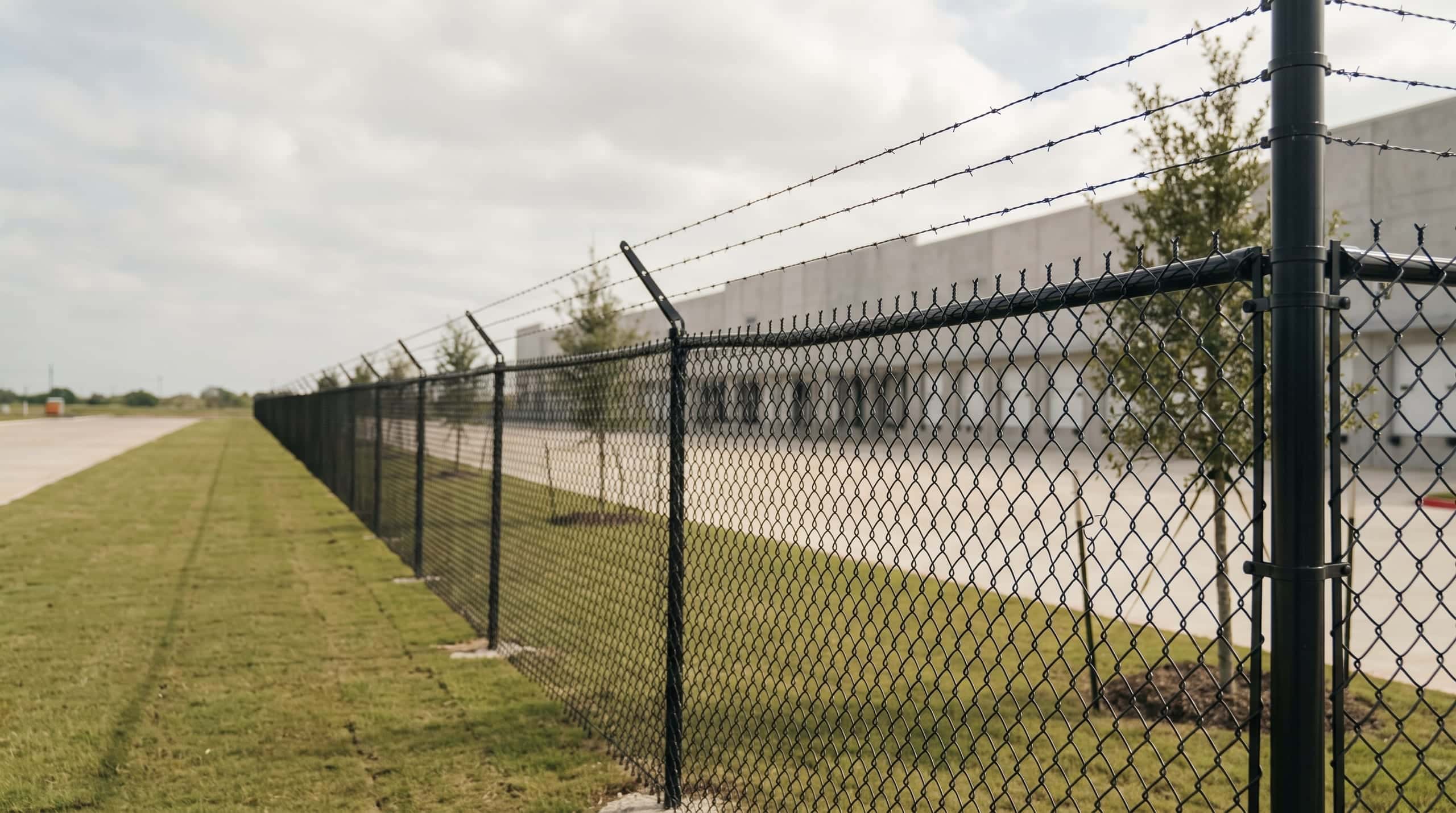
For a Texas commercial perimeter, chain link is the cheapest to install and suits industrial yards that need to see through the line, wood screens a site at a middle price, and masonry costs the most but is engineered like a wall and outlasts both. Choose by what the fence has to stop, then by what it costs to own.
The three land at very different prices on install day, then split apart again over the next ten years in ways a per-foot number never shows. Texas wind, heat and clay decide most of that difference.
How Do You Choose a Commercial Perimeter Fence?
Start with what it has to stop, because a commercial perimeter does one of three jobs and the job picks the material. Deter is a line most people decide not to cross. Delay buys minutes for a camera and a response. Stop means the barrier holds against a hand tool or a vehicle. IronSite puts standard security fencing at 6 to 10 feet tall, with anti-climb designs above 10 feet.
Facilities buyers get burned when the bid answers a different question than the site asked. A storage yard behind a building needs sight lines and a locked gate. A street-facing campus needs screening, and a substation needs a barrier that survives a bolt cutter. Those are three different fences, and only one of them is cheap.
| Term | What it means on your property line |
|---|---|
| Deter, delay, stop | Three levels of protection. Most commercial fences deter; few stop |
| Screening | Whether a person outside can see what you store inside |
| Anti-climb | Design that removes footholds, usually tight mesh or a smooth face |
| Anti-cut | Resistance to hand tools like bolt cutters or a hacksaw |
| Ground contact | Wood rated and treated for burial in soil, the standard for posts |
| Class 2 coating | The heavier zinc coating class on chain link fabric |
We build all three types across Houston, Dallas-Fort Worth, Austin, and San Antonio, including perimeter work for general contractors on industrial sites and the data-center buildout going up across Texas.
Is Chain Link the Cheapest Commercial Fence?
Yes, to install. Chain link is the cheapest fence to install and the most active line item after that. IronSite’s published ten-year cost table follows a standard chain link fence from $15,000 at purchase to $18,000 by year 2 for cut repairs and tensioning, $25,000 by year 5 for rust and sag, and $39,000 by year 10 once sections have been replaced. Same fence. Two and a half times the money.
What it stops is modest. Fabric can be cut with hand tools, the mesh gives a climber a foothold, and it screens nothing at all. IronSite rates standard chain link 1 of 5 on anti-cut, anti-climb, and visual screen, and points to mini-mesh as the upgrade that shrinks footholds and resists cutting.
Coating class is the one line that changes its lifespan, and almost no bid names it. Galvanized fabric carries a minimum zinc coating of 1.2 ounces per square foot in Class 1 and 2.0 in Class 2, and the heavier class is what outlasts a humid Gulf Coast year (ASTM A392, 2017). Ask for Class 2 or vinyl-coated fabric on any commercial run, then compare bids.
Chain link is the right answer for a back lot line, a laydown yard, or a substation where you want to see through the fence. It is the wrong answer when the fence is also the front door of your brand.
What Makes Chain Link Commercial Grade?
The wire in the fabric and the steel in the framework, because chain link is not one product. The word on the bid is the same whether the fence is a big-box backyard kit or a fence built to hold an industrial yard for twenty years, and two things separate them: the wire in the fabric and the steel in the framework.
- Wire gauge on the fabric. Gauge runs backward, so a lower number is a thicker wire. Residential fabric uses a lighter wire than commercial fabric, and the heavier wire is what resists a bolt cutter, a truck mirror, and years of tensioning. Make the bid name the gauge as a number, not as galvanized.
- Framework, not tubing. Commercial line posts, terminal posts, and top rail are schedule-rated steel pipe specified to a strength and coating standard (ASTM F1083 for welded galvanized pipe, ASTM F1043 for framework strength and coating). Residential kits use thin-wall tubing that bends at the first gate slam or gust. Ask which standard the pipe meets and what the wall thickness is.
- Fittings and tension members. Commercial runs use heavier bands, rail ends, tension bars, and bottom tension wire. This is the quietest place a bidder shaves cost, because nobody inspects a brace band.
Those three lines, plus the Class 2 or vinyl coating named above, are the whole difference between a fence that gets retensioned and a fence that gets replaced.
The Two Upgrades That Change What Chain Link Can Do
Chain link starts with no screening and a climbable face. Two add-ons move it:
- Privacy slats. Vertical slats woven through the mesh take a see-through fence to a screened one, usually in the 75% to 90% range depending on the slat style. They are how a storage yard, a dumpster enclosure, or a contractor lot hides inventory without paying for wood or masonry. They also add wind load to the run, so posts and spacing have to be sized for a screened fence, not an open one.
- Barbed arms at the top. Three-strand barbed wire on angled extension arms adds height and a hostile top to the line. Turned outward it deters entry; turned inward it slows exit, which is why it shows up on equipment yards and utility sites. Barbed and razor tops are also the first thing a city ordinance restricts, so confirm what the zoning allows at that address before it goes on the spec.
Slats and arms do not make chain link cut-resistant. They fix the screening and the climb, and they cost a fraction of stepping up a material class, which is why a screened commercial chain link run often beats a wood fence on both the install number and the ten-year number.
When Is Wood the Right Commercial Perimeter?
When the site needs screening at a middle price, and its ten-year cost is set by two words on the quote. A wood fence runs about 20 years of service life under normal conditions (InterNACHI). In the wet, hot band along the Gulf Coast it runs shorter, and the failure almost always starts where the post meets the dirt.
Posts belong in Use Category 4A, general ground contact, with the preservative retention that goes with decades of burial (AWPA Standard U1). A picket-grade post dropped in a hole looks identical on install day and rots years sooner. So does a #3 picket sold to you as a #1.
Grade is the other word. We quote wood by picket grade, #1 through #3, by name, because that is the number a competitor can quietly swap to win a bid. Master Halco named us its Largest Volume Customer for both the Southwest Region and the World in 2026, so we buy pickets at a cost a three-crew shop does not get, and that difference goes into the price rather than into a thinner board.
Why Does a Masonry Perimeter Cost the Most?
Because it is engineered like a wall. Masonry is priced high because it is designed, not just built. A solid fence is treated as a solid freestanding wall, with the design wind force applied across its full solid face and a force coefficient that climbs as the wall runs longer relative to its height, checked against an eccentric end-zone case (ASCE/SEI 7-22, 2022). That is the same math used on the buildings behind it.
The reinforcement follows from the wind tier. An 8-foot masonry fence in the 20 psf tier calls for No. 4 vertical bars at 16 to 24 inches on center over a 12-by-42-inch footing (NCMA, 2007). Steel and concrete in the ground are most of the cost, and they are also the reason the wall shrugs off a gust that flattens a wood fence.
What you buy for that money is the longest replacement clock in the trade. Brick walls run 100 to 150-plus years before major repair, with repointing on a 50-plus year cycle (Brick Industry Association Technical Note 46, 2017). Unit selection is part of that number: brick is specified by weathering grade for the moisture and freeze exposure at the site, and concrete masonry units carry their own strength and moisture-content requirements under the code that governs the wall (TMS 402/602-22).
Masonry also stops what the other two do not: it cannot be cut, gives a climber nothing, and screens the site completely. Two more reasons show up on the buyer's side of the table more often than security does.
- Noise buffering. Sound is stopped by mass, and a solid grouted masonry wall has more mass per square foot than any fence in the trade. It is why a wall gets specified between a loading dock and a residential street, or along a frontage road at a hotel or medical office. An open fabric fence attenuates nothing, and a board fence with gaps at the pickets does very little.
- Fire resistance. Concrete masonry and brick are noncombustible, and concrete masonry assemblies are rated for fire resistance by their equivalent thickness (NCMA TEK 14-16B). On a site storing pallets, fuel, or vehicles, or where a wall separates your yard from a neighbor's, a wall that will not carry fire across the line is the reason the wall is there.
A Block Wall and Stone Columns With Infill Are Two Different Buys
Both get called masonry, and they price and screen differently.
A continuous block wall is CMU laid the full length of the run, reinforced vertically and horizontally, on a continuous footing, then finished with stucco, split-face block, or a brick or stone veneer. It is one uninterrupted solid surface, which is what gives you full screening, the acoustic mass, and the fire separation. It is also the most expensive per foot, because every foot carries steel and concrete.
Stone or brick columns with infill between them puts the masonry only where it does the most work. Columns go on their own footings at a set spacing, each one engineered for the wind load it carries, and the panels between them are filled with something lighter: precast concrete panels, wood pickets, ornamental steel, or chain link. You keep the masonry look at the street and the column strength at the posts, and you cut the linear masonry cost substantially. What you give up depends on the infill. Wood or precast infill still screens; steel or chain link infill does not, and neither infill matches a solid wall on noise or fire.
For a street frontage where appearance and screening carry the property, a solid wall or precast infill is the answer. For a long boundary where the wall is mostly about definition and durability, columns with infill is usually the better buy, and it is the combination we build most often on large sites.
One planning note. Houston requires a building permit for a fence built wholly or partly of masonry or concrete at any height, while ordinary wood and metal fences at 8 feet and under are exempt. We determine whether a commercial project needs a permit and file it.