
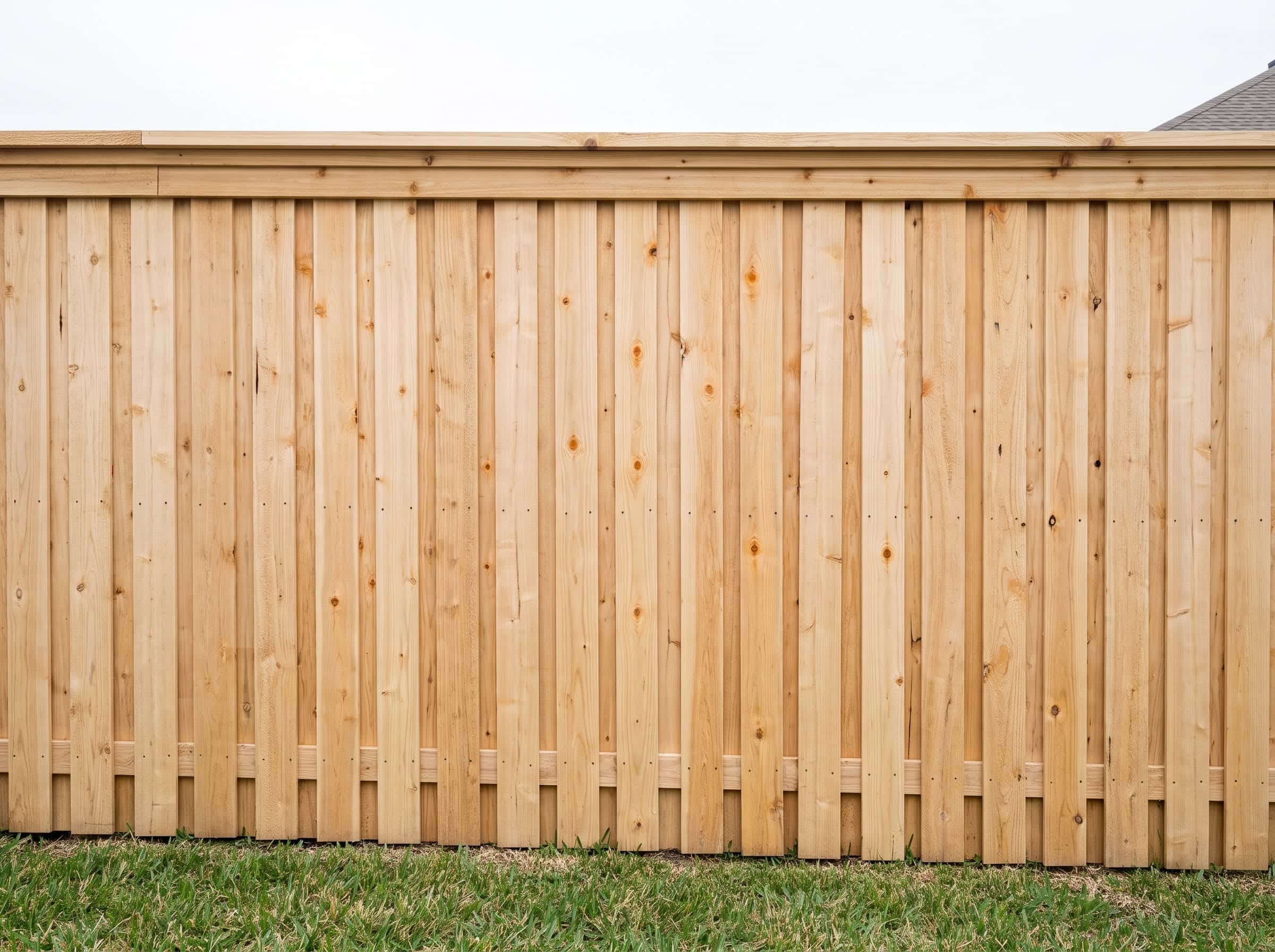
Cedar is the better wood for the pickets of a Texas fence, and pressure-treated pine is the better wood for the posts. Cedar heartwood resists rot above ground, and pine treated for ground contact is built for the part you bury, so most good Texas fences use both.
Where the fence stands decides how much the choice matters. The same cedar picket and the same pine post age on different clocks in Houston, Dallas, Austin and San Antonio, and on a wet Houston lot the wrong wood shows within a few years.
Does Cedar or Pine Last Longer in Houston Than in Dallas?
Both last longer in Dallas, because Houston’s wetter climate rots wood faster. The USDA Forest Products Laboratory scores decay hazard by location, and Houston comes in at 77.2, past the 65 mark that defines high risk, while Dallas sits at 44.3 in the moderate band (USDA Forest Products Laboratory, 2009). Same wood, same crew, two different clocks. That is the variable a national comparison leaves out.
The index is built from a location’s temperature and rainfall records. Warm and wet feeds the fungus that eats a fence; dry and hot does not. Houston is warm and wet almost year round, and the Gulf Coast is worse still.
| Metro | Decay hazard index | Risk band | Source |
|---|---|---|---|
| Port Arthur (Gulf Coast) | 80.7 | High, above 65 | USDA FPL, 2009 |
| Houston | 77.2 | High, above 65 | USDA FPL, 2009 |
| Austin | 55.2 | Moderate, 35 to 65 | USDA FPL, 2009 |
| San Antonio | 52.2 | Moderate, 35 to 65 | USDA FPL, 2009 |
| Dallas | 44.3 | Moderate, 35 to 65 | USDA FPL, 2009 |
We install across all four of those metros, and the fences that come out early are almost always the Houston-area ones. That is not bad luck. It is a climate number doing exactly what the chart says it will do.
Is Cedar More Rot-Resistant Than Pine?
Yes, cedar heartwood is, though the pale cedar sapwood is not. Heartwood is the darker wood at the center of the tree. Oregon State University’s worldwide durability checklist rates western redcedar as resistant, class 2 on a 1 to 4 scale, and southern pine as only moderately resistant to perishable, class 3 to 4 (Oregon State University, 1998). That gap is why cedar costs more. It also applies to one part of the log.
A Forest Products Laboratory test fence ran softwoods and hardwoods in the weather for up to 22 years. The heartwood of western redcedar came in among the most decay-resistant woods tested, estimated at over 20 years above ground, while the sapwood of those same species failed markedly sooner (USDA Forest Products Laboratory, 1995).
So the pale, light-colored boards in a cheap cedar bundle are cedar by species and ordinary softwood by performance. When a quote says cedar and nothing else, that is the board you might be buying. Ask what share of the picket is heartwood before you pay a cedar price for it.
Why Use Pressure-Treated Pine for Fence Posts?
Treated pine is engineered for ground contact, which is the exposure cedar handles worst. The American Wood Protection Association places fence posts in Use Category UC4A, general ground contact, and pairs that exposure with a minimum preservative retention meant for long in-ground service (American Wood Protection Association, Standard U1). The treatment is a specification. It either matches the use or it does not.
The payoff shows up in long-run field data. At a severe-exposure test site in southern Mississippi, pressure-treated wood came back with expected durability over 60 years, while untreated stakes in the same soil lasted a year to a few years (USDA Forest Products Laboratory, 2013).
That is the honest split. Below the dirt, chemistry beats species. Above it, species and grade start to matter again.
What Should a Cedar or Pine Fence Bid Name?
Four words carry most of what a wood fence bid is actually promising. Two of them describe the tree, one describes the treatment, and one describes the sort. A quote that names all four is a spec. A quote that names none of them is a price with a species written next to it.
| Term | What it means | Why it changes your fence |
|---|---|---|
| Heartwood | The darker inner wood of the tree | Carries cedar’s natural decay resistance |
| Sapwood | The pale outer wood near the bark | Ages like untreated softwood, even in a cedar board |
| Ground contact (UC4A) | AWPA use category for buried wood | Sets the minimum preservative retention for posts |
| Picket grade | The mill’s sort of the same species, #1 through #3 | Decides how clean the board is and what it costs |
Can You Use Cedar Pickets on Pine Posts?
Yes, and pressure-treated pine below the ground line with cedar above it is the build most Texas installers land on, because of moisture. Serious decay needs wood held above the fiber saturation point, an average of 30% moisture content, while air-dried wood usually stays at or under 20%, which the Wood Handbook calls a reasonable margin of safety against fungal damage (USDA Forest Products Laboratory, 2021). Wet wood rots. Dry wood waits.
- Posts. Pressure-treated pine, rated for ground contact, set in concrete. This is the part you cannot swap out later without taking the fence apart.
- Rails. Treated pine does fine here and keeps the cost down. Rails sit above grade and dry out between rains.
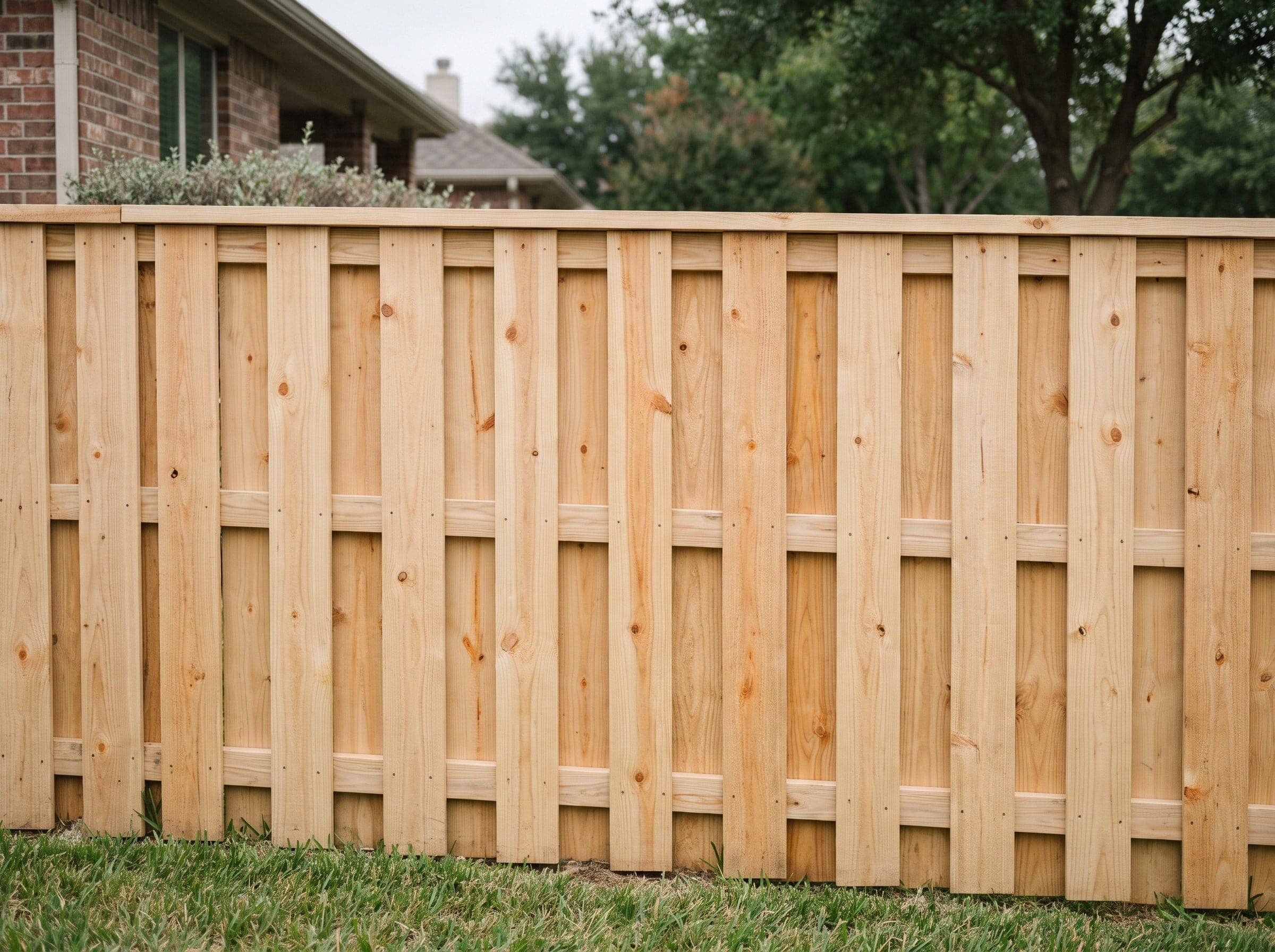
- Pickets. Cedar, where the budget allows it, because this is the face of the fence and the part that weathers in full view.
- The bottom edge. Keep the pickets up off the dirt. A picket resting in a flower bed wicks water and stays above 30% moisture for weeks at a time.
In Houston, Kingwood, and Conroe, the hybrid is the build we push hardest. In Dallas, with a decay index in the mid-40s, all-treated pine is a reasonable buy that will not embarrass anybody.
Does Cedar Grade Matter on a Fence Quote?
Yes, because two bids can both say cedar and mean different boards. Grade is the mill’s sort of the same species, numbered #1 through #3, and the number tells you how clean and sound the board is. Price follows the number down. When the grade is missing from the paperwork, the cheapest quote in the stack is often cheapest because it dropped a grade and never said so.
This is where a bargain quote quietly turns into a shorter-lived fence. Nobody lies. The word cedar is on both pages. One yard just sent a lower-graded bundle to the truck.
We name the grade in writing on every quote, #1, #2, or #3, so the comparison you make is a real one. Ask every bidder to do the same, and ask whether the post is rated for ground contact while you are at it. Two lines of paperwork is all it takes.
How Much Do Cedar and Pine Fences Cost Per Foot in Texas?
A 6-foot pressure-treated pine privacy fence runs about $18 to $30 per foot installed in Texas, and cedar about $25 to $45 (HomeGuide and Angi, 2026). Texas wood fencing prices below the national average. National wood-fence installs run $20 to $50 per linear foot (HomeGuide, 2026), while Houston-area wood privacy fences are commonly quoted at $16 to $42 per foot (Angi Houston and HomeBlue, 2026). Heavy local competition and nearby pine and cedar supply are why.
| Fence type (6 ft residential) | Texas installed cost per linear foot | What moves it |
|---|---|---|
| Pressure-treated pine privacy | $18 to $30 | Basic picket grade sits at the low end |
| Cedar privacy | $25 to $45 | Clear, knot-free grades push toward the top |
| Hybrid, pine posts and cedar pickets | Between the two | Post and rail cost stays at the pine level |
Those ranges cover materials and labor on flat, clear ground. They exclude tearing out and hauling off the old fence, gates and operators, permits, and rocky or heavy-clay digging, all of which add money to a real quote.
Here is the part that changes the math on cedar. Master Halco named us its 2026 Largest Volume Customer for both the Southwest Region and the World, and we are a top customer of Solid Wood. That buying power gets us a picket cost a three-crew shop cannot get, and we pass it through. The same fence for less, because we buy the wood for less, which is often what closes the gap between the pine quote and the cedar one.