A data center perimeter in Texas gets specified like security equipment. Crash-rated vehicle gates, anti-climb mesh, Schedule 40 reinforcement, thousands of feet of it, all built to slow someone down long enough for a response. The harder question on that job is not which welder does the prettiest corner. It is who can measure the run, load the material, and hold crews on site for weeks without missing a day.
Data Center Fencing Gets Specified to Delay an Intruder
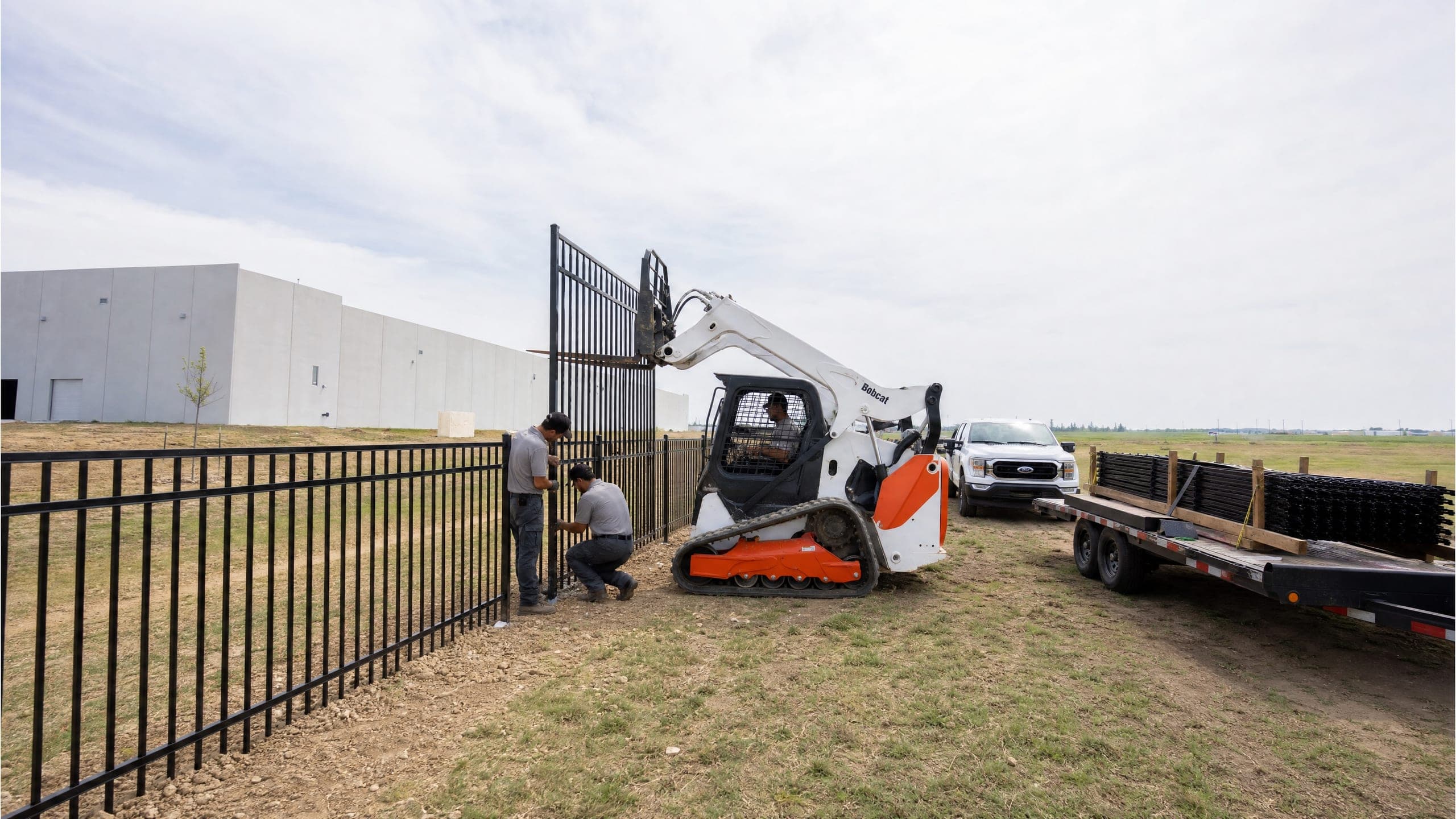
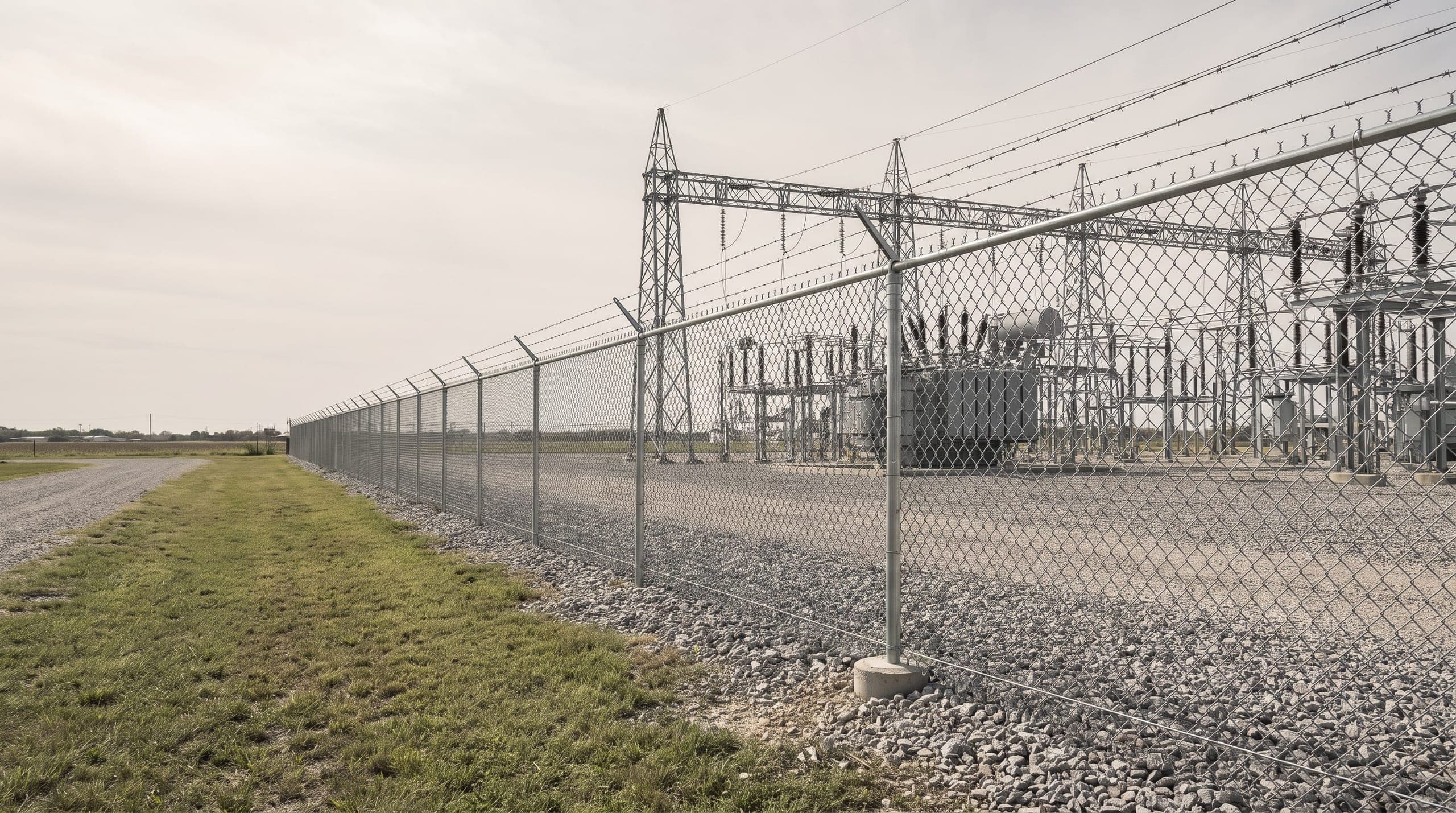
The perimeter on a hyperscale or power-generation site is written as a delay device, and the footage tells you why. Robinson Fence reported building 2,016 linear feet of 8-foot ornamental iron security fencing at the Stream Hyperscale DFW VII campus in Garland, with multiple access gates and automated operators, and roughly 8,690 linear feet of chain link plus 3,000 feet of 10-foot ornamental iron on a data center project in Pryor, Oklahoma.
Those are not backyard numbers. A residential fence job is 150 to 250 feet. A single data center compound can run past a mile of line, in two or three different fence types, with vehicle gates, pedestrian gates, and operators at every opening.
The spec follows the job. Every element is chosen to make climbing slow, cutting slow, and driving through it impossible.
Know These Terms Before You Read a Perimeter Fence Spec
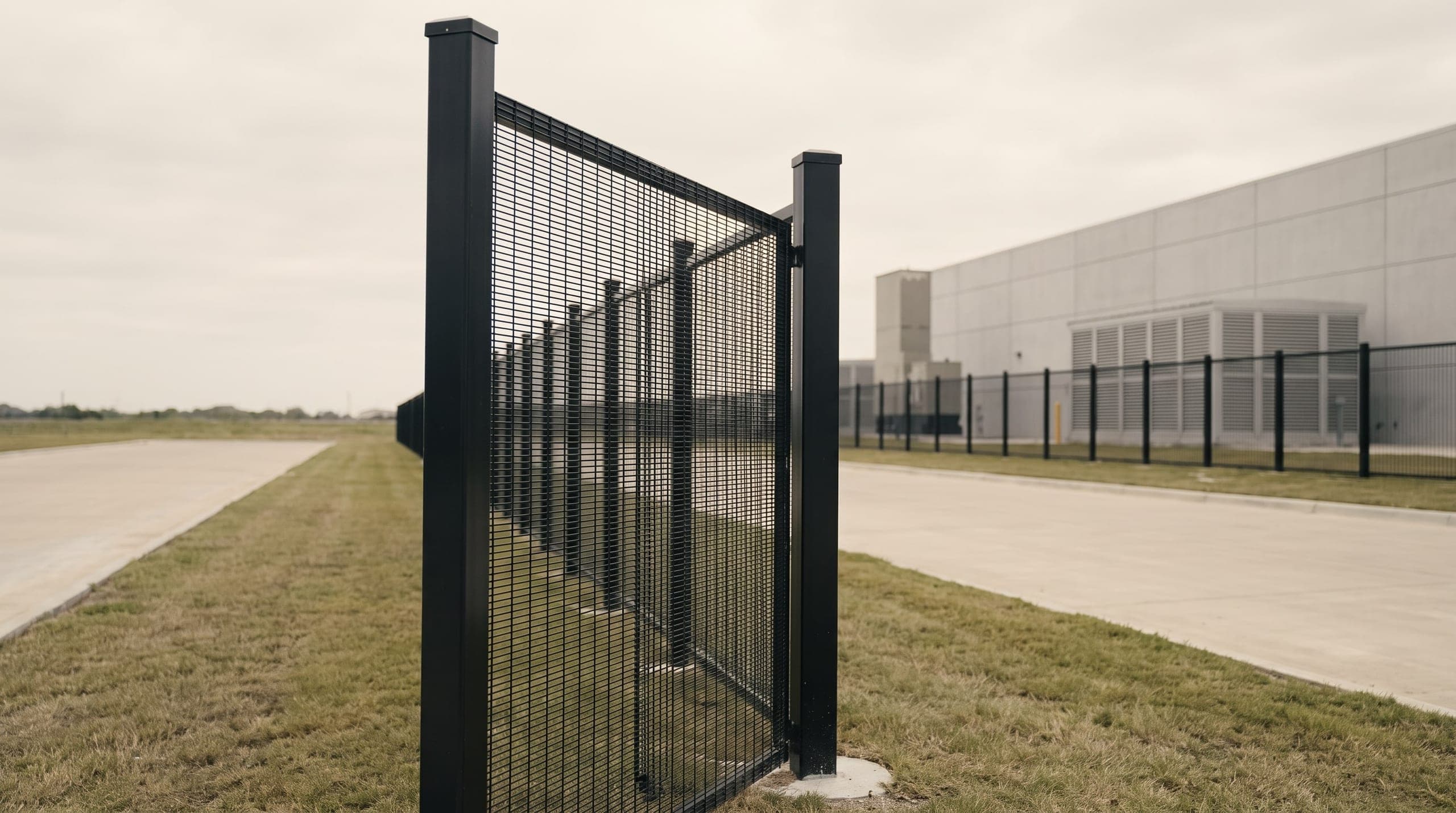
Six words carry most of the difference between a data center fence and an ordinary commercial one, and a general contractor reading bids should be able to price all six. The bid packages on these sites call for heavy-gauge chain link in 9-gauge or 6-gauge galvanized or vinyl-coated steel, Schedule 40 terminal posts, 358 mesh and welded wire for anti-climb, and M30 and M50 P1 crash-rated gate systems.
| Term on the spec | What it means | Why it lands on a data center job |
|---|---|---|
| 9-gauge or 6-gauge fabric | Wire thickness; the lower number is the thicker wire | Thicker wire takes far longer to cut through |
| 358 mesh | Anti-climb welded mesh with openings too tight for a boot toe | Removes the ladder a standard chain link diamond gives a climber |
| Schedule 40 post | A heavier pipe wall class than residential-grade tube | Terminal and gate posts carry the whole line’s load |
| Crash-rated gate (M30, M50 P1) | A gate assembly tested to stop a vehicle impact | Vehicle approach lanes need a tested assembly with documentation |
| UL 325 | The safety standard automatic gate operators are listed to | Every powered gate on the site falls under it |
| ASTM F2200 | The construction standard for automated vehicular gates | Sets the usage class the gate has to be built to |
How Does a Data Center Fence Differ From a Standard Commercial One?
Every line on the spec moves up a grade, and the gate moves up two. A standard commercial security fence marks a boundary and slows a casual trespasser. A data center perimeter is engineered to buy response time against someone who arrived prepared, with tools, or in a vehicle.
Here is where the two specs part company.
| Spec line | Standard commercial fence | Data center perimeter |
|---|---|---|
| Height | 6 to 8 feet | 8 to 10 feet, often with a topping detail |
| Fabric or infill | Standard-gauge galvanized chain link | 9-gauge, 6-gauge, or 358 anti-climb mesh |
| Posts | Residential or light commercial tube | Schedule 40 terminal and gate posts |
| Vehicle gate | Cantilever slide with a standard operator | Crash-rated assembly with a listed operator |
| Coating | Class 1 galvanized fabric | Class 2 galvanized or vinyl-coated fabric |
That coating row carries more weight than it looks. ASTM A392 sets minimum zinc coating weights of 1.2 oz/ft² for Class 1 and 2.0 oz/ft² for Class 2 chain link fabric (ASTM A392, 2017). The heavier class is what keeps a 10-year-old perimeter from rusting into a cuttable one.
None of that matters if the installation itself is the weak link, which is why we track the number that actually proves a crew builds to this grade every time: zero craftsmanship warranty callbacks across more than 20,000 jobs completed last year. That is not a target we’re working toward; it’s the closed-out record for the year, a 100% callback-free rate on every job that left our crews’ hands. On a data center perimeter, where a single loose post or under-spec fabric run undermines every other line item in that record is the difference between a fence that holds the line and one that just looks like it will.
The Gate Is Where the Perimeter Gets Won or Lost
An automated gate on a restricted site is a listed system, and the code treats it that way. Every entrapment zone needs at least two independent, different-type entrapment-protection means in each direction of travel, and since August 1, 2018, all external sensors must be monitored, so the operator drops to constant-pressure or manual control on any fault or lost signal (DASMA, 2018).
That is not a preference. It answers a real casualty record, and it means a motor bolted onto an existing fence line does not pass.
The construction side is governed too. ASTM F2200 sorts automated vehicular gates into four usage classes, with guarded or restricted-access sites in the top class, and requires the gate to comply with both F2200 and UL 325 (ASTM F2200, 2024). A crash-rated gate raises the bar again, because the rating belongs to the tested assembly, gate leaf, posts, foundation, and all. Substituting a post because the right one was three weeks out voids the thing you paid for.
Texas Wind Sizes the Fence, and the Soil Sizes the Post
A solid or near-solid perimeter panel is engineered as a freestanding wall, loaded across its full area. Under ASCE 7-22, design wind force runs F equals q_h times G times C_f times A_s, with a force coefficient that climbs as the wall gets longer relative to its height, checked including an eccentric end-zone case (ASCE 7-22, 2022). Anything with less than 30% open area counts as solid.
Long runs are exactly what a data center perimeter is. So the end panels, the corners, and the tall posts flanking a gate carry the highest loads on the site.
Then the load has to go into the ground. The code sizes fence and gate posts as cantilevered poles, with embedment depth growing as the wind force and its lever arm grow, and shrinking only as the soil gets stronger (IBC, 2021). Texas clay is not strong soil. A heavy crash-rated gate on a tall post in Blackland clay drives a deep, wide concrete footing, and that footing is a real line item on the quote. A bid that never mentions it has either priced it invisibly or has not priced it at all.
But Thousands of Feet Is a Staffing Problem First
The spec is the easy part. Finding a contractor who can put enough people on a mile of line, every day, for weeks, is where perimeter dates get missed. The trades are small: about 599,000 specialty-trade-contractor establishments employ roughly 5.26 million workers nationally, fewer than ten per establishment on average (BLS QCEW, 2025). Most fence companies run one to three crews.
One to three crews is fine for a backyard. On an 8,000-foot perimeter with a hard energization date, it means one sick crew, one truck in the shop, or one better-paying job across town stops your schedule cold.
The labor pool is not getting looser either. Associated Builders and Contractors models a need for about 349,000 net new construction workers in 2026 just to keep pace with demand, and 456,000 in 2027 (ABC, 2026). We built around that problem by running over 100 crews, 25 to 30 of them in Houston alone and 5 to 15 in every other market, which is how we put up more than 2 million feet of fence across more than 20,000 projects in the last year. Crew depth is local, and it is the reason a missed day for one crew never becomes a missed week for a site.