A backyard fence marks a line. A substation fence is part of the security system, and it gets bought the way the equipment behind it does, by numbers: yield strength, wall thickness, coating weight, infill type. When those numbers are missing from a bid, the perimeter becomes the cheapest way into the most expensive site on the property.
Before the Steel Comes the Code That Governs a Substation Perimeter
Everything below is how a fence gets built. At a substation or a generation site, it is also how a fence gets approved, and four standards shape the perimeter before anyone prices a post.
| Standard | What it sets | What to require on the drawing |
|---|---|---|
| NEC 110.31 | Enclosure and height for outdoor installations over 1,000 volts | Overall fence height and the barbed or razor extension detail |
| NERC CIP-014 | Physical security plan for identified critical transmission sites | Barrier, access point, and detection items tied to the site threat assessment |
| IEEE Std 80 | Substation grounding, including the fence | Bonding conductors, grid ties, and gate hinge jumpers |
| Clearance rules | Distance from the fence to energized parts | Setback stated per bus voltage before the fence line is staked |
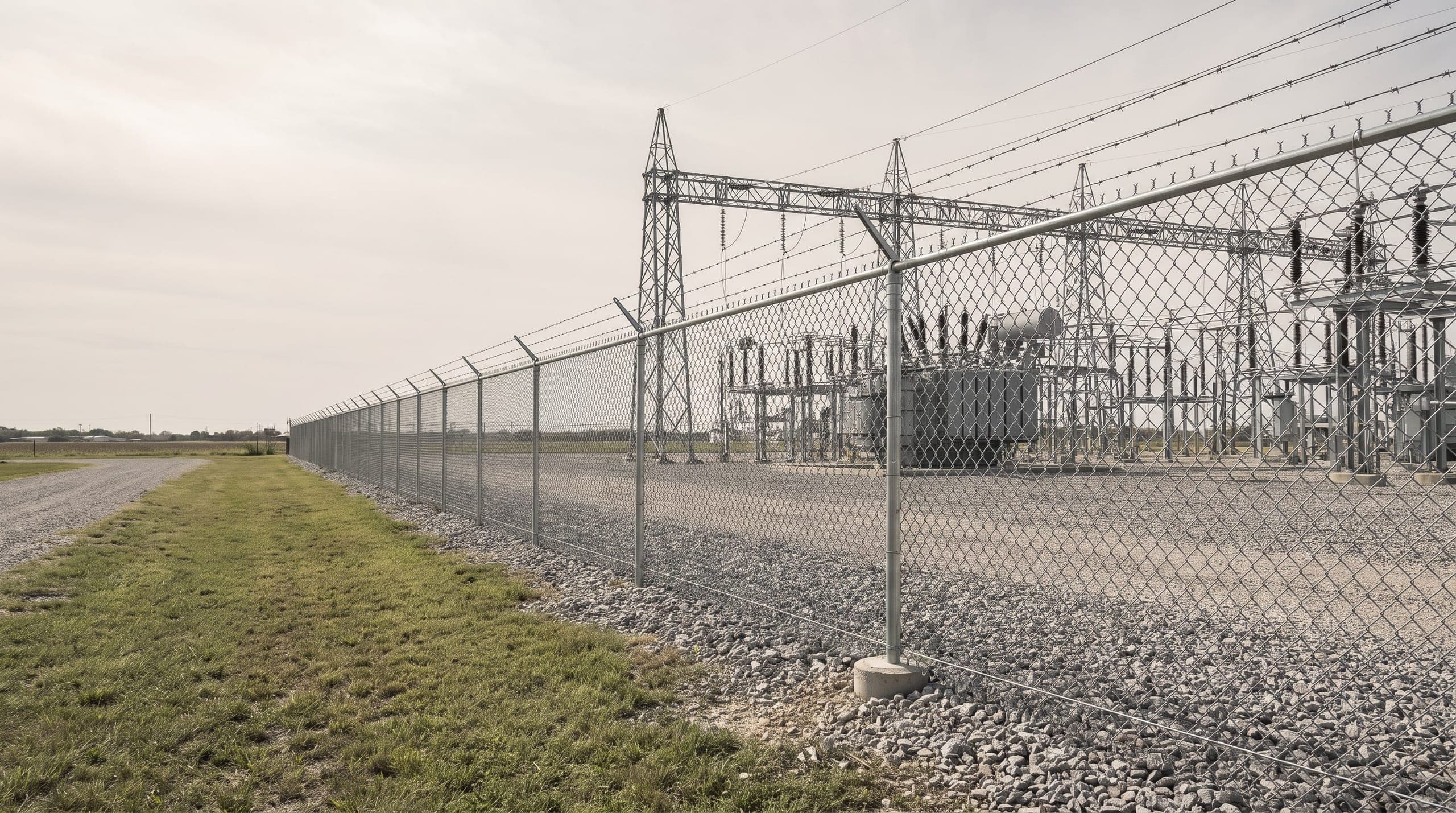
Height comes out of NEC 110.31. The National Electrical Code governs fencing that encloses outdoor electrical installations operating over 1,000 volts, and the figure utilities build to is seven feet overall, ordinarily six feet of fabric or mesh with a one-foot barbed extension on an arm. Read that height off the code edition your authority having jurisdiction has adopted and off the utility's own construction standard rather than a fence catalog, because arm angle and strand count are frequently specified tighter than the code floor.
NERC CIP-014 decides whether this is a fence job or a security program. A transmission station identified as critical under the standard carries a documented physical security plan, and the perimeter is one of its line items: deterrence barriers, controlled access points, detection and assessment, and evidence that each was evaluated against the site's threat assessment. On those sites the fence submittal becomes an attachment to that plan, and “we installed what was on the drawing” is not the record an audit wants.
IEEE Std 80 puts the fence on the ground grid. Metallic fence inside or adjacent to a substation rises in potential during a ground fault, and the hazard is touch voltage to whoever has a hand on the fabric at that moment. That is why posts and fabric get bonded and tied into the station ground grid, why gate leaves get flexible jumpers across the hinge, and why the grid often extends past the fence line. Grounding conductors, connection type, and jumper detail belong on the fence drawing, not on a field decision.
Clearance to live equipment grows with voltage. The fence cannot sit where a hand, a tool, or an arc can reach energized parts, so the setback from the nearest live component is a function of bus voltage, wider at transmission voltages than at distribution. Pull the required distance from the governing code table and the owner's standard for every voltage on the site before the line is staked. Moving a fence line after the yard is graded is the expensive version of that conversation.
When Concrete Replaces Steel
Steel framework with hardened infill answers climbing and cutting. It does not answer a rifle. Where the threat assessment includes gunfire at transformers or the control building, the perimeter becomes a precast concrete wall rated to UL 752, the standard that classifies bullet-resisting barriers by the ammunition they stop, with the higher levels covering rifle rounds rather than handgun rounds. Ask for the level number rather than the word “ballistic,” and ask what the panel joints and the gate opening are rated to, because a wall performs at its weakest segment.
Wildlife and Vehicles Are Separate Barriers
A perimeter built for people does nothing about the two intrusions that actually take substations offline.
- Animals. Squirrels, raccoons, and snakes cause a large share of minor outages by bridging energized parts, and they cross a security fence over, under, or through it. The answer is a second barrier: fine mesh skirting at the fence line, plus non-conductive guarding or pulse-type barriers wrapped at the transformers and the equipment they climb.
- Vehicles. Where the perimeter fronts a road, a parking area, or a drive aisle, those segments should be crash rated, K-rated or M-rated, for the impact they are exposed to. A crash rating covers post, foundation, and beam as an assembly, so it cannot be bolted onto an existing fence line by changing the infill.
A Substation Perimeter Gets Specified Like the Equipment Inside It
Utility fencing starts with a spec sheet, and the first line on it is steel. On a Texas WETT transmission project in Big Spring dated May 7, 2026, Gregory Industries says its Super-C posts were chosen because they are formed from 60,000 psi minimum yield steel, which it describes as exceeding typical ASTM F1043 performance requirements for industrial fence framework. Nobody picked that post for how it looks.
That is the difference between this job and a property line. A commercial fence has to stand up, stay square, and last. A substation fence has to slow down a person who came with tools and every intention of getting through.
Which is why two bids for the same 1,800 feet of perimeter can land within a few thousand dollars of each other and describe completely different fences. One of them names the steel. The other says “heavy duty.”
Know These Terms Before You Read a Security Fence Quote
Five terms carry almost all the meaning on a high-security fence quote, and a bid that leaves them blank has left the spec blank. Framework and infill are the two halves of the fence. Yield strength, wall thickness, and coating weight are the three numbers that decide how long the framework holds and how long it lasts.
| Term | What it means | Why it decides the job |
|---|---|---|
| Yield strength | The pressure in psi at which steel bends and stays bent | A post that yields under a pry bar has already lost |
| Wall thickness | The thickness of the steel in the post, in decimal inches | Thicker walls resist cutting, prying, and vehicle contact |
| Coating weight | Zinc applied per square foot of steel surface | Zinc is consumed over time; more zinc buys more years |
| Framework | Posts, rails, and braces that hold the fence up | Sized for wind load and attack, and replaced only by digging |
| Infill | Mesh, fabric, or panel filling the space between posts | The part an intruder actually cuts or climbs |
Post Yield Strength Is the First Number to Check
Yield strength tells you what happens the moment force is applied, and wall thickness tells you how much force it takes. Gregory Industries lists the Super-C post in 0.130 inch and 0.150 inch wall thicknesses, both formed from that 60,000 psi minimum yield steel. Two numbers, both printed, both checkable against what shows up on the truck.
Compare that to how most fence quotes describe a post. They give a diameter and a “schedule,” or they give nothing at all. Neither one tells a utility engineer whether the post will hold a climbing load at the top rail or take a hit from a service vehicle backing up in the dark.
Ask for the yield strength in psi and the wall thickness in decimal inches. A contractor who builds high-security work has both on hand in about a minute. A contractor who has to call the supplier and get back to you has told you something too.
Zinc Coating Decides How Long the Framework Survives Texas
Galvanizing is the part of the fence nobody inspects and everybody pays for later. A 100-micron hot-dip galvanized coating in a moderate atmosphere is modeled at roughly 47 to 143 years to first maintenance, while zinc in industrial air corrodes at 2.1 to 4.2 microns per year against 0.1 to 0.7 in rural air (ISO 9223 / American Galvanizers Association, 2012). Same steel, same fence, wildly different service life depending on the air around it.
Gregory Industries says the Super-C carries a uniform 2 oz. zinc coating on both interior and exterior surfaces, applied by continuous galvanizing. Both surfaces matter. Zinc on the outside of a post does nothing for the inside of it.
Texas adds heat to the corrosion math. The Office of the Texas State Climatologist projects that 100-degree days are on track to become roughly four times as common by 2036 as they were in the 1970s and 1980s (Office of the Texas State Climatologist, 2024). A West Texas substation sees that heat every summer for the life of the asset, and the coating either was specified for it or it was not.
Why Open-Channel Posts Change the Corrosion Math
The shape of the post decides what a galvanizing line can reach. Gregory Industries makes the case that its open channel design reduces internal corrosion compared with closed tubular posts, because a continuous line coats the full profile inside and out. A round tube has an interior that no one coats evenly and no one ever sees again.
That hidden interior is where a lot of old industrial fence dies. Water enters at a cap, a weld, or a drilled hole, sits at the bottom of the tube, and works outward. By the time rust shows on the outside, the wall thickness that was doing the work is gone.
An open profile also lets an inspector look at the steel years later. On a 25-year asset with a security job, being able to check the framework without pulling it out of the ground is worth something real.
Choose Infill for Cutting and Climbing Resistance
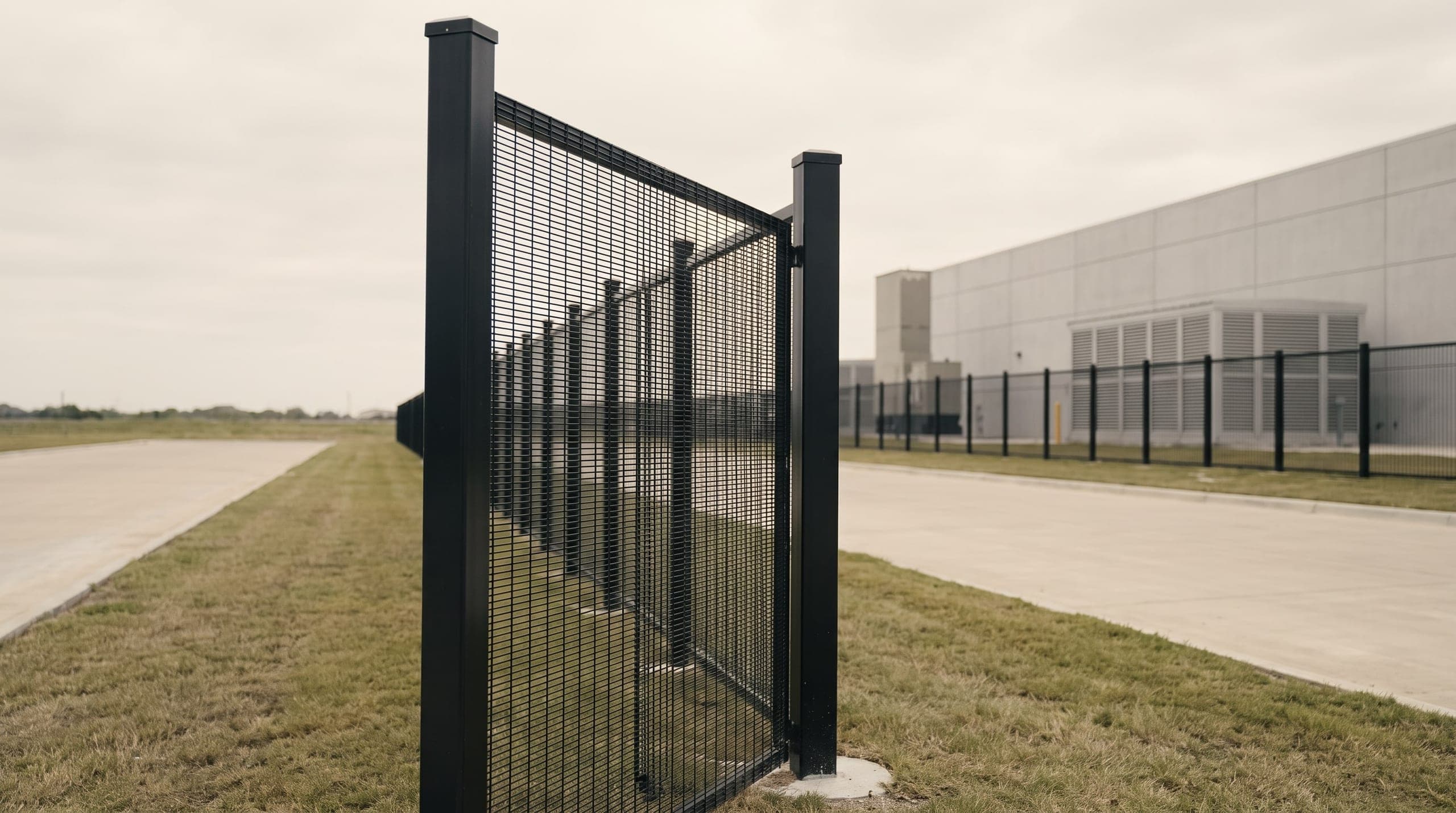
Infill is the part an intruder touches, so it gets picked for how it fails under bolt cutters and boots. Gregory Industries describes pairing its posts with high-security infill systems including welded wire and expanded metal mesh for utility-provider protection. The chain link most people picture is a third option, and its life is governed by coating class: ASTM A392 sets minimum zinc weights of 1.2 oz/ft² for Class 1 and 2.0 oz/ft² for Class 2 (ASTM A392, 2017).
Here is how the three compare on the two things that matter at a substation.
| Infill type | How it resists attack | What to name in the spec |
|---|---|---|
| Welded wire mesh | Small openings deny finger and toe holds for climbing | Wire diameter and mesh opening size |
| Expanded metal mesh | Cut and stretched from solid sheet, so there are no strands to snip | Sheet thickness and strand pattern |
| Chain link fabric | Widely available and the easiest of the three to cut | Class 2 zinc coating at 2.0 oz/ft², or vinyl-coated fabric |
Chain link is not disqualified. It is a legitimate choice for parts of a site where delay matters less, as long as the coating class is written down and the fabric gauge is named. What fails is a spec that says “chain link” and stops.