
Replace your Fort Worth fence when several posts are rotting or leaning, or when more than 30 to 40% of it is damaged. A wood fence 15 years old or older should be inspected first. Weathered appearance alone is not a reason to replace it.
Most homeowners reading this have already been burned: a fence that failed too soon, a quote that left out the picket grade, or a crew that never came back. The answers below give you the thresholds, the local facts and the companies that build in this market.
Replace a Fort Worth fence when posts rot and damage spreads
A few bad boards mean a repair, and one or two failing posts mean replacing just those posts. Several rotting posts mean the fence has lost its structure, so replace the whole fence.
Widespread damage points the same way. When more than 30 to 40% of the fence is deteriorating, get a replacement estimate.
Walk the fence and count. Say, hypothetically, a fence has 40 sections and 14 of them have rotted posts or broken boards. That is 35%, inside the range where a replacement estimate makes sense. Every figure in that example is hypothetical, so count your own sections.
Which signs show your Fort Worth fence is past repair?
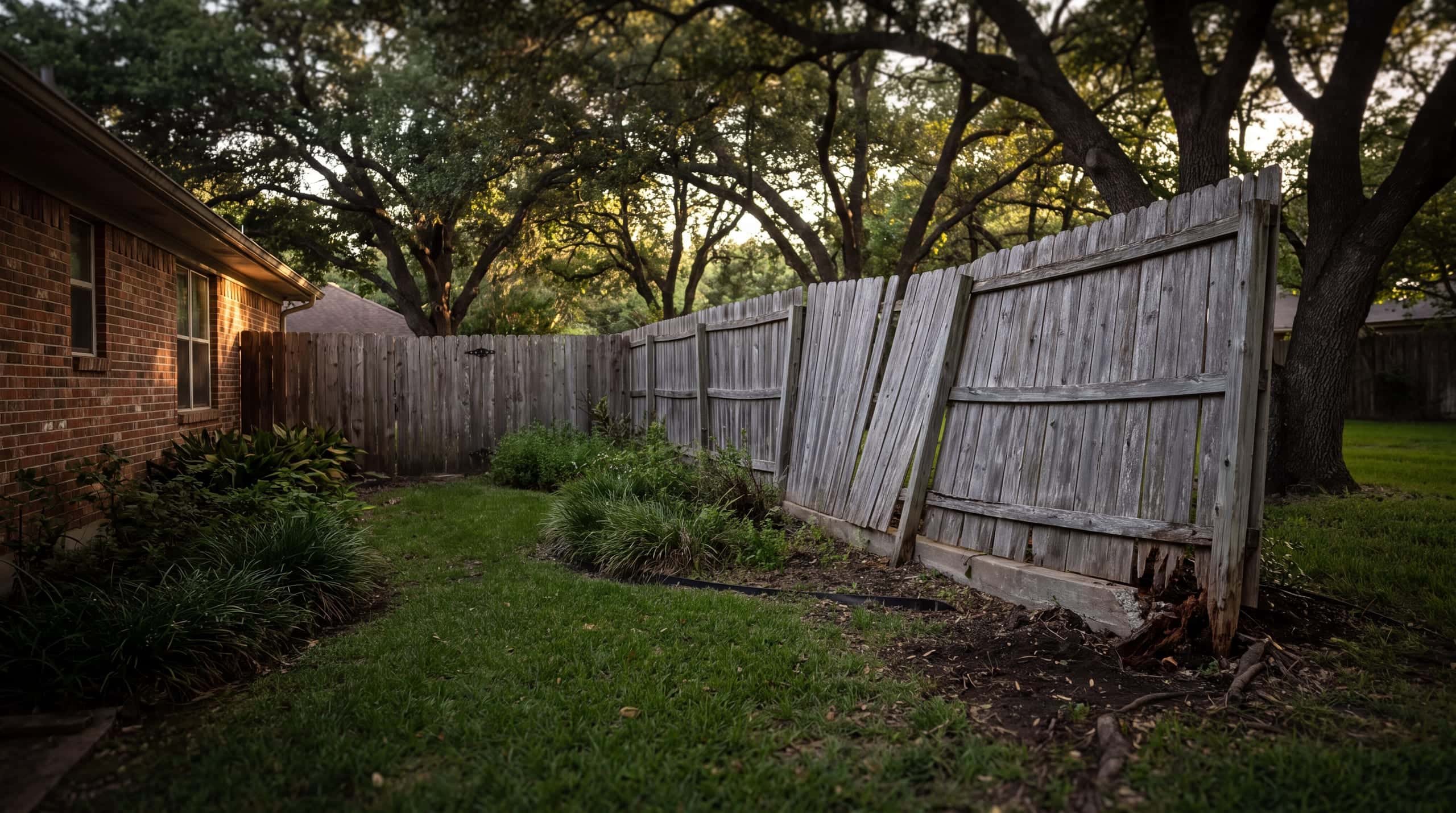
The clearest sign is in the posts: they are soft, rotting at the ground, or no longer firmly anchored. A post in that shape cannot hold a new board, and fresh boards on a rotted post cost you twice.
One bad post is a post problem. Several of them across the fence mean the fence itself is done. Count the soft or loose posts first, then count the sections they carry. If that count gets near the 30 to 40% mark, you are past patching.
How long does each fence material last in Fort Worth?
These are general estimates, and installation quality and maintenance make a difference. Fort Worth’s heat, intense sun, heavy rain, humidity and occasional hail can make wood fences deteriorate faster than homeowners expect.
The decay numbers back that up. The USDA Forest Products Laboratory’s 2009 decay hazard report puts Dallas at 44.3, in the moderate band of 35 to 65, against Houston at 77.2, deep in the high band above 65. The same agency’s 2021 Wood Handbook says serious decay starts only when wood stays above about 30% moisture, and that fully air-dried wood usually holds 20% or less. A fence that drains and dries lasts longer.
The species matters too. In a 1995 USDA Forest Products Laboratory test-fence study, the heartwood of western redcedar, redwood and Douglas-fir lasted over 20 years above ground. The sapwood of those same species failed markedly sooner, so decay resistance comes from heartwood, not sapwood.
Then there is the ground. FoundationRepairHQ (2026) lists the Ovan soil series, among the most-mapped around Fort Worth, at a high shrink-swell rating of 7.5%. Foundationsoils.com (2026) puts 45.7% of mapped Fort Worth city-limits land in USDA’s high shrink-swell class. Your posts stand in that clay.
When is the best time of year to replace a fence in Fort Worth?
September through November is a good time to schedule installation. December through February brings cooler weather and potentially better contractor availability.
March through August is often busier, particularly after spring storms. If your fence is already failing, book before that rush instead of waiting for the next storm to finish the job.
What does a new Fort Worth fence cost next to patching the old one?
Patching adds up fast. DFW Fence Experts lists a single wood post replacement at $150 to $350 and an 8-foot wood panel at $200 to $450. Storm damage on 1 to 3 sections runs $300 to $1,200 on its list for Dallas-Fort Worth.
North Texas repair prices from outside Fort Worth point the same way. TX Fence (2026) puts storm-damaged panel replacement in Allen at $300 to $700 per section, and says most of its Allen repair calls fall between $200 and $700. Cedar Park Fence & Deck (2026) says repair in the Cedar Park metro typically runs $150 to $1,500, depending on what is actually wrong.
Those are repair prices for a fence that is still standing, and they repeat every time another section goes. When you are spending more money patching an aging fence than replacing it, replacement is the cheaper move.
What does Fort Worth require before you replace a fence?
Fort Worth’s residential permitting page says building permits are required for solid fences above 7 feet and for open fences above 8 feet. It also says fences in the front yard can be no more than 4 feet tall and must be open, picket style, and that chain link is prohibited there.
The city’s Zoning Ordinance Section 5.305 sets the rest:
- No fence over 8 feet is allowed surrounding residential property behind the front building setback line.
- No solid fence or wall is permitted in the required front yard of a one- or two-family home.
- On a corner lot, no fence over 2 feet is permitted within the triangle formed 20 feet in each direction from the street-intersection corner.
- Height is measured from the highest adjacent grade to the highest point of the fence or gate.
The permitting page adds that a property in a historic district may require additional approval.