
Keep every part of the fence 2 feet tall or lower inside the 20-foot corner visibility triangle, measured 20 feet along each street-side property line from the corner, and start the taller fence outside it. Behind the front building setback, a Fort Worth residential fence can go to 8 feet.
Corner lots are where homeowners run into the other trouble too: a fence the city calls too tall at the corner, a quote that left out the picket grade, a crew that never came back. Get the lines right first, and the rest of the job gets simpler.
Measure 20 feet along both street lines to find your Fort Worth visibility triangle
Start at the point where your two street-side property lines meet, measure 20 feet along one line, then 20 feet along the other, and connect the two marks. The triangle those marks form is where Fort Worth allows no fence over 2 feet (City of Fort Worth, Zoning Ordinance Section 5.305).
The limit applies within and along that triangle, and the reason is plain: a fence there can block a driver’s view of approaching traffic. The city measures height from the highest adjacent grade to the highest point of the fence or gate. A gate counts as part of the fence, and so does a post cap on ground that rises.
Set stakes and string at the three corners of the triangle before anyone draws a fence layout, so every post location can be checked against it.
How tall can your fence be outside the triangle in Fort Worth?
In the required front yard, a Fort Worth fence can be no taller than 4 feet, in an open design with no more than 50% density. Behind the front building setback, a residential fence can reach 8 feet (City of Fort Worth, Zoning Ordinance Section 5.305).
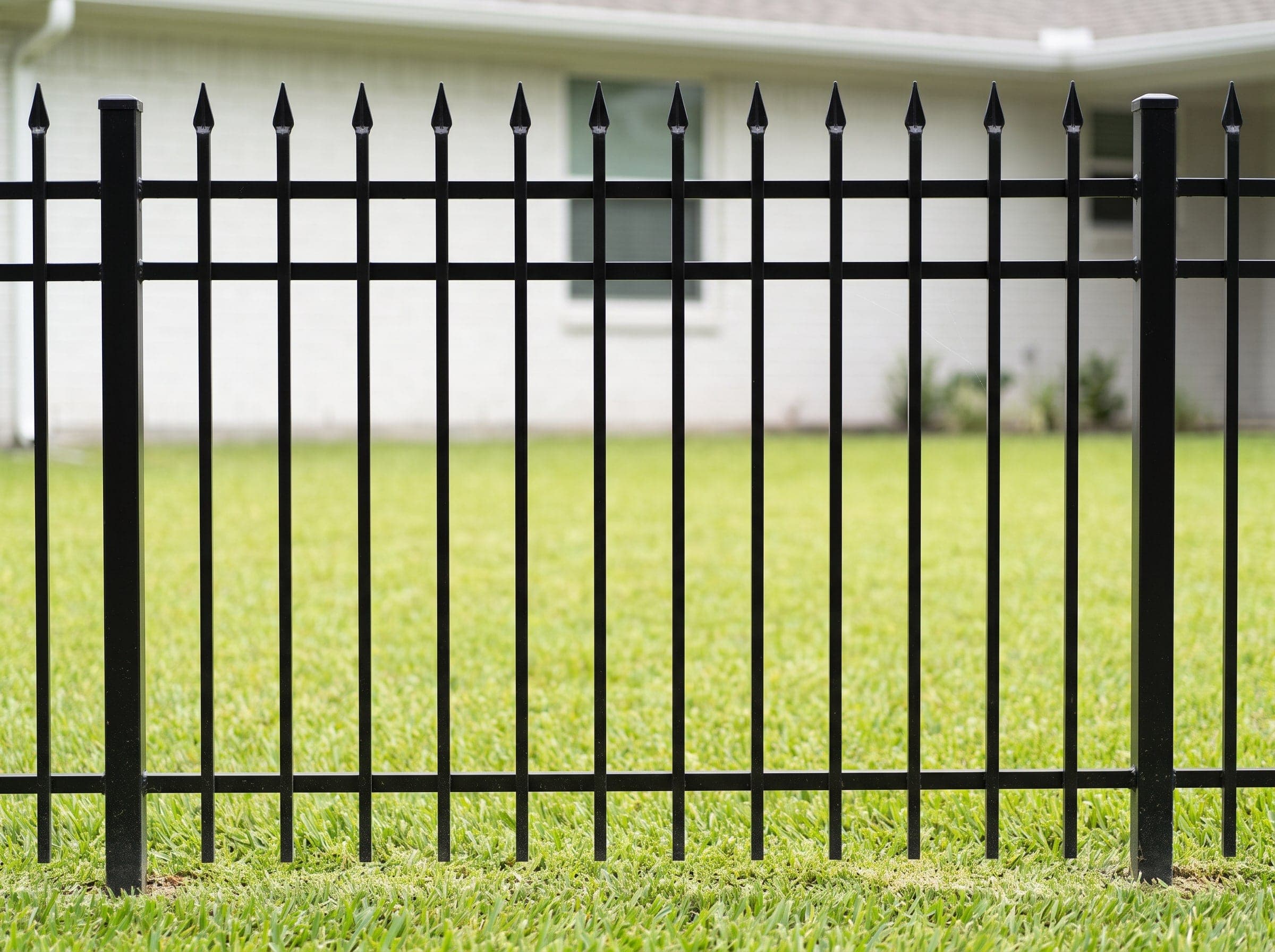
The open design has a definition. Wrought iron, tubular steel, picket or a similar material made for fencing qualifies, as long as it does not obscure visibility. Chain link is excluded, and the Development Services Residential Permitting page says the same: chain link is prohibited in the front yard and projected front yard (City of Fort Worth Development Services).
Solid fences are a separate matter. No solid fence or wall is permitted in the required front yard, projected front yard or platted front yard of a one- or two-family home. The board of adjustment can grant a special exception for a solid fence or wall no taller than 4 feet there, under the special exception requirements in Chapter 3, Article 3 of the ordinance (Fort Worth Code of Ordinances, Section 5.305).
Height also decides permits. Development Services says building permits are required for solid fences above 7 feet and for open fences above 8 feet. If your property sits in a historic district, the page says the fence may require additional approval.
What else sets how much sight room a Fort Worth corner needs?
The 20-foot fence limit is not the only visibility test on a corner. The city also uses engineering sight-distance criteria, which vary with street classification, speed limit, stop signs or signals and roadway geometry, so a busier street can ask for more clear room.
For a homeowner, that means a fence that meets the 2-foot rule can still sit on a corner where the city wants more open space. A lot at a signalized intersection or on a curving road is a different case from a lot at a quiet four-way crossing, even though the 20-foot triangle measures the same on paper.
Before you set posts, tell Development Services which two streets meet at your corner and ask whether anything beyond the 20-foot triangle applies to them. A fence moved after it is built costs you the work twice.
What to confirm with Fort Worth Development Services before you build
Ask Development Services whether your fence needs a permit and whether your lot sits in a historic district. The city’s Residential Permitting page says building permits are required for solid fences above 7 feet and for open fences above 8 feet, and that fences in a historic district may require additional approval (City of Fort Worth Development Services).
Bring four questions. Which lines are your street-side property lines? Where is your front building setback line? Does any sight-distance requirement reach beyond the 20-foot triangle on your corner? And is replacing an existing fence treated any differently from building a new one? The city’s page gives no separate rule for replacement, so get the answer for your address before the quote is signed.
On our jobs, we handle permit determination and filing where a project needs one. You do not have to read the permit rules yourself to start, but you should still know the triangle, because it decides where each section of fence goes.
Where does your 6-foot privacy fence start on a Fort Worth corner lot?
Your 6-foot privacy fence starts outside the 20-foot triangle and behind the front building setback line. Fort Worth allows no solid fence or wall in the required front yard of a one- or two-family home, and behind that setback line a residential fence can reach 8 feet (City of Fort Worth, Zoning Ordinance Section 5.305).
On a corner lot, that gives the fence two zones. Near the street, the city’s rule is a low open fence of 4 feet or less, and inside the triangle it drops to 2 feet. Past the setback line, a solid 6-foot privacy section is inside the 8-foot limit. The line where the privacy fence begins is a point you mark on the ground, and it should appear on the quote.
The privacy section is where picket grade matters. The framing on our fences is pressure-treated and the pickets are cedar. Each job’s pickets are graded from #1 through #3 and priced by grade, and the grade is named in writing on the quote, so you can compare one bid against another on the same footing.
What should a Fort Worth corner-lot fence quote say before you sign?
A corner-lot quote should name the footage, the height of each section, the picket grade, the gates and the point where the taller fence starts. Pricing is per linear foot, set by the footage measured on site and the picket grade chosen, so a quote that skips either one cannot be checked.
Other Texas fence companies’ own reviews show what goes wrong when a quote or a job stays vague. A 2-star Google review of Texas Fence from May 19, 2026 reads: “our gates have continued to fall apart. Even the ones we don’t use. They have come to repair them twice already and need to come a third and we’ve only had the fence for a couple of months. They haven’t given us an answer as to why this is happening.” Gates are part of the fence height measurement on a corner, so each one belongs on the quote with its height and position.
Ask each contractor for the triangle, the setback line and the picket grade in writing. A contractor who cannot put them on paper has not measured your corner.
For our fences, the on-site visit covers the linear footage, the fence type and the picket grade. We price every project by custom quote after the free on-site estimate and have no fixed published price list. Cost depends on fence type, materials, length, gates and site conditions, and each of those has a line on the quote.