
Replace a Texas fence from fall through winter, September to February, when cooler weather is easier on crews and new wood and the spring rush has not started. Johnson Fence’s more than 100 crews mean a start date holds in any season.
Most Texas homeowners have already seen the other side: a fence that failed too soon, a quote that left out the picket grade, a crew that never came back. The month matters, but the date your contractor can actually keep matters more.
Fall and winter are the best time to replace a fence in Texas
In Dallas-Fort Worth the normal high is 56.5°F in January and 95.8°F in August (NOAA, 1991 to 2020). Crews set posts in the cool months without fighting that heat, and new wood goes in before the spring rush builds a queue.
The queue is real. DFW fence contractors commonly have installation queues of three to six weeks from quote acceptance to installation day in peak spring (DFW Pressure Washing & Fence Staining LLC, 2025). Top Rail Fences (2026) lists a winter wait of 1 to 2 weeks for Fort Worth and DFW projects.
Plan for the digging, too. Texas Utilities Code Chapter 251 counts powered digging to a depth of 16 inches or more as excavation. The notice goes to the notification center no earlier than 14 days and no later than 48 hours before digging begins, weekends and holidays excluded.
What does Texas summer heat do to a new wood fence?
Summer heat dries new boards too fast and slows the crew’s day. Austin’s normal August high is 97.8°F (MonthSky, 2026), and OSU Extension (2024) says lumber in direct sun can dry faster than lumber inside the stack.
Uncontrolled drying causes surface and end checks, and those occur during the first drying period, when wood is wettest (OSU Extension, 2024). Dallas reaches a 97.1°F normal high in August. Houston reaches 94.9°F.
The crew feels it as well. OSHA’s 2026 heat guidance lists scheduling work for the morning and shorter shifts with frequent rest breaks in the shade as ways to keep workers’ body temperatures down. A summer fence crew works under that constraint every day.
Does the best month to replace a fence change between Houston and Dallas?
Yes, because Houston’s wood faces more rot than Dallas’s. The USDA Forest Products Laboratory’s decay index (2009) puts Houston at 77.2, in the high-hazard band above 65.
Dallas scores 44.3, San Antonio 52.2 and Austin 55.2, all in the moderate band of 35 to 65 (USDA Forest Products Laboratory, 2009). The soil adds to it. The USDA Natural Resources Conservation Service (2023) classifies Houston Black, the Texas state soil, as a smectite clay with very high shrink-swell, and coastal Houston clay behaves the same way.
Rain follows the same split. A typical January brings 3.4 inches to Houston, 2.0 to Dallas and 1.7 to Austin (Weather Spark). A winter install in Dallas or Austin meets less rain at the post hole, and a Houston install needs a dry stretch picked on purpose. The NRCS Texas fence specification (2021) says all posts are buried no less than three feet deep.
How do you hold a fence start date during the Texas spring rush?
Ask every contractor how many crews it fields, because a company with one crew has no spare when rain or a busy season hits. Johnson Fence fields over 100 crews, so a crew missing a day never stops a job and the start date holds when spring fills up.
Johnson has 25 to 30 crews in Houston alone. From 2002 to 2019 Johnson was the top choice for regional and national homebuilders in Houston, and the backyard fence is the last trade on site before a home can close. That work was run more like logistics management than a typical fence contract, and the same discipline now serves one backyard at a time.
A 2-star Google review of a fence company from March 25, 2026 reads: “Slow turnaround, uncompetitive pricing, lack of follow-through on follow-ups and revisions”. The spring queues in the first section show how that happens.
What does it cost to replace a wood fence in Texas?
A six-foot wood fence in Texas costs $18 to $45 per linear foot installed, as measured by HomeGuide, Angi and HomeAdvisor (2026). Season moves that number, and Johnson Fence prices every project by custom quote after a free on-site estimate.
In Houston, Angi’s 2026 guide puts wood fence installation at $8.50 to $25.50 per linear foot. Angi’s 2026 guide also puts a winter or late-fall booking discount at 10% to 25%, as long as the climate allows. HomeStars (2026) reports 5 to 10% lower quotes in late summer or fall than in spring, and FenceCalc (2026) puts winter pricing 10% to 20% below the annual average when a contractor is working.
Johnson has no fixed published price list, because cost depends on fence type, materials, length, gates and site conditions. We quote the picket grade, #1 to #3, by name. Master Halco named us its 2026 Largest Volume Customer for Southwest Region and for the World, and that wood-picket buying power goes to the buyer, so you pay less for the same spec, not less for a thinner one.
Chris B. wrote in an August 2026 Google review: “They were great to work with from start to finish. Their team was professional, friendly, and efficient throughout the entire process. Their pricing beat every other quote we received.”
When should you replace a Texas fence now instead of waiting for fall?
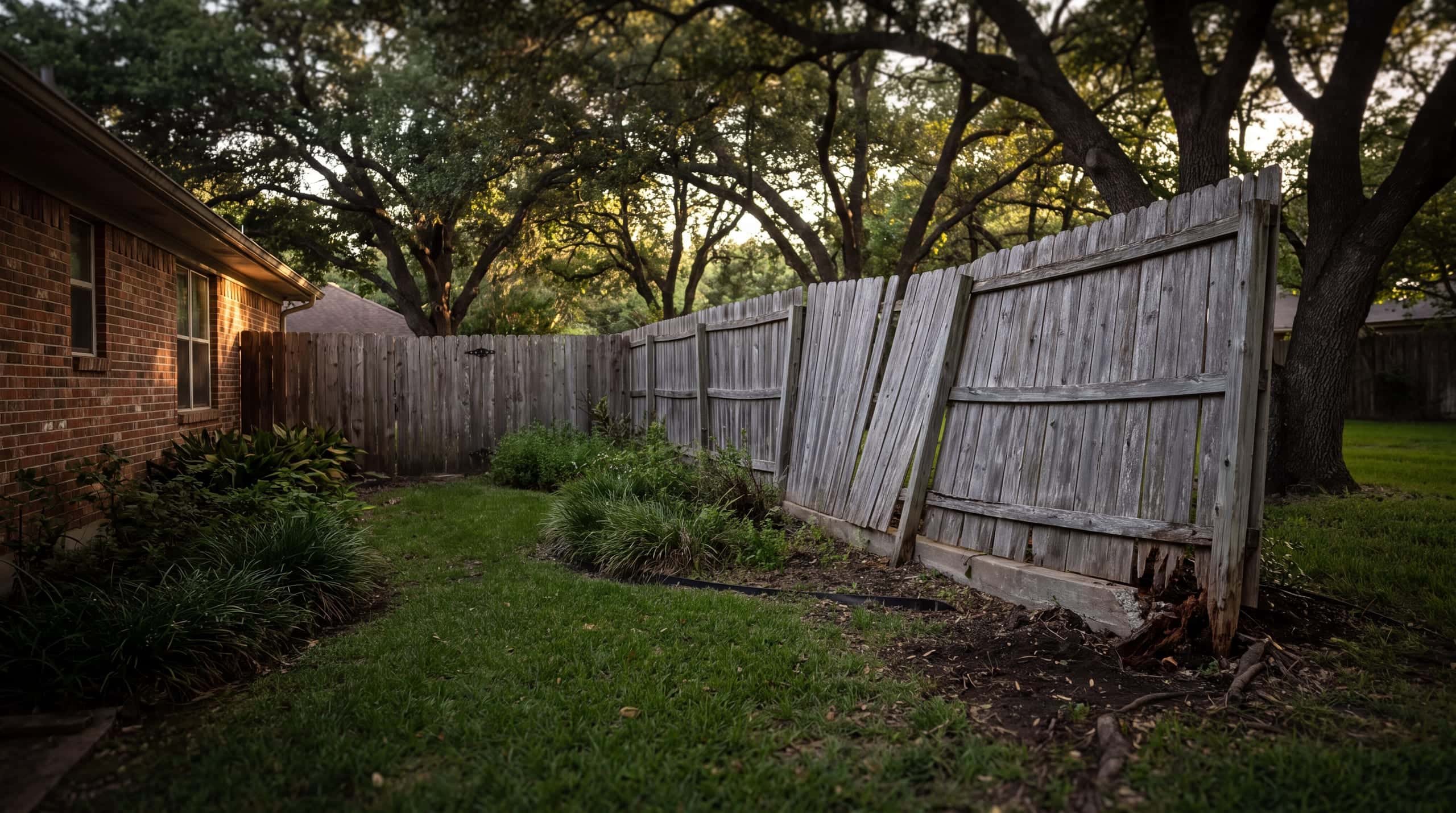
Replace now when the posts have gone.
T.A.P. (2024) says posts usually fail first, from rot at the ground line or heaving in clay soil, and new boards on a rotted post buy you nothing. Widespread gray, cracked or rotting boards, posts you can wiggle and sections leaning after storms mean the fence is aging out (T.A.P., 2024).
Age and weather add urgency. Pressure-treated pine lasts 10 to 15 years with maintenance and western red cedar 15 to 20 years with regular staining (TX Fence & Deck, 2026). Central Texas severe thunderstorms with hail run from March through June, and older dried-out wood fences are especially prone to cracking in hail (Purple Fencing Company, 2026).