
No single Texas law requires a fence around every private home pool, but Texas Local Government Code §214.101 lets cities set minimum pool-fence rules, so your city’s code decides. State rules do require an enclosure at public pools and a barrier at child-care facilities.
That leaves the homeowner with a rule that changes by address and a fence that still has to be built right. Most people reading this have already seen a fence fail too soon, a quote that left out the picket grade, or a crew that never came back.
Texas has no one pool fence law for homes, so your city decides
The city or town where the pool sits writes the minimum for a private pool through its building and swimming pool codes. Two homeowners with the same pool can face different rules, because Texas does not impose one statewide fence requirement that applies identically to every home.
Cities can require pool fences through local ordinances, and that is where a private pool is governed. If your pool is in Houston, the rule sits in Houston’s Code of Ordinances. If it is in a smaller town, the rule sits in that town’s code, and the town on your mailing address may not be the town that governs your lot.
So the first step is to find the code for the city your lot answers to, before you buy a single post. A fence built to one city’s minimum can fall short a few miles away. Price a pool fence only after you know which code applies, because height, gate hardware and openings all trace back to it.
Which Texas pools must have a fence under state rules?
Public swimming pools must have an enclosure around the pool area under state regulations, and child-care facilities must have a barrier. A pool at a private home sits outside both groups.
That split matters for how you read what you find online. A rule about enclosing a public pool, or about barriers at a child-care facility, speaks to those places and does not set the rule for your backyard. Your pool’s rule comes from your city.
If you are adding a pool, ask your city’s building office what it requires for a private pool before the fence is designed. The answer then goes on the quote.
When does a backyard fence count as the pool barrier in Texas?
Only your city’s pool code can say whether an existing backyard fence counts as the barrier or whether a separate enclosure is required. The answer is local, so it can differ from one Texas city to the next.
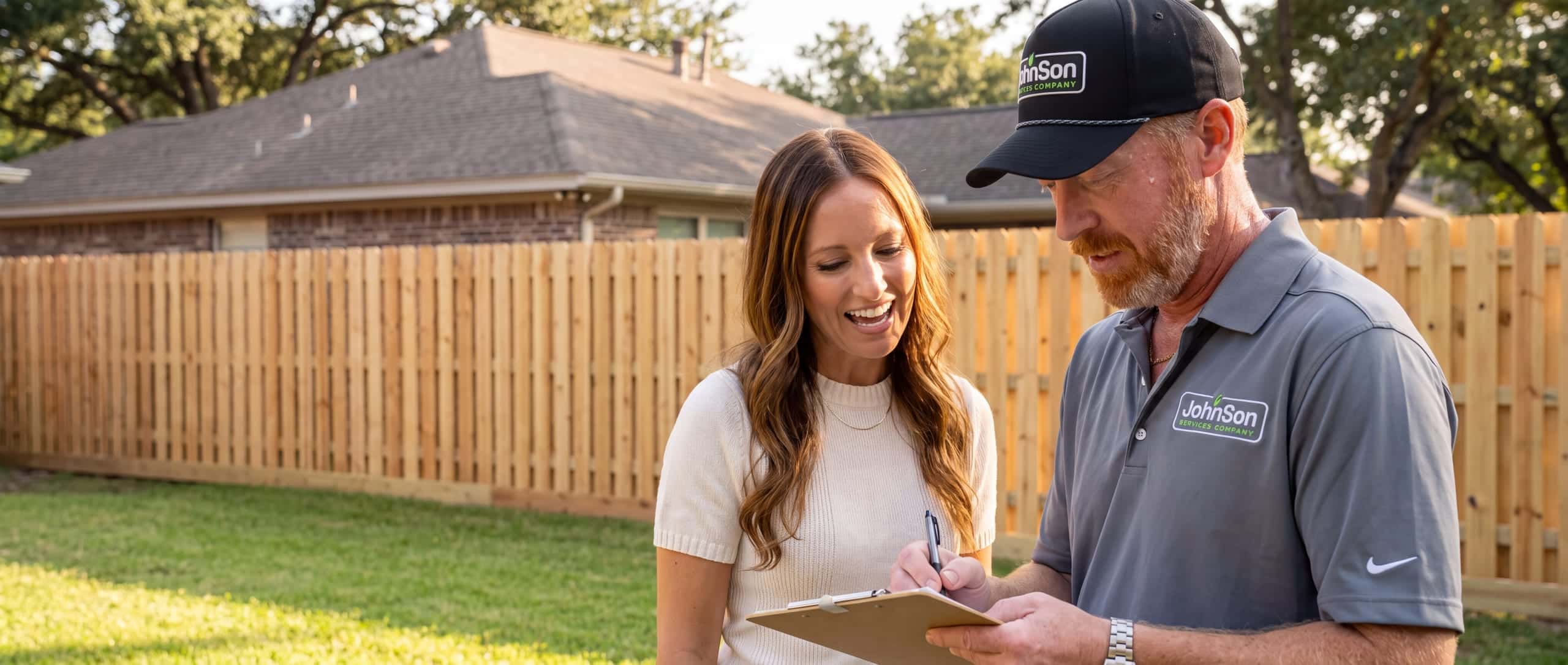
What we can tell you is what the fence in your yard is made of and where it stands. On site, our salesperson measures the linear footage and confirms the fence type and picket grade. We measure your fence line before we price it, and the quote is the price you pay. A figure given over the phone from the address is only ever called a rough estimate, never the quote.
That matters when the old fence is a candidate for the barrier. You want the real footage and the real condition in front of you before you decide to keep it or replace it. We build fences with pressure-treated framing and cedar pickets.
On cost, the market range for wood fence, pine to cedar, is $18 to $45 a foot, measured by HomeGuide, Angi and HomeAdvisor. Where you land in that range depends on the grade of picket and the footage, which is why the measuring comes first.
What gate and gap rules does a Texas pool fence have to meet?
Gate and gap rules come from your city’s code, and Houston’s shows what they look like. Houston’s Code of Ordinances, Chapter 43, Pool and Spa Safety, says: “Include self-closing and self-latching devices on the upper quarter of all gates and doors opening directly into the enclosure, so that the doors or gates remain securely closed at all times when not in actual use, except that the door of any residential dwelling that forms any part of the enclosure need not be so equipped.”
The same city’s materials on the 2021 Swimming Pool and Spa Code add a limit on openings. Where a latch release is on the inside of a barrier, openings in the door, gate and barrier within 18 inches of the latch cannot be greater than 1/2 inch in any dimension (Houston Construction Code Modernization, 2021).
Those two rules tell you what to ask a builder. The gate needs hardware that closes and latches by itself, and the area around the latch release needs tight openings. Your own city may word its rule differently, so read its code before you sign.
On our side, we quote the picket grade, #1 to #3, by name. Wood is graded from #1 picket through #3 picket and priced accordingly, so a quote with no grade on it leaves out the part that sets the price. Our salesperson confirms fence type and picket grade on site.