
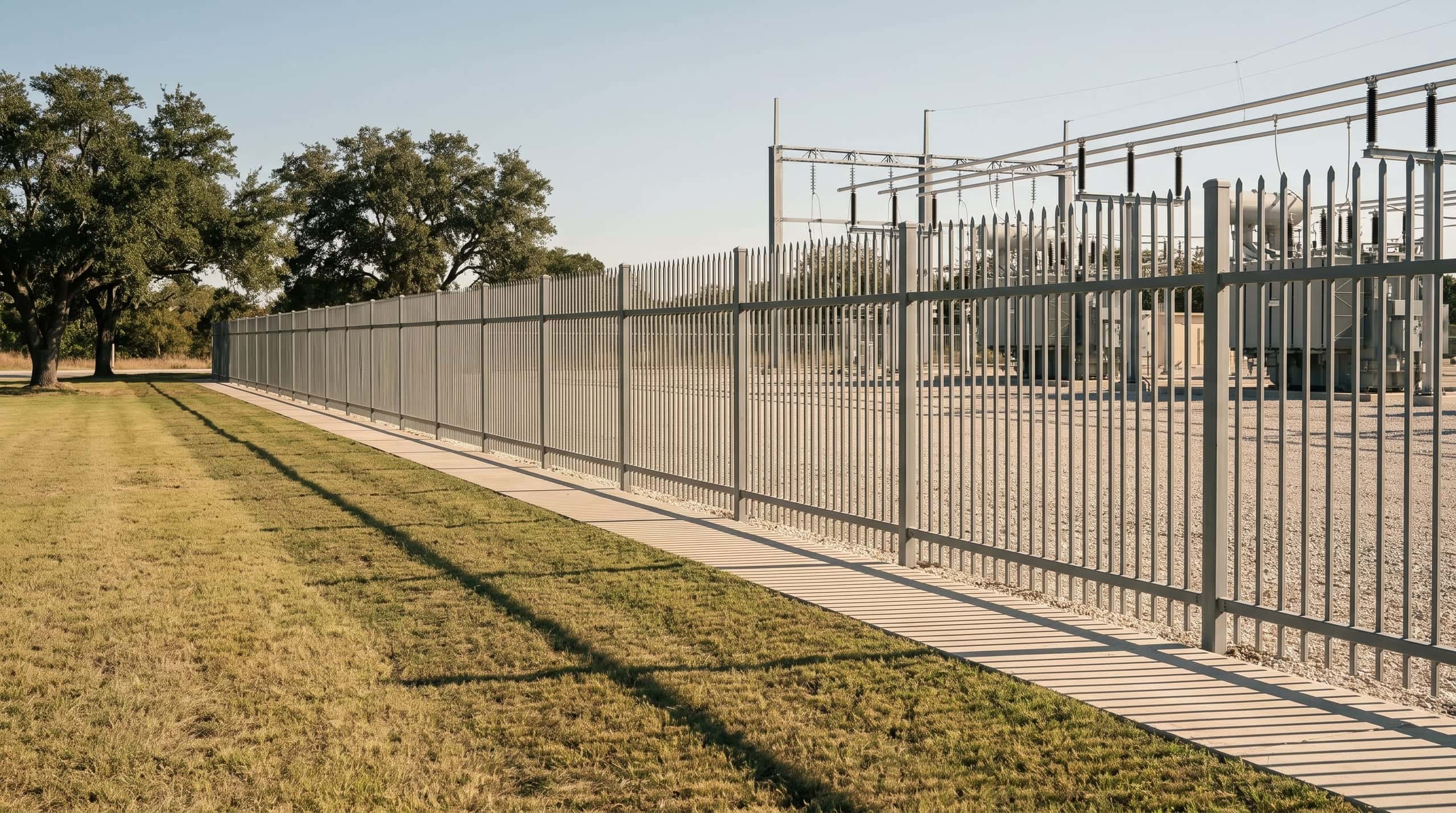
Most commercial fence conversations in San Antonio start with a number. How tall can we go, and does it need a permit. That number is real, and it is the cheapest part of the spec to get right.
The expensive part is everything a height limit never tests. A fence can clear Section 35-514, pass inspection, and still come down in a windstorm or leave you holding a gate entrapment claim.
San Antonio Permits a Commercial Fence on Height Alone
San Antonio requires a building permit for any new fence inside city limits, with limited exemptions, and sets height by use and yard (San Antonio Unified Development Code, Section 35-514, 2025). That is what plan review checks. It confirms where the fence sits and how tall it is.
It does not confirm that your posts are sized for the wind that will hit them. It does not confirm that the gate at the front entrance has the protection the national standards require. Those are separate tests, run by different documents, and no inspector’s approval on the height line covers either one.
So get your district’s number from Development Services early, then stop treating it as the spec. It is one line in a stack you still have to clear.
Learn These Five Terms Before You Read a Commercial Fence Spec
The vocabulary changes depending on which document you are reading, and the same fence can be described three ways in one submittal package. Here is the short list a general contractor or property manager needs to follow a bid.
| Term | What it means on your job | Where it comes from |
|---|---|---|
| Solid screen fence | A fence face that is mostly closed, with openings under 30% of the area | ASCE 7-22 wind provisions |
| Predominantly open fence | A fence you can largely see through, such as chain link or pickets | San Antonio UDC 35-514 |
| Engineer certification | A licensed engineer’s signed wind-load design for the fence | San Antonio UDC 35-514 |
| Embedment | How deep the post sits below grade, sized as a cantilever in soil | International Building Code |
| Entrapment zone | Any place a moving gate can trap a person or a limb | ANSI/UL 325 |
| Usage class | The four classes that sort an automated gate by site type | ASTM F2200 |
Read a bid with these in hand and the gaps show up fast. A quote that names a height and a material, and none of the six, is a price for boards and labor.
Over 8 Feet, the Code Wants an Engineer to Sign the Wind Design
San Antonio requires engineer certification of the wind-load design for a solid screen fence over 8 feet (San Antonio Unified Development Code, Section 35-514, 2025). Read that requirement closely, because the city is telling you something about the other side of the height limit. Above a certain face area, the city will not accept height compliance as proof the fence stands up.
A certified design is not a formality, and it produces numbers your crew builds to:
- The design wind speed and exposure category for that specific address, which drives every other figure on the sheet.
- Panel and post sizes with a spacing, because a longer span between posts loads each post harder.
- Footing size and reinforcement, which is where most of the resistance actually comes from.
The masonry industry’s prescriptive standard shows what that output looks like. It sizes cantilevered fence walls against lateral-load tiers of 15, 20, and 25 psf, and an 8-foot fence in the 20 psf tier needs No. 4 vertical bars at 16 to 24 inches on center over a 12-by-42-inch footing (NCMA/CMHA TEK 14-16B, 2007). Nothing about that spec is visible from the height number.
San Antonio Has Reviewed Plans Against the 2024 Codes Since May 2025
City Council adopted the 2024 editions of the International Building Code and the other ICC codes on January 30, 2025, effective May 1, 2025, superseding the 2021 edition that had governed since February 2023 (City of San Antonio, Ordinance No. 2025-01-30-0075, 2025). A drawing set built on the older references gets corrected in review, and corrections cost you calendar days you already budgeted for install.
For a fence and gate package, the edition matters in one specific place. The building code is what points your design at the wind provisions, and the wind provisions are what decide post size and footing depth. Confirm the edition your engineer worked from before the package goes in.
A Solid Screen Fence Loads Like a Wall in Texas Wind
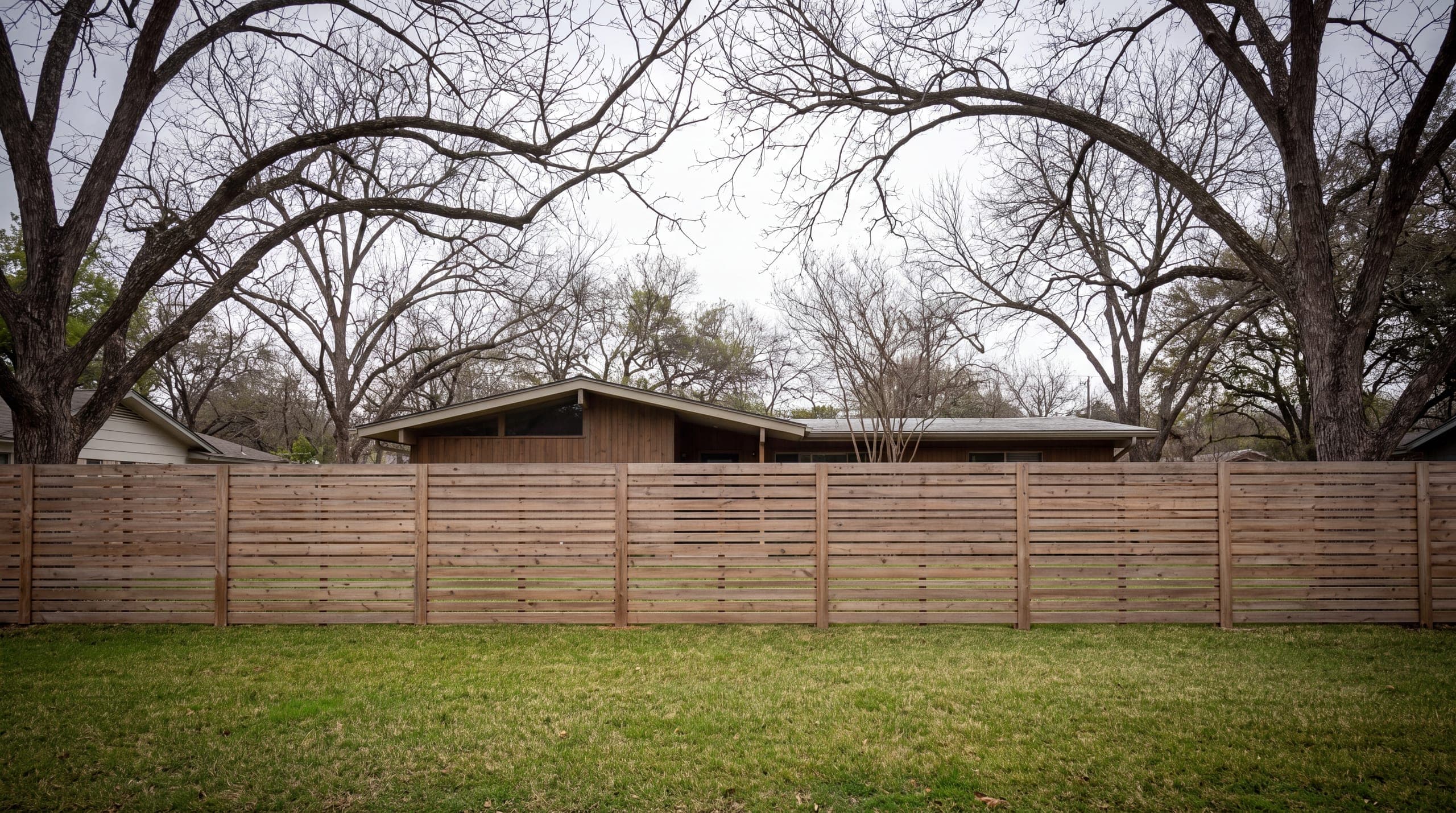
Wind engineers do not treat a solid privacy fence as a fence. They treat it as a solid freestanding wall, with the design force applied across the full solid face and a net force coefficient that climbs as the wall grows longer relative to its height, checked under several cases including an eccentric end-zone case (ASCE/SEI 7-22, 2022). Your 8-foot screen is a sail bolted to the ground.
That is why the corners, the end panels, and the tall posts flanking a gate opening are the parts that go down first. It is also why the choice of face matters more than the choice of wood species on a windy site.
| Fence type | How it takes wind | Security role on a commercial site | What the spec has to name |
|---|---|---|---|
| Solid wood or composite screen | The full face loads like a wall | Blocks sight lines into the yard | An engineer’s certification above 8 feet |
| Chain link | The open weave passes most of the wind through | Defines the line and delays entry | The zinc coating class of the fabric |
| Ornamental steel | Pickets let air through the face | Hard to climb, easy to observe through | Post size and embedment for the wind load |
| Masonry or concrete | Engineered as a freestanding wall | Highest mass and highest deterrence | Vertical reinforcement and footing size |
Caliche and Clay Decide How Deep a San Antonio Post Goes
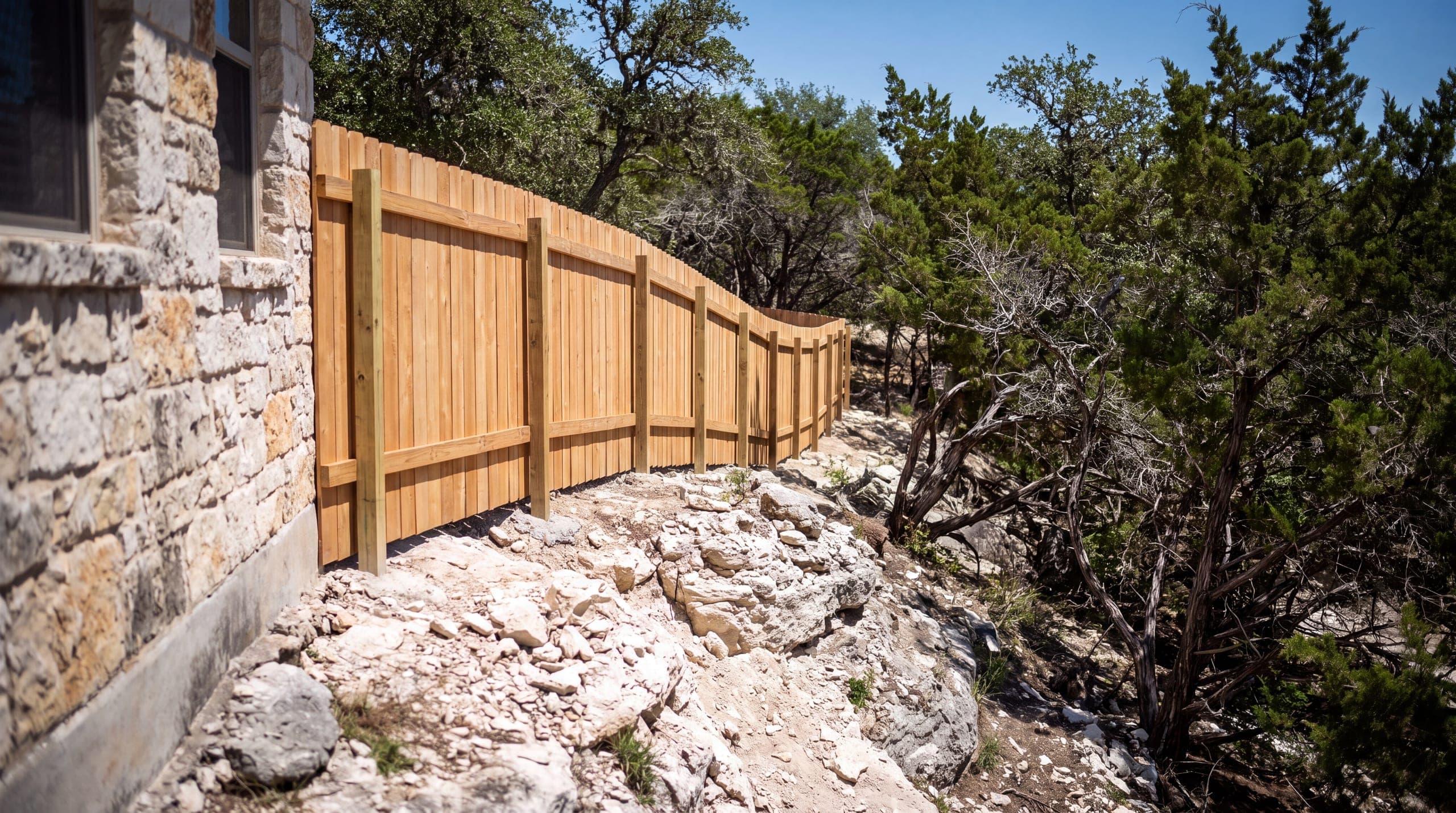
The building code sizes a fence post as a cantilevered pole in soil, and the required embedment grows with the wind force and its lever arm while shrinking as the soil gets stronger (International Building Code, 2021). Soft ground and a tall solid face together drive a deep, wide concrete footing. That is arithmetic, and it does not care what the fence permit says.
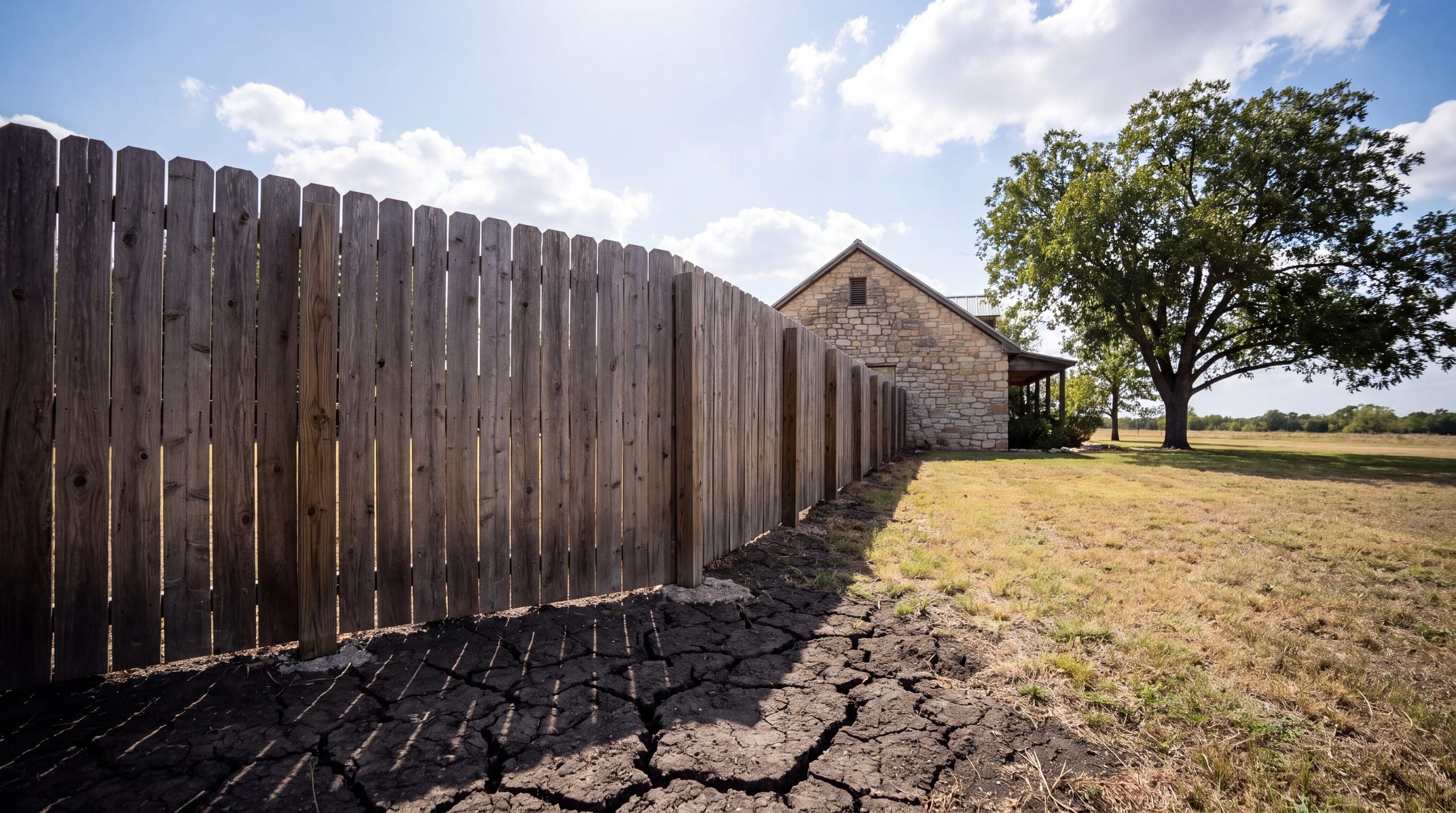
San Antonio soil makes this local. In one Texas soil series, the depth to the cemented caliche horizon runs 10 to 20 inches, and that whole range can show up within 25 horizontal feet (USDA NRCS National Cooperative Soil Survey). One hole hits rock at a foot. The next one digs soft for four feet.
A crew running a fixed depth down the whole line will be too shallow somewhere. Ask any bidder how they handle the holes that do not match the others, and whether their price changes when the auger stops early.
But an Automated Gate Needs Two Different Entrapment Protections
Every entrapment zone on an automated gate has to be protected by at least two independent, different-type means in each direction of travel, an inherent reversing system plus an external non-contact photo eye or a contact edge, and since August 1, 2018 those external sensors must be monitored so the operator drops to constant-pressure or manual operation on any fault, wiring break, or lost signal (DASMA Technical Data Sheet #353, 2018). Monitored is the word that catches people out.
A sensor that quietly stops reporting is a compliance failure the day it stops, and nobody sees it until someone gets hurt. This is where the security spec and the liability spec are the same document. It is also where a consumer-grade operator bolted onto a commercial entrance becomes the most expensive line item on the property.