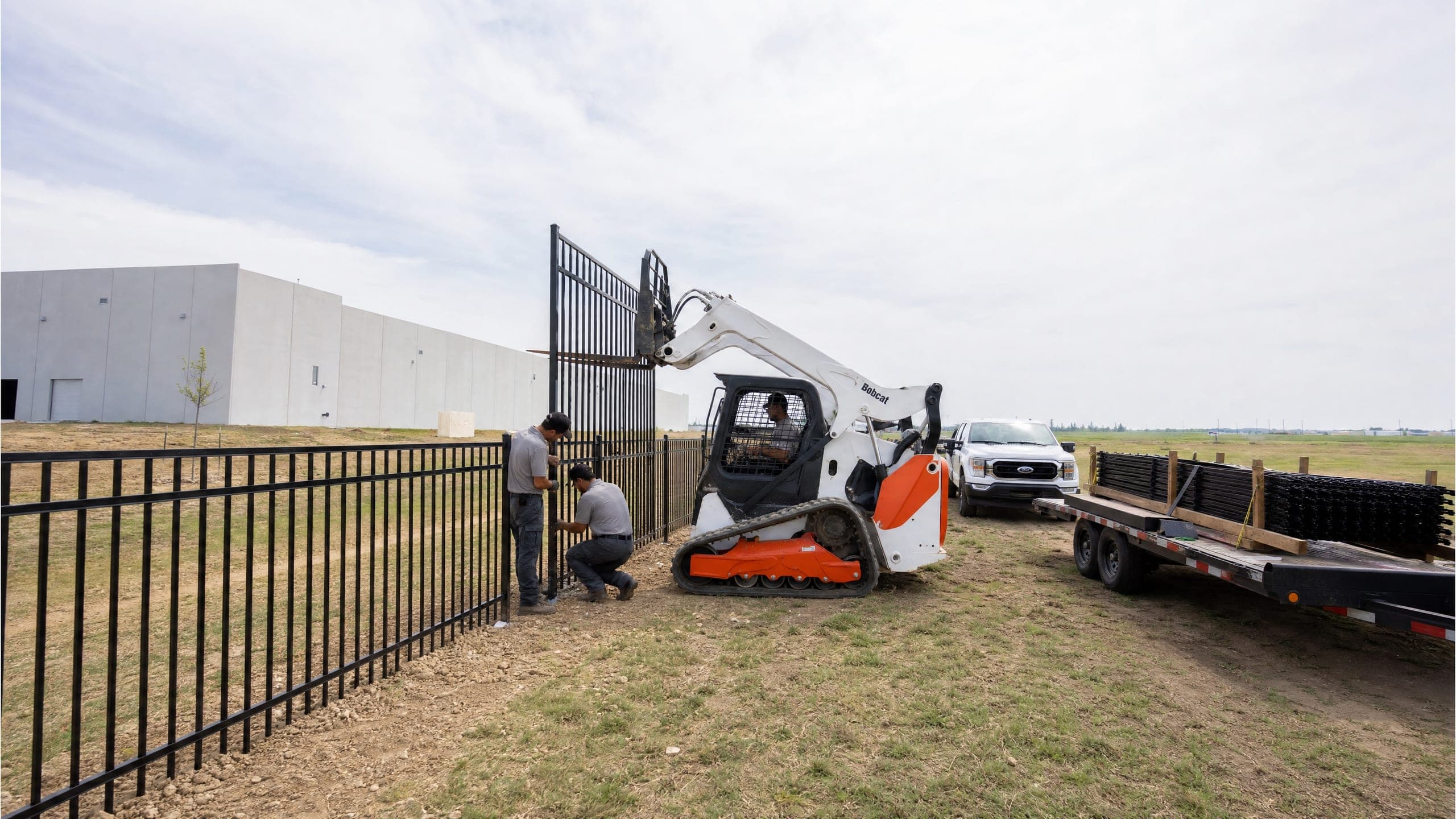

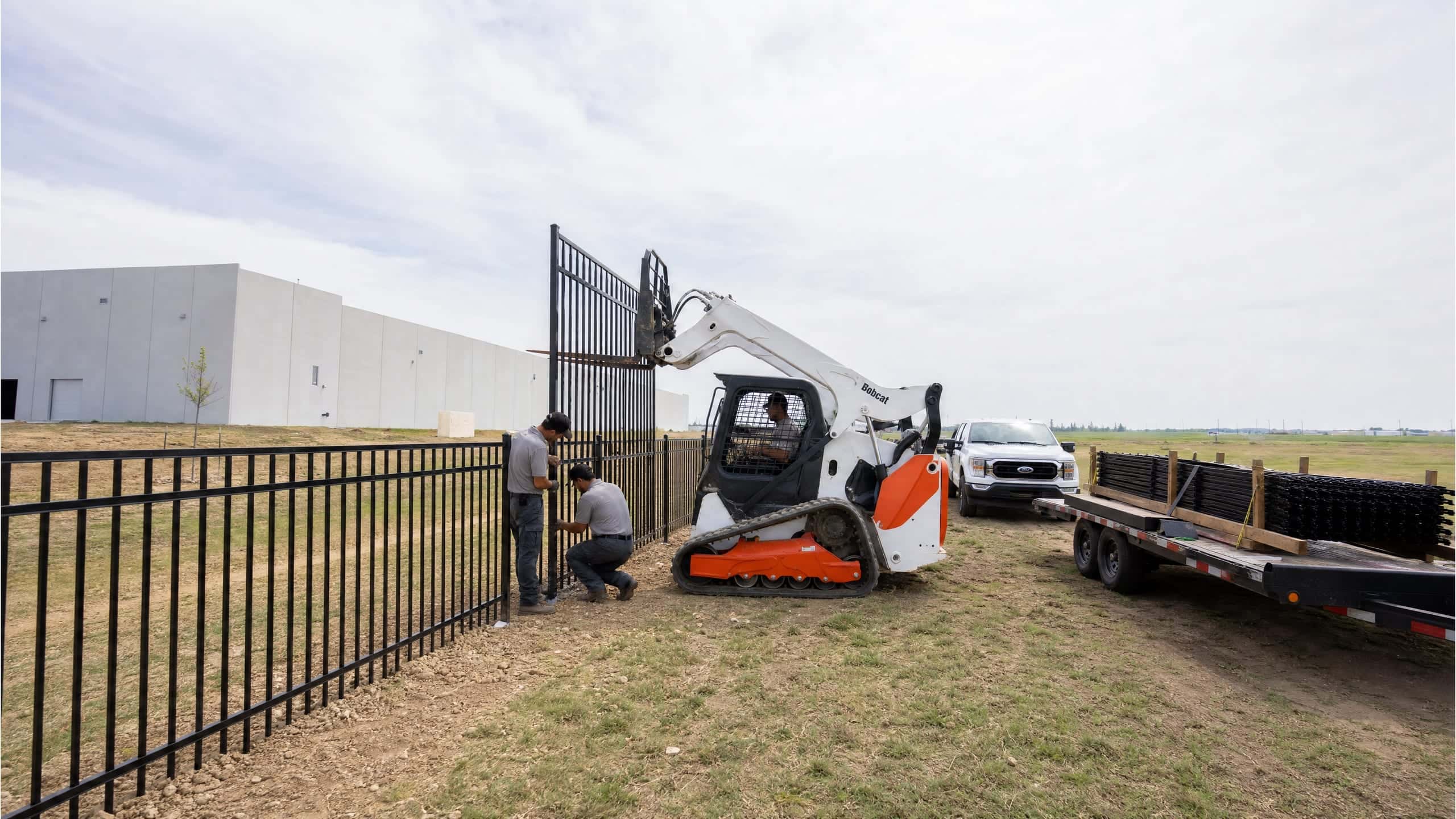
The best security fence for a Texas industrial site is commercial-grade chain link with 6-gauge wire and Class 2 fabric for a long perimeter, or anti-climb welded mesh where intrusion is the real threat, set on posts and footings sized for that site’s wind and clay. Automatic gates have to meet UL 325 on top of that.
A quote that opens with a price per foot has skipped the questions an industrial site actually asks. Wind pushes on the whole face of a near-solid barrier, Texas clay works the posts loose from underneath, and every automatic gate has to meet UL 325 before it is legal to run. At 8 feet and up you are buying a structure, and the spec behind it decides whether the perimeter stands for 20 years or comes down in the first gulf windstorm.
What Does a Commercial Security Fence Cost Per Foot?
Chain link installs at about $12 to $28 per linear foot and ornamental steel or wrought iron at $45 to $90 (HomeGuide and Angi, 2026), with commercial-grade fabric, taller heights and anti-climb mesh above those ranges. A per-foot range tells you what the fabric costs and nothing about the ground it stands in, and it only holds if the posts, footings, and gate hardware behind it were sized for the wind and soil at your address. Two bids at the same price can buy very different fences.
What a per-foot range does not include is embedment depth, post spacing, concrete volume, gate operator class, or the entrapment sensors the code requires.
We buy fence material at volume, and Master Halco named us its Largest Volume Customer for 2026 in both the Southwest Region and the world. That buying power shows up in what a customer pays for a given spec. It never shows up as a thinner spec.
What Should an Industrial Fence Spec Name?
Four of the five terms below decide the price of an industrial fence, and most bids leave all of them out. A buyer who asks for embedment depth, coating class, and operator duty cycle by name gets a comparable set of quotes. A buyer who asks only for a price per foot gets five numbers that measure five different fences.
| Term | What it means | Why it changes the quote |
|---|---|---|
| Solid barrier | A fence whose openings are under 30% of its gross face area | Wind loads the full face, so posts and footings grow |
| Embedment | How deep the post sits in the ground, in concrete | Set by wind force, post height, and soil strength |
| Coating class | The weight of zinc or the coating stack on steel | Heavier coating class outlasts lighter on the same fabric |
| Entrapment protection | The sensors that stop and reverse a powered gate | Two independent, different-type means are required per direction |
| Duty cycle | Gate cycles an operator is rated for per day or hour | An undersized operator on a busy gate wears out early |
How Much Wind Does an 8-Foot Security Fence Catch?
Nearly all of it, on a near-solid face. A near-solid barrier catches close to the full free-stream wind. Boundary-layer wind-tunnel tests on freestanding walls found a normal-force coefficient of about 1.45, nearly independent of wall length across aspect ratios from 0.5 to 5 (Letchford, 2001). A tall anti-climb panel does not shed wind. It collects it and hands the whole load to the posts.
That is why the code treats these fences as walls. ASCE 7-22 designs a solid freestanding wall for a force spread over the entire solid area, with a coefficient that climbs as the wall runs longer relative to its height, and it counts a fence as solid once openings drop under 30% of the face (ASCE/SEI 7-22, 2022). Houston-area sites carry basic design wind speeds on the order of 130 to 140 mph, rising toward 150 mph at the shoreline.
Pressure is not even along the run, either. It peaks near free ends and leading edges. On a finished site that shows up in a predictable order: end panels first, then corners, then the tall posts flanking the gate.
How Deep Should Industrial Fence Posts Go in Texas?
As deep as the wind load and the soil require, so post depth is calculated for each site, with soil as one of its inputs. The 2021 International Building Code sizes a nonconstrained embedded post as a cantilever, with required depth growing as the wind force and its lever arm grow, and shrinking as the soil gets stronger (2021 International Building Code, 2021). The code also lets the soil resist over only about one-third of the embedded depth, which is what drives deep, wide footings on a tall gate post.
Then there is the dirt itself. The Houston Black series, the official Texas state soil, covers roughly 1.5 million acres of Blackland Prairie from Dallas down to San Antonio, runs about 60% to 80% clay, and carries very high shrink-swell potential (USDA NRCS, 2023). It swells wet and pulls back dry, season after season.
A post set at residential depth in that soil starts to work loose long before the fabric fails. Deeper holes and more concrete cost money on install day. They cost far less than a leaning switchyard perimeter in year four.
Which Commercial Fence Type Is Most Secure?
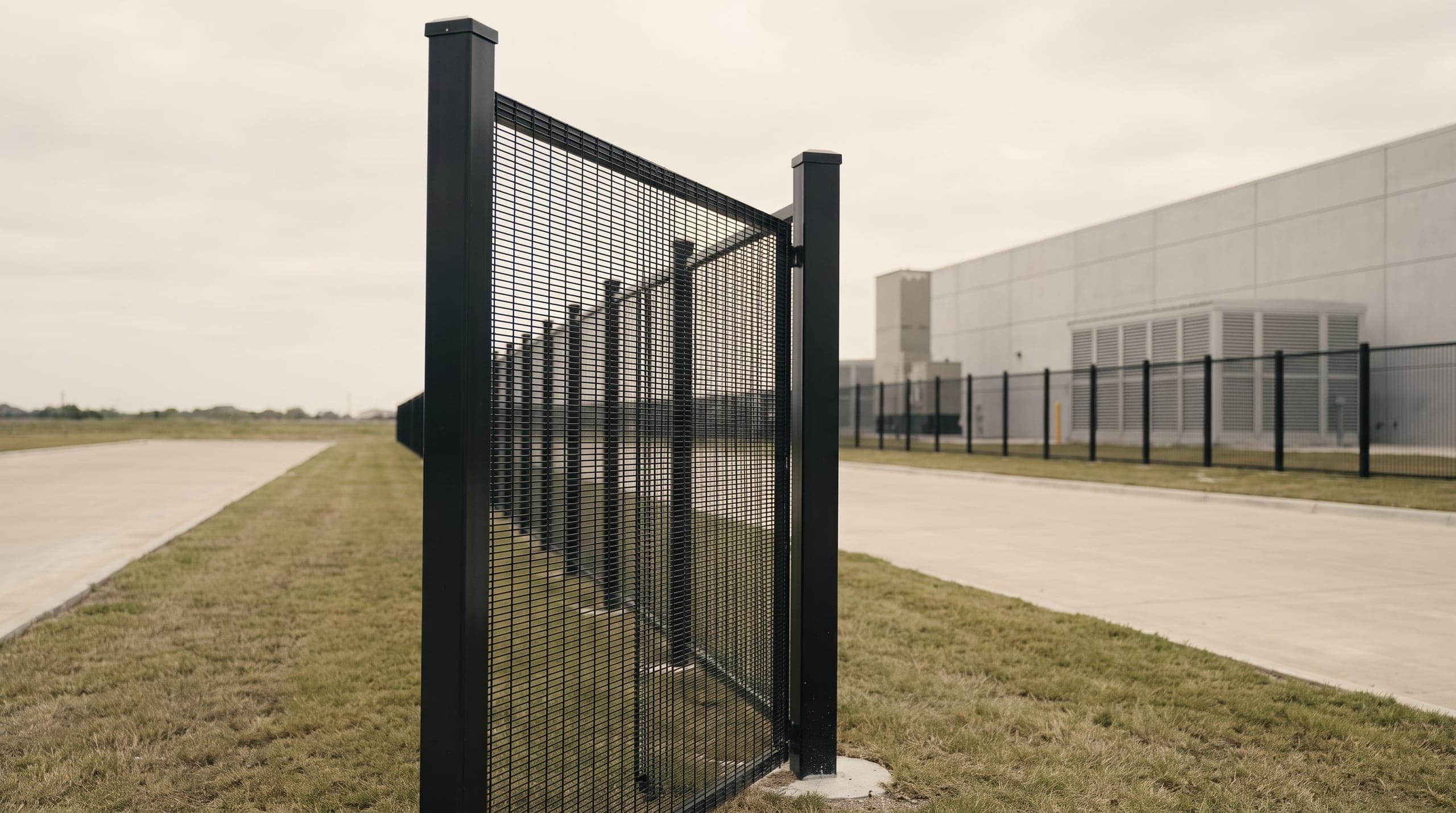
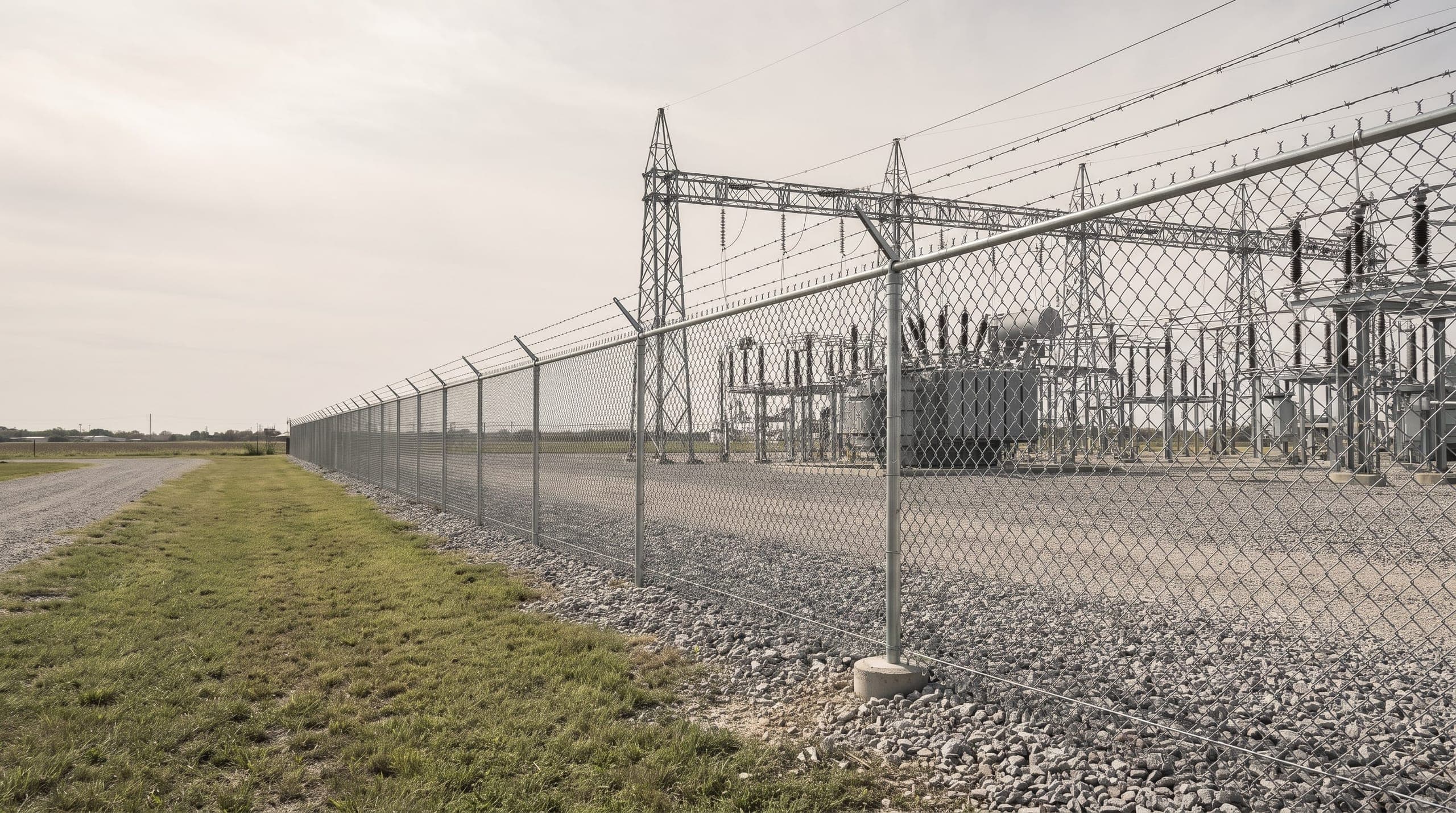
Anti-climb welded mesh and 6-gauge chain link are the most secure, and open fabrics also buy you cheaper posts, while solid faces buy privacy at the price of a bigger footing. Scheiderer Fencing notes that 9-gauge chain link wire is standard while 6-gauge gives considerably better resistance, and that welded mesh apertures are often 3 by 0.5 inches or smaller to defeat climbing and cutting. Here is how the four types sort out once wind and soil are part of the decision.
| Fence type | How it takes wind load | What decides its service life | Where it fits on an industrial site |
|---|---|---|---|
| Chain link | Open fabric, wind passes through, lightest load on posts | Zinc coating weight; Class 2 fabric outlasts Class 1 | Long perimeter runs, upgraded with 6-gauge wire and tighter mesh |
| Welded wire mesh | Near-open, low wind load, rigid panels | Weld integrity and coating at the panel joints | Substation and data-center lines needing anti-climb without a solid face |
| Ornamental steel or wrought iron | Open pickets, modest wind load, heavy panels on posts | The multi-stage coating stack over the steel | Entrances, office frontage, anywhere the site is seen from the road |
| Anti-climb steel panel | Near-solid face, highest wind load, biggest footings | Panel gauge plus the coating on cut edges | Switchyards, fuel storage, controlled-access zones |
Coating class is the quiet line item on chain link. Standard galvanized fabric and a heavier Class 2 coating look identical on install day and diverge badly by year ten in Gulf Coast air. Ask which one the bid priced.
What Does an Industrial Automatic Gate Need?
UL 325 entrapment protection, because the gate is where an industrial perimeter fails first. Every entrapment zone on an automated gate needs at least two independent, different-type protection means in each direction of travel, an inherent reversing system plus a photo eye or contact edge, and since August 1, 2018 every external sensor has to be monitored, so the operator drops to constant-pressure or manual on any fault or lost signal (DASMA, 2018). A motor bolted to an existing fence does not meet that. A gate system does.
Four things to name in the bid:
- Usage class. Residential, commercial and multi-family, industrial, or guarded access. The class drives the construction requirements for the gate itself.
- Duty cycle. LiftMaster classifies operators as light-duty at about 25 cycles a day, medium-duty at 50 a day, and industrial-duty at 25 an hour. Match the class to real traffic, including construction traffic.
- Gate post and footing. The tallest, heaviest, most-loaded post on the site. It is sized on its own, never off the line-post detail.
- Monitored sensors. Photo eyes and edges wired so a break in the wire is a fault, not a silent failure.
We install gate operators to UL 325, and on commercial work we determine whether the project needs a permit and file it.