
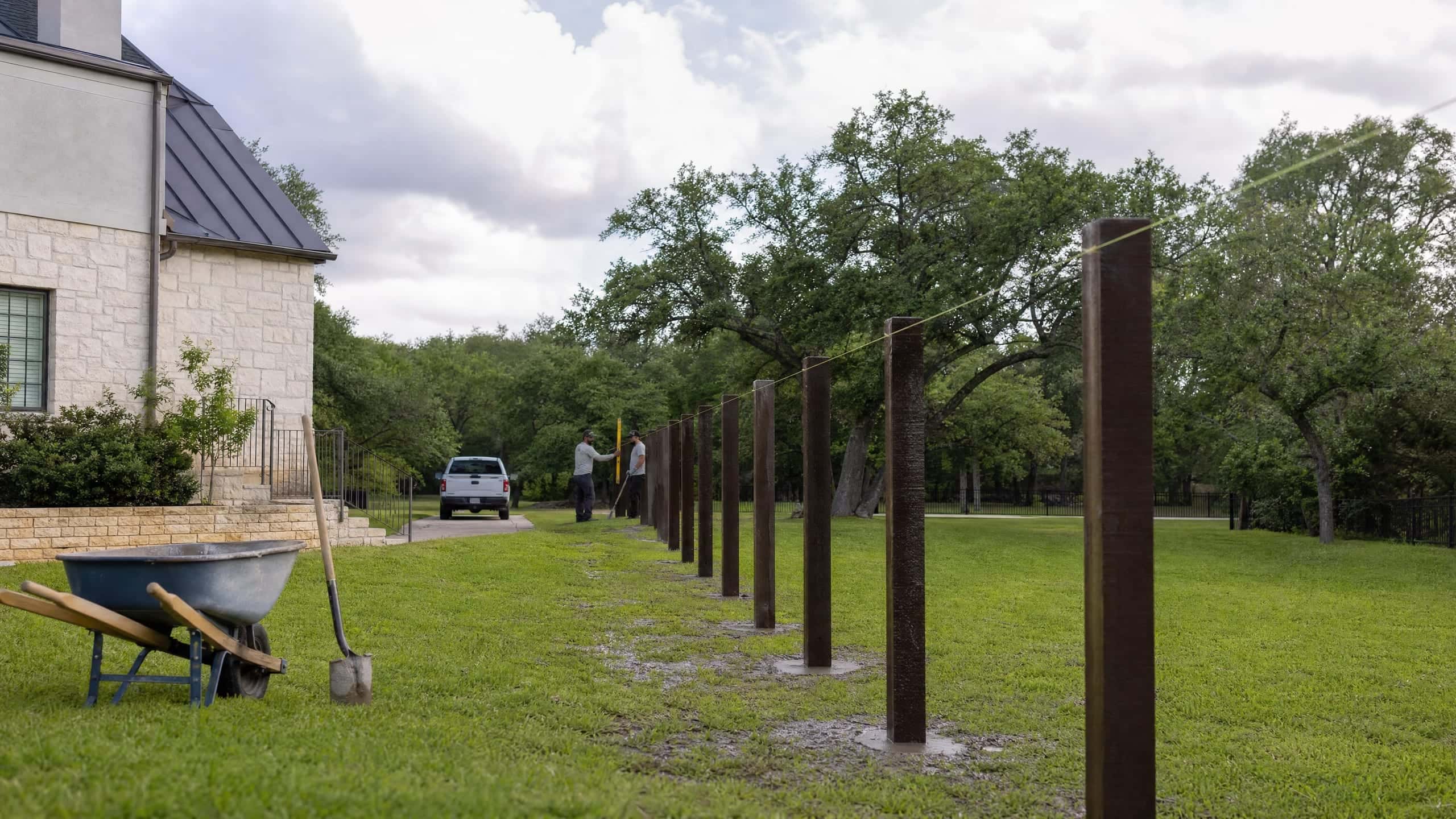
Your fence leans after four years, and the contractor says the boards just need replacing. Or the quote you signed never named the post depth or the picket grade, so you cannot tell what the crew will set. Most advice reduces a fence to one number, how deep the hole goes.
Depth matters, but a Texas fence stands or leans on five details together: depth below the active clay, spacing matched to the panel, a proper concrete collar, drainage at the post, and a crew that sets all of it the same way every time.
How deep should a fence post be in Texas clay soil?
A Texas fence post goes below the active layer of expansive clay, and the depth grows with fence height and wind exposure. The 2021 International Building Code, Section 1807.3.2.1, sizes fence and gate posts as cantilevered poles and lets the soil resist over only one-third of the embedded depth, so a tall solid fence in soft clay needs a deep, wide footing.
The Houston Black clay, Texas’s official state soil, is about 60 to 80 percent clay (USDA NRCS, 2023). In Hill Country the problem flips: limestone bedrock sits 4 to 20 inches down on the Eckrant series (USDA NRCS, 2018), and 17 to 21 inches on a mapped Tarpley clay unit in Hays County (Texas State University, 2000). Either way, the soil under your yard sets the depth, and the post depth goes on the quote for the job.
A leaning fence usually means the posts have rotted off below the dirt, and new boards do not fix a rotted post.
Why does expansive clay lift and tilt Texas fence posts?
Texas clay swells when wet and shrinks when dry, and that movement pushes on a shallow post until the fence leans. Shrink-swell soils cause about $2.3 billion in yearly damage to U.S. structures, more than floods, hurricanes, tornadoes and earthquakes combined (Jones and Holtz, ASCE, 1973).
Rot works on the same posts from a different side. The USDA Forest Products Laboratory puts Houston at 77.2 on the decay hazard index, against Austin at 55.2, San Antonio at 52.2 and Dallas at 44.3 (Carll, 2009), with anything above 65 in the high band. A 2010 Lebow and Carll analysis of 167 locations found index values trending upward, so older maps understate today’s risk. A Houston post faces both the moving clay and the heaviest rot pressure of the four metros.
How far apart should fence posts be set in Texas?
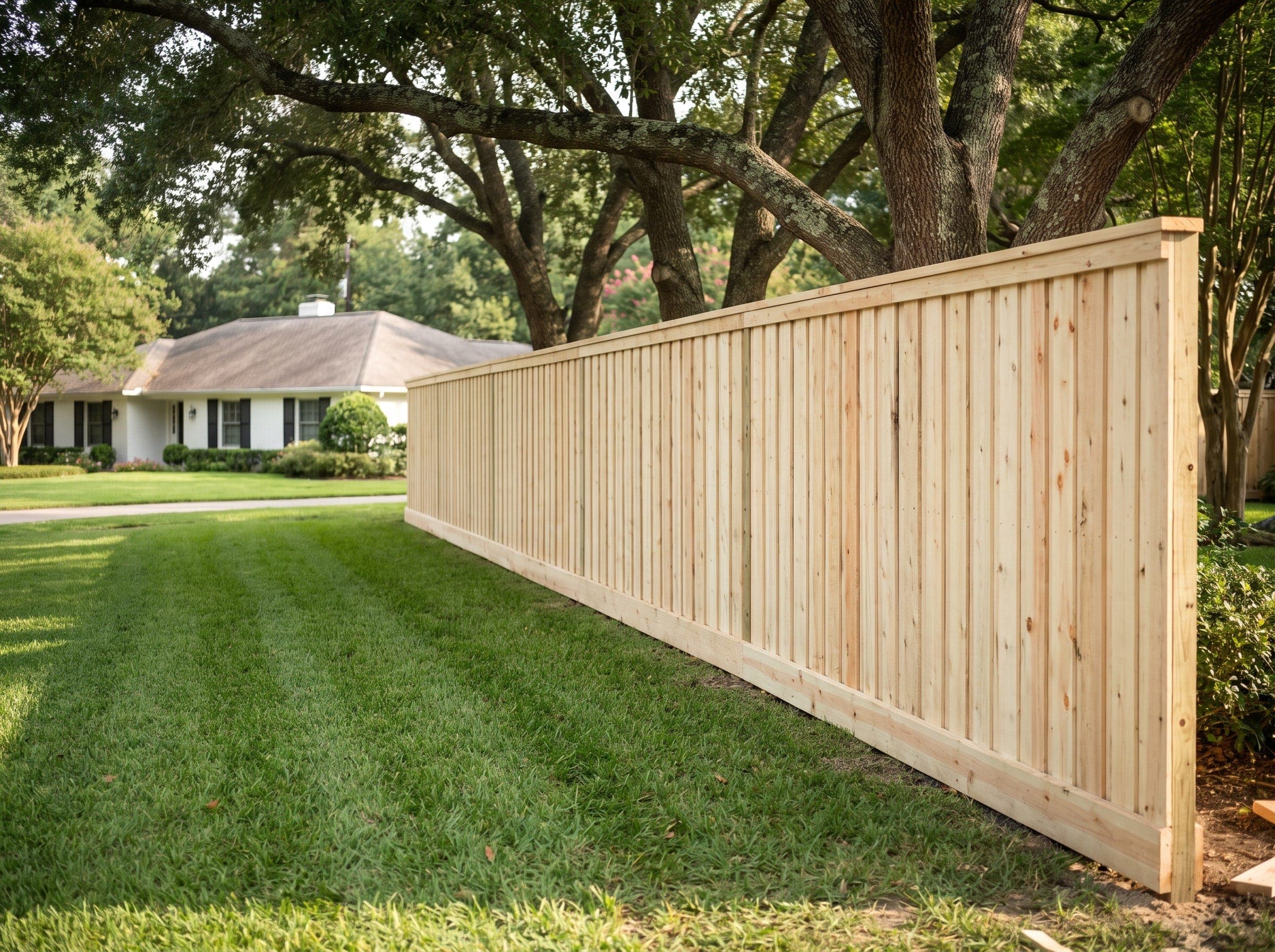
Posts are spaced to the rail and the panel, commonly about eight feet on center for a wood privacy fence, with closer spacing where wind, gates or slope load the line. Wind tests on full-scale walls found pressure highest near free ends and leading edges (Robertson, Hoxey and colleagues, 1996), which is why end panels, corners and gate posts fail first.
A solid privacy fence catches wind like a wall. Wind-tunnel tests give a ground-mounted wall a force coefficient of about 1.45 (Letchford, 2001), and ASCE/SEI 7-22 counts a fence as solid when its openings are under 30% of the face. That same standard maps Houston at design wind speeds of 130 to 140 mph for ordinary structures in Exposure C (ASCE/SEI 7-22, 2022). Wider spacing means more load per post, so spacing and depth have to be set together.
Why does a fence post need a concrete collar, and how much concrete?
A concrete collar anchors a post against the pull of shifting clay, and it works when the hole holds concrete only, set around a post that sits on a gravel base. The collar should slope away from the post so water sheds instead of pooling against the wood.
The code points the same way: a heavy gate on a tall post in soft clay drives a wide concrete footing (2021 International Building Code, 2021). Fence posts belong in the ground-contact class, UC4A, with preservative retention built for in-ground service (American Wood Protection Association, Standard U1). Rocky yards add cost, since limestone often needs extra equipment to dig holes and set footings, and clearing and leveling can add $200 to $1,000 (Angi, 2026). A crew that skips the footing saves that time and hands you the bill later.
What goes wrong when a Texas fence is installed too fast or too cheap?
A fence that leans or rots early traces to a short post, a missing gravel base, dirt mixed into the concrete, or water pooling at the post. Each failure maps back to one skipped step, and heavy-clay soil that slows post holes is exactly what tempts a rushed crew to shorten them.
Homeowners describe the result in their own words. In a 1-star Google review from May 26, 2026, a fence company reviewer wrote: “The post should be 2 feet underground but they only did 1 feet. I cannot imagine a fence professional company could do something like that. Now my fence is in bad condition and it is leaning because of that and they are not willing to come back to fix it.”
The step for you is to get the post depth written on the quote before signing. A depth that is on paper can be checked against the hole.
What should a fence quote show about post depth and picket grade?
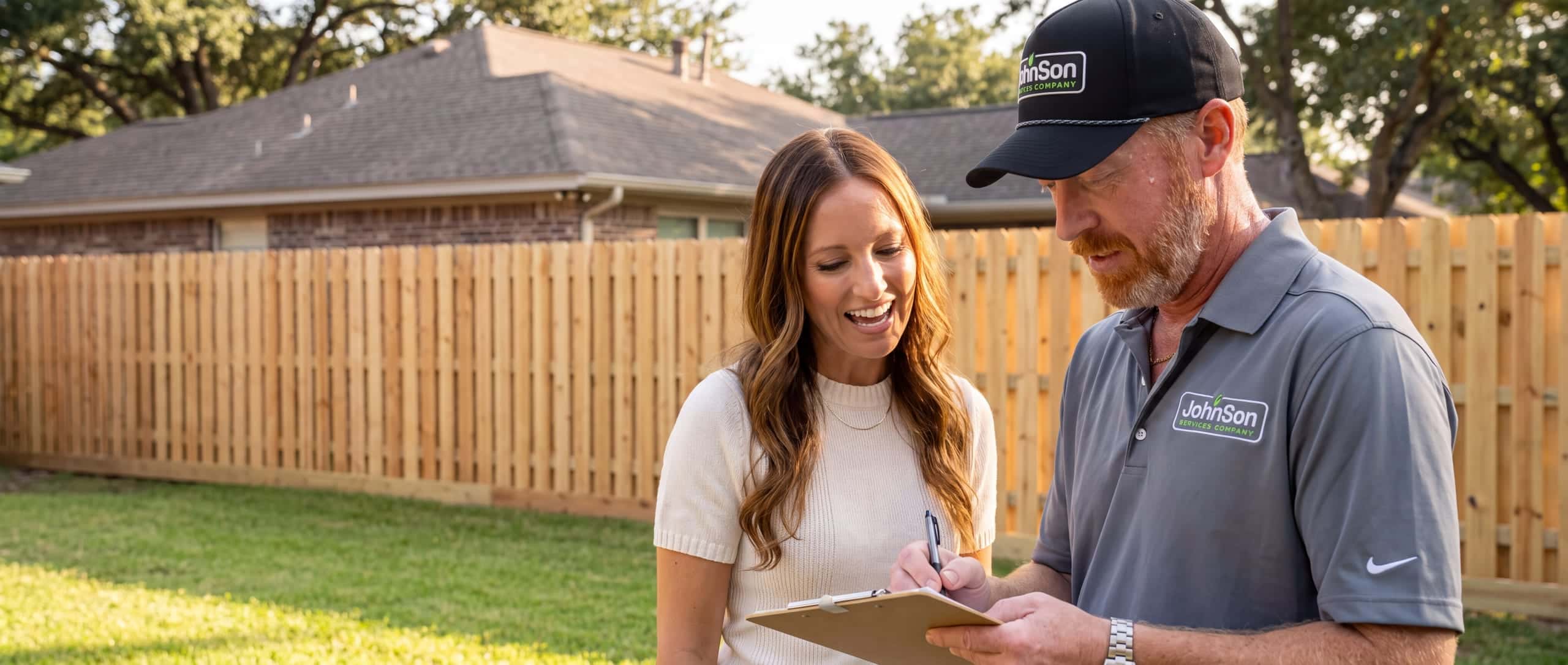
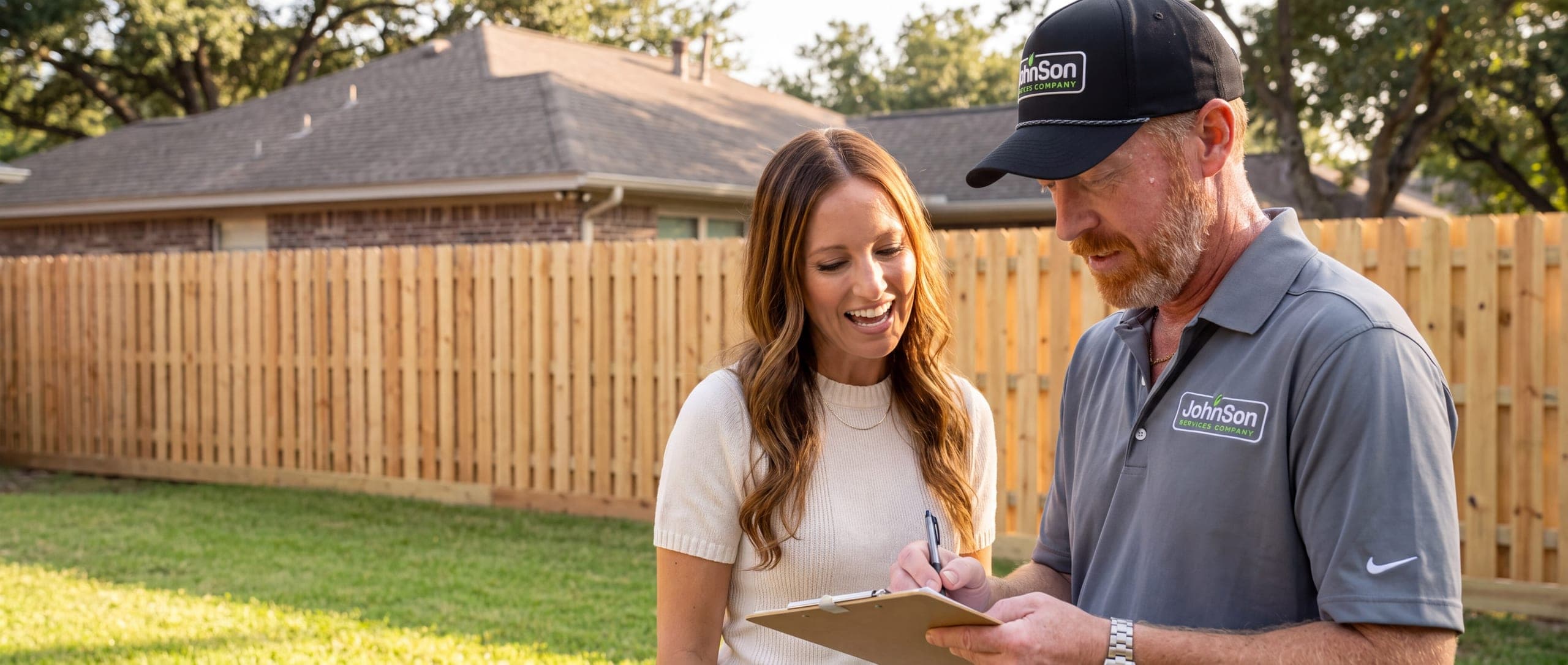
A quote worth signing states the post depth, the post spacing, the concrete, the picket grade and the footage measured on site. Johnson Fence prices every project by custom quote after a free on-site estimate, so the depth and grade are written down before work starts.
We name the picket grade, #1 through #3, on the quote. The footage comes from measuring the fence line on site, and that quote is the price the customer pays. A figure over the phone from the address is only ever a rough estimate.
Quotes that never arrive are a common complaint. In a 1-star Google review from March 27, 2026, a fence company reviewer wrote: “No showing an initial evaluation and quote with no notifications”. Ask for the on-site visit and the written quote together.
On price, Houston-area wood privacy fences are commonly quoted at $16 to $42 per linear foot (Angi Houston and HomeBlue, 2025 to 2026). Nobody buys more fence pickets than we do, so the same wood costs you less here.