
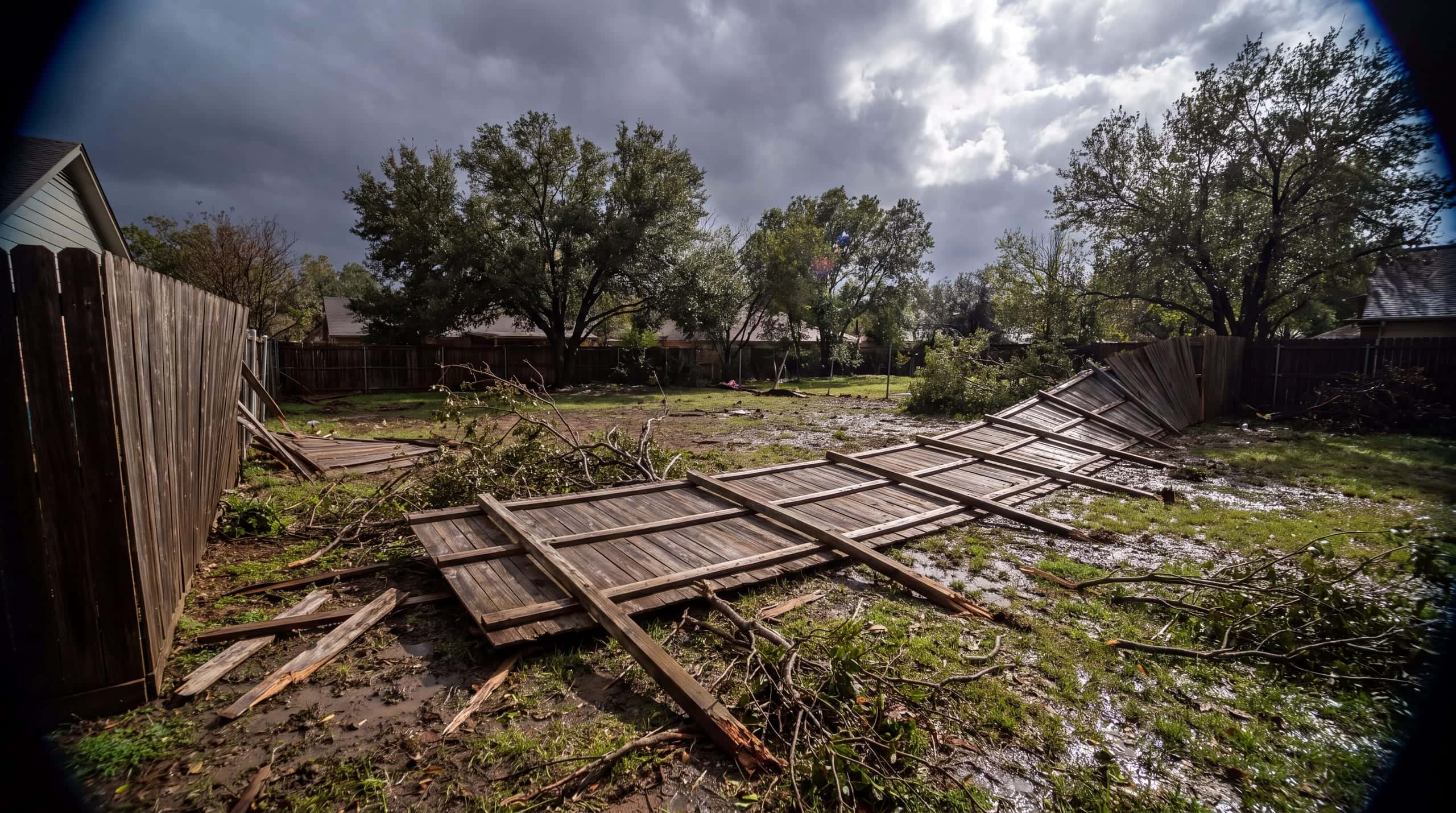
A Dallas fence almost never breaks in the middle of a panel. It goes at the corner, at the free end of a run, and at the gate. That pattern is the fence telling you what actually failed, and a rebuild that only swaps pickets hands the next wind line the same corner.
Dallas Wind Takes the Corner Post First
Wind pressure piles up at the ends of a fence run. Full-scale tests on freestanding walls found the highest pressures near the free ends and the leading edge, with return corners cutting that load sharply (Journal of Wind Engineering and Industrial Aerodynamics, 1996). The last post before your gate opening carries more load than the ten posts behind it.
Walk any North Texas neighborhood after a storm and the damage repeats itself. A run of panels stands, then one corner is flat on the ground with the post still bolted to it. Roof Raiders & Co, a Dallas-area repair contractor, says it takes 30 to 40 of these calls a month across Plano, Frisco, Dallas, and the surrounding suburbs, and it names the May 28, 2023 derecho and the May 23, 2024 wind line among the storms behind them.
The reason is simple once you see it. A post in the middle of a run has fence on both sides pushing back and sharing the load. A post at the end of a run has fence on one side and open air on the other, so it takes the hit alone.
A Solid Privacy Fence Loads Up Like a Wall
Engineers size a solid fence the way they size a freestanding wall. ASCE 7-22 counts a fence as solid once its openings drop under 30% of the face area, then loads the whole face and runs a separate case where the force sits off-center toward the end (ASCE/SEI 7-22, 2022). A 6-foot board-on-board fence in Frisco is a wall as far as the wind is concerned.
That is worth knowing before you read a bid, because the words below decide what you get.
| Term | What it means | Why it shows up on a Dallas rebuild |
|---|---|---|
| Solid fence | Openings under 30% of the face area | Board-on-board and overlapped pickets catch close to the full wind |
| Free end | A run that stops with no return corner | Wind force is highest there, so that post takes the most load |
| Embedment | How deep the post sits below grade | Sets how much soil is available to resist the push at the top |
| Lever arm | The height where the wind force acts on the post | A taller fence pushes harder on the same post and footing |
| Picket grade | Mill grade of the board, #1 through #3 | A bid saying “cedar” with no grade has not named the board yet |
A spaced-picket or shadowbox fence lets some of that wind through. A board-on-board fence does not, which is why the privacy fence most Dallas homeowners want is also the one that fights the wind hardest.
Read the Damage Before You Order New Pickets
Walk the line before anyone prices it. Most of what a windstorm leaves behind is a post problem wearing a picket problem’s clothing, and the four signs below sort it out in ten minutes. Roof Raiders & Co says the first scope a carrier writes usually misses 30 to 50% of what is actually broken, so photograph everything before a single board gets hauled off.
- The post that rocks. Push the top rail near an end or corner. Movement at the top means the footing has lost its grip below, and new pickets on that post buy you nothing.
- The gate that stopped latching. A gate post carries the fence load plus a swinging gate on one side. When the latch no longer lines up, the post has tilted.
- The crack at grade. Wood posts fail right at the ground line, where water sits and the bending load is highest. A crack there is a replacement, and no bracket fixes it.
- The panel lying flat with its posts still upright. This is the good outcome. Rails or pickets let go, the posts held, and you have a boards-and-hardware job.
Three of those four are post failures. That is the reason a storm bid deserves a closer read than a fresh-build bid.
How Deep Should a Fence Post Go in Dallas?
Deep enough for the wind load and the height it acts on, which the code turns into a formula. The IBC sizes a fence post as a cantilevered pole, where required depth grows with the wind force and its lever arm and shrinks as the soil gets stronger (2021 International Building Code, Section 1807.3.2.1). Because the code lets soil resist over only part of the buried depth, a tall gate in soft clay drives a deep, wide footing.
Posts sit in the ground, which the wood-preservation standard classes as Use Category UC4A and pairs with a preservative retention set for long in-ground service (AWPA Standard U1, current edition). A post treated for above-ground use goes in the ground and starts the clock on the next failure.
Getting this arithmetic right on every post, every time, is why the craftsmanship record on more than 20,000 jobs completed last year stands at zero warranty callbacks; not a target, a closed-out fact. That’s a 100% record, and it holds because depth and footing size are calculated per post position rather than guessed at from a single number for the whole run.
Here is how the posts in a single run differ from each other.
| Post in the run | Load it takes | What a rebuild should specify |
|---|---|---|
| Line post | Shares the wind push with panels on both sides | Standard depth and footing for the run’s height |
| Free end post | Full wind load with no panel behind it to help | Deeper embedment and a wider footing than the line posts |
| Corner post | Two runs meeting, which sheds load through the return | Standard-plus depth, with concrete carried to the bottom |
| Gate post | Fence load plus the gate weight swinging on one side | The largest post and the largest footing on the property |
Blackland Clay Decides Whether the Footing Holds
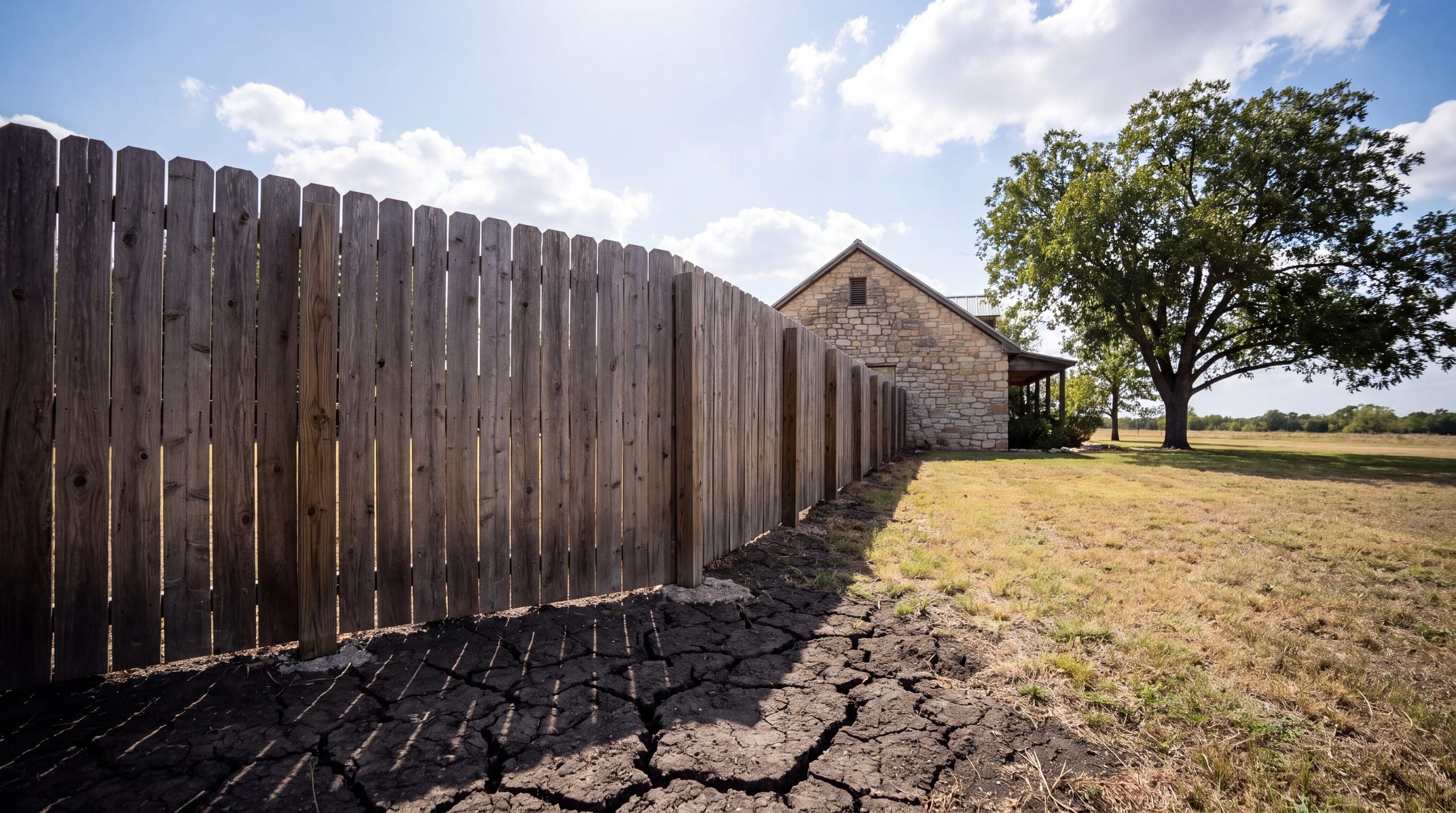
North Texas soil grips a post in February and lets go in August. The NRCS classifies Houston Black, the Texas state soil running from Dallas south through the Blackland Prairie, as a smectite Vertisol at 60% to 80% clay with very high shrink-swell potential (USDA NRCS, 2023). A footing sized for stable dirt loosens as that clay cycles through a summer.
This is why two fences on the same street, built the same week, can behave differently five years later. The one with concrete carried to the bottom of the hole and a footing wider at the base has something for the clay to push against. The one set in a narrow straight-sided hole gets worked loose season by season, and then a 60 mph gust finishes a job the soil started.
Slope and drainage do the rest. Water that runs along a fence line and pools at the low corner keeps that post wet, and wet clay holds a post the least on the day you need it most.